gce model questions vol1 2025 biology | Objective

Prepare for your exams with gce model questions vol1 questions? Reviewing past/model questions is one of the most effective ways to guarantee a high score. This practice hub features authentic 2025 biology (Objective) questions designed to simulate the real exam environment.

Practice these randomly selected questions to test your readiness.

Question 1 View Details
A desert cactus has evolved spines that reduce its effective photosynthetic surface area to 5 % of that of a typical leaf of the same overall size. Under standard conditions at 25 °C, a typical leaf loses water at a rate of \(0.12\ \text{g\,m}^{-2}\text{h}^{-1}\). The rate of water loss doubles for each 10 °C increase in temperature. If the ambient temperature is 35 °C and the total leaf‑equivalent area of the cactus is \(0.03\ \text{m}^2\), calculate the percentage reduction in water loss achieved by the cactus compared with a hypothetical leaf of the same total area that lacks spines.
A. 85 %
Correct B. 95 %
C. 80 %
D. 90 %

Correct Answer: B

Want to see the full step-by-step solution? Unlock AI Explanation & Analytics
Question 2 View Details
A fertilised egg (zygote) undergoes successive rounds of mitotic division. After how many cells are present after exactly five complete rounds of division?
Correct A. 32
B. 24
C. 16
D. 64

Correct Answer: A

Want to see the full step-by-step solution? Unlock AI Explanation & Analytics
Question 3 View Details
In a diploid population with an effective size \(N_e = 500\), the probability that a newly arisen neutral allele becomes fixed is \(1/(2N_e)\). A newly arisen beneficial allele has a selection coefficient \(s = 0.02\). For a large population, the fixation probability of a beneficial allele can be approximated by \(2s\). Calculate the ratio of the fixation probability of the beneficial allele to that of the neutral allele.
A. 80
Correct B. 40
C. 20
D. 10

Correct Answer: B

Want to see the full step-by-step solution? Unlock AI Explanation & Analytics
Question 4 View Details
Species X and Y diverged from a common ancestor \(150\) million years ago, while species Z diverged from the lineage leading to X \(300\) million years ago. All three species possess forelimbs that contain a humerus, radius and ulna. Determine whether the similarity of the forelimb bones among the three species is best described as homologous or analogous.
A. parallel
B. analogous
Correct C. homologous
D. convergent

Correct Answer: C

Want to see the full step-by-step solution? Unlock AI Explanation & Analytics
Question 5 View Details
An infectious disease spreads in a community where each infected individual makes on average \(c = 12\) potentially infectious contacts per day. The probability of transmission per contact is \(\beta = 0.04\). Infected individuals recover at a constant rate \(\gamma\) corresponding to an average infectious period of 5 days. Initially, 80 % of the population is susceptible. Calculate the effective reproduction number \(R_e\) at the start of the outbreak.
Correct A. 1.92
B. 0.48
C. 0.38
D. 2.40

Correct Answer: A

Want to see the full step-by-step solution? Unlock AI Explanation & Analytics
Question 6 View Details
In a plant species, allele A (dominant) gives purple flowers, allele a (recessive) gives white flowers, and heterozygotes (Aa) show pink flowers (incomplete dominance). A cross is made between a pink‑flowered plant (Aa) and a white‑flowered plant (aa). A seedling is then selected at random from the F1 generation and allowed to self‑fertilise. What is the probability that a randomly chosen offspring of this self‑fertilised seedling will have white flowers? Express your answer as a fraction in lowest terms.
A. 1/2
B. 5/16
C. 3/8
Correct D. 5/8

Correct Answer: D

Want to see the full step-by-step solution? Unlock AI Explanation & Analytics
Question 7 View Details
A drug has an elimination half‑life of 6 h, oral bioavailability \(F = 0.8\), and a volume of distribution \(V_d = 40\) L. It is administered every 8 h at a dose \(D\) mg. At steady state the peak (just after dosing) concentration is given by \(C_{\text{max}} = \frac{F D}{V_d}\frac{1}{1-e^{-k\tau}}\) and the trough concentration just before the next dose is \(C_{\text{min}} = C_{\text{max}}e^{-k\tau}\), where \(k = \frac{\ln 2}{\text{half‑life}}\) and \(\tau = 8\) h. The therapeutic window requires \(C_{\text{min}} \ge 2\) µg mL\(^{-1}\) and \(C_{\text{max}} \le 10\) µg mL\(^{-1}\). What is the maximum whole‑milligram dose \(D\) that satisfies both constraints?
A. 250 mg
B. 350 mg
Correct C. 301 mg
D. 280 mg

Correct Answer: C

Want to see the full step-by-step solution? Unlock AI Explanation & Analytics
Question 8 View Details
A 30‑year‑old female weighing 65 kg and 165 cm tall follows a diet providing 2500 kcal per day. The macronutrient distribution is 8 % protein, 60 % carbohydrate and 32 % fat. The recommended protein intake is \(0.8\) g kg\(^{-1}\) body weight. To meet exactly the recommended protein amount while keeping total calories and the amount of fat unchanged, the minimum amount of carbohydrate must be replaced by protein. How many grams of carbohydrate should be replaced, and what are the new percentages of protein, carbohydrate and fat (to one decimal place) in the diet?
A. 15 g; protein 9.5 %, carbohydrate 58.5 %, fat 32.0 %
Correct B. 2 g; protein 8.3 %, carbohydrate 59.7 %, fat 32.0 %
C. 10 g; protein 9.0 %, carbohydrate 59.0 %, fat 32.0 %
D. 5 g; protein 8.6 %, carbohydrate 59.4 %, fat 32.0 %

Correct Answer: B

Want to see the full step-by-step solution? Unlock AI Explanation & Analytics
Question 9 View Details
In a lake ecosystem primary producers generate 10 000 MJ of energy each year. Energy transfer efficiency between successive trophic levels is 10 %. A particular fish species is a secondary consumer that obtains 5 % of the energy available at its trophic level. A pollutant reduces primary production by 20 % and also causes a 30 % mortality in the fish population. Assuming the remaining fish retain the same per‑capita energy intake, calculate the percentage change in the total energy available to the fish species after the pollutant impact (give the magnitude of decrease as a positive percentage).
Correct A. 44 % decrease
B. 20 % decrease
C. 30 % decrease
D. 55 % decrease

Correct Answer: A

Want to see the full step-by-step solution? Unlock AI Explanation & Analytics
Question 10 View Details
The following binary character matrix describes five species (A-E). ‘1' denotes the presence of a derived character state, ‘0' the absence. | Species | Nucleus (1) | Cell‑wall type cellulose (1) | Chloroplasts (1) | Flagella (1) | |---------|------------|-----------------------------|------------------|--------------| | A | 1 | 1 | 1 | 0 | | B | 1 | 0 | 0 | 1 | | C | 0 | 0 | 0 | 1 | | D | 1 | 1 | 0 | 0 | | E | 1 | 1 | 1 | 0 | Using the principle of maximum parsimony, which two species are most likely sister taxa? Provide the pair of species.
A. B and D
Correct B. A and E
C. B and C
D. A and D

Correct Answer: B

Want to see the full step-by-step solution? Unlock AI Explanation & Analytics
Question 11 View Details
A person has a glomerular filtration rate of \(120\ \text{mL min}^{-1}\). The plasma concentration of urea is \(0.2\ \text{g L}^{-1}\). If \(60\%\) of the filtered urea is reabsorbed and the urine flow rate is \(1.5\ \text{mL min}^{-1}\), what is the concentration of urea in the final urine (in \(\text{g L}^{-1}\))?
A. 7.8 g L⁻¹
B. 5.2 g L⁻¹
Correct C. 6.4 g L⁻¹
D. 4.0 g L⁻¹

Correct Answer: C

Want to see the full step-by-step solution? Unlock AI Explanation & Analytics
Question 12 View Details
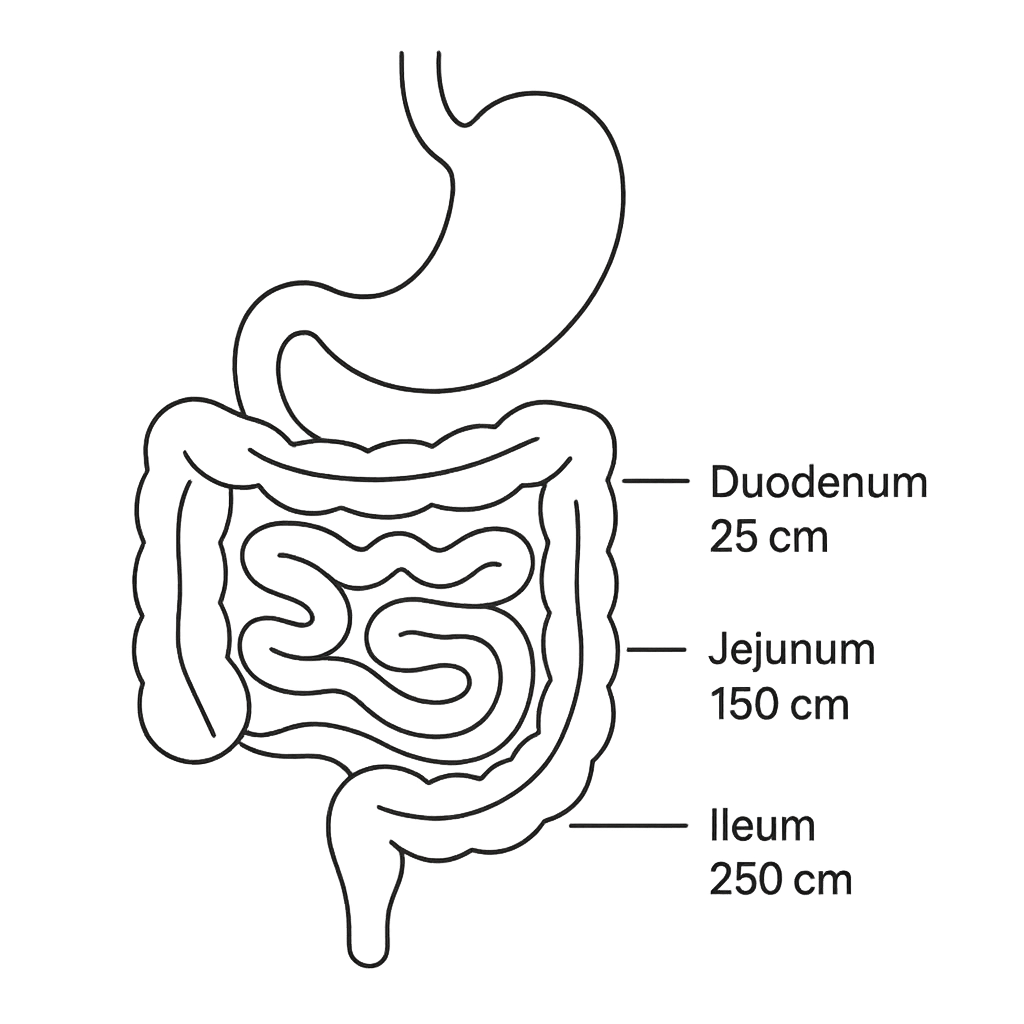
Based on the labelled diagram of the human small intestine, the duodenum, jejunum and ileum have lengths of 25 cm, 150 cm and 250 cm respectively. If a meal contains 120 g of carbohydrate and 90 % of it is absorbed in the small intestine, assuming the amount absorbed per centimetre of intestinal length is constant, how many grams of carbohydrate are absorbed in the ileum?
A. 45.0 g
Correct B. 63.5 g
C. 54.0 g
D. 71.2 g

Correct Answer: B

Want to see the full step-by-step solution? Unlock AI Explanation & Analytics
Question 13 View Details
Using the alveolar gas equation, calculate the alveolar partial pressure of oxygen (\(P_{A\text{O}_2}\)) given the following: atmospheric pressure \(P_B = 760\ \text{mmHg}\), water vapour pressure \(P_{H_2O}=47\ \text{mmHg}\), inspired oxygen fraction \(F_{iO_2}=0.21\), arterial carbon dioxide pressure \(P_{aCO_2}=40\ \text{mmHg}\), and respiratory quotient \(R=0.8\).
A. 115 mmHg
B. 95 mmHg
C. 105 mmHg
Correct D. 100 mmHg

Correct Answer: D

Want to see the full step-by-step solution? Unlock AI Explanation & Analytics
Question 14 View Details
Two genes, A and B, are located on the same chromosome and are 12 % recombination apart. An individual heterozygous for both genes in the cis configuration (genotype \(A^{+}B^{+}/ab\)) is crossed with a homozygous recessive individual (\(ab/ab\)). What proportion of the offspring will display the recombinant phenotype \(A^{+}b\)?
Correct A. 0.06
B. 0.03
C. 0.12
D. 0.18

Correct Answer: A

Want to see the full step-by-step solution? Unlock AI Explanation & Analytics
Question 15 View Details
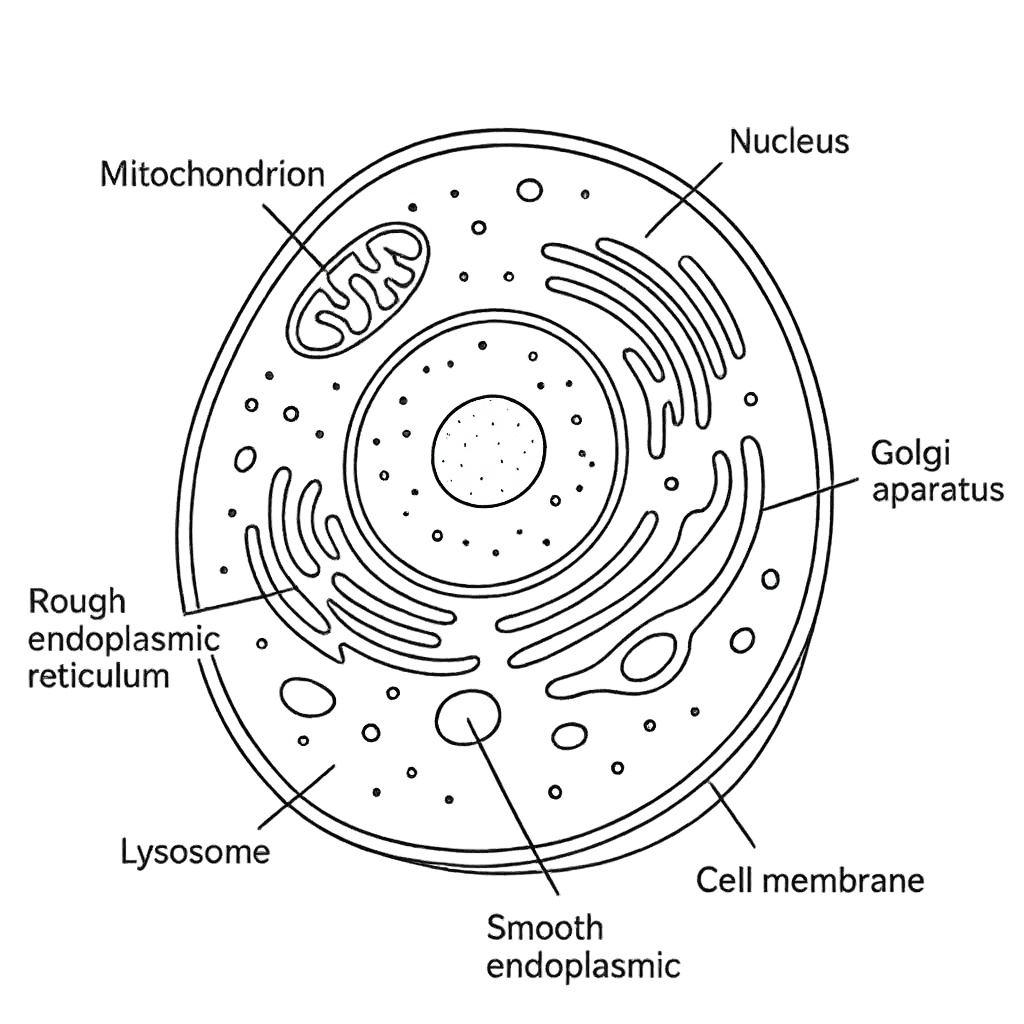
Refer to the labelled diagram of an animal cell. Which organelle is the main site of ATP production?
A. Ribosome
B. Nucleus
C. Chloroplast
Correct D. Mitochondrion

Correct Answer: D

Want to see the full step-by-step solution? Unlock AI Explanation & Analytics
Question 16 View Details
Which organelle is primarily responsible for the synthesis of ATP in eukaryotic cells?
Correct A. Mitochondrion
B. Nucleus
C. Ribosome
D. Chloroplast

Correct Answer: A

Want to see the full step-by-step solution? Unlock AI Explanation & Analytics
Question 17 View Details
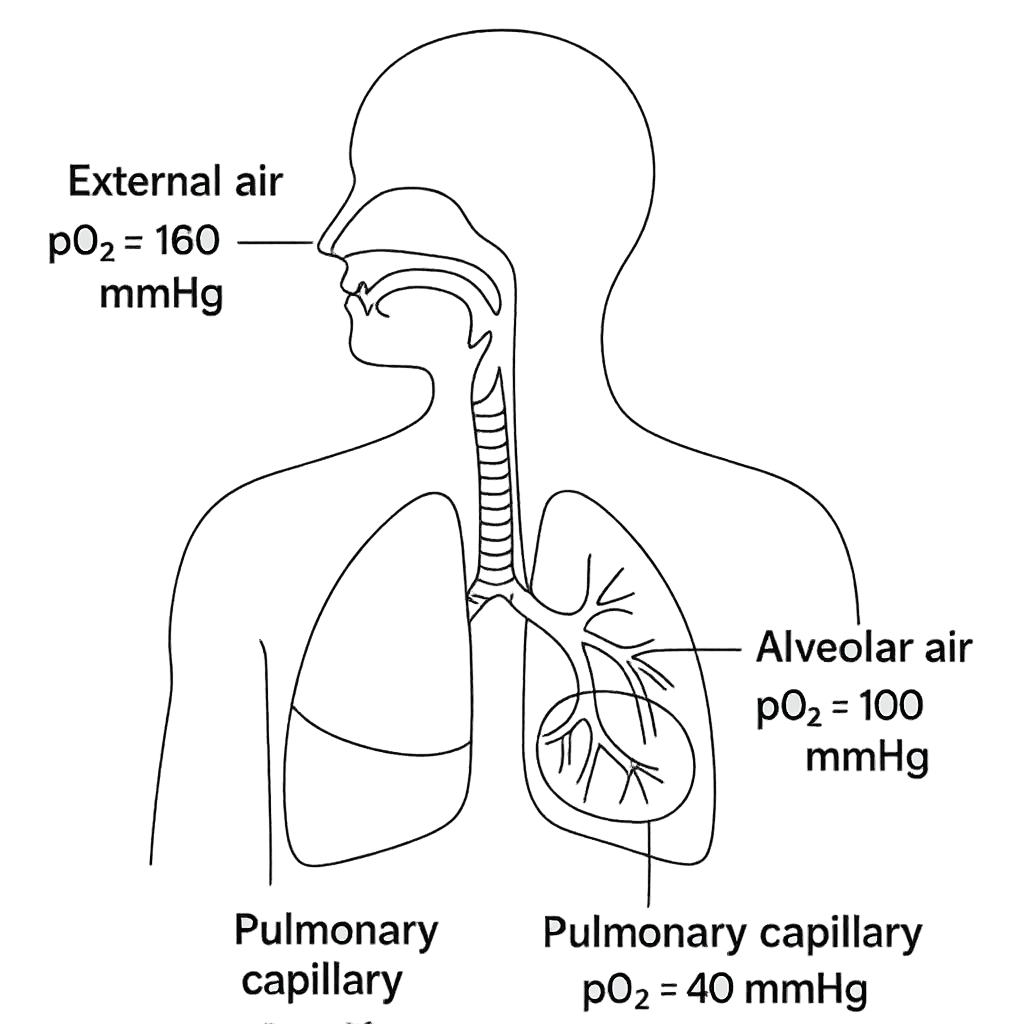
Refer to the labelled diagram of the respiratory system. The diagram shows the partial pressures of oxygen (\(pO_{2}\)) in four compartments: external air (\(pO_{2}=160\) mmHg), alveolar air (\(pO_{2}=100\) mmHg), pulmonary capillary blood (\(pO_{2}=40\) mmHg) and venous blood (\(pO_{2}=30\) mmHg).\n\n(a) State the direction of diffusion of oxygen between the alveolar air and the pulmonary capillary blood.\n(b) Calculate the magnitude of the oxygen partial‑pressure gradient driving this diffusion.
Correct A. From alveolar air to pulmonary capillary blood; gradient = 60 mmHg
B. From pulmonary capillary blood to alveolar air; gradient = 60 mmHg
C. From alveolar air to pulmonary capillary blood; gradient = 50 mmHg
D. From alveolar air to pulmonary capillary blood; gradient = 70 mmHg

Correct Answer: A

Want to see the full step-by-step solution? Unlock AI Explanation & Analytics
Question 18 View Details
An unknown unicellular eukaryotic organism exhibits the following characteristics:\n\n- Cell wall composed of chitin.\n- Reproduces by producing motile spores that possess a single posterior flagellum.\n- Possesses a life cycle that includes both haploid and diploid multicellular stages.\n\nBased on these features, assign the organism to its correct (i) kingdom, (ii) phylum, and (iii) class.
A. Kingdom Plantae; Phylum Chytridiomycota; Class Chytridiomycetes
Correct B. Kingdom Fungi; Phylum Chytridiomycota; Class Chytridiomycetes
C. Kingdom Fungi; Phylum Chytridiomycota; Class Zygomycetes
D. Kingdom Fungi; Phylum Ascomycota; Class Chytridiomycetes

Correct Answer: B

Want to see the full step-by-step solution? Unlock AI Explanation & Analytics
Question 19 View Details
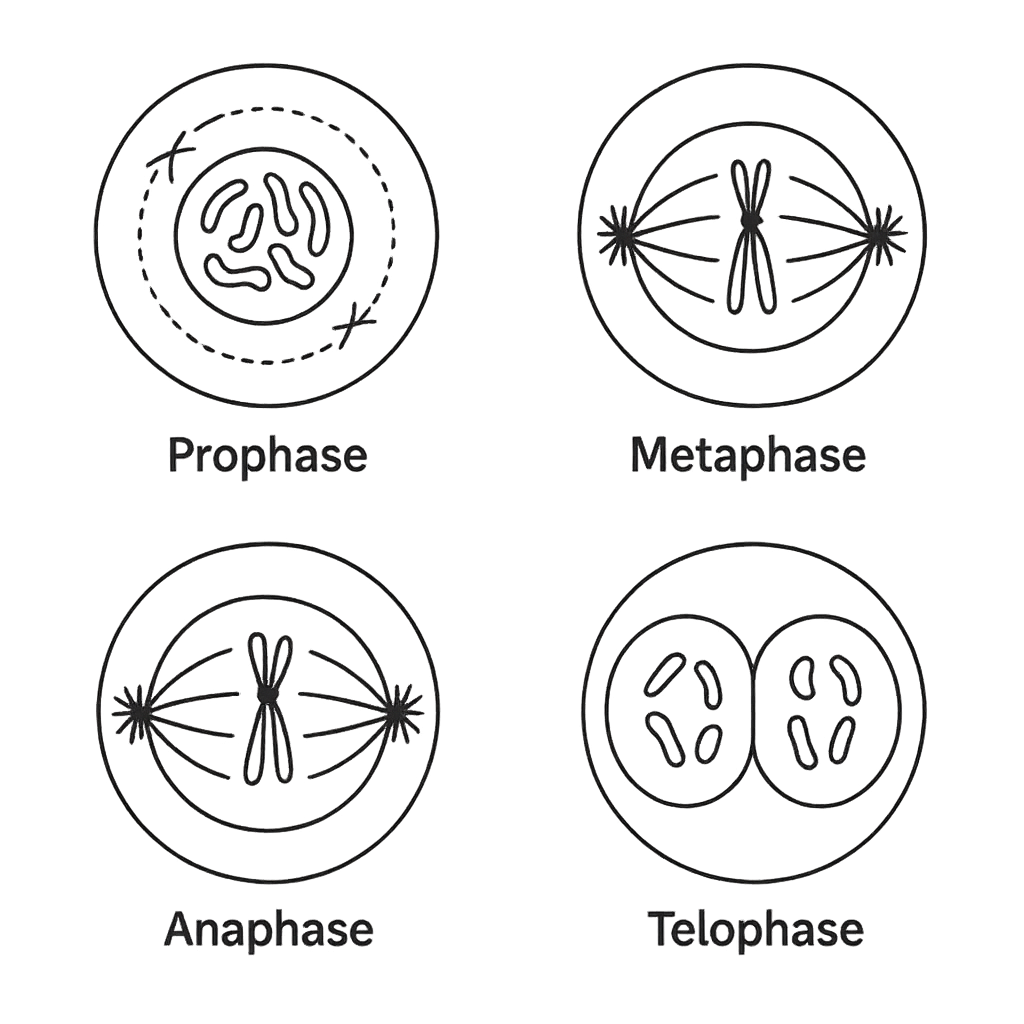
The labelled diagram depicts the four successive stages of mitosis in a eukaryotic cell: prophase, metaphase, anaphase and telophase. Identify the stage in which the chromosomes are aligned at the cell's equatorial plate (metaphase plate).
A. Prophase
B. Telophase
C. Anaphase
Correct D. Metaphase

Correct Answer: D

Want to see the full step-by-step solution? Unlock AI Explanation & Analytics
Question 20 View Details
A cell carries out aerobic respiration of one molecule of glucose. The following data are given:\n\n- Glycolysis: net production of 2 ATP and formation of 2 NADH. Each NADH produced in glycolysis is transferred into the mitochondrion via the glycerol‑3‑phosphate shuttle, yielding 1.5 ATP per NADH.\n- Pyruvate oxidation (link reaction): produces 2 NADH, each yielding 2.5 ATP in the mitochondrion.\n- Krebs cycle (per glucose): yields 2 ATP (substrate‑level), 6 NADH and 2 FADH\(_2\). Each mitochondrial NADH yields 2.5 ATP and each FADH\(_2\) yields 1.5 ATP.\n\nCalculate the net total number of ATP molecules generated from the complete aerobic oxidation of one glucose molecule under these conditions.
Correct A. 30
B. 26
C. 32
D. 28

Correct Answer: A

Want to see the full step-by-step solution? Unlock AI Explanation & Analytics
Question 21 View Details
A desert plant can adopt three possible adaptations to reduce water loss: - Adaptation A: a thick cuticle that reduces water loss by 40 % and adds a 5 % increase in energy cost. - Adaptation B: CAM photosynthesis that reduces water loss by 30 % but adds a 10 % increase in energy cost and reduces photosynthetic efficiency by 15 %. - Adaptation C: a deep taproot that reduces water loss by 25 % and adds a 12 % increase in energy cost. The plant must keep its total water loss at or below 50 % of the baseline (baseline water loss = 100 units) and its total energy cost must not exceed 15 % of the baseline. Assuming the effects of adaptations on water loss combine multiplicatively (overall reduction = 1‑(1‑a)(1‑b)…), which single adaptation(s) satisfy both constraints, and which combination of two adaptations also satisfies them?
Correct A. Adaptation A alone does not meet the water‑loss limit. The only combination that satisfies both the water‑loss (≤50 units) and energy‑cost (≤15 %) constraints is Adaptation A + Adaptation B.
B. Adaptation C alone meets both constraints. The only combination that satisfies both the water‑loss (≤50 units) and energy‑cost (≤15 %) constraints is Adaptation A + Adaptation C.
C. Adaptation A alone meets both constraints. The only combination that satisfies both the water‑loss (≤50 units) and energy‑cost (≤15 %) constraints is Adaptation B + Adaptation C.
D. Adaptation B alone meets both constraints. The only combination that satisfies both the water‑loss (≤50 units) and energy‑cost (≤15 %) constraints is Adaptation B + Adaptation C.

Correct Answer: A

Want to see the full step-by-step solution? Unlock AI Explanation & Analytics
Question 22 View Details
An animal produces metabolic heat at a rate of \(200\ \text{kJ h}^{-1}\). It can dissipate heat by sweating (efficiency \(0.7\ \text{kJ g}^{-1}\)) and by panting (efficiency \(0.5\ \text{kJ g}^{-1}\)). High ambient humidity reduces the efficiency of both mechanisms by 20 %. The animal may lose up to \(1.5\ \text{L}\) of water per hour without risking dehydration. What is the minimum volume of water the animal must lose per hour to maintain thermal balance under the humid conditions?
A. Approximately \(0.60\ \text{L}\) of water per hour.
Correct B. Approximately \(0.36\ \text{L}\) of water per hour.
C. Approximately \(0.45\ \text{L}\) of water per hour.
D. Approximately \(0.25\ \text{L}\) of water per hour.

Correct Answer: B

Want to see the full step-by-step solution? Unlock AI Explanation & Analytics
Question 23 View Details
In a female frog, estrogen is produced at a constant rate of \(5\ \mu\text{g day}^{-1}\) and is removed by first‑order degradation with a rate constant of \(0.1\ \text{day}^{-1}\). When the estrogen concentration reaches \(30\ \mu\text{g}\), a negative feedback reduces the production rate by 20 % (to \(4\ \mu\text{g day}^{-1}\)). Ovulation occurs when the concentration reaches \(38\ \mu\text{g}\). How many days after the start of the cycle will ovulation occur?
A. Approximately \(22\ \text{days}\) (more precisely \(22.7\ \text{days}\)).
B. Approximately \(20\ \text{days}\) (more precisely \(20.1\ \text{days}\)).
C. Approximately \(30\ \text{days}\) (more precisely \(30.4\ \text{days}\)).
Correct D. Approximately \(25\ \text{days}\) (more precisely \(25.3\ \text{days}\)).

Correct Answer: D

Want to see the full step-by-step solution? Unlock AI Explanation & Analytics
Question 24 View Details
Renal plasma flow is \(600\ \text{mL min}^{-1}\) and the filtration fraction is 20 %. Plasma glucose concentration is \(12\ \text{g L}^{-1}\). The proximal tubule can reabsorb glucose at a maximum rate of \(9\ \text{g L}^{-1}\) of filtrate. How many grams of glucose are excreted per minute?
A. 0.24 g of glucose per minute.
B. 0.60 g of glucose per minute.
C. 0.48 g of glucose per minute.
Correct D. 0.36 g of glucose per minute.

Correct Answer: D

Want to see the full step-by-step solution? Unlock AI Explanation & Analytics
Question 25 View Details
A single diploid cell undergoes three successive rounds of mitotic division, each followed by cytokinesis. How many cells are present after the third division?
Correct A. 8
B. 4
C. 6
D. 16

Correct Answer: A

Want to see the full step-by-step solution? Unlock AI Explanation & Analytics

Master the Exam!

You've seen a preview, but there are thousands more questions plus AI tutor to break down complex solutions.

Unlock Full Access Available for Android & Windows
Help others prepare! Share this practice hub:
Chat with Support