gce model questions vol1 2024 biology | Objective

Prepare for your exams with gce model questions vol1 questions? Reviewing past/model questions is one of the most effective ways to guarantee a high score. This practice hub features authentic 2024 biology (Objective) questions designed to simulate the real exam environment.

Practice these randomly selected questions to test your readiness.

Question 1 View Details
Three organisms are described: - Organism X: multicellular, eukaryotic, cells contain cellulose cell walls, chloroplasts, and exhibit alternation of generations. - Organism Y: multicellular, eukaryotic, cells lack cell walls, possess a chitinous exoskeleton, jointed appendages, and molt (ecdysis) during growth. - Organism Z: unicellular, prokaryotic, has a peptidoglycan cell wall and reproduces by binary fission. Based on these characteristics, which organism can be placed in the phylum Arthropoda? Give the letter of the organism.
Correct A. Y
B. X
C. A
D. Z

Correct Answer: A

Want to see the full step-by-step solution? Unlock AI Explanation & Analytics
Question 2 View Details
During meiosis a diploid human somatic cell (2n = 46) undergoes the full process to produce gametes. After the second meiotic division (telophase II), how many chromosomes and how many chromatids are present in each resulting gamete cell? Provide your answer as two integers separated by a comma: (chromosomes, chromatids).
A. 46, 46
B. 46, 23
C. 23, 46
Correct D. 23, 23

Correct Answer: D

Want to see the full step-by-step solution? Unlock AI Explanation & Analytics
Question 3 View Details
A diet plan for a day provides 120 g of carbohydrate, 45 g of protein, and 30 g of fat. The energy yields are 4 kcal/g for carbohydrate and protein, and 9 kcal/g for fat. The recommended daily energy intake for a moderately active adult is 2500 kcal. (a) Calculate the total energy supplied by the diet (in kcal). (b) Determine the percentage of the recommended intake this diet supplies, rounded to the nearest whole percent.
Correct A. 930 kcal; 37%
B. 850 kcal; 34%
C. 900 kcal; 36%
D. 950 kcal; 38%

Correct Answer: A

Want to see the full step-by-step solution? Unlock AI Explanation & Analytics
Question 4 View Details
At sea level the atmospheric pressure is 760 mmHg, and the fraction of inspired oxygen is 0.21. In the alveoli, the partial pressure of water vapour is 47 mmHg and the alveolar \(P_{CO_2}\) is 40 mmHg. Using the alveolar gas equation \(P_{A\text{O}_2}=F_{iO_2}(P_{B}-P_{H_2O})-P_{aCO_2}/R\) with a respiratory quotient \(R = 0.8\), calculate the alveolar partial pressure of oxygen \(P_{A\text{O}_2}\) (in mmHg). Round your answer to the nearest whole number.
Correct A. 100
B. 110
C. 105
D. 95

Correct Answer: A

Want to see the full step-by-step solution? Unlock AI Explanation & Analytics
Question 5 View Details
An athlete's VO\(_2\) max is measured at 55 mL·kg⁻¹·min⁻¹. During a high‑intensity exercise session lasting 30 minutes, the athlete maintains 80% of VO\(_2\) max. Assuming the athlete's body mass is 70 kg and that each litre of O\(_2\) consumed yields approximately 5 kcal of energy, estimate the total energy expended (in kilocalories) during the session. Round to the nearest kilocalorie.
A. 370
B. 471
C. 404
Correct D. 462

Correct Answer: D

Want to see the full step-by-step solution? Unlock AI Explanation & Analytics
Question 6 View Details
A newly discovered multicellular organism exhibits the following characteristics: it is eukaryotic, lacks cell walls, is heterotrophic, reproduces by internal fertilisation, possesses mammary glands, is covered with hair, has three middle ear bones, and a placenta. Additionally, it has a specialised larynx that enables deep roaring and its paws bear thick, non‑retractable claws. Based on these traits, state the most specific taxonomic rank that can be assigned with certainty, and give the name of that rank.
A. Genus Panthera
B. Class Mammalia
Correct C. Order Carnivora
D. Family Felidae

Correct Answer: C

Want to see the full step-by-step solution? Unlock AI Explanation & Analytics
Question 7 View Details
In a plant species two genes, A/a and B/b, are located on the same chromosome in the cis configuration (AB/ab) in a heterozygous individual. The recombination frequency between the genes is \(10\%\). This plant is crossed with a homozygous recessive individual (ab/ab). What proportion of the offspring are expected to display both dominant phenotypes (i.e., possess at least one dominant allele at each locus)? Express your answer as a decimal.
A. 0.55
B. 0.40
C. 0.35
Correct D. 0.45

Correct Answer: D

Want to see the full step-by-step solution? Unlock AI Explanation & Analytics
Question 8 View Details
At sea level the arterial partial pressure of oxygen (\(P_{O_2}\)) is approximately 21 kPa. When a person ascends to a high altitude the ambient \(P_{O_2}\) falls by 30 %. Assuming that arterial oxygen saturation (\(S_{aO_2}\)) varies proportionally with \(P_{O_2}\), and that the oxygen content of blood is given by \(C_{O_2}=1.34\,\text{Hb}\times S_{aO_2}\) (where Hb is the haemoglobin concentration in g L\(^{-1}\) and the factor 1.34 mL O\(_2\) g\(^{-1}\) Hb), determine the percentage increase in haemoglobin concentration required to keep the arterial oxygen content unchanged at altitude. Give your answer to one decimal place.
A. 60.0
B. 50.0
Correct C. 42.9
D. 30.0

Correct Answer: C

Want to see the full step-by-step solution? Unlock AI Explanation & Analytics
Question 9 View Details
Using the Harris-Benedict equation, the basal metabolic rate (BMR) for a 25‑year‑old female weighing 60 kg and 165 cm tall is \(BMR = 655 + 9.6W + 1.8H - 4.7A\) (kcal day\(^{-1}\)). If her activity factor is 1.55, calculate her total daily energy expenditure (TDEE). Then, assuming a recommended macronutrient distribution of 55 % carbohydrate, 15 % protein and 30 % fat, determine the daily amount (in grams) of each macronutrient she should consume. Provide the three values rounded to the nearest gram.
A. 285 g carbohydrate, 90 g protein, 70 g fat
B. 310 g carbohydrate, 80 g protein, 75 g fat
C. 295 g carbohydrate, 85 g protein, 72 g fat
Correct D. 301 g carbohydrate, 82 g protein, 73 g fat

Correct Answer: D

Want to see the full step-by-step solution? Unlock AI Explanation & Analytics
Question 10 View Details
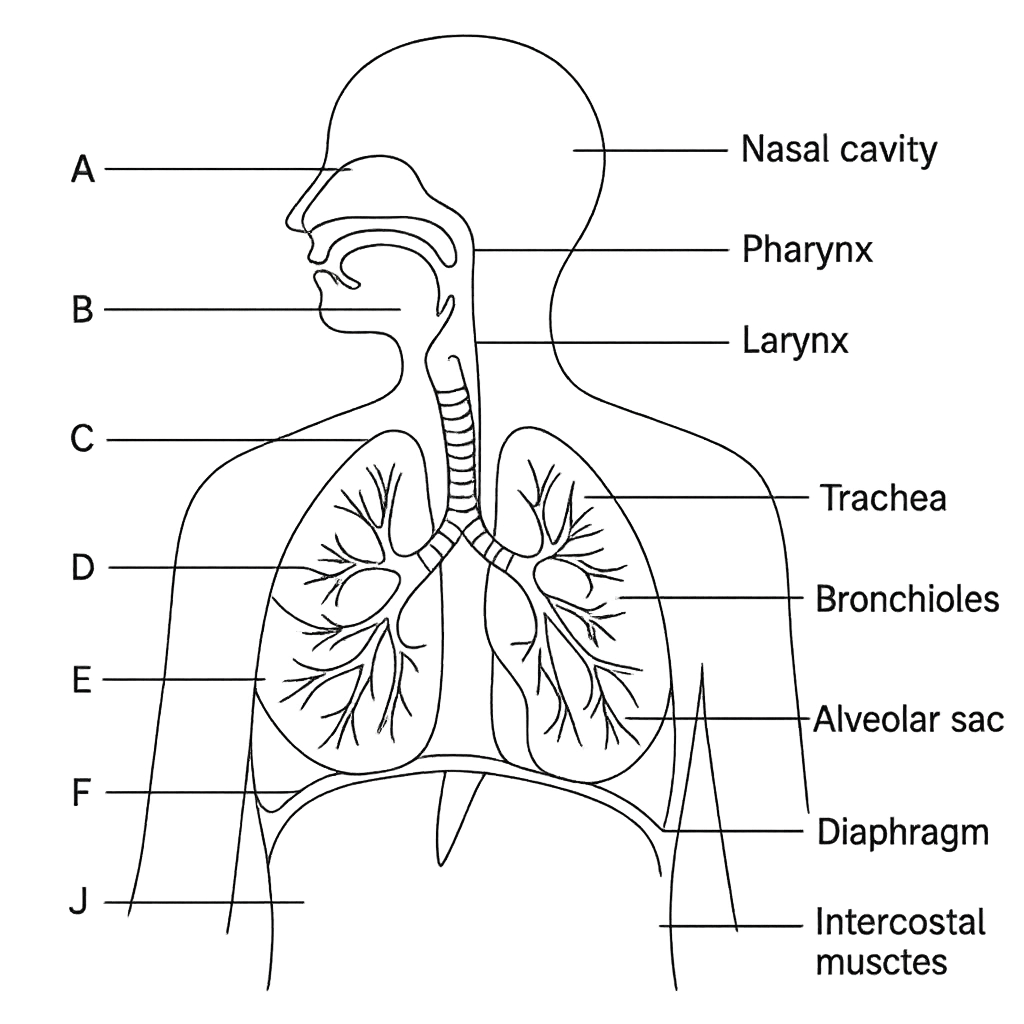
Refer to the labelled diagram of the human respiratory system. During quiet inhalation the diaphragm contracts, moving downwards and increasing the thoracic cavity volume by 0.5 L, while the rib cage expands, adding a further 0.3 L. Assuming the initial lung volume at the end of a normal exhalation is 2.5 L and atmospheric pressure is 760 mm Hg, use Boyle's law to calculate the average intrathoracic pressure at the midpoint of the inhalation (i.e., when the total volume increase is half of 0.8 L). Give your answer in mm Hg to the nearest whole number.
A. 633
B. 576
Correct C. 655
D. 679

Correct Answer: C

Want to see the full step-by-step solution? Unlock AI Explanation & Analytics
Question 11 View Details
A leaf's cuticle thickness t (in µm) reduces water loss rate W (mg H₂O h⁻¹ cm⁻²) according to \(W = W_0\bigl(1 - e^{-0.2t}\bigr)\) where \(W_0 = 10\). The same cuticle reduces CO₂ uptake rate P (mg CO₂ h⁻¹ cm⁻²) according to \(P = P_0\bigl(1 - 0.1t\bigr)\) with \(P_0 = 5\). Net carbon gain is \(G = P - 0.5W\). To maintain a net gain of at least 2 mg CO₂ h⁻¹ cm⁻², what is the minimum cuticle thickness t (to two decimal places) required?
A. 3.10 µm
B. 2.75 µm
C. 1.85 µm
Correct D. 2.30 µm

Correct Answer: D

Want to see the full step-by-step solution? Unlock AI Explanation & Analytics
Question 12 View Details
Two plant species A and B compete in a meadow. Their dynamics are described by\n\[\frac{dN_A}{dt}= r_A N_A\Bigl(1-\frac{N_A+\alpha N_B}{K_A}\Bigr),\qquad\frac{dN_B}{dt}= r_B N_B\Bigl(1-\frac{N_B+\beta N_A}{K_B}\Bigr).\]\nGiven \(r_A = 0.4\ \text{month}^{-1},\ K_A = 5000,\ r_B = 0.3\ \text{month}^{-1},\ K_B = 4000,\ \alpha = 0.5,\ \beta = 0.8\). A herbivore reduces the intrinsic growth rate of species A by 20 % (so the effective \(r_A\) becomes 0.32). Assuming the system reaches equilibrium (\(dN_A/dt = dN_B/dt = 0\)), what are the equilibrium population sizes \(N_A^*\) and \(N_B^*\) (in individuals)?
Correct A. 5000, 0
B. 4000, 1000
C. 2500, 2500
D. 0, 4000

Correct Answer: A

Want to see the full step-by-step solution? Unlock AI Explanation & Analytics
Question 13 View Details
A diploid human cell (2n = 46 chromosomes) enters mitosis. At the end of anaphase the sister chromatids have been separated into two daughter nuclei. How many chromosomes and how many chromatids are present in each daughter nucleus at this stage?
A. 23 chromosomes, 46 chromatids
B. 46 chromosomes, 92 chromatids
Correct C. 46 chromosomes, 46 chromatids
D. 92 chromosomes, 46 chromatids

Correct Answer: C

Want to see the full step-by-step solution? Unlock AI Explanation & Analytics
Question 14 View Details
A bacterial culture starts with \(10^{3}\) cells and has a generation time of 30 min under optimal conditions. After 2 h an antibiotic is introduced that reduces the specific growth rate by 30 %. Consequently the new generation time becomes \(g = \frac{30\ \text{min}}{0.7}\). The culture is observed for a total of 5 h. Estimate the total number of cells present after 5 h (give your answer in scientific notation to two significant figures).
Correct A. 2.9×10^5
B. 3.2×10^5
C. 2.9×10^4
D. 1.5×10^5

Correct Answer: A

Want to see the full step-by-step solution? Unlock AI Explanation & Analytics
Question 15 View Details
At rest a human produces metabolic heat at a rate of 100 W. Heat loss to the environment occurs by conduction/radiation at a rate \(H_c = k (T_{core} - T_{amb})\) with \(k = 5\ \text{W °C}^{-1}\) and by sweating. The evaporative cooling power is \(H_s = L\,S\) where the latent heat of vapourisation \(L = 2.43\times10^{3}\ \text{J ml}^{-1}\) and the sweat rate \(S\) (ml min\(^{-1}\)) increases linearly with core temperature above 36.5 °C according to \(S = 10\,(T_{core} - 36.5)\) for \(T_{core}>36.5\) °C, otherwise \(S=0\). The ambient temperature is 30 °C, the initial core temperature is 37 °C, and the body's heat capacity is \(C = 3.5\times10^{5}\ \text{J °C}^{-1}\). Assuming the rates adjust instantly to the current core temperature, what is the core temperature after 30 min? Give your answer to one decimal place in °C.
Correct A. 36.6 °C
B. 37.2 °C
C. 38.1 °C
D. 35.8 °C

Correct Answer: A

Want to see the full step-by-step solution? Unlock AI Explanation & Analytics
Question 16 View Details
A subject's creatinine clearance is \(120\ \text{mL min}^{-1}\) and the urine flow rate is \(1.5\ \text{mL min}^{-1}\). The urine creatinine concentration is \(100\ \text{mg dL}^{-1}\) and the plasma creatinine concentration is \(1\ \text{mg dL}^{-1}\). What percentage of the filtered creatinine load is excreted in the urine?
A. 100%
B. 150%
C. 75%
Correct D. 125%

Correct Answer: D

Want to see the full step-by-step solution? Unlock AI Explanation & Analytics
Question 17 View Details
A patient has a cardiac output of \(5\ \text{L min}^{-1}\) and a haemoglobin concentration of \(150\ \text{g L}^{-1}\). Each gram of haemoglobin carries \(1.34\ \text{mL O}_{2}\). Arterial oxygen saturation is \(98\%\) and venous saturation is \(75\%\). How many millilitres of oxygen are extracted from the blood each minute?
A. 180
Correct B. 231
C. 200
D. 250

Correct Answer: B

Want to see the full step-by-step solution? Unlock AI Explanation & Analytics
Question 18 View Details
Two algal species compete in a pond. Species A follows logistic growth with intrinsic rate \(r_{A}=0.4\ \text{day}^{-1}\) and carrying capacity \(K_{A}=1.0\times10^{6}\) cells. Species B has \(r_{B}=0.3\ \text{day}^{-1}\) and \(K_{B}=8.0\times10^{5}\) cells. The competition coefficients are \(\alpha=0.5\) (effect of B on A) and \(\beta=0.7\) (effect of A on B). Assuming the Lotka‑Volterra competition model, which species attains the higher equilibrium population and what is that equilibrium (to two significant figures)?
A. Species B, ≈7.5 × 10⁵ cells
B. Species B, ≈9.2 × 10⁵ cells
C. Species A, ≈1.1 × 10⁶ cells
Correct D. Species A, ≈9.2 × 10⁵ cells

Correct Answer: D

Want to see the full step-by-step solution? Unlock AI Explanation & Analytics
Question 19 View Details
In a monosynaptic stretch reflex, the afferent (sensory) fibre is 0.8 m long and conducts at \(60\ \text{m s}^{-1}\). The efferent (motor) fibre is 0.6 m long and conducts at \(45\ \text{m s}^{-1}\). The synaptic delay at the spinal cord is \(0.5\ \text{ms}\). Calculate the total latency from the onset of muscle stretch to the beginning of muscle contraction, giving your answer in milliseconds (rounded to the nearest whole number).
A. 24 ms
Correct B. 27 ms
C. 22 ms
D. 30 ms

Correct Answer: B

Want to see the full step-by-step solution? Unlock AI Explanation & Analytics
Question 20 View Details
A lake has a surface area of \(2\ \text{km}^{2}\). Its annual primary productivity is \(800\ \text{g C m}^{-2}\text{ yr}^{-1}\). At each trophic level, 30 % of the biomass is respired before any transfer to the next level. The transfer efficiencies are 10 % from primary producers to herbivores, 20 % from herbivores to secondary consumers, and 15 % from secondary to tertiary consumers. Estimate the total annual carbon biomass (in tonnes) that can be supported by the tertiary consumers.
A. 1.5 tonnes
B. 2.0 tonnes
Correct C. 1.65 tonnes
D. 0.9 tonnes

Correct Answer: C

Want to see the full step-by-step solution? Unlock AI Explanation & Analytics
Question 21 View Details
A woman's menstrual cycle length varies between 28 and 32 days. The luteal phase is consistently 14 days. Assuming the fertile period extends from five days before ovulation up to the day of ovulation, on which days of the cycle is she definitely fertile regardless of the exact cycle length?
A. Days 11 and 12
Correct B. Days 13 and 14
C. Days 12 and 13
D. Days 14 and 15

Correct Answer: B

Want to see the full step-by-step solution? Unlock AI Explanation & Analytics
Question 22 View Details
A 65‑year‑old male weighing 70 kg has a serum creatinine concentration of 150 µmol L^{-1}. The standard dosing regimen for the antibiotic is 500 mg every 12 h for patients with a creatinine clearance (CrCl) > 50 mL min^{-1}. For CrCl between 30 and 50 mL min^{-1} the recommended dose is 250 mg every 24 h, and the drug is contraindicated if CrCl < 30 mL min^{-1}. Using the Cockcroft-Gault equation, determine the appropriate dosing regimen for this patient.
A. 125 mg once daily
Correct B. 250 mg once daily
C. 250 mg twice daily
D. 500 mg once daily

Correct Answer: B

Want to see the full step-by-step solution? Unlock AI Explanation & Analytics
Question 23 View Details
The renal plasma flow (RPF) is 600 mL min^{-1} and the filtration fraction (FF) is 20 %. A solute is present in the plasma at a concentration of 15 mg mL^{-1}. If 85 % of the filtered load of this solute is reabsorbed, calculate the rate at which the solute is excreted (in mg min^{-1}).
A. 360 mg min^{-1}
Correct B. 270 mg min^{-1}
C. 1620 mg min^{-1}
D. 1350 mg min^{-1}

Correct Answer: B

Want to see the full step-by-step solution? Unlock AI Explanation & Analytics
Question 24 View Details
In a cohort study of 200 individuals, 80 are smokers and 120 are non‑smokers. Among the smokers, 30 develop disease X, whereas among the non‑smokers, 20 develop disease X. Calculate (a) the relative risk (RR) of disease X for smokers compared with non‑smokers, and (b) the odds ratio (OR) for the same comparison. Based on these calculations, which measure provides a more appropriate estimate of the association in this study design?
Correct A. RR = 2.25, OR = 3.0; RR is the more appropriate measure for this cohort study.
B. RR = 3.0, OR = 2.25; OR is the more appropriate measure for this cohort study.
C. RR = 2.25, OR = 2.5; RR is the more appropriate measure for this cohort study.
D. RR = 1.5, OR = 2.0; OR is the more appropriate measure for this cohort study.

Correct Answer: A

Want to see the full step-by-step solution? Unlock AI Explanation & Analytics
Question 25 View Details
An organelle is observed to (i) possess its own circular DNA, (ii) be the site of aerobic respiration, and (iii) be bounded by two membranes. Identify this organelle.
Correct A. Mitochondrion
B. Nucleus
C. Chloroplast
D. Endoplasmic reticulum

Correct Answer: A

Want to see the full step-by-step solution? Unlock AI Explanation & Analytics

Master the Exam!

You've seen a preview, but there are thousands more questions plus AI tutor to break down complex solutions.

Unlock Full Access Available for Android & Windows
Help others prepare! Share this practice hub:
Chat with Support