gce model questions vol1 2024 agricultural_science | Essay

Prepare for your exams with gce model questions vol1 questions? Reviewing past/model questions is one of the most effective ways to guarantee a high score. This practice hub features authentic 2024 agricultural_science (Essay) questions designed to simulate the real exam environment.

Practice these randomly selected questions to test your readiness.

Question 1 View Details
A farmer wishes to adopt ecological principles to improve the sustainability of his mixed‑crop farm.
Question Parts
(a)
Define agricultural ecology and explain its importance in maintaining ecosystem services on farms.
(b)
Discuss two major adverse effects of monoculture cropping on soil health and biodiversity, providing concrete examples.
(c)
Propose three management practices that integrate ecological concepts to enhance productivity while conserving resources. For each practice, indicate the ecological principle it addresses.
Detailed Essay Solution & Marking Scheme Available

Get the step-by-step mathematical proofs, key points required by examiners, and a comprehensive breakdown from our AI Tutor.
Question 2 View Details
A soil scientist conducts a laboratory experiment to compare the infiltration characteristics of three different soil types: sandy loam (S1), clay loam (S2) and peat (S3). The experiment uses a rectangular soil column (30 cm high, 10 cm wide) divided into three equal compartments, each 10 cm high and labelled S1, S2 and S3 as shown in the illustration. Water is poured at a constant rate into the top of the column and the time taken for a fixed volume of 200 ml to infiltrate each compartment is recorded. Data recorded: - S1 (sandy loam): 30 s - S2 (clay loam): 70 s - S3 (peat): 120 s Using this information, answer the following:
Question Parts
(a)
Calculate the average infiltration rate (in ml s⁻¹) for each soil type.
(b)
Explain, with reference to soil texture, why the infiltration rates differ among the three soils.
(c)
Based on the results, recommend an appropriate soil amendment for the soil with the lowest infiltration rate and justify how it will improve infiltration.
Detailed Essay Solution & Marking Scheme Available

Get the step-by-step mathematical proofs, key points required by examiners, and a comprehensive breakdown from our AI Tutor.

Question 3 View Details
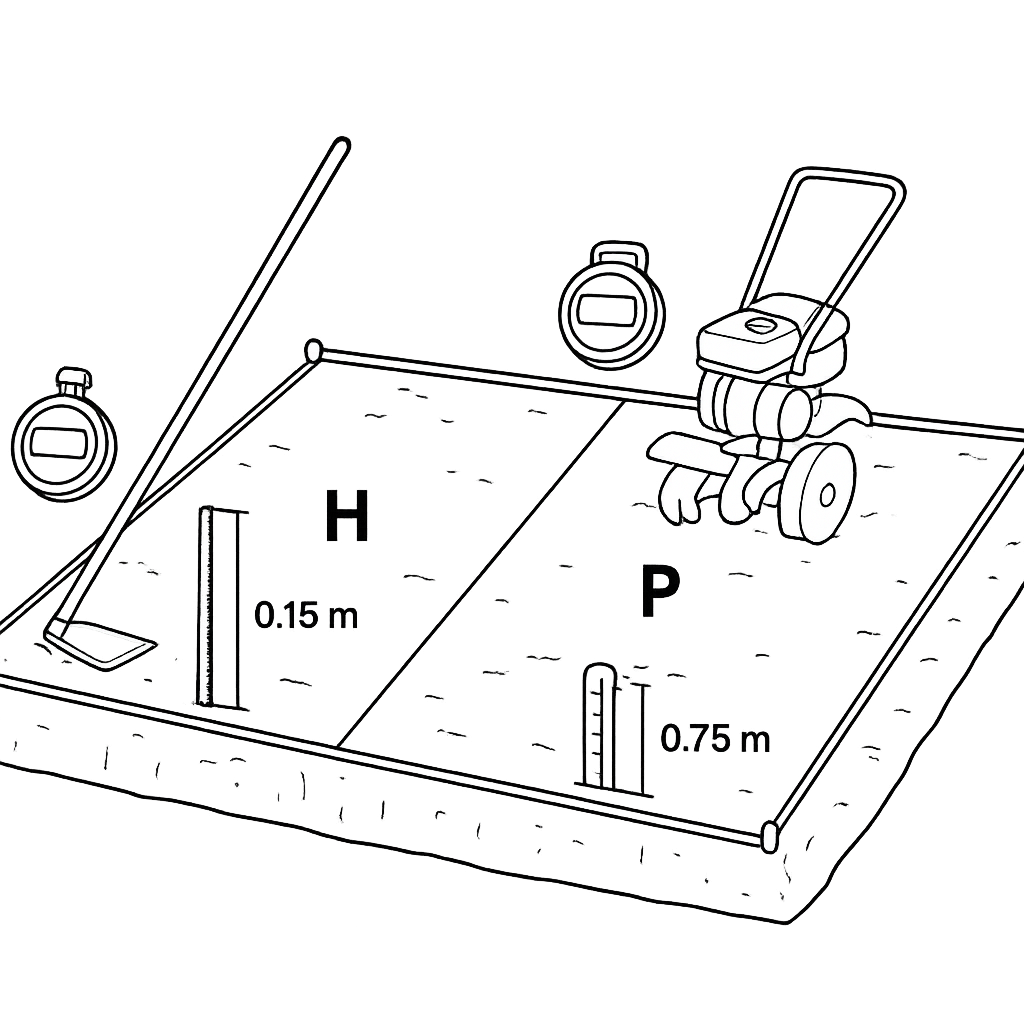
A practical test is arranged to compare the efficiency of a hand hoe and a small motorised plough in turning over the topsoil of a field. The test plot is a rectangular area of 2 m × 1 m, divided into two equal sections of 1 m × 1 m. Each section is prepared to a uniform depth of 0.15 m. A stopwatch is used to record the time taken to turn over the soil in each section, and a ruler is used to verify the depth. The recorded times are: hand hoe – 12 minutes; motorised plough – 3 minutes. The farmer intends to cultivate a total area of 0.5 ha (5 000 m²) using either tool.
Question Parts
(a)
Calculate the average rate of soil turnover (in cubic metres per minute) for each tool.
(b)
State the ratio of the productivity of the motorised plough to the hand hoe and comment on what this implies for a small‑holder farmer.
(c)
Estimate the total time required to prepare the entire 0.5 ha using each tool. Based on these estimates, advise which tool is more appropriate for a small‑holder farmer who has limited financial resources but wishes to finish the work within a fortnight (14 days).
Detailed Essay Solution & Marking Scheme Available

Get the step-by-step mathematical proofs, key points required by examiners, and a comprehensive breakdown from our AI Tutor.

Question 4 View Details
A small diesel tractor is used to pull a single‑blade plough for land preparation. Two loading conditions are tested on a level field:\n\n• Load A: 500 kg of soil attached to the plough. The tractor travels 10 km and consumes 12 L of diesel.\n• Load B: 800 kg of soil attached to the plough. The tractor travels the same 10 km and consumes 15 L of diesel.\n\nThe plough has an effective working width of 0.75 m. Diesel price is ₦200 per litre. The farmer wishes to minimise fuel cost per hectare while maintaining reasonable productivity.
Question Parts
(a)
Calculate the fuel consumption (in litres per hectare) for each loading condition.
(b)
Determine the fuel cost per hectare for each load and state which load is more economical.
(c)
Discuss the trade‑offs between using the higher load (800 kg) and the lower load (500 kg) in terms of (i) fuel efficiency, (ii) soil compaction risk, and (iii) overall field productivity.
Detailed Essay Solution & Marking Scheme Available

Get the step-by-step mathematical proofs, key points required by examiners, and a comprehensive breakdown from our AI Tutor.

Question 5 View Details
A farmer has 5 ha of land suitable for both maize and soybean. The farmer wishes to obtain at least 2,500 kg of protein from the crops in one season. Maize yields 4 t ha⁻¹ and contains 9 % protein (by weight). Soybean yields 2.5 t ha⁻¹ and contains 40 % protein.
Question Parts
(a)
Determine the minimum area of soybean that must be planted, assuming the remaining area is planted to maize, to meet the protein target.
(b)
If the farmer allocates the land equally between the two crops, calculate the total protein that will be produced and state whether the target is met.
(c)
Briefly discuss two agronomic advantages of rotating maize with soybean.
Detailed Essay Solution & Marking Scheme Available

Get the step-by-step mathematical proofs, key points required by examiners, and a comprehensive breakdown from our AI Tutor.

Question 6 View Details
A smallholder dairy farmer keeps 20 lactating cows, each averaging 12 L of milk per day. The average live weight of a cow is 350 kg. The recommended crude‑protein (CP) intake for a cow producing 12 L of milk is 2 % of its body weight. The farmer feeds a concentrate mixture containing 30 % CP and maize stover containing 6 % CP. Each cow receives 8 kg of stover per day. The cost of the concentrate is ₦150 kg⁻¹ and the cost of stover is ₦30 kg⁻¹.
Question Parts
(a)
Calculate the amount of concentrate (in kg) required per cow per day to meet the CP requirement.
(b)
Determine the total daily feed cost for the whole herd.
Detailed Essay Solution & Marking Scheme Available

Get the step-by-step mathematical proofs, key points required by examiners, and a comprehensive breakdown from our AI Tutor.

Question 7 View Details
A farmer in northern Nigeria cultivates maize on a 2‑hectare field. The field contains 10,000 maize stems per hectare. The main pest affecting the crop is the African stem borer (Chilo partellus).
Question Parts
(a)
Describe the life cycle of the African stem borer, highlighting the stage that causes the most damage to maize.
(b)
The farmer wishes to adopt an Integrated Pest Management (IPM) approach. List three cultural, two biological and two chemical control methods that could be incorporated, and briefly explain how each reduces pest damage.
(c)
Each stem borer larva destroys an average of 12 cm of the maize stalk. A yield loss of 1 % occurs for every 5 % of stems damaged. In a monitoring survey the farmer counted 150 larvae per hectare. Estimate the expected percentage yield loss for the whole 2‑hectare field and state whether the economic threshold of a 2 % yield loss has been exceeded.
Detailed Essay Solution & Marking Scheme Available

Get the step-by-step mathematical proofs, key points required by examiners, and a comprehensive breakdown from our AI Tutor.

Question 8 View Details
A farmer observes leaf spots on his tomato crop. A survey of 200 plants gave the following distribution of disease severity: - Immune (0–5 % leaf area affected): 30 plants - Mild (6–25 %): 80 plants - Moderate (26–50 %): 60 plants - Severe (>50 %): 30 plants The observed symptoms are circular brown lesions with yellow halos on the lower leaves.
Question Parts
(a)
Calculate the disease incidence and the Disease Severity Index (DSI) using the formula: DSI = [ Σ (severity class midpoint × number of plants) ] ÷ (total plants × 100) × 100. Show all steps.
(b)
Identify the most likely causal pathogen based on the symptom description and propose two cultural and two chemical control measures suitable for this disease.
Detailed Essay Solution & Marking Scheme Available

Get the step-by-step mathematical proofs, key points required by examiners, and a comprehensive breakdown from our AI Tutor.

Question 9 View Details
A mixed‑breed cattle herd on a smallholder farm in northern Nigeria has shown an increase in mortality over the past three months. The farmer reports that affected animals develop fever, swollen lymph nodes, and a sudden drop in milk production before death. Laboratory tests confirm the presence of *Mycobacterium bovis*.
Question Parts
(a)
Explain the epidemiology of bovine tuberculosis in cattle, including the main routes of transmission and factors that favour its spread in smallholder farms.
(b)
Propose an integrated control programme for this herd, covering immediate, medium‑term and long‑term actions. Justify each component of the programme.
(c)
Assess the potential public health implications of bovine tuberculosis in this community and recommend measures to protect human health.
Detailed Essay Solution & Marking Scheme Available

Get the step-by-step mathematical proofs, key points required by examiners, and a comprehensive breakdown from our AI Tutor.

Question 10 View Details
A smallholder farmer in the savanna zone of Nigeria intends to diversify his 5‑ha mixed farm (crops and livestock) over the next five years to improve food security and income stability. The current enterprise mix consists of 3 ha of maize, 1 ha of cowpea, and 1 ha of mixed poultry (approximately 150 birds). The farmer has access to a seasonal water source, a modest capital of ₦250,000, and a willingness to adopt improved practices.
Question Parts
(a)
Develop a five‑year enterprise plan that introduces at least two new enterprises (crop or livestock). For each new enterprise, specify the land area, expected annual output, and gross revenue (use realistic Nigerian market prices).
(b)
Using the data from part (a), prepare a simplified cash‑flow projection for the first three years, showing total revenue, total variable costs (seed, feed, veterinary, labour), and net cash flow. State any assumptions made.
(c)
Identify three major risks that could affect the profitability of the proposed plan and suggest a mitigation strategy for each.
(d)
Discuss how the proposed diversification contributes to the long‑term sustainability of the farm, considering environmental, economic and social dimensions.
Detailed Essay Solution & Marking Scheme Available

Get the step-by-step mathematical proofs, key points required by examiners, and a comprehensive breakdown from our AI Tutor.

Master the Exam!

You've seen a preview, but there are thousands more questions plus AI tutor to break down complex solutions.

Unlock Full Access Available for Android & Windows
Help others prepare! Share this practice hub:
Chat with Support