gce model questions vol1 2023 geography | Objective

Prepare for your exams with gce model questions vol1 questions? Reviewing past/model questions is one of the most effective ways to guarantee a high score. This practice hub features authentic 2023 geography (Objective) questions designed to simulate the real exam environment.

Practice these randomly selected questions to test your readiness.

Question 1 View Details
River X is \(240\) km long and falls a total of \(180\) m from source to mouth. The upper course occupies one‑third of the total length and drops \(30\) m. The lower course occupies one‑half of the total length. The middle course therefore occupies the remaining length and has a gradient that is twice the gradient of the lower course. What is the average gradient (in m km⁻¹) of the lower course?
Correct A. 0.75
B. 0.90
C. 0.60
D. 1.20

Correct Answer: A

Want to see the full step-by-step solution? Unlock AI Explanation & Analytics
Question 2 View Details
A wheat yield (ton ha⁻¹) can be approximated by the quadratic model \(Y = pN - qN^{2}\), where \(N\) is the amount of nitrogen fertilizer applied (kg ha⁻¹). Field trials gave \(Y = 3.2\) t ha⁻¹ when \(N = 60\) kg ha⁻¹ and \(Y = 3.6\) t ha⁻¹ when \(N = 100\) kg ha⁻¹. The region receives 180 mm of rainfall, which is 20 mm below the optimal 200 mm; each 10 mm deficit reduces the actual yield by 0.1 t ha⁻¹. Determine the nitrogen rate that maximises the actual yield after accounting for the water deficit, and give that maximum actual yield (to two decimal places).
Correct A. 92 kg ha⁻¹; 3.43 t ha⁻¹
B. 100 kg ha⁻¹; 3.50 t ha⁻¹
C. 95 kg ha⁻¹; 3.40 t ha⁻¹
D. 85 kg ha⁻¹; 3.30 t ha⁻¹

Correct Answer: A

Want to see the full step-by-step solution? Unlock AI Explanation & Analytics
Question 3 View Details
A soil sample contains 45 % sand, 35 % silt and 20 % clay (by mass). A farmer incorporates 10 kg of organic matter per 100 kg of soil, and the organic matter behaves like silt. After mixing, what are the new percentages (to one decimal place) of sand, silt and clay, and what USDA texture class does the amended soil belong to?
Correct A. Sand 40.9 %; Silt 40.9 %; Clay 18.2 %; loam
B. Sand 40.0 %; Silt 41.0 %; Clay 19.0 %; loam
C. Sand 39.0 %; Silt 42.0 %; Clay 19.0 %; loam
D. Sand 41.5 %; Silt 38.5 %; Clay 20.0 %; loam

Correct Answer: A

Want to see the full step-by-step solution? Unlock AI Explanation & Analytics
Question 4 View Details
In a regional input‑output model three sectors - Manufacturing (M), Agriculture (A) and Services (S) - purchase inputs from each other as follows: M purchases 30 % of its inputs from A and 20 % from S; A purchases 10 % from M and 15 % from S; S purchases 5 % from M and 10 % from A. No sector purchases from itself. The final demand (outside the three sectors) is 200 million for M, 150 million for A and 250 million for S. Assuming linear inter‑industry relationships, calculate the total output required from the manufacturing sector to satisfy the final demand (in millions, rounded to the nearest whole number).
A. 340
B. 280
Correct C. 325
D. 300

Correct Answer: C

Want to see the full step-by-step solution? Unlock AI Explanation & Analytics
Question 5 View Details
A catchment has a length of \(L = 2.5\) km and an average slope of \(S = 0.04\) (4 %). The Kirpich formula gives the time of concentration (minutes) as \(T_c = 0.0195\,L^{0.77}\,S^{-0.385}\) with \(L\) in metres. Thirty percent of the catchment is urbanised, and for that portion the effective length is reduced by 15 %. Assuming the overall time of concentration is the area‑weighted average of the urban and rural portions, calculate the effective \(T_c\) for the whole catchment (rounded to one decimal place).
A. 30.2
B. 24.5
C. 28.8
Correct D. 27.0

Correct Answer: D

Want to see the full step-by-step solution? Unlock AI Explanation & Analytics
Question 6 View Details
The average monthly temperature \(T\) (in \(^\circ\)C) in a city can be approximated by \(T = 12 + 8\sin\left(\frac{\pi}{6}(m-3)\right)\), where \(m\) is the month number (January = 1). Determine the first month (as a number) when the temperature exceeds \(18^\circ\text{C}\).
Correct A. 5
B. 6
C. 4
D. 7

Correct Answer: A

Want to see the full step-by-step solution? Unlock AI Explanation & Analytics
Question 7 View Details
In a region, forest covers 40 % of the land, grassland 35 %, and wetland 15 %. Overlaps are: forest ∩ grassland = 10 %, forest ∩ wetland = 5 %, grassland ∩ wetland = 3 %, and the three types together cover 2 % of the land. What percentage of the region is covered by at least one of these vegetation types?
A. 80
B. 71
Correct C. 74
D. 68

Correct Answer: C

Want to see the full step-by-step solution? Unlock AI Explanation & Analytics
Question 8 View Details
A town's population was 120 000 in 2015 and 138 000 in 2020. During the five‑year period there were 14 500 births and 9 200 deaths. Assuming net migration was constant each year, calculate the average annual net migration (in persons per year).
A. 2800
Correct B. 2540
C. 2675
D. 2420

Correct Answer: B

Want to see the full step-by-step solution? Unlock AI Explanation & Analytics
Question 9 View Details
An industrial zone uses three fuels. In 2022 it consumed 1.2 million t of coal (energy content 24 MJ kg⁻¹, efficiency 35 %), 3.5 billion m³ of natural gas (38 MJ m⁻³, efficiency 45 %), and 1.8 TWh of electricity (100 % efficiency). In 2020 it consumed 2.0 million t of coal, 4.0 billion m³ of gas, and 2.0 TWh of electricity, with the same efficiencies. The government aims for at least a 15 % reduction in total useful energy consumption compared with 2020. Does the 2022 consumption meet the target? State "Yes" or "No" and give the percentage change (to one decimal place).
A. Yes, 20.0% reduction
B. Yes, 12.5% reduction
C. No, 3.2% increase
Correct D. Yes, 17.3% reduction

Correct Answer: D

Want to see the full step-by-step solution? Unlock AI Explanation & Analytics
Question 10 View Details
On the map, City A is located at latitude \(5^\circ\text{N}\) and City B at latitude \(2^\circ\text{S}\). What is the absolute difference in latitude between the two cities in degrees?
A. 8
B. 3
Correct C. 7
D. 9

Correct Answer: C

Want to see the full step-by-step solution? Unlock AI Explanation & Analytics
Question 11 View Details
A farmer applies nitrogen fertilizer at a rate of \(F\) kg ha\(^{-1}\). The crop yield (ton ha\(^{-1}\)) before any adjustments is given by \(Y = 2 + 0.05F - 0.0001F^{2}\). A forecasted rainfall deficit will reduce the yield by \(0.02\) t for each percent of deficit; the expected deficit is 10 %. After the rainfall effect, pest damage reduces the remaining yield by 5 %. Determine the amount of nitrogen fertilizer \(F\) (kg ha\(^{-1}\)) that maximises the final yield after all adjustments.
A. 225
Correct B. 250
C. 300
D. 200

Correct Answer: B

Want to see the full step-by-step solution? Unlock AI Explanation & Analytics
Question 12 View Details
A river drops a total of 300 m over a length of 120 km. The gradient in the upper 40 km is twice the gradient in the lower 80 km. Assuming the source elevation is 500 m above sea level, calculate (a) the gradient (m km\(^{-1}\)) of the upper and lower reaches, and (b) the elevation of the river 40 km downstream from the source.
A. Upper gradient = 5.00 m km⁻¹, lower gradient = 2.50 m km⁻¹, elevation at 40 km = 300 m
B. Upper gradient = 4.00 m km⁻¹, lower gradient = 2.00 m km⁻¹, elevation at 40 km = 340 m
C. Upper gradient = 3.50 m km⁻¹, lower gradient = 1.75 m km⁻¹, elevation at 40 km = 360 m
Correct D. Upper gradient = 3.75 m km⁻¹, lower gradient = 1.875 m km⁻¹, elevation at 40 km = 350 m

Correct Answer: D

Want to see the full step-by-step solution? Unlock AI Explanation & Analytics
Question 13 View Details
The demand for a product is given by \(Q = 1200 - 20P\), where \(P\) is the price in £ per unit and \(Q\) is the quantity demanded per month. Fixed costs are £10 000 per month. The variable cost per unit is \(5 + 0.01P\) £. Determine the price \(P\) that maximises monthly profit and state the maximum profit (rounded to the nearest pound).
A. £30.00, maximum profit ≈ £4,500
Correct B. £32.53, maximum profit ≈ £4,946
C. £35.20, maximum profit ≈ £5,200
D. £28.75, maximum profit ≈ £4,100

Correct Answer: B

Want to see the full step-by-step solution? Unlock AI Explanation & Analytics
Question 14 View Details
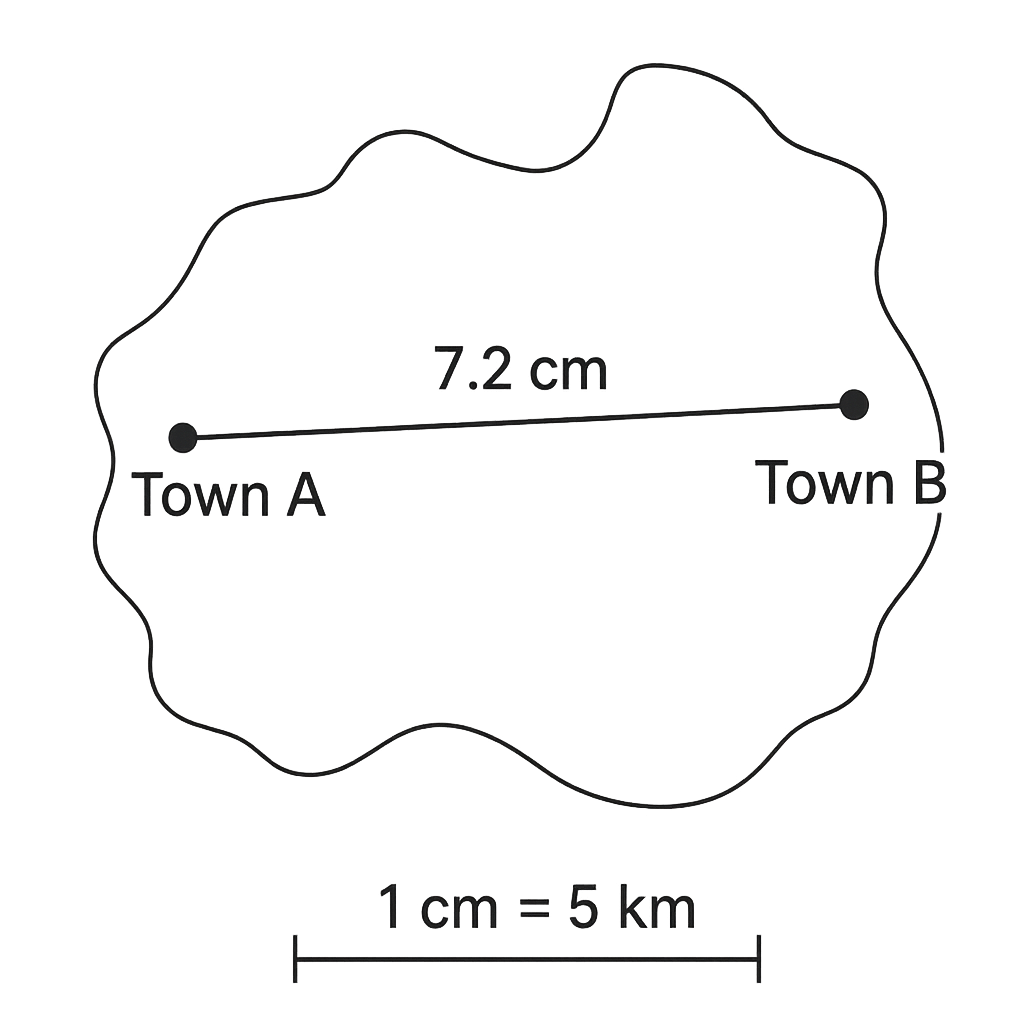
A map of a coastal region uses a scale of 1 cm : 5 km. The straight‑line distance between Town A and Town B measures 7.2 cm on the map. What is the actual distance between the two towns in kilometres?
A. 30
B. 42
Correct C. 36
D. 48

Correct Answer: C

Want to see the full step-by-step solution? Unlock AI Explanation & Analytics
Question 15 View Details
The following average monthly climate data (temperature in °C, precipitation in mm) are recorded for two regions during the wheat growing season (April-September).\n\nRegion X: April 15/40, May 18/45, June 22/50, July 24/55, August 23/60, September 19/45.\nRegion Y: April 12/70, May 14/80, June 16/90, July 18/100, August 17/95, September 13/85.\n\nWheat requires an average temperature between 10 °C and 25 °C and total precipitation between 300 mm and 600 mm over the growing season. Which region is more suitable for wheat cultivation? Justify your answer with calculations.
A. Region Z
B. Region W
Correct C. Region Y
D. Region X

Correct Answer: C

Want to see the full step-by-step solution? Unlock AI Explanation & Analytics
Question 16 View Details
A 1.5 m deep soil layer over 1 ha has a bulk density of 1.3 g cm\(^{-3}\) and contains 12 % organic matter by weight. Assuming organic matter is 58 % carbon, calculate the amount of carbon stored in the layer (in tonnes per hectare).
A. 1245
B. 1480
Correct C. 1357
D. 1600

Correct Answer: C

Want to see the full step-by-step solution? Unlock AI Explanation & Analytics
Question 17 View Details
A sandstone has a bulk density of 2.35 g cm\(^{-3}\). Its mineral composition is 70 % quartz (grain density 2.65 g cm\(^{-3}\)), 20 % feldspar (2.55 g cm\(^{-3}\)) and 10 % mica (2.80 g cm\(^{-3}\)). Assuming the minerals are tightly packed with no intra‑mineral pores, estimate the porosity of the rock as a percentage.
A. 9
B. 15
C. 13
Correct D. 11

Correct Answer: D

Want to see the full step-by-step solution? Unlock AI Explanation & Analytics
Question 18 View Details
A crop yield (tonnes ha\(^{-1}\)) varies with nitrogen fertilizer rate \(N\) (kg ha\(^{-1}\)) according to \(Y = 0.02N - 0.0001N^{2} + 3\).\n(a) Determine the nitrogen rate that maximises yield.\n(b) Calculate the maximum attainable yield.\n(c) If the farmer can only apply 120 kg ha\(^{-1}\), what is the percentage reduction in yield relative to the maximum (rounded to the nearest whole percent)?\nGive your answers as three numbers separated by semicolons: optimal \(N\) (kg ha\(^{-1}\)); maximum yield (t ha\(^{-1}\)); percentage loss (%).
A. 120; 4.2; 0
Correct B. 100; 4; 1
C. 90; 3.9; 2
D. 80; 3.8; 5

Correct Answer: B

Want to see the full step-by-step solution? Unlock AI Explanation & Analytics
Question 19 View Details
A location records mean monthly temperatures (°C) of 22, 23, 24, 25, 26, 27, 28, 27, 26, 25, 24 and 23. Annual precipitation is 1800 mm and the driest month receives 120 mm. Using the Köppen classification, identify the climate type (choose from Af, Am, Aw, Cfa, Cfb, Cwa).
A. Cwa
B. Am
Correct C. Af
D. Cfa

Correct Answer: C

Want to see the full step-by-step solution? Unlock AI Explanation & Analytics
Question 20 View Details
In a soil texture triangle, a point is located 30 % of the way from the sand vertex toward the silt vertex, and from that intermediate point it lies 40 % of the way toward the clay vertex. Determine the percentages of sand, silt and clay in the soil (express each as a whole number percentage).
A. 42; 28; 30
Correct B. 42; 18; 40
C. 30; 30; 40
D. 36; 24; 40

Correct Answer: B

Want to see the full step-by-step solution? Unlock AI Explanation & Analytics
Question 21 View Details
Region A covers \(12\,000\) km\(^2\). Its population was \(8.4\) million in the year 2000 and \(10.2\) million in 2010. Assuming the population grows at a constant annual rate, estimate the population in 2025. The region is considered ecologically sustainable if its population density does not exceed \(1\,500\) persons per km\(^2\). Will the projected 2025 population be within the sustainable limit? State "Yes" or "No" and give the projected population (to two decimal places in millions).
A. No, 12.80 million
B. No, 14.20 million
Correct C. No, 13.65 million
D. Yes, 13.65 million

Correct Answer: C

Want to see the full step-by-step solution? Unlock AI Explanation & Analytics
Question 22 View Details
A 5 000 km\(^2\) region contains three vegetation zones: tropical rainforest (30 % of the area, net primary productivity \(2\,200\) g C m\(^{-2}\) yr\(^{-1}\)), savanna (45 % area, NPP \(1\,200\) g C m\(^{-2}\) yr\(^{-1}\)) and grassland (25 % area, NPP \(800\) g C m\(^{-2}\) yr\(^{-1}\)). Calculate the region's average NPP per square metre and then decide whether the total annual carbon sequestration exceeds 5 million tonnes of carbon. State "Yes" or "No" and give the total sequestration (to the nearest million tonnes).
A. No, 7 million tonnes
B. Yes, 5 million tonnes
Correct C. Yes, 7 million tonnes
D. Yes, 8 million tonnes

Correct Answer: C

Want to see the full step-by-step solution? Unlock AI Explanation & Analytics
Question 23 View Details
A freight company can use either rail or road to move goods. Fixed cost per trip: rail £500, road £200. Variable cost per ton‑km: rail £0.04, road £0.06. Maximum load per trip: rail 30 t, road 10 t. The company must transport 45 t over 350 km. Determine the minimum total cost and the combination of trips (how many rail and road trips, and the load on each) that achieves this minimum cost.
A. £1 635, using one full rail trip (30 t) and a second road trip with 15 t
B. £1 700, using three road trips (10 t each) and one rail trip (15 t)
C. £1 650, using one full rail trip (30 t) and two road trips (10 t and 5 t)
Correct D. £1 630, using one full rail trip (30 t) and a second rail trip with 15 t

Correct Answer: D

Want to see the full step-by-step solution? Unlock AI Explanation & Analytics
Question 24 View Details
Station A is at sea level with a pressure of \(1013\) hPa and a temperature of \(25\) °C. Station B records a pressure of \(900\) hPa; its temperature is unknown. Assuming a standard atmosphere and a dry‑adiabatic lapse rate of \(9.8\) °C km\(^{-1}\), estimate the temperature at Station B. Give your answer to one decimal place in °C.
A. 14.3 °C
B. 13.5 °C
C. 16.8 °C
Correct D. 15.1 °C

Correct Answer: D

Want to see the full step-by-step solution? Unlock AI Explanation & Analytics
Question 25 View Details
In a transport network the travel times (in minutes) between cities are: A‑B 50, A‑C 80, B‑C 40, B‑D 70, C‑D 60, D‑E 30, C‑E 120. Find the shortest travel time from A to E. A new road B‑E would take 55 minutes. Re‑calculate the shortest travel time with this new road and state the percentage reduction in travel time (to the nearest whole percent).
A. 110 minutes, 27 % reduction
B. 115 minutes, 23 % reduction
C. 120 minutes, 20 % reduction
Correct D. 105 minutes, 30 % reduction

Correct Answer: D

Want to see the full step-by-step solution? Unlock AI Explanation & Analytics

Master the Exam!

You've seen a preview, but there are thousands more questions plus AI tutor to break down complex solutions.

Unlock Full Access Available for Android & Windows
Help others prepare! Share this practice hub:
Chat with Support