gce model questions vol1 2023 chemistry | Objective

Prepare for your exams with gce model questions vol1 questions? Reviewing past/model questions is one of the most effective ways to guarantee a high score. This practice hub features authentic 2023 chemistry (Objective) questions designed to simulate the real exam environment.

Practice these randomly selected questions to test your readiness.
Question 1 View Details
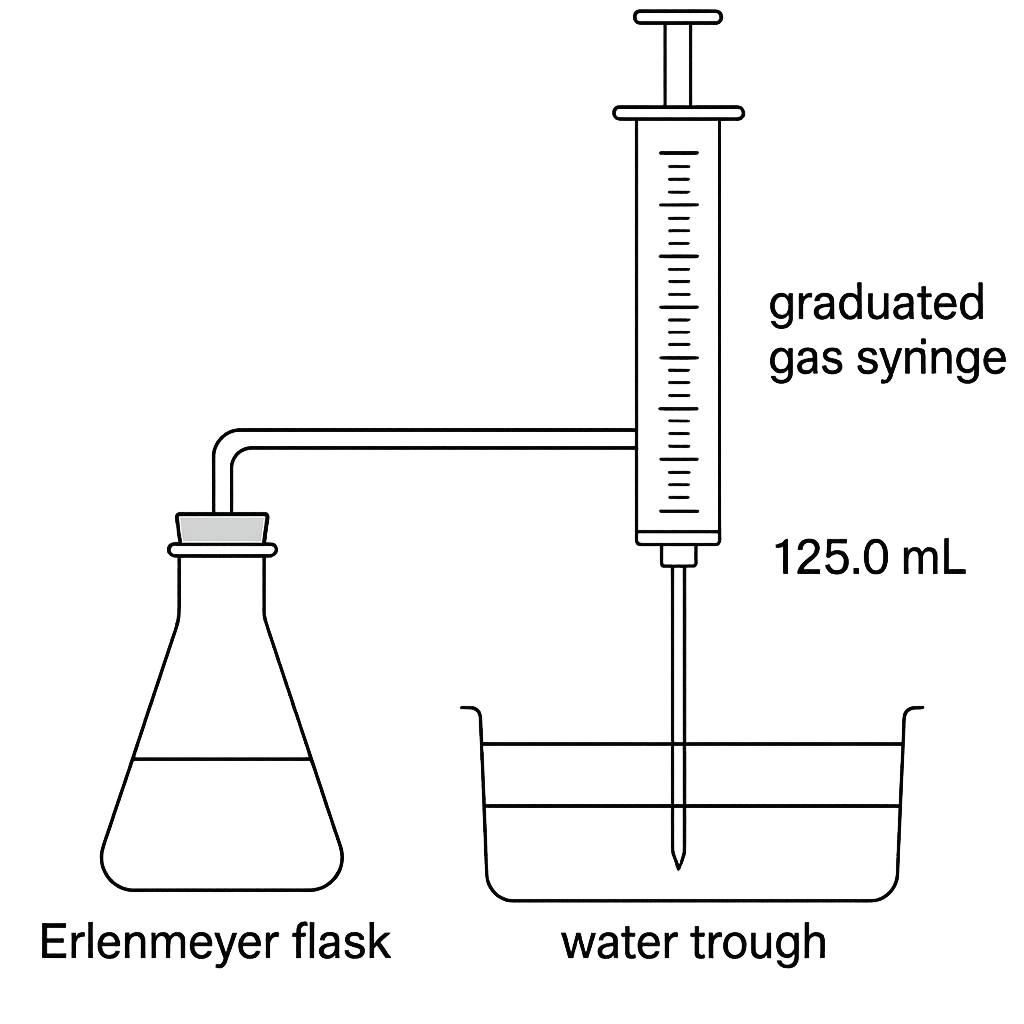
A gas collection over water apparatus is used to collect hydrogen gas produced from the reaction of an unknown metal M with excess hydrochloric acid. The graduated gas syringe shows a volume of \(125.0\) mL at \(298\) K and a total pressure of \(760\) mmHg. The water vapour pressure at \(298\) K is \(23.8\) mmHg. The metal is iron (atomic mass \(55.8\) g·mol⁻¹) and reacts according to \(\text{M} + 2\text{HCl} \rightarrow \text{MCl}_2 + \text{H}_2\). Calculate the mass of iron that reacted.
A. 0.350 g
Correct B. 0.277 g
C. 0.300 g
D. 0.250 g

Correct Answer: B

Want to see the full step-by-step solution? Unlock AI Explanation & Analytics
Question 2 View Details
A copper pipe of length \(2.00\) m and internal diameter \(20\) mm is immersed in seawater and corrodes uniformly. After six months the measured mass loss is \(0.85\) g. Assuming the corrosion reaction is \(\text{Cu} \rightarrow \text{Cu}^{2+} + 2e^{-}\), calculate the average corrosion current density in \(\text{A cm}^{-2}\). (Take \(M_{Cu}=63.55\) g·mol⁻¹, \(F=96485\) C·mol⁻¹, and 1 month = 30.44 days.)
Correct A. 1.3×10⁻⁷ A cm⁻²
B. 2.6×10⁻⁷ A cm⁻²
C. 1.3×10⁻⁶ A cm⁻²
D. 9.5×10⁻⁸ A cm⁻²

Correct Answer: A

Want to see the full step-by-step solution? Unlock AI Explanation & Analytics
Question 3 View Details
A 10.0 g sample of a mixture of ethanol (\(\mathrm{C_2H_5OH}\), \(M=46.07\) g·mol⁻¹) and 2‑propanol (\(\mathrm{C_3H_7OH}\), \(M=60.10\) g·mol⁻¹) is completely oxidised by excess acidified potassium dichromate. The reduction of dichromate produces \(0.130\) mol of \(\mathrm{Cr^{3+}}\). Assuming each mole of alcohol donates two electrons in the oxidation, determine the mass percentages of ethanol and 2‑propanol in the original mixture.
A. Ethanol 49.5 %, 2‑propanol 50.5 %
B. Ethanol 52.3 %, 2‑propanol 47.7 %
Correct C. Ethanol 56.5 %, 2‑propanol 43.5 %
D. Ethanol 58.0 %, 2‑propanol 42.0 %

Correct Answer: C

Want to see the full step-by-step solution? Unlock AI Explanation & Analytics
Question 4 View Details
A 250.0 mL buffer solution contains 0.200 mol of acetic acid (\(\mathrm{CH_3COOH}\)) and 0.150 mol of sodium acetate (\(\mathrm{CH_3COONa}\)). The acid dissociation constant of acetic acid at 25 °C is \(K_a = 1.8\times10^{-5}\).\ (a) Calculate the initial pH of the buffer.\ (b) After adding 0.0200 mol of \(\mathrm{HCl}\) (volume change negligible), calculate the new pH.\ (c) To restore the original pH, how many millilitres of 0.100 M \(\mathrm{NaOH}\) solution are required?
A. 150 mL of 0.100 M NaOH
B. 200 mL of 0.050 M NaOH
Correct C. 200 mL of 0.100 M NaOH
D. 250 mL of 0.100 M NaOH

Correct Answer: C

Want to see the full step-by-step solution? Unlock AI Explanation & Analytics
Question 5 View Details
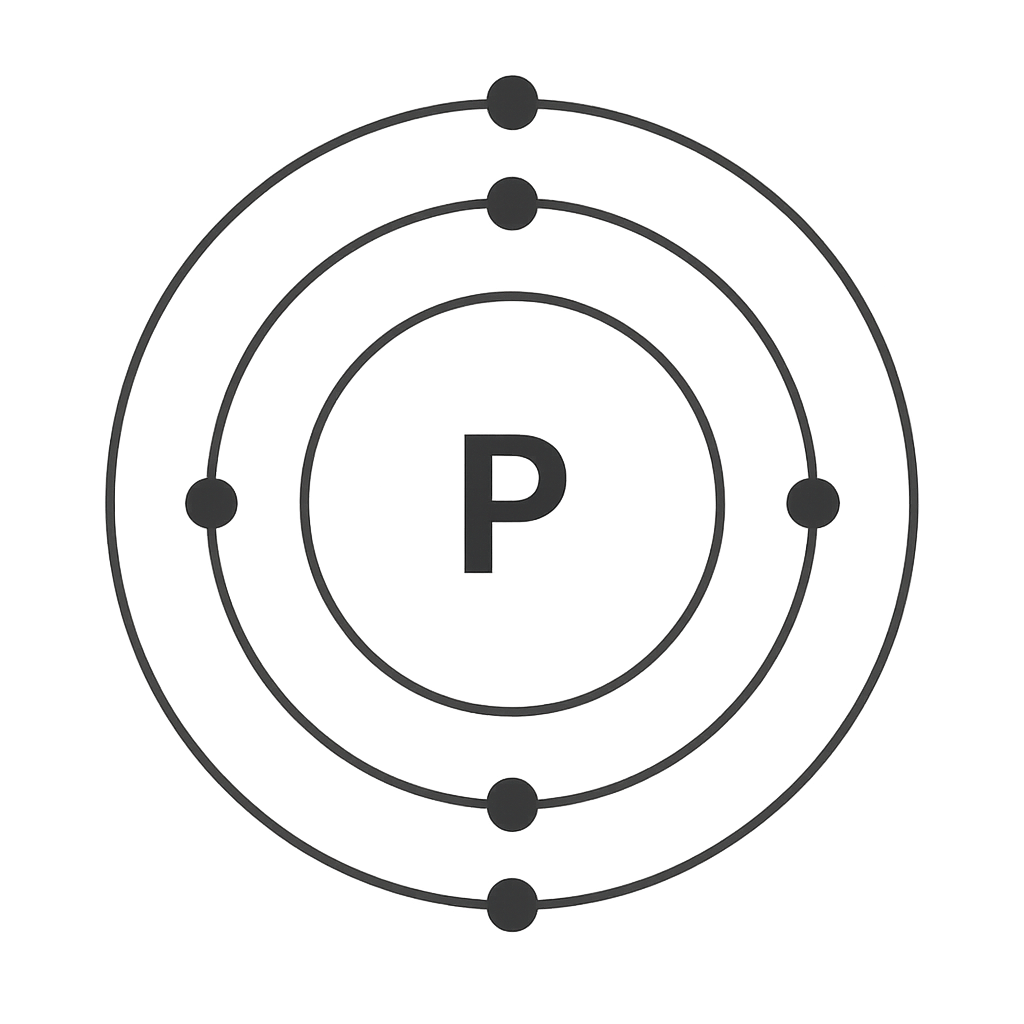
The diagram shows a Bohr model of an atom with \(Z = 15\) electrons arranged in shells: 2 electrons in the first shell, 8 in the second, and 5 in the third. Using this information, identify the element, write its ground‑state electron configuration, state its most common oxidation state, and give the number of unpaired electrons.
A. Element: sulfur; configuration: 1s² 2s² 2p⁶ 3s² 3p⁴; common oxidation state: -2; unpaired electrons: 2
B. Element: silicon; configuration: 1s² 2s² 2p⁶ 3s² 3p²; common oxidation state: +4; unpaired electrons: 0
Correct C. Element: phosphorus; configuration: 1s² 2s² 2p⁶ 3s² 3p³; common oxidation state: +5; unpaired electrons: 3
D. Element: chlorine; configuration: 1s² 2s² 2p⁶ 3s² 3p⁵; common oxidation state: -1; unpaired electrons: 1

Correct Answer: C

Want to see the full step-by-step solution? Unlock AI Explanation & Analytics
Question 6 View Details
An element has the electron configuration \([\text{Ar}]\,4s^{2}\,3d^{10}\,4p^{5}\). What is its atomic number?
A. 34
B. 36
C. 37
Correct D. 35

Correct Answer: D

Want to see the full step-by-step solution? Unlock AI Explanation & Analytics
Question 7 View Details
A solution of a weak monoprotic acid HA has pH = 3.00. The acid dissociation constant is \(K_{a}=1.0\times10^{-5}\). Calculate the concentration of the acid solution (in mol L^{-1}).
A. 0.010
B. 0.011
C. 0.110
Correct D. 0.101

Correct Answer: D

Want to see the full step-by-step solution? Unlock AI Explanation & Analytics
Question 8 View Details
2.00 g of magnesium metal reacts with excess hydrochloric acid according to \(\text{Mg}+2\text{HCl}\rightarrow\text{MgCl}_{2}+\text{H}_{2}\). The hydrogen gas is collected over water at 25 °C and a total pressure of 750 mm Hg. The volume of wet gas collected is 0.650 L. (Water vapour pressure at 25 °C is 23.8 mm Hg.) Calculate the percent yield of hydrogen (use \(R=0.082057\,\text{L·atm·K}^{-1}\text{mol}^{-1}\)).
Correct A. 29.9
B. 41.2
C. 33.5
D. 25.0

Correct Answer: A

Want to see the full step-by-step solution? Unlock AI Explanation & Analytics
Question 9 View Details
A 2.00 g mixture of ethane (C₂H₆) and propane (C₃H₈) is combusted completely in excess oxygen. The volume of carbon dioxide produced at 298 K and 1.00 atm is 3.30 L. (Molar masses: C₂H₆ = 30.07 g mol⁻¹, C₃H₈ = 44.10 g mol⁻¹.) Determine the mass percentage of ethane in the original mixture.
A. 34.5
B. 27.0
C. 42.0
Correct D. 38.7

Correct Answer: D

Want to see the full step-by-step solution? Unlock AI Explanation & Analytics
Question 10 View Details
A mixture containing 0.200 mol of chloroform (CHCl₃) and 0.300 mol of carbon tetrachloride (CCl₄) is placed in a sealed 5.00 L container at 25 °C. The vapour pressures of the pure liquids at 25 °C are \(P^{\circ}_{\text{CHCl}_{3}}=0.190\,\text{atm}\) and \(P^{\circ}_{\text{CCl}_{4}}=0.100\,\text{atm}\). Assuming the liquids form an ideal solution, calculate the total pressure above the solution using Raoult's law. Then, if the temperature is raised to 35 °C where the vapour pressures become \(P^{\circ}_{\text{CHCl}_{3}}=0.260\,\text{atm}\) and \(P^{\circ}_{\text{CCl}_{4}}=0.140\,\text{atm}\), determine the new total pressure.
A. 0.150 atm (25 °C), 0.210 atm (35 °C)
B. 0.130 atm (25 °C), 0.180 atm (35 °C)
C. 0.124 atm (25 °C), 0.172 atm (35 °C)
Correct D. 0.136 atm (25 °C), 0.188 atm (35 °C)

Correct Answer: D

Want to see the full step-by-step solution? Unlock AI Explanation & Analytics
Question 11 View Details
A wastewater sample contains \(150\) mg/L of \(\mathrm{NH_3\! -\! N}\) and \(80\) mg/L of \(\mathrm{PO_4^{3-}}\). The treatment plant first nitrifies \(80\)% of the ammonia to nitrate, then denitrifies \(70\)% of the nitrate to nitrogen gas. Phosphate is removed by precipitation with a \(60\)% efficiency. After treatment the effluent is mixed with river water in a \(1:4\) volume ratio (treated : river). Assuming the river water contains negligible nitrogen, calculate the final concentration of total nitrogen (as \(\mathrm{N}\)) in the mixed discharge (in mg/L).
A. 9.0 mg/L
Correct B. 13.2 mg/L
C. 66 mg/L
D. 26.4 mg/L

Correct Answer: B

Want to see the full step-by-step solution? Unlock AI Explanation & Analytics
Question 12 View Details
The solubility product of the sparingly soluble salt \(AB\) at \(25\)\(^\circ\)C (\(298\) K) is \(K_{sp}=1.0\times10^{-10}\). The dissolution is endothermic with \(\Delta H_{sol}=+40\) kJ·mol\(^{-1}\). Using the van\'t Hoff equation, estimate the solubility of \(AB\) at \(35\)\(^\circ\)C (\(308\) K). Give your answer in mol·L\(^{-1}\) (use two significant figures).
A. 1.7e-5 mol/L
B. 1.0e-5 mol/L
Correct C. 1.3e-5 mol/L
D. 7.5e-6 mol/L

Correct Answer: C

Want to see the full step-by-step solution? Unlock AI Explanation & Analytics
Question 13 View Details
A pure substance X boils at \(350\) K under a pressure of \(1\) atm and at \(365\) K under \(2\) atm. Assuming the liquid‑vapour coexistence line is linear between these points, use the Clapeyron equation (\(\frac{dP}{dT}=\frac{\Delta H_{vap}}{T\Delta V}\)) and the ideal‑gas approximation for the vapour (\(\Delta V\approx \frac{RT}{P}\)) to estimate the enthalpy of vapourisation \(\Delta H_{vap}\) of X. Give your answer in kJ·mol\(^{-1}\) (to two significant figures).
A. 38 kJ/mol
Correct B. 47 kJ/mol
C. 62 kJ/mol
D. 55 kJ/mol

Correct Answer: B

Want to see the full step-by-step solution? Unlock AI Explanation & Analytics
Question 14 View Details
In the reaction \(2\,\mathrm{Al} + 3\,\mathrm{CuSO_{4}} \rightarrow \mathrm{Al_{2}(SO_{4})_{3}} + 3\,\mathrm{Cu}\), a sample containing \(15.0\) g of aluminium and \(30.0\) g of copper(II) sulphate is heated. Determine the volume (in litres, at \(500\) K and \(0.8\) atm) of copper vapour that would be produced, assuming ideal‑gas behaviour. (Use \(R = 0.082057\) L·atm·mol\(^{-1}\)·K\(^{-1}\)).
Correct A. 9.6 L
B. 6.7 L
C. 12.4 L
D. 8.2 L

Correct Answer: A

Want to see the full step-by-step solution? Unlock AI Explanation & Analytics
Question 15 View Details
Write the ground‑state electron configuration of chromium (atomic number 24) and state how many unpaired electrons are present in its ground state.
Correct A. [Ar] 3d5 4s1, 6 unpaired electrons
B. [Ar] 3d6 4s0, 2 unpaired electrons
C. [Ar] 3d4 4s2, 4 unpaired electrons
D. [Ar] 3d5 4s1, 4 unpaired electrons

Correct Answer: A

Want to see the full step-by-step solution? Unlock AI Explanation & Analytics
Question 16 View Details
A 150 g sample of a substance has a melting point of \(120^{\circ}\text{C}\). Its specific heat capacity is \(0.5\ \text{J g}^{-1}\text{K}^{-1}\) in the solid state and \(0.8\ \text{J g}^{-1}\text{K}^{-1}\) in the liquid state. The latent heat of fusion is \(60\ \text{J g}^{-1}\). The sample is initially at \(20^{\circ}\text{C}\) and is supplied with \(12.0\ \text{kJ}\) of heat. Determine the final state of the sample (solid, liquid or mixture) and its temperature, and state how many grams of the substance are melted.
Correct A. Mixture of solid and liquid at \(120^{\circ}\text{C}\); 75 g melted (75 g solid remains).
B. Mixture of solid and liquid at \(130^{\circ}\text{C}\); 80 g melted (70 g solid remains).
C. All liquid at \(120^{\circ}\text{C}\); 150 g melted (0 g solid remains).
D. All solid at \(120^{\circ}\text{C}\); 0 g melted (150 g solid remains).

Correct Answer: A

Want to see the full step-by-step solution? Unlock AI Explanation & Analytics
Question 17 View Details
The standard enthalpy of formation of hydrogen fluoride gas is \(\Delta_f H^\circ(\text{HF}) = -270\ \text{kJ mol}^{-1}\). The bond dissociation energy of the H-H bond is \(D(\text{H-H}) = 436\ \text{kJ mol}^{-1}\) and that of the H-F bond is \(D(\text{H-F}) = 565\ \text{kJ mol}^{-1}\). Using Hess's law, calculate the bond dissociation energy of the F-F bond, \(D(\text{F-F})\), in \(\text{kJ mol}^{-1}\).
A. 136
Correct B. 154
C. 190
D. 172

Correct Answer: B

Want to see the full step-by-step solution? Unlock AI Explanation & Analytics
Question 18 View Details
A galvanic cell is constructed as \(\text{Zn}|\text{Zn}^{2+}(0.010\ \text{M})||\text{Cu}^{2+}(0.10\ \text{M})|\text{Cu}\). The standard electrode potentials are \(E^\circ(\text{Zn}^{2+}/\text{Zn}) = -0.76\ \text{V}\) and \(E^\circ(\text{Cu}^{2+}/\text{Cu}) = +0.34\ \text{V}\). Calculate the cell potential at \(298\ \text{K}\) using the Nernst equation. Give your answer to two decimal places in volts.
Correct A. 1.13 V
B. 1.03 V
C. 1.23 V
D. 0.93 V

Correct Answer: A

Want to see the full step-by-step solution? Unlock AI Explanation & Analytics
Question 19 View Details
When 2.00 g of magnesium metal reacts with excess hydrogen chloride gas at \(1.00\ \text{atm}\) and \(298\ \text{K}\), the reaction is \(\text{Mg} + 2\text{HCl} \rightarrow \text{MgCl}_2 + \text{H}_2\). Determine the volume of hydrogen gas produced at the same temperature and pressure. Give your answer in litres to two significant figures.
A. 3.0 L
B. 1.5 L
Correct C. 2.0 L
D. 2.5 L

Correct Answer: C

Want to see the full step-by-step solution? Unlock AI Explanation & Analytics
Question 20 View Details
A polymer solution at \(25^{\circ}\text{C}\) has an intrinsic viscosity of \([\eta] = 0.85\ \text{dL g}^{-1}\). The Mark-Houwink parameters for this polymer are \(K = 1.2 \times 10^{-3}\ \text{dL g}^{-1}\) and \(a = 0.75\). (i) Calculate the viscosity‑average molecular weight \(M_v\) of the polymer. (ii) A film requires a minimum \(M_v\) of \(1.0 \times 10^{5}\ \text{g mol}^{-1}\). State whether this polymer meets the requirement.
A. M_v \approx 2.1 \times 10^{4}\ \text{g mol}^{-1}; does not meet the requirement.
B. M_v \approx 6.3 \times 10^{3}\ \text{g mol}^{-1}; meets the requirement.
Correct C. M_v \approx 6.3 \times 10^{3}\ \text{g mol}^{-1}; does not meet the requirement.
D. M_v \approx 1.2 \times 10^{5}\ \text{g mol}^{-1}; does not meet the requirement.

Correct Answer: C

Want to see the full step-by-step solution? Unlock AI Explanation & Analytics
Question 21 View Details
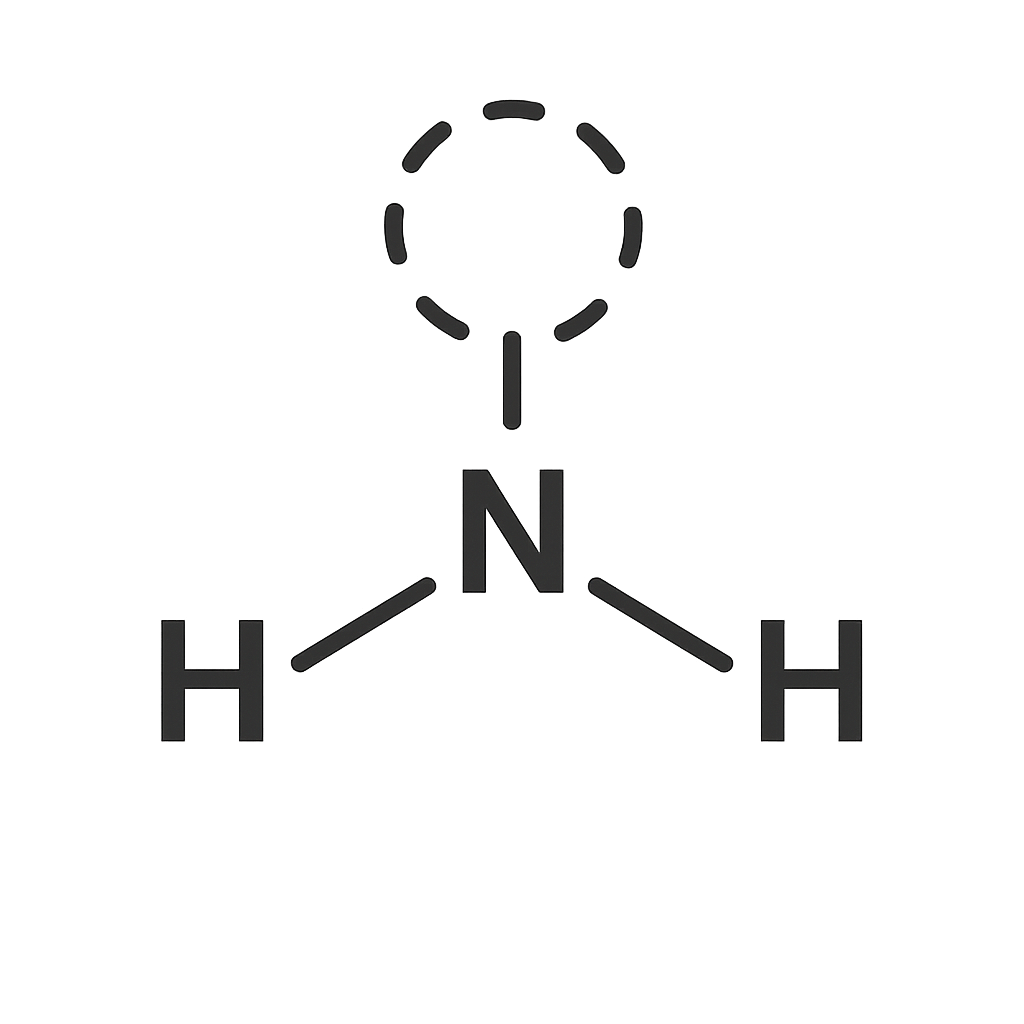
The diagram shows a molecule of ammonia (\( \mathrm{NH_3} \)) with nitrogen at the centre, three hydrogen atoms and one lone pair. Based on the diagram, state the hybridisation of the nitrogen atom and the approximate H-N-H bond angle.
A. sp² hybridisation, about 120°
B. sp hybridisation, about 180°
C. sp³ hybridisation, about 109.5°
Correct D. sp³ hybridisation, about 107°

Correct Answer: D

Want to see the full step-by-step solution? Unlock AI Explanation & Analytics
Question 22 View Details
A colourless liquid has molecular formula \( \mathrm{C_5H_{10}O} \), shows a strong IR absorption at \( 1715\ \mathrm{cm^{-1}} \) and reacts with NaBH₄ to give an optically active alcohol. Propose the IUPAC name of the original compound.
A. pentan‑3‑one
Correct B. pentan‑2‑one
C. hexan‑2‑one
D. pentan‑2‑ol

Correct Answer: B

Want to see the full step-by-step solution? Unlock AI Explanation & Analytics
Question 23 View Details
Using the average bond enthalpies given below, calculate the standard enthalpy change (\( \Delta H^\circ \)) for the complete combustion of propane (\( \mathrm{C_3H_8} \)) in oxygen: \( \mathrm{C_3H_8 + 5\ O_2 \rightarrow 3\ CO_2 + 4\ H_2O} \). Bond enthalpies (kJ mol⁻¹): C-C 347, C-H 413, O=O 498, C=O (in CO₂) 799, O-H 463.
A. -2105 kJ mol⁻¹
B. -1950 kJ mol⁻¹
Correct C. -2010 kJ mol⁻¹
D. -1800 kJ mol⁻¹

Correct Answer: C

Want to see the full step-by-step solution? Unlock AI Explanation & Analytics
Question 24 View Details
What is the hybridisation of the central atom in boron trifluoride (\( \mathrm{BF_3} \)) and what is the ideal bond angle between the B-F bonds?
A. sp hybridisation, 180°
B. sp² hybridisation, 90°
C. sp³ hybridisation, 109.5°
Correct D. sp² hybridisation, 120°

Correct Answer: D

Want to see the full step-by-step solution? Unlock AI Explanation & Analytics
Question 25 View Details
The oxide \( \mathrm{X_2O_5} \) decomposes on heating according to: \( \mathrm{X_2O_5 \rightarrow X_2O_3 + O_2} \), with a standard enthalpy change \( \Delta H^\circ = +150\ \mathrm{kJ\ mol^{-1}} \). The average X-O bond energy in \( \mathrm{X_2O_3} \) is \( 560\ \mathrm{kJ\ mol^{-1}} \), and the O=O bond energy in \( \mathrm{O_2} \) is \( 498\ \mathrm{kJ\ mol^{-1}} \). Assuming that the number of X-O bonds broken equals the number of oxygen atoms in \( \mathrm{X_2O_5} \) and that the number of X-O bonds formed equals the number of oxygen atoms in \( \mathrm{X_2O_3} \), calculate the average X-O bond energy in \( \mathrm{X_2O_5} \).
A. ≈ 420 kJ mol⁻¹
Correct B. ≈ 466 kJ mol⁻¹
C. ≈ 520 kJ mol⁻¹
D. ≈ 590 kJ mol⁻¹

Correct Answer: B

Want to see the full step-by-step solution? Unlock AI Explanation & Analytics

Master the Exam!

You've seen a preview, but there are thousands more questions plus AI tutor to break down complex solutions.

Unlock Full Access Available for Android & Windows
Help others prepare! Share this practice hub:
Chat with Support