gce model questions vol1 2022 chemistry | Objective

Prepare for your exams with gce model questions vol1 questions? Reviewing past/model questions is one of the most effective ways to guarantee a high score. This practice hub features authentic 2022 chemistry (Objective) questions designed to simulate the real exam environment.

Practice these randomly selected questions to test your readiness.

Question 1 View Details
A mixture containing 5.0 g of aluminium metal and 20.0 g of copper(II) sulphate pentahydrate is reacted according to (2Al + 3CuSO_4·5H_2O \rightarrow Al_2(SO_4)_3 + 3Cu + 5H_2O). The reaction gives a percent yield of 78 % for aluminium sulphate, \(Al_2(SO_4)_3\). Calculate the mass of copper metal actually produced.
A. 5.03 g
B. 4.21 g
C. 3.62 g
Correct D. 3.97 g

Correct Answer: D

Want to see the full step-by-step solution? Unlock AI Explanation & Analytics
Question 2 View Details
A 250.0 mL solution of 0.20 M sodium sulphate is mixed with 250.0 mL of 0.15 M barium chloride solution. Barium sulphate precipitates. Given \(K_{sp}(BaSO_4)=1.1\times10^{-10}\), calculate (a) the mass of \(BaSO_4\) formed, and (b) the concentration of \(Ba^{2+}\) remaining in the final solution.
A. Mass = 9.12 g; \([Ba^{2+}] = 3.9\times10^{-9}\) M
Correct B. Mass = 8.75 g; \([Ba^{2+}] = 4.4\times10^{-9}\) M
C. Mass = 7.95 g; \([Ba^{2+}] = 4.8\times10^{-9}\) M
D. Mass = 8.30 g; \([Ba^{2+}] = 5.1\times10^{-9}\) M

Correct Answer: B

Want to see the full step-by-step solution? Unlock AI Explanation & Analytics
Question 3 View Details
A hydrocarbon containing only carbon and hydrogen is completely combusted, producing 44.8 g of \(CO_2\) and 18.0 g of \(H_2O\). The hydrocarbon has a molar mass of 58.1 g mol⁻¹. (a) Determine its molecular formula, assuming it is an alkene. (b) Using the average bond enthalpies (kJ mol⁻¹): C=C 614, C-C 348, C-H 413, O=O 498, C=O (in \(CO_2\)) 799, O-H (in \(H_2O\)) 463, calculate the standard enthalpy change for its combustion.
A. Molecular formula: C₄H₁₀; \(\Delta H_{comb} = -2.05\times10^{3}\) kJ mol⁻¹ (≈ -2050 kJ mol⁻¹)
B. Molecular formula: C₅H₁₀; \(\Delta H_{comb} = -2.30\times10^{3}\) kJ mol⁻¹ (≈ -2300 kJ mol⁻¹)
Correct C. Molecular formula: C₄H₈; \(\Delta H_{comb} = -2.15\times10^{3}\) kJ mol⁻¹ (≈ -2146 kJ mol⁻¹)
D. Molecular formula: C₃H₆; \(\Delta H_{comb} = -1.95\times10^{3}\) kJ mol⁻¹ (≈ -1950 kJ mol⁻¹)

Correct Answer: C

Want to see the full step-by-step solution? Unlock AI Explanation & Analytics
Question 4 View Details
Ten grams of ammonia are reacted with excess copper(II) oxide according to \(2NH_3 + 3CuO \rightarrow 3Cu + N_2 + 3H_2O\). The nitrogen gas produced is collected over water at 25 °C, total pressure 750 mmHg, water vapour pressure 23.8 mmHg, and occupies 0.85 L. Determine the percent yield of \(N_2\) based on the theoretical yield.
A. 20.0 %
Correct B. 11.3 %
C. 9.8 %
D. 15.6 %

Correct Answer: B

Want to see the full step-by-step solution? Unlock AI Explanation & Analytics
Question 5 View Details
In an esterification, 5.0 g of acetic acid (\(CH_3COOH\)) are mixed with 4.5 g of ethanol (\(C_2H_5OH\)) in the presence of excess sulphuric acid catalyst. The reaction forms ethyl acetate (\(CH_3COOC_2H_5\)) and water. Assuming an 80 % isolated yield, calculate (a) the mass of ethyl acetate obtained and (b) the volume of ethyl acetate produced, given its density is 0.902 g mL⁻¹.
A. Mass = 6.61 g; Volume = 7.3 mL
B. Mass = 5.14 g; Volume = 5.7 mL
C. Mass = 7.34 g; Volume = 8.1 mL
Correct D. Mass = 5.87 g; Volume = 6.5 mL

Correct Answer: D

Want to see the full step-by-step solution? Unlock AI Explanation & Analytics
Question 6 View Details
A 10.0 g sample of iron filings is mixed with excess chlorine gas. Due to surface oxidation, only 85% of the iron actually reacts according to \(2\,\text{Fe} + 3\,\text{Cl}_2 \rightarrow 2\,\text{FeCl}_3\). The FeCl\(_3\) formed is later crystallised and a 90% mass recovery is obtained. Calculate the mass of FeCl\(_3\) finally obtained (in grams, three significant figures).
A. 24.6 g
B. 20.0 g
C. 19.8 g
Correct D. 22.2 g

Correct Answer: D

Want to see the full step-by-step solution? Unlock AI Explanation & Analytics
Question 7 View Details
A hydrocarbon is combusted completely. From 1.16 g of the hydrocarbon, 3.52 g of CO\(_2\) and 1.80 g of H\(_2\)O are produced. (a) Determine its molecular formula, given that its molar mass is 58 g·mol⁻¹. (b) Using the molecular formula, calculate the volume of O\(_2\) (at STP, 22.4 L·mol⁻¹) required to combust 2.00 g of the hydrocarbon.
A. Molecular formula: C₃H₈; O₂ volume: 4.20 L
B. Molecular formula: C₅H₁₂; O₂ volume: 5.68 L
C. Molecular formula: C₄H₈; O₂ volume: 4.75 L
Correct D. Molecular formula: C₄H₁₀; O₂ volume: 5.01 L

Correct Answer: D

Want to see the full step-by-step solution? Unlock AI Explanation & Analytics
Question 8 View Details
A galvanic cell is set up as \(\text{Zn(s)}|\text{Zn}^{2+}(0.010\,\text{M})\,||\,\text{Cu}^{2+}(0.10\,\text{M})|\text{Cu(s)}\) at 25 °C. Standard potentials: \(E^{\circ}(\text{Zn}^{2+}/\text{Zn}) = -0.76\,\text{V}\), \(E^{\circ}(\text{Cu}^{2+}/\text{Cu}) = +0.34\,\text{V}\). (a) Calculate the cell EMF under the given concentrations using the Nernst equation. (b) If the cell delivers a constant current of 0.50 A for 2.00 h, what mass of copper is deposited on the cathode, assuming a current efficiency of 95%? Give your answer in grams to three significant figures.
A. EMF = 1.20 V; Cu deposited = 1.25 g
B. EMF = 0.96 V; Cu deposited = 0.95 g
Correct C. EMF = 1.13 V; Cu deposited = 1.13 g
D. EMF = 1.13 V; Cu deposited = 0.85 g

Correct Answer: C

Want to see the full step-by-step solution? Unlock AI Explanation & Analytics
Question 9 View Details
Ethanol (M = 46.07 g·mol⁻¹) is oxidised to acetaldehyde (M = 44.05 g·mol⁻¹) using pyridinium chlorochromate (PCC, M = 322.9 g·mol⁻¹). In a laboratory experiment, 5.00 g of ethanol is reacted with 20.0 g of PCC (excess). The reaction proceeds with 1:1 stoichiometry (1 mol ethanol : 1 mol PCC). After work‑up, 3.20 g of acetaldehyde is isolated, corresponding to a 67% overall recovery. (a) Calculate the theoretical mass of acetaldehyde that could be formed from the given ethanol. (b) Determine the overall percent yield based on the isolated mass. (c) If the oxidation were instead carried out with acidic dichromate (Cr₂O₇²⁻) in aqueous solution, 10% of the ethanol would be converted to ethanoic acid (M = 60.05 g·mol⁻¹) and the remaining ethanol would be fully converted to acetaldehyde, with 100% isolation of the acetaldehyde. What mass of acetaldehyde would be obtained in this alternative method? Compare the two methods.
Correct A. Theoretical mass = 4.78 g; overall yield = 67%; dichromate method gives 4.30 g acetaldehyde (≈1.10 g more than PCC).
B. Theoretical mass = 5.00 g; overall yield = 64%; dichromate method gives 4.10 g acetaldehyde (≈0.90 g more than PCC)
C. Theoretical mass = 4.78 g; overall yield = 70%; dichromate method gives 4.50 g acetaldehyde (≈0.70 g more than PCC)
D. Theoretical mass = 4.60 g; overall yield = 67%; dichromate method gives 3.90 g acetaldehyde (≈0.80 g less than PCC)

Correct Answer: A

Want to see the full step-by-step solution? Unlock AI Explanation & Analytics
Question 10 View Details
For the molecule methane, CH\(_4\), state the hybridisation of the carbon atom and the approximate H-C-H bond angle.
A. sp³ hybridisation; bond angle ≈ 90°
B. sp² hybridisation; bond angle ≈ 120°
Correct C. sp³ hybridisation; bond angle ≈ 109.5°
D. sp hybridisation; bond angle ≈ 180°

Correct Answer: C

Want to see the full step-by-step solution? Unlock AI Explanation & Analytics
Question 11 View Details
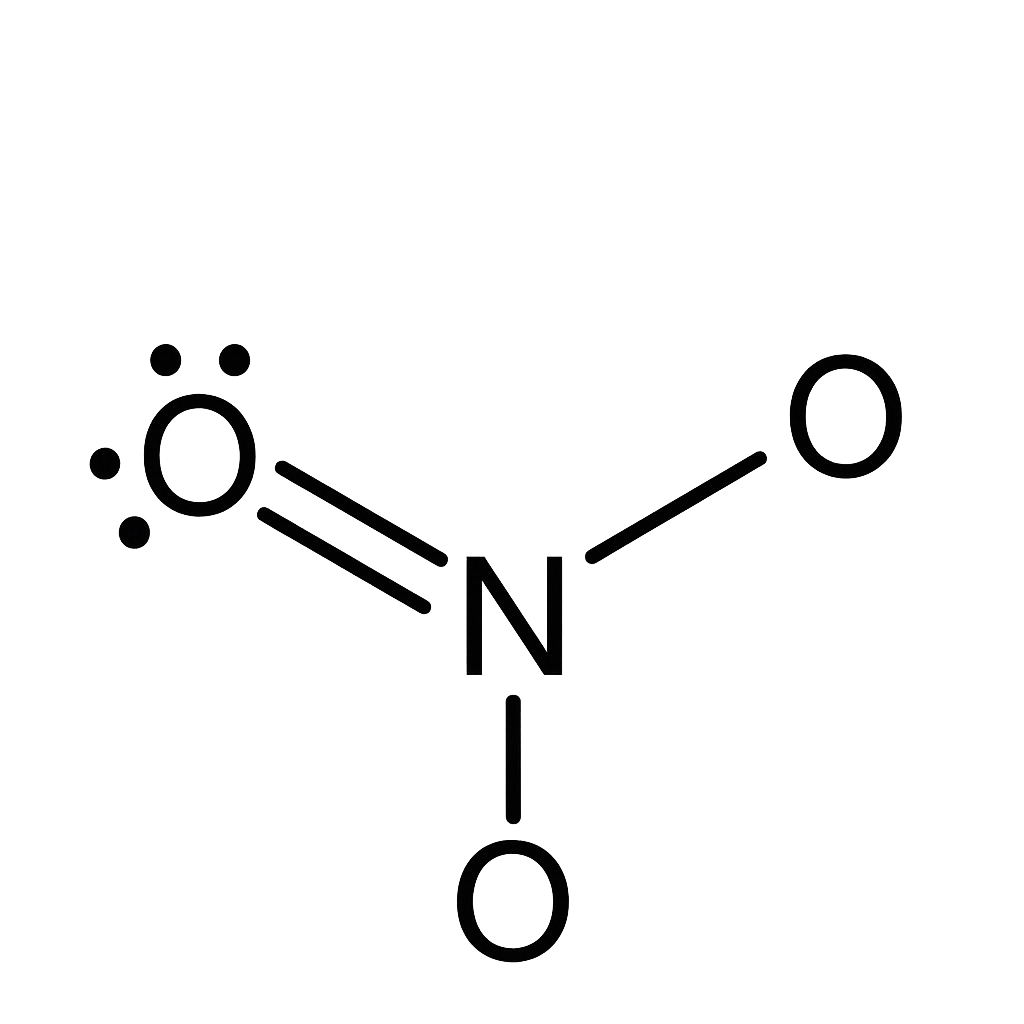
The diagram shows the Lewis structure of the nitrite ion \( \mathrm{NO_2^-} \). Using the diagram, calculate the formal charge on the nitrogen atom.
A. +1
B. -1
Correct C. 0
D. -2

Correct Answer: C

Want to see the full step-by-step solution? Unlock AI Explanation & Analytics
Question 12 View Details
A 25.0 cm³ sample of an aqueous solution of \( \mathrm{Fe^{2+}} \) is titrated with 0.100 mol dm⁻³ \( \mathrm{KMnO_4} \) solution. In acidic medium the reaction is\n\[ \mathrm{MnO_4^- + 5 Fe^{2+} + 8 H^+ \rightarrow Mn^{2+} + 5 Fe^{3+} + 4 H_2O} \]\nThe volume of \( \mathrm{KMnO_4} \) required to reach the endpoint is 18.2 cm³.\n(a) Calculate the concentration of \( \mathrm{Fe^{2+}} \) in the original sample.\n(b) If the original sample was prepared by dissolving an unknown mass of ferrous ammonium sulfate hexahydrate \( \mathrm{(NH_4)_2Fe(SO_4)_2·6H_2O} \) in 250.0 cm³ water, determine the mass of the salt present.
A. 0.280 mol dm⁻³; 28.0 g
B. 0.312 mol dm⁻³; 30.2 g
C. 0.400 mol dm⁻³; 38.5 g
Correct D. 0.364 mol dm⁻³; 35.7 g

Correct Answer: D

Want to see the full step-by-step solution? Unlock AI Explanation & Analytics
Question 13 View Details
A solution contains 0.050 mol of benzoic acid \( \mathrm{C_6H_5COOH} \) and 0.075 mol of sodium benzoate in 1.00 L of water. The solution is titrated with 0.200 mol dm⁻³ \( \mathrm{HCl} \) until the pH drops to 3.00. (a) Calculate the pH of the original buffer solution (use \(pK_a = 4.20\) for benzoic acid). (b) Determine the volume of \( \mathrm{HCl} \) required to reach pH 3.00. (c) After the addition, calculate the new concentrations of benzoic acid and benzoate, and state which species is now in excess.
A. Original pH = 4.10; HCl volume = 250 mL; [HA] ≈ 0.075 M, [A⁻] ≈ 0.018 M (benzoate in excess)
B. Original pH = 4.55; HCl volume = 400 mL; [HA] ≈ 0.095 M, [A⁻] ≈ 0.0040 M (benzoic acid in excess)
Correct C. Original pH = 4.38; HCl volume = 338 mL; [HA] ≈ 0.088 M, [A⁻] ≈ 0.0055 M (benzoic acid in excess)
D. Original pH = 3.90; HCl volume = 150 mL; [HA] ≈ 0.060 M, [A⁻] ≈ 0.012 M (benzoate in excess)

Correct Answer: C

Want to see the full step-by-step solution? Unlock AI Explanation & Analytics
Question 14 View Details
Write the ground‑state electron configuration of the \( \mathrm{Cr^{3+}} \) ion and state how many unpaired electrons it contains.
Correct A. [Ar] 3d³; 3
B. [Ar] 3d⁴; 4
C. [Ar] 4s¹ 3d³; 3
D. [Ar] 3d²; 2

Correct Answer: A

Want to see the full step-by-step solution? Unlock AI Explanation & Analytics
Question 15 View Details
A solution is prepared by dissolving 5.00 g of a non‑volatile solute (molar mass 180 g mol⁻¹) in 200.0 g of water. The boiling‑point elevation constant for water is \(K_b = 0.512\,^{\circ}\!\text{C\,kg\,mol}^{-1}\).\n(a) Calculate the elevation in boiling point of the solution.\n(b) If the solution is then cooled until it freezes at \(-2.0^{\circ}\!\text{C}\), determine the molality of the solute in the liquid phase assuming the freezing‑point depression constant for water is \(K_f = 1.86\,^{\circ}\!\text{C\,kg\,mol}^{-1}\).\n(c) Discuss whether the solute is likely to be an electrolyte based on the results.
A. ΔTb = 0.14 °C; i ≈ 3.9 (suggests weak electrolyte)
Correct B. ΔTb = 0.07 °C; i ≈ 7.7 (suggests strong electrolyte or error)
C. ΔTb = 0.09 °C; i ≈ 9.2 (suggests very strong electrolyte)
D. ΔTb = 0.05 °C; i ≈ 5.5 (suggests moderate electrolyte)

Correct Answer: B

Want to see the full step-by-step solution? Unlock AI Explanation & Analytics
Question 16 View Details
A 0.500 g sample of an unknown monoprotic carboxylic acid is dissolved in 250.0 mL of water. The initial pH of the solution is 2.85. The solution is then titrated with 0.100 M NaOH. The volume of NaOH required to raise the pH to 5.85 is 18.2 mL. Assuming activity coefficients are unity, determine the molar mass of the acid (in g mol\(^{-1}\)).
A. 250 g mol⁻¹
Correct B. 274 g mol⁻¹
C. 300 g mol⁻¹
D. 215 g mol⁻¹

Correct Answer: B

Want to see the full step-by-step solution? Unlock AI Explanation & Analytics
Question 17 View Details
The standard enthalpies of formation (Δ_fH°) of three binary oxides are: N₂O₅ : -11.3 kJ mol\(^{-1}\); P₄O₁₀ : -2984 kJ mol\(^{-1}\); SO₃ : -395.7 kJ mol\(^{-1}\). For each oxide (i) write the balanced reduction reaction to the element and O₂(g), (ii) calculate the enthalpy change per mole of O₂ released, and (iii) state which oxide is the strongest oxidising agent on a per‑O₂ basis.
A. CO₂ (carbon dioxide) is the strongest oxidising agent per O₂ released.
B. SO₃ (sulfur trioxide) is the strongest oxidising agent per O₂ released.
Correct C. P₄O₁₀ (phosphorus pentoxide) is the strongest oxidising agent per O₂ released.
D. N₂O₅ (dinitrogen pentoxide) is the strongest oxidising agent per O₂ released.

Correct Answer: C

Want to see the full step-by-step solution? Unlock AI Explanation & Analytics
Question 18 View Details
The liquid-vapour equilibrium of a substance obeys the Clausius-Clapeyron relation with a constant enthalpy of vaporisation over the temperature range considered. At 350 K the vapour pressure is 0.80 atm and at 370 K it is 1.20 atm. Its solid-vapour equilibrium also follows the same relation with a constant enthalpy of sublimation. At 300 K the sublimation pressure is 0.10 atm and at 320 K it is 0.25 atm. Using R = 8.314 J mol\(^{-1}\) K\(^{-1}\), calculate (i) the enthalpy of vaporisation ΔHvap, (ii) the enthalpy of sublimation ΔHsub, both in kJ mol\(^{-1}\), and (iii) the enthalpy of fusion ΔHfus.
A. ΔHvap ≈ 24.5 kJ mol⁻¹; ΔHsub ≈ 38.2 kJ mol⁻¹; ΔHfus ≈ 13.5 kJ mol⁻¹
B. ΔHvap ≈ 22.3 kJ mol⁻¹; ΔHsub ≈ 40.1 kJ mol⁻¹; ΔHfus ≈ 12.0 kJ mol⁻¹
C. ΔHvap ≈ 19.0 kJ mol⁻¹; ΔHsub ≈ 34.0 kJ mol⁻¹; ΔHfus ≈ 15.2 kJ mol⁻¹
Correct D. ΔHvap ≈ 21.8 kJ mol⁻¹; ΔHsub ≈ 36.6 kJ mol⁻¹; ΔHfus ≈ 14.8 kJ mol⁻¹

Correct Answer: D

Want to see the full step-by-step solution? Unlock AI Explanation & Analytics
Question 19 View Details
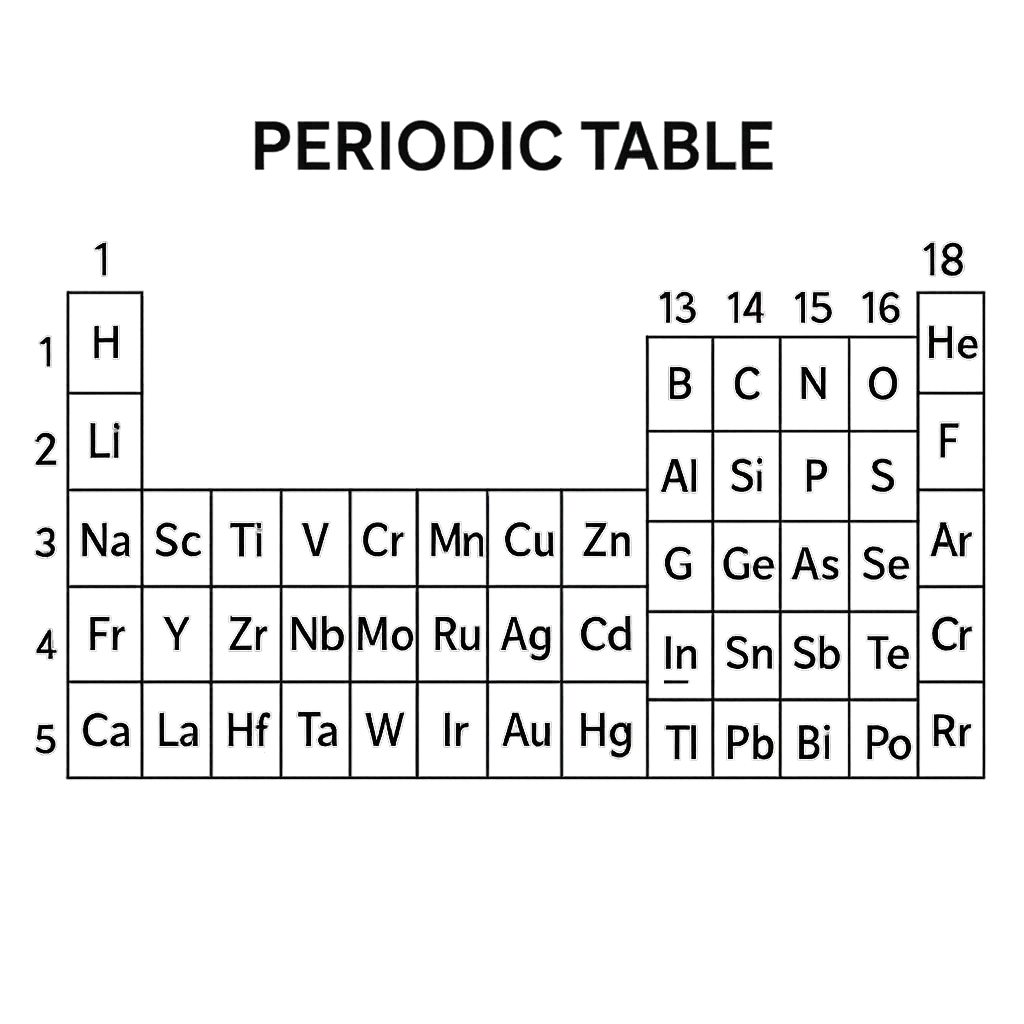
The diagram shows a segment of the periodic table containing elements with atomic numbers 1 to 18, together with their groups and periods. Which element is located in period 3 and group 16? State its chemical symbol and atomic number.
A. Se, 34
Correct B. S, 16
C. Cl, 17
D. O, 8

Correct Answer: B

Want to see the full step-by-step solution? Unlock AI Explanation & Analytics
Question 20 View Details
A 0.500 L solution contains 0.050 mol of the weak acid HA (Ka = 1.8 × 10\(^{-5}\)). It is titrated with 0.10 M NaOH. (a) After adding 20.0 mL of NaOH, calculate the pH of the mixture. (b) After enough NaOH has been added to reach the equivalence point, the total volume is adjusted to 1.00 L. Calculate the pH at the equivalence point.
Correct A. pH after 20 mL NaOH ≈ 3.36; pH at equivalence ≈ 8.72
B. pH after 20 mL NaOH ≈ 3.10; pH at equivalence ≈ 8.50
C. pH after 20 mL NaOH ≈ 3.80; pH at equivalence ≈ 9.00
D. pH after 20 mL NaOH ≈ 3.20; pH at equivalence ≈ 8.30

Correct Answer: A

Want to see the full step-by-step solution? Unlock AI Explanation & Analytics
Question 21 View Details
A 1.00 L solution contains 0.250 mol of acetic acid \(\mathrm{CH_3COOH}\) and 0.150 mol of sodium acetate \(\mathrm{CH_3COONa}\). The acid dissociation constant is \(K_a = 1.8 \times 10^{-5}\). (a) Calculate the initial pH of the solution. (b) After adding 0.050 mol of \(\mathrm{HCl}\) to the solution, what is the new pH? Assume the volume change is negligible.
Correct A. 4.52, 4.26
B. 4.60, 4.20
C. 4.78, 4.12
D. 4.45, 4.31

Correct Answer: A

Want to see the full step-by-step solution? Unlock AI Explanation & Analytics
Question 22 View Details
Ethanoic acid \(\mathrm{CH_3COOH}\) reacts with ethanol \(\mathrm{C_2H_5OH}\) to give ethyl acetate \(\mathrm{CH_3COOC_2H_5}\) and water. At 25 °C the equilibrium constant is \(K_c = 4.0\). In a 1.00 L flask 0.500 mol of each reactant are mixed. (a) Determine the equilibrium concentrations of all species. (b) The reaction enthalpy is \(\Delta H^{\circ}=+8.0\ \text{kJ mol}^{-1}\). Estimate the new equilibrium constant at 35 °C using the van't Hoff equation (assume \(\Delta H^{\circ}\) is constant). (c) Using the new \(K_c\) value, calculate the equilibrium concentration of ethyl acetate at 35 °C.
A. 0.180 M CH₃COOH, 0.180 M C₂H₅OH, 0.320 M CH₃COOC₂H₅, 0.320 M H₂O; Kc(35°C)≈4.60; [CH₃COOC₂H₅]≈0.330 M
B. 0.160 M CH₃COOH, 0.160 M C₂H₅OH, 0.340 M CH₃COOC₂H₅, 0.340 M H₂O; Kc(35°C)≈4.80; [CH₃COOC₂H₅]≈0.345 M
C. 0.150 M CH₃COOH, 0.150 M C₂H₅OH, 0.350 M CH₃COOC₂H₅, 0.350 M H₂O; Kc(35°C)≈4.20; [CH₃COOC₂H₅]≈0.350 M
Correct D. 0.167 M CH₃COOH, 0.167 M C₂H₅OH, 0.333 M CH₃COOC₂H₅, 0.333 M H₂O; Kc(35 °C)≈4.44; [CH₃COOC₂H₅]≈0.339 M

Correct Answer: D

Want to see the full step-by-step solution? Unlock AI Explanation & Analytics
Question 23 View Details
A 250.0 mL solution contains 0.0250 mol of \(\mathrm{Fe^{2+}}\). It is titrated with 0.0200 M \(\mathrm{KMnO_4}\) in acidic medium. The net reaction is \(\mathrm{MnO_4^- + 5 Fe^{2+} + 8 H^+ \rightarrow Mn^{2+} + 5 Fe^{3+} + 4 H_2O}\). (a) Calculate the volume of \(\mathrm{KMnO_4}\) solution required to reach the equivalence point. (b) If an additional 5.00 mL of the \(\mathrm{KMnO_4}\) solution is added beyond equivalence, determine the concentration of excess \(\mathrm{MnO_4^-}\) in the mixture. (c) The lake initially contains \(0.100\) M \(\mathrm{H_2SO_4}\). The titration consumes 8 mol of \(\mathrm{H^+}\) per mole of \(\mathrm{MnO_4^-}\). Calculate the pH of the solution after the excess \(\mathrm{KMnO_4}\) has been added.
A. 260.0 mL; 2.10×10⁻⁴ M; pH ≈ 1.68
B. 245.0 mL; 1.85×10⁻⁴ M; pH ≈ 1.80
C. 250.0 mL; 2.20×10⁻⁴ M; pH ≈ 1.60
Correct D. 250.0 mL; 1.98×10⁻⁴ M; pH ≈ 1.74

Correct Answer: D

Want to see the full step-by-step solution? Unlock AI Explanation & Analytics
Question 24 View Details
2‑Bromo‑2‑methylpropane \(\mathrm{(CH_3)_3CBr}\) reacts with aqueous \(\mathrm{NaOH}\) under SN1 conditions. (a) Write the mechanism and name the carbocation intermediate. (b) Predict the major product(s) and justify the outcome. (c) Ten grams of the substrate are reacted with excess \(\mathrm{NaOH}\) and 3.20 g of product is isolated. Calculate the percentage yield.
A. ≈ 52 % yield
Correct B. ≈ 59 % yield
C. ≈ 70 % yield
D. ≈ 45 % yield

Correct Answer: B

Want to see the full step-by-step solution? Unlock AI Explanation & Analytics
Question 25 View Details
A lake of volume \(5.0\times10^{6}\) m³ initially contains nitrate at \(0.050\) mg L⁻¹. A runoff event adds 2000 m³ of water with nitrate concentration \(0.300\) mg L⁻¹. (a) Calculate the nitrate concentration in the lake after complete mixing. (b) Nitrate removal follows first‑order kinetics with rate constant \(k = 1.5\times10^{-6}\) s⁻¹. How long (in days) will it take for the concentration to fall from the mixed value to \(0.040\) mg L⁻¹? (c) A point‑source discharge adds \(2.0\times10^{5}\) mol of ammonium per day, which is fully nitrified to nitrate (1 mol NH₄⁺ → 1 mol NO₃⁻). Assuming the lake is perfectly mixed and no other losses, what is the daily increase in nitrate concentration (mg L⁻¹ day⁻¹) caused by this source? (d) Briefly state which of the three influences (runoff, bioremediation, point source) has the greatest impact on lake nitrate levels.
A. a) 0.049 mg L⁻¹; b) ≈ 0.9 days; c) 3.12 mg L⁻¹ day⁻¹; d) bioremediation has the greatest impact
Correct B. a) 0.0501 mg L⁻¹; b) ≈ 1.7 days; c) 2.48 mg L⁻¹ day⁻¹; d) point source has the greatest impact
C. a) 0.051 mg L⁻¹; b) ≈ 2.5 days; c) 1.24 mg L⁻¹ day⁻¹; d) runoff has the greatest impact
D. a) 0.052 mg L⁻¹; b) ≈ 3.0 days; c) 0.62 mg L⁻¹ day⁻¹; d) point source has the greatest impact

Correct Answer: B

Want to see the full step-by-step solution? Unlock AI Explanation & Analytics

Master the Exam!

You've seen a preview, but there are thousands more questions plus AI tutor to break down complex solutions.

Unlock Full Access Available for Android & Windows
Help others prepare! Share this practice hub:
Chat with Support