gce model questions vol1 2021 chemistry | Objective

Prepare for your exams with gce model questions vol1 questions? Reviewing past/model questions is one of the most effective ways to guarantee a high score. This practice hub features authentic 2021 chemistry (Objective) questions designed to simulate the real exam environment.

Practice these randomly selected questions to test your readiness.

Question 1 View Details
A diatomic molecule XY has a measured dipole moment of \(2.5\ \text{D}\) and a bond length of \(150\ \text{pm}\). Assuming the dipole arises solely from partial ionic charge transfer, calculate the percentage ionic character of the XY bond. (Use \(1\ \text{D}=3.336\times10^{-30}\ \text{C·m}\) and elementary charge \(e=1.602\times10^{-19}\ \text{C}\). Based on the percentage, state whether the bond is predominantly ionic or covalent (consider >50 % ionic as predominantly ionic).
Correct A. 34.7 % ionic character; the bond is predominantly covalent
B. 52.3 % ionic character; the bond is predominantly ionic
C. 28.9 % ionic character; the bond is predominantly covalent
D. 45.2 % ionic character; the bond is predominantly ionic

Correct Answer: A

Want to see the full step-by-step solution? Unlock AI Explanation & Analytics
Question 2 View Details
In the esterification of 2‑butanol with acetic acid catalysed by \(\mathrm{H_2SO_4}\), the reaction is: \(\mathrm{C_4H_9OH + CH_3COOH \rightleftharpoons C_4H_9OCOCH_3 + H_2O}\). Initially \(0.10\ \text{mol}\) of 2‑butanol and \(0.12\ \text{mol}\) of acetic acid are placed in a \(1.0\ \text{L}\) flask. At \(25\ ^\circ\text{C}\) the equilibrium constant \(K_c\) for the reaction is 4.0. Assuming ideal behaviour, calculate (a) the equilibrium amount of butyl acetate formed (in moles) and (b) the percentage yield based on the limiting reagent.
A. 0.065 mol ester formed; 65 % yield
B. 0.058 mol ester formed; 58 % yield
C. 0.084 mol ester formed; 84 % yield
Correct D. 0.072 mol ester formed; 72 % yield

Correct Answer: D

Want to see the full step-by-step solution? Unlock AI Explanation & Analytics
Question 3 View Details
A buffer solution is prepared by dissolving \(0.20\ \text{mol}\) of acetic acid (\(\mathrm{CH_3COOH}\)) and \(0.15\ \text{mol}\) of sodium acetate (\(\mathrm{CH_3COONa}\)) in \(1.0\ \text{L}\) of water. The acid dissociation constant is \(K_a = 1.8\times10^{-5}\). (a) Calculate the initial pH of the buffer. (b) How many moles of \(0.10\ \text{M}\) HCl must be added to lower the pH to 4.50? (c) After the addition, what is the new ratio \([\mathrm{A^-}]/[\mathrm{HA}]\) in the solution?
A. Initial pH = 4.80; add 0.0250 mol HCl; new ratio [A⁻]/[HA] = 0.62
Correct B. Initial pH = 4.62; add 0.0228 mol HCl; new ratio [A⁻]/[HA] = 0.571
C. Initial pH = 4.45; add 0.0185 mol HCl; new ratio [A⁻]/[HA] = 0.45
D. Initial pH = 4.30; add 0.0200 mol HCl; new ratio [A⁻]/[HA] = 0.50

Correct Answer: B

Want to see the full step-by-step solution? Unlock AI Explanation & Analytics
Question 4 View Details
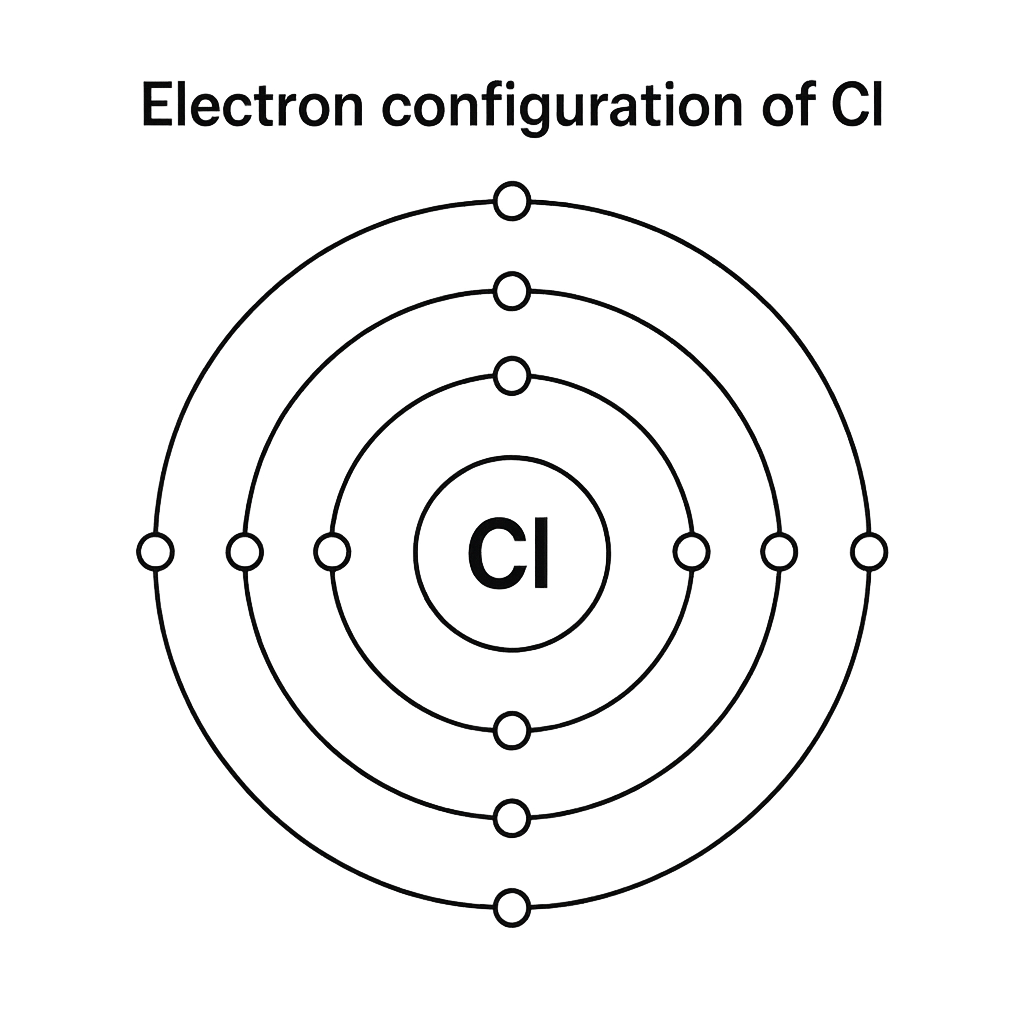
The diagram shows the Bohr model of a chlorine atom (atomic number 17) with electrons distributed in shells as indicated. Using the diagram, state (a) the number of valence electrons of chlorine and (b) the common oxidation states it can exhibit.
A. 6 valence electrons; common oxidation states: -2, +2, +4, +6
B. 8 valence electrons; common oxidation states: -1, +2, +4, +6
Correct C. 7 valence electrons; common oxidation states: -1, +1, +3, +5, +7
D. 7 valence electrons; common oxidation states: -2, +2, +4, +6

Correct Answer: C

Want to see the full step-by-step solution? Unlock AI Explanation & Analytics
Question 5 View Details
Consider the galvanic cell: \(\text{Zn(s)}\ |\ \text{Zn}^{2+}(0.010\ \text{M})\ \|\ \text{Cu}^{2+}(0.10\ \text{M})\ |\ \text{Cu(s)}\). Standard reduction potentials are \(E^{\circ}(\text{Zn}^{2+}/\text{Zn}) = -0.76\ \text{V}\) and \(E^{\circ}(\text{Cu}^{2+}/\text{Cu}) = +0.34\ \text{V}\). (a) Calculate the cell potential at \(25\ ^\circ\text{C}\) using the Nernst equation. (b) Determine the equilibrium constant \(K\) for the overall cell reaction.
Correct A. E = 1.13 V; K ≈ 1.6×10^{37}
B. E = 0.98 V; K ≈ 3.2×10^{30}
C. E = 0.85 V; K ≈ 2.1×10^{25}
D. E = 1.25 V; K ≈ 5.0×10^{40}

Correct Answer: A

Want to see the full step-by-step solution? Unlock AI Explanation & Analytics
Question 6 View Details
A sample of a carboxylic acid with molecular formula \(\mathrm{C_7H_6O_2}\) is reduced with excess LiAlH\(_4\) in dry ether. In addition to the expected primary alcohol, 10 % of the acid undergoes decarboxylation to give an alkane. Starting with 5.00 g of the acid, calculate (a) the identity of the acid and the two organic products, and (b) the masses of the alcohol and the alkane obtained (to two significant figures).
A. Phenylacetic acid; phenylmethanol 3.5 g; toluene 0.45 g
B. Benzoic acid; benzyl alcohol 3.98 g; ethylbenzene 0.38 g
C. Benzoic acid; benzyl alcohol 4.2 g; toluene 0.30 g
Correct D. Benzoic acid; benzyl alcohol 3.98 g; toluene 0.38 g

Correct Answer: D

Want to see the full step-by-step solution? Unlock AI Explanation & Analytics
Question 7 View Details
A 250 mL solution of a weak monoprotic acid HA has an initial pH of 3.00. After adding 0.010 mol of NaOH, the pH becomes 8.00. Determine (a) the acid dissociation constant \(K_a\) of HA and (b) the base dissociation constant \(K_b\) of its conjugate base \(A^-\).
A. Ka = 3.3×10⁻⁵, Kb = 3.0×10⁻¹⁰
Correct B. Ka = 2.5×10⁻⁵, Kb = 4.0×10⁻¹⁰
C. Ka = 5.0×10⁻⁶, Kb = 2.0×10⁻⁹
D. Ka = 1.2×10⁻⁴, Kb = 8.3×10⁻¹¹

Correct Answer: B

Want to see the full step-by-step solution? Unlock AI Explanation & Analytics
Question 8 View Details
When the alkene \(\mathrm{C_5H_{10}}\) is hydrogenated with \(\mathrm{H_2}\) to give the alkane \(\mathrm{C_5H_{12}}\), the enthalpy change is \(-120\ \text{kJ mol}^{-1}\). Using the average bond enthalpies \(E_{\mathrm{C=C}} = X\ \text{kJ mol}^{-1}\) (unknown), \(E_{\mathrm{C-C}} = 347\ \text{kJ mol}^{-1}\), \(E_{\mathrm{C-H}} = 413\ \text{kJ mol}^{-1}\) and \(E_{\mathrm{H-H}} = 436\ \text{kJ mol}^{-1}\), calculate the experimental bond enthalpy of the C=C bond in this alkene.
A. 590 kJ mol⁻¹
B. 660 kJ mol⁻¹
Correct C. 617 kJ mol⁻¹
D. 630 kJ mol⁻¹

Correct Answer: C

Want to see the full step-by-step solution? Unlock AI Explanation & Analytics
Question 9 View Details
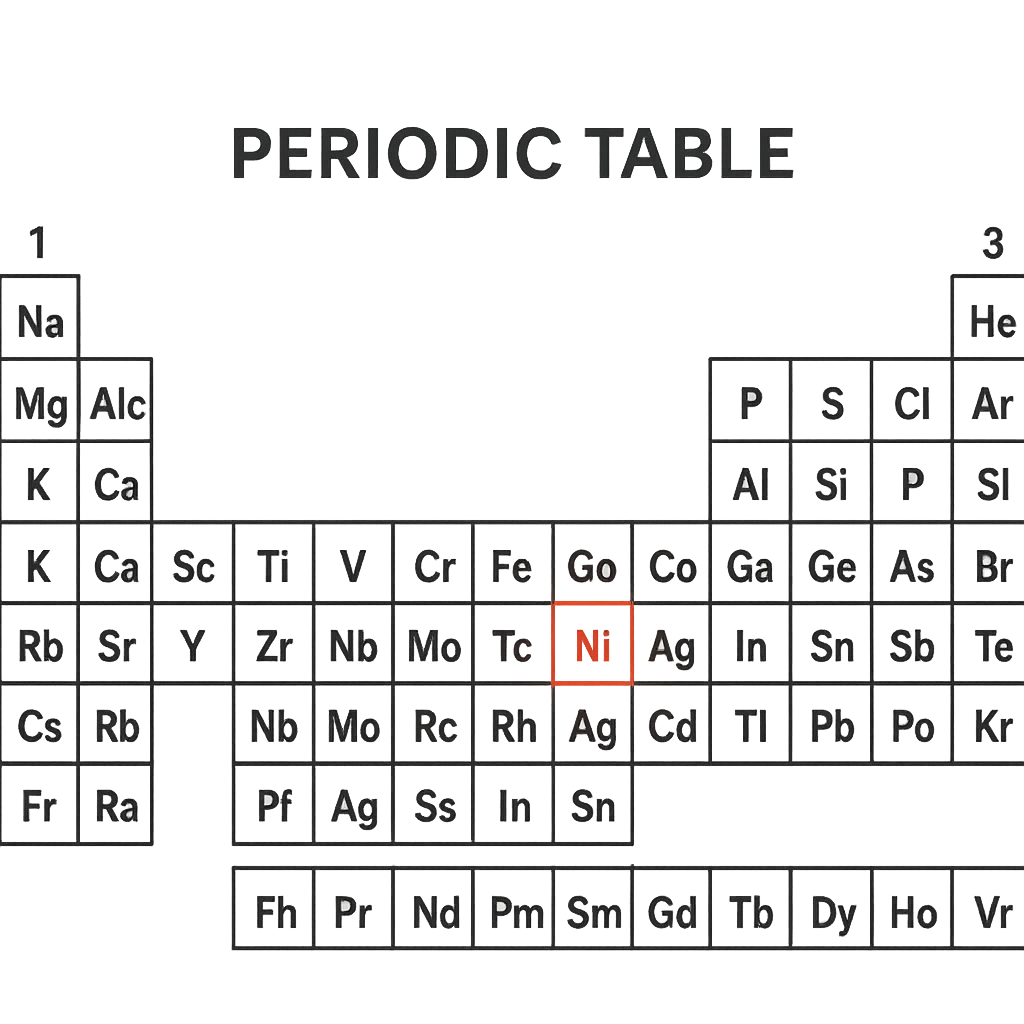
The diagram shows a portion of the periodic table. The element highlighted in red lies in period 4 and group 10. What is the chemical symbol of this element?
A. Co
Correct B. Ni
C. Cu
D. Zn

Correct Answer: B

Want to see the full step-by-step solution? Unlock AI Explanation & Analytics
Question 10 View Details
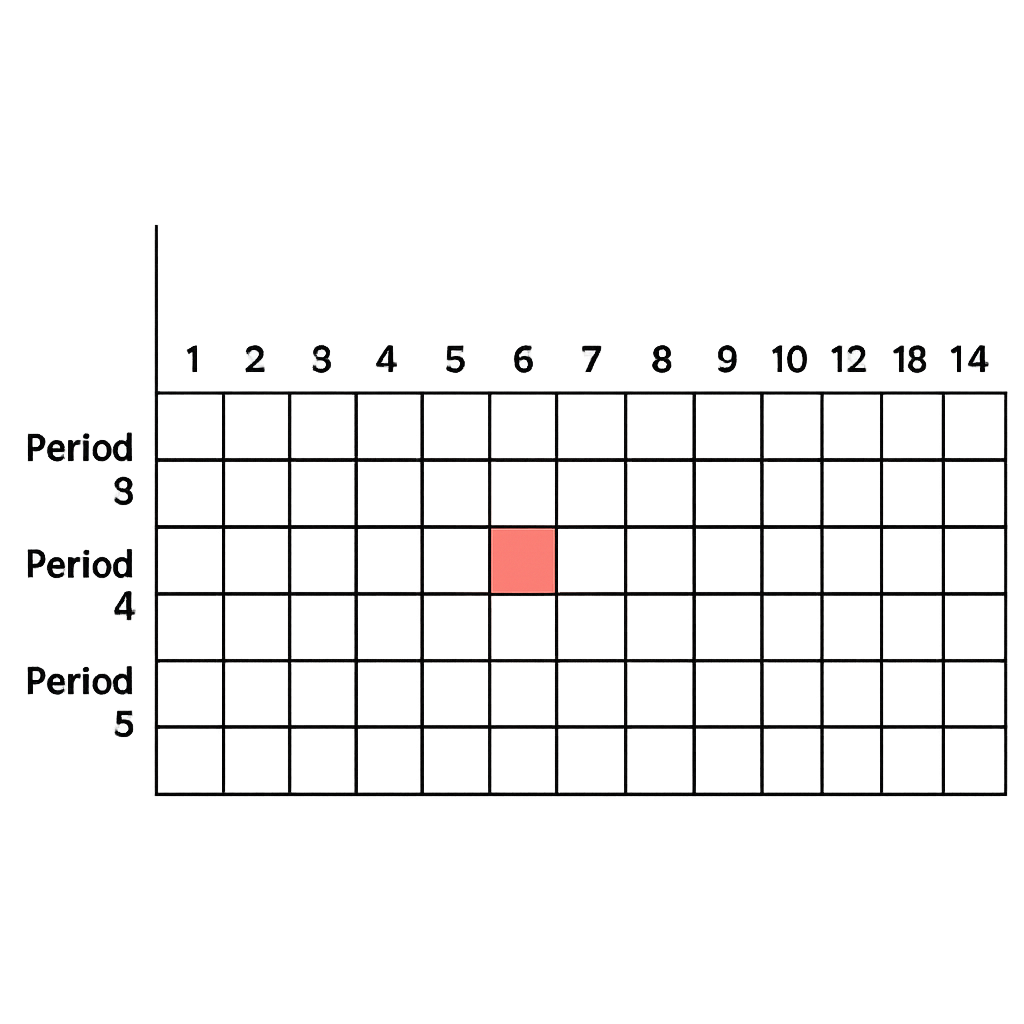
In the diagram of the periodic table, the element located at the intersection of the d‑block, period 4 and group 11 is highlighted. State the chemical symbol of this element.
A. Au
B. Ag
Correct C. Cu
D. Ni

Correct Answer: C

Want to see the full step-by-step solution? Unlock AI Explanation & Analytics
Question 11 View Details
In one molecule of carbon dioxide, ( mathrm{CO_{2}} ), each carbon‑oxygen double bond consists of one sigma bond and one pi bond. How many sigma bonds are present in a single ( mathrm{CO_{2}} \) molecule?
A. 1
B. 3
Correct C. 2
D. 4

Correct Answer: C

Want to see the full step-by-step solution? Unlock AI Explanation & Analytics
Question 12 View Details
The balanced equation for the reaction of aluminium with chlorine gas is \( 2\,\mathrm{Al} + 3\,\mathrm{Cl_{2}} \rightarrow 2\,\mathrm{AlCl_{3}} \). If \(5.0\) g of aluminium reacts with excess chlorine, calculate (a) the mass of aluminium chloride produced and (b) the volume of chlorine gas at STP that would be required for the reaction.
Correct A. 24.7 g of AlCl₃ and 6.22 L of Cl₂
B. 24.7 g of AlCl₃ and 5.00 L of Cl₂
C. 26.0 g of AlCl₃ and 6.50 L of Cl₂
D. 22.5 g of AlCl₃ and 5.80 L of Cl₂

Correct Answer: A

Want to see the full step-by-step solution? Unlock AI Explanation & Analytics
Question 13 View Details
Element copper has atomic number 29. Using the principle of electron shells, how many electrons are present in the K‑shell of a neutral copper atom?
Correct A. 2
B. 3
C. 1
D. 4

Correct Answer: A

Want to see the full step-by-step solution? Unlock AI Explanation & Analytics
Question 14 View Details
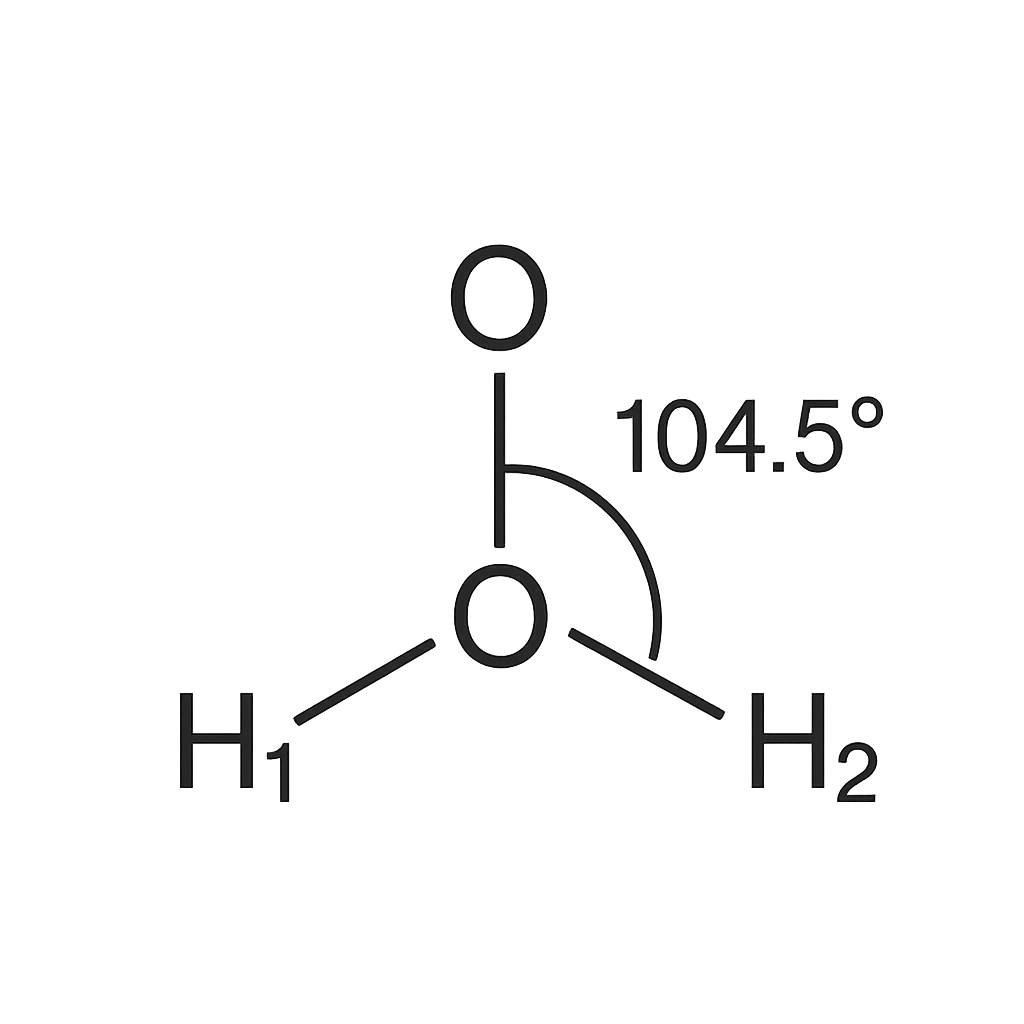
The diagram shows a water molecule with the O-H bonds and a bond angle of \(104.5^{\circ}\). State the type of each O-H bond and explain whether the molecule is polar or non‑polar.
Correct A. The O-H bonds are polar covalent and the molecule is polar.
B. The O-H bonds are non‑polar covalent and the molecule is non‑polar.
C. The O-H bonds are non‑polar covalent and the molecule is polar.
D. The O-H bonds are polar covalent and the molecule is non‑polar.

Correct Answer: A

Want to see the full step-by-step solution? Unlock AI Explanation & Analytics
Question 15 View Details
Anisole ((\mathrm{C_{6}H_{5}OCH_{3}}\)) is nitrated using a mixture of concentrated \(\mathrm{HNO_{3}}\) and \(\mathrm{H_{2}SO_{4}}\). Predict the position(s) on the aromatic ring where the nitro group is most likely to be introduced and give the IUPAC name of the major product.
A. meta‑Nitroanisole (IUPAC: 3‑nitroanisole)
B. ortho‑Nitroanisole (IUPAC: 2‑nitroanisole)
Correct C. para‑Nitroanisole (IUPAC: 4‑nitroanisole)
D. 2,4‑Dinitroanisole (IUPAC: 2,4‑dinitroanisole)

Correct Answer: C

Want to see the full step-by-step solution? Unlock AI Explanation & Analytics
Question 16 View Details
A 1.00 L aqueous solution is prepared by adding excess solid AgCl to pure water at 25 °C. The solubility product of AgCl at this temperature is \(K_{sp}=1.8\times10^{-10}\). (a) Calculate the molar solubility of AgCl in pure water. (b) The solution is then mixed with 0.10 mol L\(^{-1}\) NaCl. Determine the new molar solubility of AgCl in the presence of the common ion. (c) If 0.500 g of solid AgCl is added to the NaCl‑containing solution, how much AgCl remains dissolved (in grams) at equilibrium? Give your answer to three significant figures.
Correct A. 2.6\times10^{-7}\,\text{g (approximately)}
B. 1.3\times10^{-7}\,\text{g (approximately)}
C. 5.2\times10^{-7}\,\text{g (approximately)}
D. 2.6\times10^{-6}\,\text{g (approximately)}

Correct Answer: A

Want to see the full step-by-step solution? Unlock AI Explanation & Analytics
Question 17 View Details
A 25.0 mL sample of an aqueous iron solution contains both Fe^{2+} and Fe^{3+} ions. The total amount of iron (Fe^{2+}+Fe^{3+}) is 0.0100 mol. The solution is acidified and titrated with 0.0200 M KMnO_{4} in acidic medium. The titration reaches the endpoint after 31.2 mL of KMnO_{4} solution has been added. (a) Write the net ionic equation for the reaction between MnO_{4}^{-} and Fe^{2+} in acidic solution. (b) Calculate the concentration of Fe^{2+} in the original sample. (c) Determine the concentration of Fe^{3+} in the original sample.
A. Fe^{2+} concentration = 0.125\,\text{M}; Fe^{3+} concentration = 0.225\,\text{M}
B. Fe^{2+} concentration = 0.150\,\text{M}; Fe^{3+} concentration = 0.250\,\text{M}
Correct C. Fe^{2+} concentration = 0.125\,\text{M}; Fe^{3+} concentration = 0.275\,\text{M}
D. Fe^{2+} concentration = 0.100\,\text{M}; Fe^{3+} concentration = 0.300\,\text{M}

Correct Answer: C

Want to see the full step-by-step solution? Unlock AI Explanation & Analytics
Question 18 View Details
The solubility product of a sparingly soluble salt MX at 25 °C (298 K) is \(K_{sp,25}=2.0\times10^{-9}\). The dissolution is endothermic with an enthalpy change \(\Delta H_{sol}=+45\) kJ mol\(^{-1}\). Estimate the value of \(K_{sp}\) at 35 °C (308 K). Give your answer in scientific notation with two significant figures.
A. 2.0\times10^{-9}
Correct B. 3.6\times10^{-9}
C. 1.2\times10^{-8}
D. 4.5\times10^{-9}

Correct Answer: B

Want to see the full step-by-step solution? Unlock AI Explanation & Analytics
Question 19 View Details
A rigid, sealed container of volume 2.00 L initially contains 100 g of liquid water at 20 °C. The container is then heated to 120 °C. The vapor pressure of water at 120 °C is 1.99 atm. (a) Assuming the water vapour behaves as an ideal gas and the container can withstand a maximum pressure of 1.5 atm, determine the pressure inside the container after heating. (b) Calculate the mass of water that has vaporised at this temperature. (c) State whether any liquid water remains in the container.
A. Pressure = 1.2 atm; mass vaporised = 2.10 g; liquid water remains
Correct B. Pressure = 1.5 atm; mass vaporised = 1.68 g; liquid water remains
C. Pressure = 1.5 atm; mass vaporised = 1.68 g; no liquid water remains
D. Pressure = 1.5 atm; mass vaporised = 0.95 g; liquid water remains

Correct Answer: B

Want to see the full step-by-step solution? Unlock AI Explanation & Analytics
Question 20 View Details
The reaction \(2\,\text{Al} + 3\,\text{CuSO}_{4}\cdot5\text{H}_{2}\text{O} \rightarrow \text{Al}_{2}(\text{SO}_{4})_{3} + 3\,\text{Cu} + 15\,\text{H}_{2}\text{O}\) occurs in aqueous solution. If 5.00 g of aluminium metal are mixed with 10.0 g of copper(II) sulphate pentahydrate, (a) identify the limiting reagent, (b) calculate the theoretical mass of copper that can be produced, and (c) if the actual mass of copper obtained is 2.10 g, determine the percent yield of the reaction.
A. Limiting reagent: Al; theoretical Cu = 5.12 g; percent yield = 41.0 %
Correct B. Limiting reagent: CuSO_{4}·5H_{2}O; theoretical Cu = 7.64 g; percent yield = 27.5 %
C. Limiting reagent: Al; theoretical Cu = 7.64 g; percent yield = 27.5 %
D. Limiting reagent: CuSO_{4}·5H_{2}O; theoretical Cu = 6.20 g; percent yield = 33.9 %

Correct Answer: B

Want to see the full step-by-step solution? Unlock AI Explanation & Analytics
Question 21 View Details
A 2.00 g sample of a hydrocarbon CxHy is combusted completely, producing 44.8 g of \(\ce{CO2}\) and 18.0 g of \(\ce{H2O}\). The molar mass of the hydrocarbon is known to be 58 g\,mol\(^{-1}\). Determine the molecular formula of the hydrocarbon and calculate its mass percent of carbon.
A. Molecular formula \(\ce{C4H6}\); mass percent C ≈ 88.9 %
B. Molecular formula \(\ce{C3H6}\); mass percent C ≈ 85.7 %
C. Molecular formula \(\ce{C4H10}\); mass percent C ≈ 82.7 %
Correct D. Molecular formula \(\ce{C4H8}\); mass percent C ≈ 82.8 %

Correct Answer: D

Want to see the full step-by-step solution? Unlock AI Explanation & Analytics
Question 22 View Details
The sparingly soluble salt \(\ce{MX}\) (M^{2+} and X^{2-}) has a solubility of \(1.2\times10^{-4}\) mol L\(^{-1}\) at 25 °C and \(3.5\times10^{-4}\) mol L\(^{-1}\) at 35 °C. Assuming the enthalpy of solution is constant over this temperature range, (a) calculate \(\Delta H_{\text{sol}}\) in kJ mol\(^{-1}\); (b) estimate the solubility at 45 °C.
A. ΔHₛₒₗ ≈ 90 kJ mol⁻¹; solubility at 45 °C ≈ 5.0×10⁻⁴ mol L⁻¹
B. ΔHₛₒₗ ≈ 200 kJ mol⁻¹; solubility at 45 °C ≈ 1.2×10⁻³ mol L⁻¹
Correct C. ΔHₛₒₗ ≈ 165 kJ mol⁻¹; solubility at 45 °C ≈ 9.6×10⁻⁴ mol L⁻¹
D. ΔHₛₒₗ ≈ 120 kJ mol⁻¹; solubility at 45 °C ≈ 7.2×10⁻⁴ mol L⁻¹

Correct Answer: C

Want to see the full step-by-step solution? Unlock AI Explanation & Analytics
Question 23 View Details
In acidic solution the redox reaction \(\ce{MnO4^- + Fe^{2+} -> Mn^{2+} + Fe^{3+}}\) occurs. Standard potentials are: \(\ce{MnO4^- + 8H+ + 5e- -> Mn^{2+} + 4H2O}\) \(E^\circ = +1.51\) V and \(\ce{Fe^{3+} + e- -> Fe^{2+}}\) \(E^\circ = +0.77\) V. If \([\ce{Fe^{2+}}] = 0.010\) M, \([\ce{Fe^{3+}}] = 0.10\) M and the pH is 2, calculate the cell potential at 25 °C.
Correct A. E ≈ 0.49 V
B. E ≈ 0.62 V
C. E ≈ 0.78 V
D. E ≈ 0.35 V

Correct Answer: A

Want to see the full step-by-step solution? Unlock AI Explanation & Analytics
Question 24 View Details
A buffer is prepared by dissolving 0.250 mol of acetic acid (\(\ce{CH3COOH}\), \(K_a = 1.8\times10^{-5}\)) and 0.150 mol of sodium acetate (\(\ce{CH3COONa}\)) in 1.00 L of water. (a) Calculate the initial pH. (b) After adding 0.050 mol of \(\ce{HCl}\) (volume change negligible), calculate the new pH.
Correct A. Initial pH ≈ 4.52; after adding HCl pH ≈ 4.27
B. Initial pH ≈ 4.68; after adding HCl pH ≈ 4.45
C. Initial pH ≈ 4.60; after adding HCl pH ≈ 4.35
D. Initial pH ≈ 4.30; after adding HCl pH ≈ 4.10

Correct Answer: A

Want to see the full step-by-step solution? Unlock AI Explanation & Analytics
Question 25 View Details
In an electrolytic cell containing \(\ce{CuSO4}\) solution, a constant current of 2.00 A is passed for 30.0 min. The cathode reaction is \(\ce{Cu^{2+} + 2e- -> Cu(s)}\). However, 10 % of the total charge is consumed by the side reaction \(\ce{2H2O + 2e- -> H2(g) + 2OH-}\). Calculate the mass of copper actually deposited on the cathode.
A. ≈ 0.85 g of Cu deposited
B. ≈ 0.96 g of Cu deposited
Correct C. ≈ 1.07 g of Cu deposited
D. ≈ 1.20 g of Cu deposited

Correct Answer: C

Want to see the full step-by-step solution? Unlock AI Explanation & Analytics

Master the Exam!

You've seen a preview, but there are thousands more questions plus AI tutor to break down complex solutions.

Unlock Full Access Available for Android & Windows
Help others prepare! Share this practice hub:
Chat with Support