gce model questions vol1 2021 agricultural_science | Objective

Prepare for your exams with gce model questions vol1 questions? Reviewing past/model questions is one of the most effective ways to guarantee a high score. This practice hub features authentic 2021 agricultural_science (Objective) questions designed to simulate the real exam environment.

Practice these randomly selected questions to test your readiness.

Question 1 View Details
A cattle herd is at risk from a contagious disease with a basic reproduction number of \(R_0 = 2.5\). A vaccine available for the disease has an efficacy of 80 %. What minimum proportion of the herd must be vaccinated to achieve herd immunity, and how many individual animals need to be vaccinated if the herd consists of 200 cattle? Give your answer as the number of animals to vaccinate.
A. 100
Correct B. 150
C. 120
D. 160

Correct Answer: B

Want to see the full step-by-step solution? Unlock AI Explanation & Analytics
Question 2 View Details
A fish population follows logistic growth \(\frac{dN}{dt}=rN\left(1-\frac{N}{K}\right)\) with intrinsic growth rate \(r=0.4\) yr⁻¹ and carrying capacity \(K=500{,}000\) fish. Harvesting follows \(H = qEN\) where catchability \(q=0.00002\) (per boat‑day) and effort \(E\) is measured in boat‑days per year. The fishery wishes to catch a sustainable amount equal to 20 % of the maximum sustainable yield (MSY). Determine the effort \(E\) (rounded to the nearest whole boat‑day) that will give this catch and state the corresponding equilibrium population size (rounded to the nearest thousand fish).
A. 1,200 boat‑days per year; approximately 460,000 fish
B. 1,080 boat‑days per year; approximately 480,000 fish
Correct C. 1,056 boat‑days per year; approximately 474,000 fish
D. 1,040 boat‑days per year; approximately 470,000 fish

Correct Answer: C

Want to see the full step-by-step solution? Unlock AI Explanation & Analytics
Question 3 View Details
A wheat farmer incurs fixed costs of \(\₦120{,}000\) per season and a variable cost of \(\₦30{,}000\) per ton of wheat produced. The market price is \(\₦45{,}000\) per ton. The government offers a per‑ton subsidy of \(\₦5{,}000\) that is paid only if the farmer's output exceeds 8 tons. The farmer expects to produce between 6 and 12 tons. Assuming the farmer can choose any whole‑ton output in this range, at what output level is profit maximised and what is the maximum profit (in \(\₦\))?
A. 9 tons; \₦60,000
Correct B. 12 tons; \₦120,000
C. 11 tons; \₦100,000
D. 10 tons; \₦80,000

Correct Answer: B

Want to see the full step-by-step solution? Unlock AI Explanation & Analytics
Question 4 View Details
Cassava chips have an initial moisture content of 45 % (wet basis). The desired final moisture content is 12 % (wet basis). Drying follows the model \(M(t)=M_f+(M_0-M_f)e^{-kt}\) where \(M(t)\) is moisture content at time \(t\) (hours), \(M_0\) is the initial moisture content, \(M_f\) is the equilibrium moisture content (assumed 10 % wet basis), and \(k\) is the drying constant. In a trial, after 3 hours the moisture content measured is 20 % (wet basis). Determine the drying constant \(k\) (to three decimal places) and then calculate the total drying time required to reach the target 12 % moisture content. Give the time rounded to one decimal place (hours).
A. k = 0.500 h⁻¹; drying time ≈ 6.0 h
B. k = 0.418 h⁻¹; drying time ≈ 5.5 h
Correct C. k = 0.418 h⁻¹; drying time ≈ 6.9 h
D. k = 0.350 h⁻¹; drying time ≈ 7.5 h

Correct Answer: C

Want to see the full step-by-step solution? Unlock AI Explanation & Analytics
Question 5 View Details
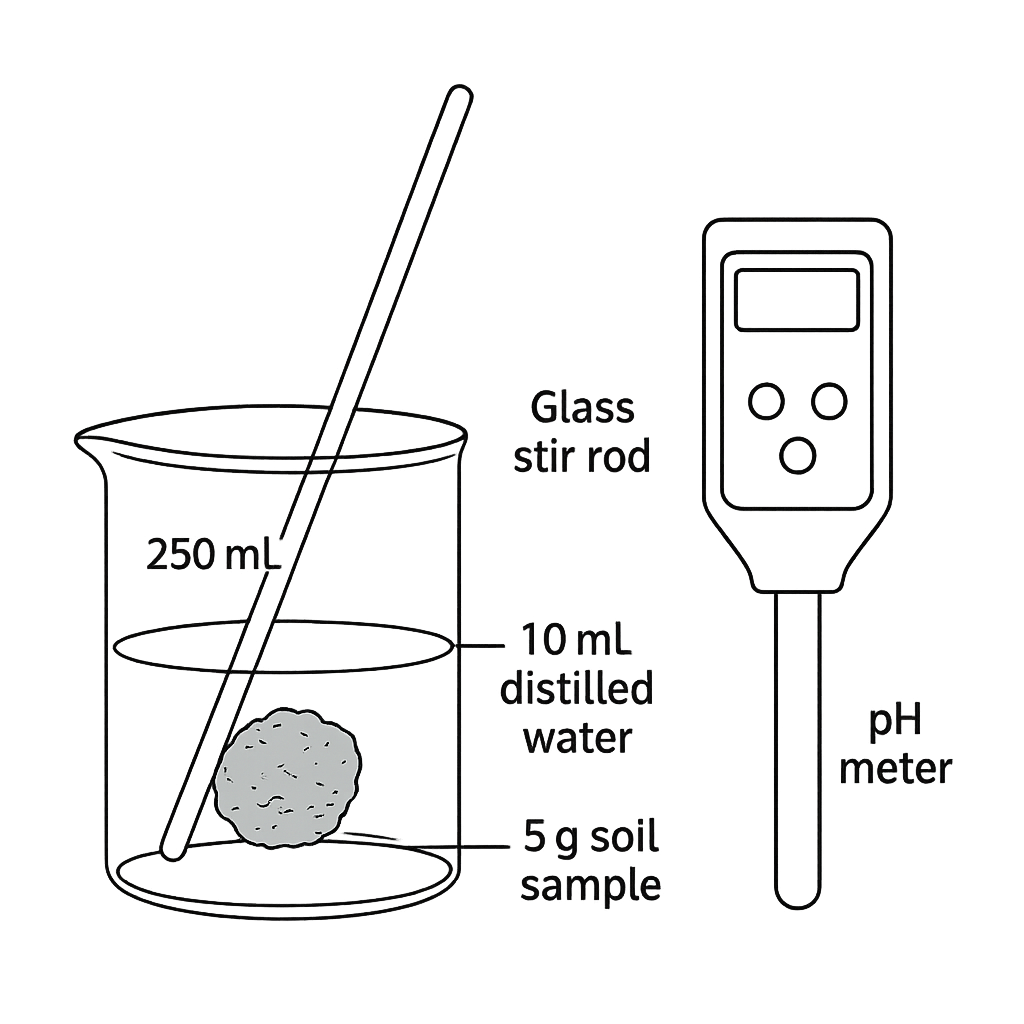
The diagram shows a simple laboratory setup for determining soil pH by the suspension method. A 250 mL beaker contains 10 mL of distilled water. A 5 g soil sample is placed in the beaker, a glass stir rod is used to mix, and a digital pH meter is positioned beside the beaker. Which component is added to the beaker first?
Correct A. Distilled water
B. Soil sample
C. Stir rod
D. pH meter

Correct Answer: A

Want to see the full step-by-step solution? Unlock AI Explanation & Analytics
Question 6 View Details
A forest stand follows the volume growth function \(V(t)=0.04t^{2}+0.5t\) (m³ ha⁻¹), where \(t\) is the age in years. Timber sells for \(\$120\) per m³ and regeneration costs \(\$250\) ha⁻¹. The annual discount rate is \(6\%\). Using the land expectation value (LEV) formula \(\text{LEV}(T)=\dfrac{P\,V(T)-C}{(1+i)^{T}-1}\), where \(P\) is price, \(C\) regeneration cost, \(i\) discount rate and \(T\) the rotation age, determine the integer rotation age (in years) that maximises LEV.
A. 24
Correct B. 22
C. 20
D. 26

Correct Answer: B

Want to see the full step-by-step solution? Unlock AI Explanation & Analytics
Question 7 View Details
A mixed farm has 5 ha of land and can keep up to 30 cows. Wheat yields 2.5 t ha⁻¹ and sells for \(\$200\) t⁻¹; variable cost is \(\$80\) t⁻¹ and fixed cost \(\$200\) ha⁻¹. Each cow produces 20 L day⁻¹ of milk, sold at \(\$0.45\) L⁻¹; variable cost is \(\$0.15\) L⁻¹ and fixed cost \(\$300\) cow⁻¹ yr⁻¹. Each cow requires 0.1 ha of land for feed. Determine the number of cows and the hectares of wheat that maximise total annual profit.
A. 25 cows and 3 ha of wheat
Correct B. 30 cows and 2 ha of wheat
C. 20 cows and 4 ha of wheat
D. 30 cows and 1 ha of wheat

Correct Answer: B

Want to see the full step-by-step solution? Unlock AI Explanation & Analytics
Question 8 View Details
The economic injury level (EIL) for a stem‑borer in maize is given by \(\text{EIL}=\dfrac{C}{V\,I}\), where \(C\) is the control cost per hectare (\$30), \(V\) is the market value of the crop per tonne (\$200) and \(I\) is the injury per pest (0.02 t per pest). A farmer monitors 5 pests per 100 m² in a 2‑ha field. Should the farmer apply control? (Answer Yes or No).
A. No
B. No, do not apply
Correct C. Yes
D. No, control not needed

Correct Answer: C

Want to see the full step-by-step solution? Unlock AI Explanation & Analytics
Question 9 View Details
In a wheat field of 4 ha, a random sample of 200 plants shows 30 with leaf‑rust symptoms. Of the symptomatic plants, 18 have severe infection (>50 % leaf area) and 12 have mild infection (≈25 % leaf area). Using the disease severity index (DSI) formula \(\text{DSI}=\dfrac{\sum (\text{severity rating}\times\text{number of plants})}{100\times N}\times100\), where the severity rating is expressed as a percentage (25 for mild, 75 for severe) and \(N\) is the total number of plants examined, calculate the DSI and state whether it exceeds the action threshold of 20 %.
A. 20.0%, action needed
Correct B. 8.25%, no action needed
C. 5.0%, no action needed
D. 12.5%, action required

Correct Answer: B

Want to see the full step-by-step solution? Unlock AI Explanation & Analytics
Question 10 View Details
A mixed‑species plantation contains species A (QMD = 30 cm, 800 trees ha⁻¹) and species B (QMD = 20 cm, 1200 trees ha⁻¹). Basal area per hectare for a species is \(\text{BA}=\dfrac{\pi}{4}\,\text{QMD}^{2}\,N\), where \(N\) is the number of trees per hectare. The manager wishes to raise total basal area by 15 % while keeping the total number of trees at 2000 ha⁻¹ by altering the proportion of species A and B (QMD values remain unchanged). What percentage of the total trees should be species A to achieve the target basal area?
A. 62
B. 45
Correct C. 58
D. 71

Correct Answer: C

Want to see the full step-by-step solution? Unlock AI Explanation & Analytics
Question 11 View Details
A farmer cultivates three equal‑size wheat fields, each containing 10\,000 plants. In field A, \(12\%\) of the plants are infected with disease X; in field B, \(18\%\) are infected. Overall, 5\,400 plants are infected across the three fields. (i) Determine the percentage of plants infected in field C. (ii) If each infected plant requires 0.02\,L of fungicide and fungicide costs $5 per litre, calculate the total cost of fungicide needed for the whole farm.
A. 20\% and $480
B. 22\% and $500
C. 26\% and $560
Correct D. 24\% and $540

Correct Answer: D

Want to see the full step-by-step solution? Unlock AI Explanation & Analytics
Question 12 View Details
The yield response of a crop to nitrogen fertilizer (kg ha\(^{-1}\)) is given by \(Y = 2N - 0.01N^{2}\) (tonnes ha\(^{-1}\)). (i) Find the range of nitrogen rates \(N\) that will give a yield between 12 t ha\(^{-1}\) and 15 t ha\(^{-1}\) inclusive. (ii) Using the lower feasible nitrogen rate, calculate the total amount of nitrogen fertilizer required for a 25 ha field (round to the nearest kilogram).
A. N between 6.0-8.0 kg ha⁻¹ (or 185.0-200.0 kg ha⁻¹); total fertilizer ≈145 kg
B. N between 5.5-8.2 kg ha⁻¹ (or 180.0-210.0 kg ha⁻¹); total fertilizer ≈140 kg
C. N between 6.3-7.5 kg ha⁻¹ (or 190.0-192.5 kg ha⁻¹); total fertilizer ≈160 kg
Correct D. N between 6.1-7.8 kg ha⁻¹ (or 192.2-193.9 kg ha⁻¹); total fertilizer ≈152 kg

Correct Answer: D

Want to see the full step-by-step solution? Unlock AI Explanation & Analytics
Question 13 View Details
A farmer uses a hand lever to lift a sack of grain weighing 150 kg. The lever is 2.0 m long and the pivot is placed 0.4 m from the sack end. The farmer applies the effort at the opposite end. The lever operates with an efficiency of 85 %. (i) Determine the minimum effort force the farmer must apply. (ii) If the farmer can exert at most 250 N, what is the greatest mass of grain that can be lifted with this lever under the same efficiency?
A. Minimum effort ≈375 N; maximum liftable mass ≈95 kg
B. Minimum effort ≈410 N; maximum liftable mass ≈70 kg
Correct C. Minimum effort ≈433 N; maximum liftable mass ≈87 kg
D. Minimum effort ≈500 N; maximum liftable mass ≈80 kg

Correct Answer: C

Want to see the full step-by-step solution? Unlock AI Explanation & Analytics
Question 14 View Details
An agricultural extension officer is organising a two‑day field day for farmers. The base expected attendance is 120 farmers. The venue costs $200 per day and each speaker costs $150 per day. Printed material costs $2 per participant and meals cost $5 per participant per day. Up to three speakers may be invited each day; each additional speaker beyond the first increases the total attendance by 10 % of the base attendance. The officer wants the total cost not to exceed $2500 and wishes to maximise attendance. Determine how many speakers should be invited on each day and the resulting total attendance.
Correct A. Two speakers on one day and one speaker on the other; total attendance 132 farmers
B. One speaker on each day; total attendance 126 farmers
C. Three speakers on one day and two speakers on the other; total attendance 144 farmers
D. Two speakers on each day; total attendance 138 farmers

Correct Answer: A

Want to see the full step-by-step solution? Unlock AI Explanation & Analytics
Question 15 View Details
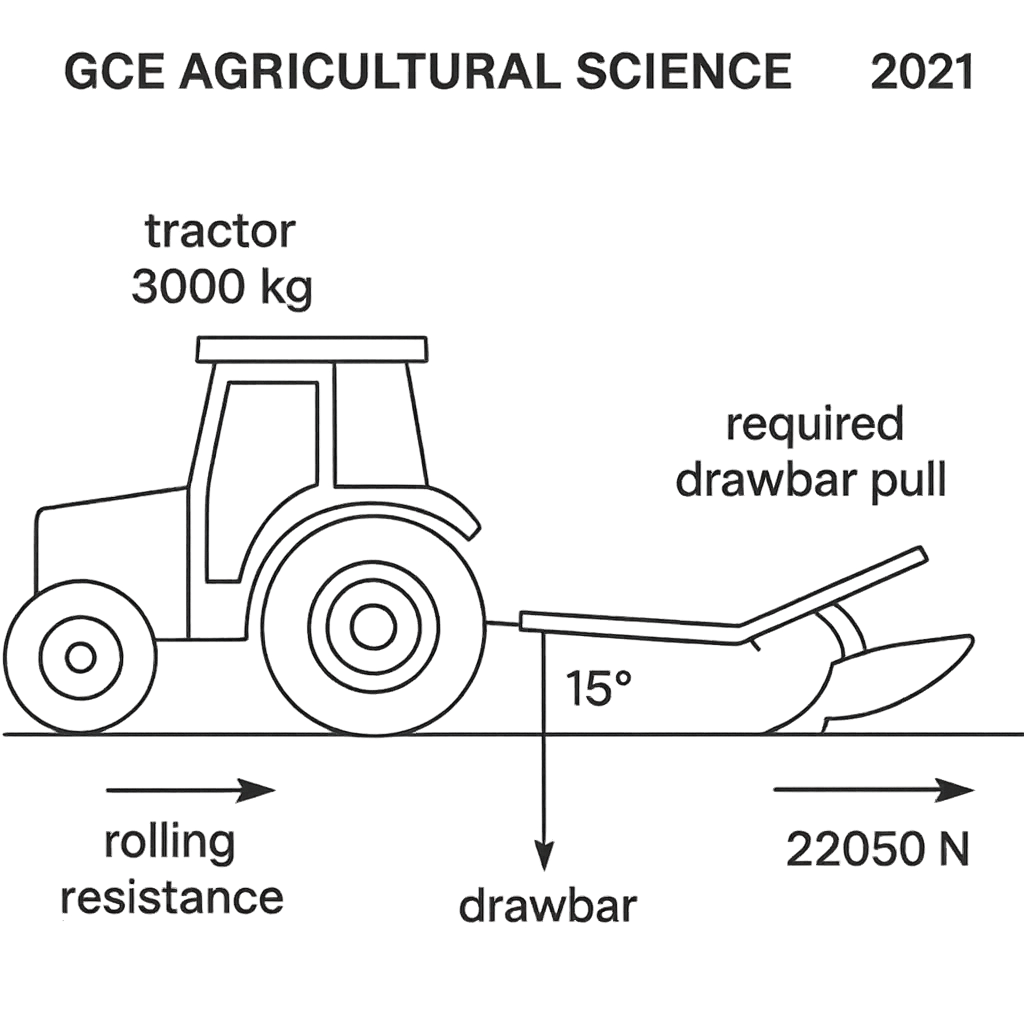
The diagram shows a tractor of mass 3000 kg pulling a plough. The drawbar is inclined at \(15^{\circ}\) above the horizontal. The plough experiences a soil resistance of 2500 N. The coefficient of rolling resistance of the tractor tyres is 0.02. The tractor moves at a constant speed of 5 km h\(^{-1}\) and the drivetrain efficiency is 85 %. (i) Calculate the total tractive effort that must be developed at the drawbar. (ii) Determine the minimum engine power (in kW) required to maintain this speed.
A. Tractive effort ≈2800 N; minimum engine power ≈4.6 kW
B. Tractive effort ≈3400 N; minimum engine power ≈5.6 kW
C. Tractive effort ≈3110 N; minimum engine power ≈4.3 kW
Correct D. Tractive effort ≈3110 N; minimum engine power ≈5.1 kW

Correct Answer: D

Want to see the full step-by-step solution? Unlock AI Explanation & Analytics
Question 16 View Details
An agronomist is assessing the economic threshold for a maize pest. The market value of the crop is $1800 per hectare. The cost of applying an insecticide is $45 per hectare. Each unit increase in pest density (per 1000 plants) causes a 0.5\% reduction in yield. Using the economic injury level formula \(EIL = \frac{C}{V \times L}\), where \(L\) is the loss per pest unit expressed as a proportion, calculate the pest density (units per 1000 plants) at which it becomes economical to spray.
A. 8
Correct B. 5
C. 4
D. 6

Correct Answer: B

Want to see the full step-by-step solution? Unlock AI Explanation & Analytics
Question 17 View Details
An 8000\,kg tractor must pull a load up a 6\% gradient at a constant speed of 6\,km\,h\^{-1}. The rolling resistance coefficient is 0.03. The drivetrain efficiency is 85\%. Determine whether a tractor with a rated engine power of 15\,kW is sufficient for this task. Answer "yes" if it is sufficient, otherwise "no".
A. negative
B. nope
Correct C. yes
D. no

Correct Answer: C

Want to see the full step-by-step solution? Unlock AI Explanation & Analytics
Question 18 View Details
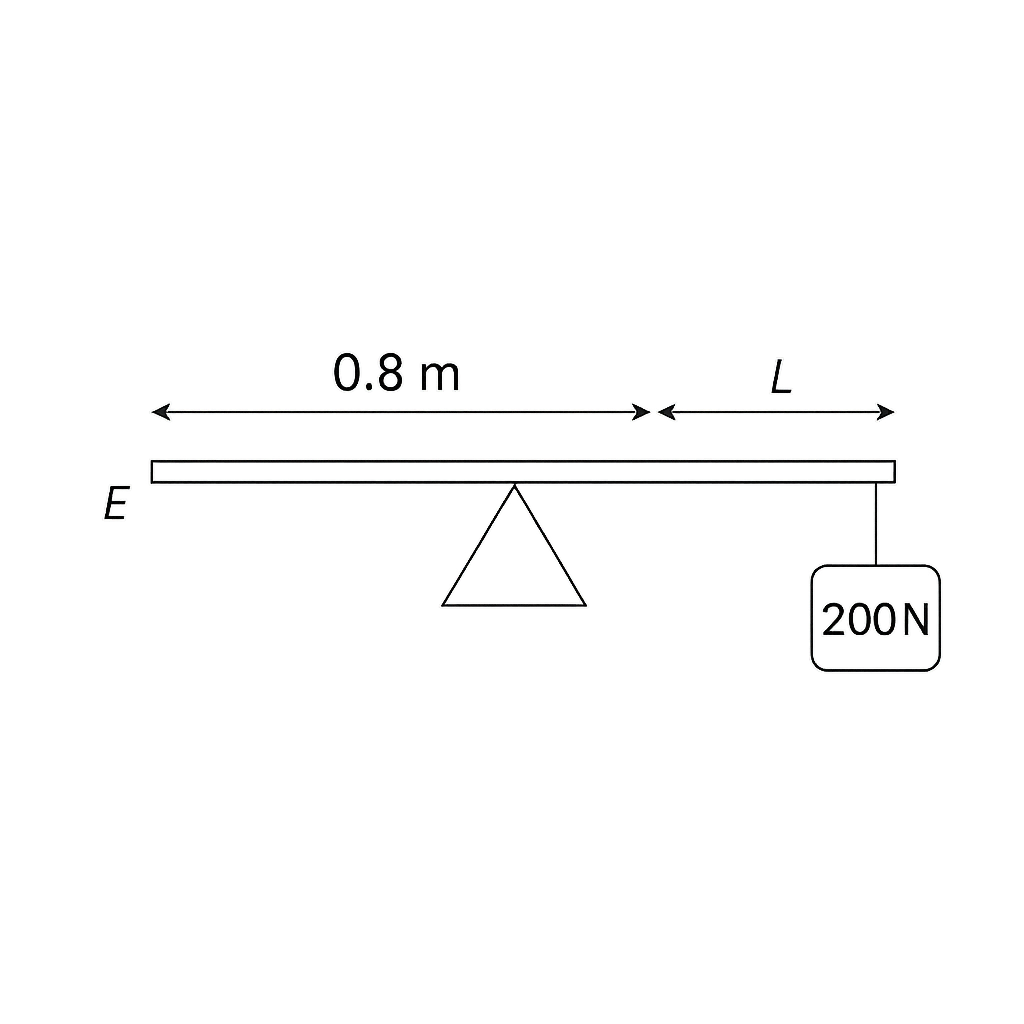
The diagram shows a first‑class lever. The distance from the fulcrum to the point where the effort is applied is 0.8\,m, and the distance from the fulcrum to the load is 0.2\,m. The load weight is 200\,N. The lever has a frictional loss equal to 10\% of the effort force. Calculate the minimum effort force (in newtons, to the nearest newton) required to keep the lever in equilibrium.
Correct A. 889
B. 800
C. 720
D. 950

Correct Answer: A

Want to see the full step-by-step solution? Unlock AI Explanation & Analytics
Question 19 View Details
After harvesting, wheat grain has a moisture content of 18\% (wet basis). It must be dried to a final moisture content of 13\% for safe storage. The dryer operates at a temperature of 30\,°C, and the equilibrium moisture temperature is 20\,°C. The drying rate follows the linear model \(\Delta M = k (T - T_{eq}) t\) where \(k = 0.05\)\%\,h\^{-1}\,°C\^{-1}. Calculate the drying time required (in hours) to reach the desired moisture content.
A. 12
B. 15
C. 8
Correct D. 10

Correct Answer: D

Want to see the full step-by-step solution? Unlock AI Explanation & Analytics
Question 20 View Details
Grain stored in a silo generates metabolic heat at a rate of 0.04\,W per kilogram. A batch of 2000\,kg of wheat is stored, and the ambient air temperature is 20\,°C. To prevent the grain temperature from rising more than 2\,°C above ambient, the silo must be ventilated. Air has a density of 1.2\,kg\,m\^{-3} and a specific heat capacity of 1005\,J\,kg\^{-1}\,K\^{-1}. Assuming the ventilation air enters at the ambient temperature, calculate the minimum ventilation rate required in cubic metres per minute (rounded to one decimal place).
Correct A. 2.0
B. 1.0
C. 4.0
D. 3.0

Correct Answer: A

Want to see the full step-by-step solution? Unlock AI Explanation & Analytics
Question 21 View Details
A poultry farmer has a flock of 120 chickens that have been affected by an outbreak of Newcastle disease. Within 5 days, 30 chickens died, 20 recovered, and the remaining chickens are still showing clinical signs. Calculate the case‑fatality rate (as a percentage) and the recovery rate (as a percentage) for this outbreak. Based on these rates, recommend the most appropriate control measure from the following options: vaccination, culling of affected birds, or quarantine.
A. Case‑fatality rate = 20 %; recovery rate = 16.7 %; recommended control measure = culling of affected birds.
B. Case‑fatality rate = 30 %; recovery rate = 16.7 %; recommended control measure = vaccination.
Correct C. Case‑fatality rate = 25 %; recovery rate = 16.7 %; recommended control measure = culling of affected birds.
D. Case‑fatality rate = 25 %; recovery rate = 20 %; recommended control measure = quarantine.

Correct Answer: C

Want to see the full step-by-step solution? Unlock AI Explanation & Analytics
Question 22 View Details
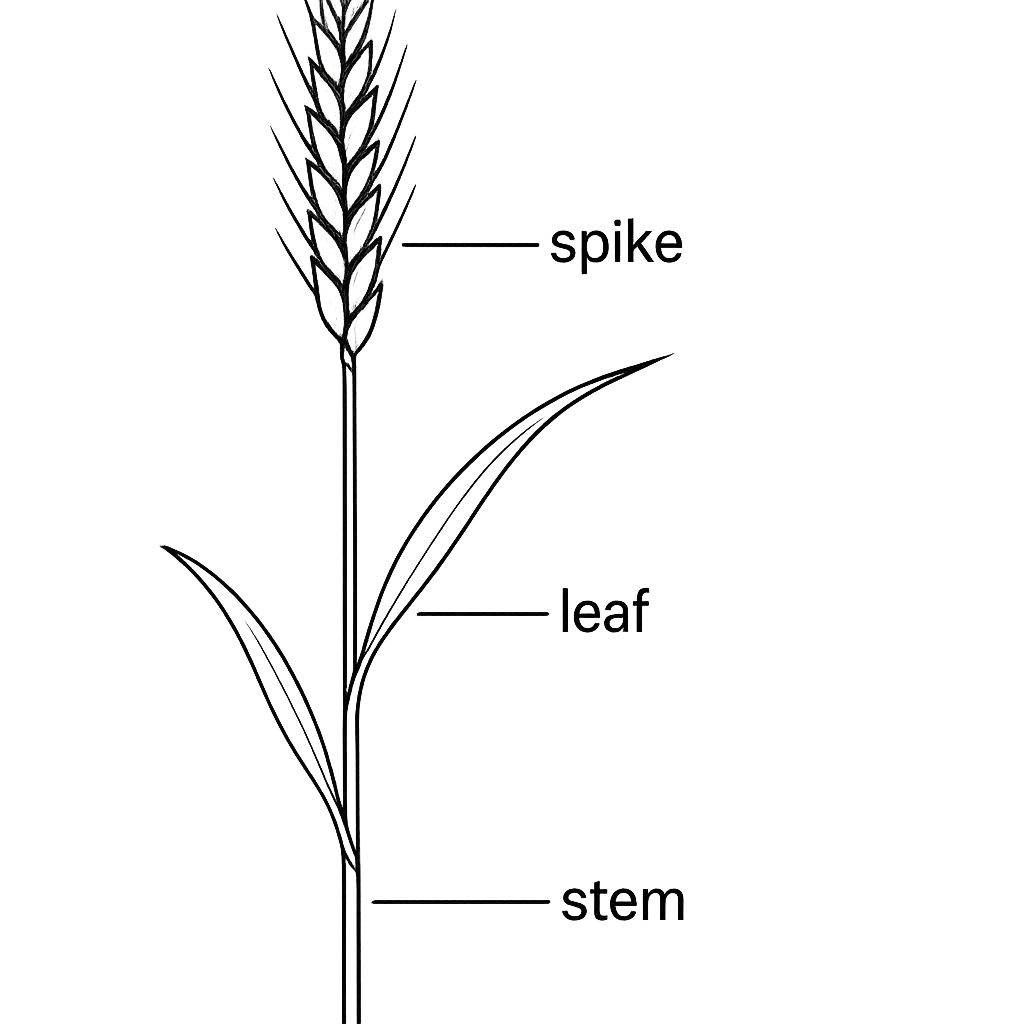
The diagram shows a wheat plant with the dry weights of its parts measured after harvest. The stem weighs 45 g and the leaf weighs 35 g. The total above‑ground biomass (stem + leaf + spike) is 120 g. The spike consists of grain and the surrounding glumes, and the grain accounts for 80 % of the spike dry weight. (a) Determine the dry weight of the spike and the grain. (b) Calculate the harvest index, defined as grain weight divided by total above‑ground biomass, and state whether it meets the target value of 0.45 for a high‑yielding wheat variety.
A. Spike weight = 45 g; grain weight = 36 g; harvest index = 0.300; does not meet the target of 0.45.
B. Spike weight = 40 g; grain weight = 32 g; harvest index = 0.400; does not meet the target of 0.45.
Correct C. Spike weight = 40 g; grain weight = 32 g; harvest index = 0.267; does not meet the target of 0.45.
D. Spike weight = 40 g; grain weight = 28 g; harvest index = 0.233; does not meet the target of 0.45.

Correct Answer: C

Want to see the full step-by-step solution? Unlock AI Explanation & Analytics
Question 23 View Details
In a 5‑ha field of tomato, a survey of 2 000 plants found 300 plants showing symptoms of early blight. Of the symptomatic plants, 150 have 30 % of their leaf area affected and the other 150 have 10 % affected. (a) Calculate the disease incidence (percentage of plants infected). (b) Calculate the overall disease severity index using the formula \( \text{DSI}= \frac{\sum (\text{severity %})}{\text{number inspected}\times 100}\times100 \). (c) If a fungicide application is recommended only when the DSI exceeds 5 %, advise whether treatment is justified.
Correct A. Disease incidence = 15 %; DSI = 3 %; treatment not justified.
B. Disease incidence = 18 %; DSI = 3 %; treatment not justified.
C. Disease incidence = 15 %; DSI = 6 %; treatment justified.
D. Disease incidence = 12 %; DSI = 4 %; treatment not justified.

Correct Answer: A

Want to see the full step-by-step solution? Unlock AI Explanation & Analytics
Question 24 View Details
A forest stand covers 50 ha and has an average tree density of 200 trees ha⁻¹. The mean diameter at breast height (DBH) is 30 cm and the average height is 20 m. Tree volume (in m³) can be approximated by \( V = 0.05 \times DBH^{2} \times H \), where DBH is in metres. (a) Calculate the total standing volume of the stand. (b) If the annual volume increment is 2 % of the standing volume, determine the sustainable annual harvest volume that would keep the stand volume constant. (c) Assuming 0.5 t of carbon is stored per cubic metre of wood, estimate the total carbon stock of the stand.
A. Total volume = 850 m³; sustainable annual harvest = 17 m³; carbon stock = 425 t C.
Correct B. Total volume = 900 m³; sustainable annual harvest = 18 m³; carbon stock = 450 t C.
C. Total volume = 1 000 m³; sustainable annual harvest = 20 m³; carbon stock = 500 t C.
D. Total volume = 950 m³; sustainable annual harvest = 19 m³; carbon stock = 475 t C.

Correct Answer: B

Want to see the full step-by-step solution? Unlock AI Explanation & Analytics
Question 25 View Details
A farmer intends to grow maize on 5 ha. Fixed costs (land rent, machinery, etc.) are ₦150 000 per ha. Variable cost is ₦30 000 per tonne of maize produced. Expected yield is 4 t ha⁻¹. The expected market price is ₦45 000 per tonne, but there is a 10 % probability that the price will fall to ₦35 000 per tonne because of market fluctuations. (a) Calculate the break‑even price per tonne of maize. (b) Determine the expected profit (or loss) without any additional investment. (c) The farmer can invest in a storage facility costing ₦200 000 that guarantees the price of ₦45 000 t⁻¹ (no price drop). Should the farmer purchase the storage facility? Justify your answer using expected‑value analysis.
Correct A. Break‑even price = ₦67 500 t⁻¹; expected profit without storage = -₦470 000; storage facility not advisable.
B. Break‑even price = ₦72 000 t⁻¹; expected profit without storage = -₦500 000; storage facility not advisable.
C. Break‑even price = ₦67 500 t⁻¹; expected profit without storage = -₦470 000; storage facility advisable.
D. Break‑even price = ₦60 000 t⁻¹; expected profit without storage = -₦350 000; storage facility not advisable.

Correct Answer: A

Want to see the full step-by-step solution? Unlock AI Explanation & Analytics

Master the Exam!

You've seen a preview, but there are thousands more questions plus AI tutor to break down complex solutions.

Unlock Full Access Available for Android & Windows
Help others prepare! Share this practice hub:
Chat with Support