gce model questions vol1 2020 biology | Objective

Prepare for your exams with gce model questions vol1 questions? Reviewing past/model questions is one of the most effective ways to guarantee a high score. This practice hub features authentic 2020 biology (Objective) questions designed to simulate the real exam environment.

Practice these randomly selected questions to test your readiness.

Question 1 View Details
A molecular clock for a group of mammals ticks at a rate of 1.5 substitutions per million years per 2000 base pairs. For the lineage leading to species O the rate is 20 % faster. The observed genetic distance between species M and N is 9 substitutions per 2000 bp, and between N and O is 12 substitutions per 2000 bp. Using these data, determine which divergence (M-N or N-O) occurred earlier and by how many million years (to one decimal place).
A. N-O diverged earlier by 0.5 million years
B. N-O diverged earlier by 1.0 million years
Correct C. N-O diverged earlier by 0.7 million years
D. M-N diverged earlier by 0.7 million years

Correct Answer: C

Want to see the full step-by-step solution? Unlock AI Explanation & Analytics
Question 2 View Details
Two leaf cells, A and B, are at 25 °C. Cell A contains a solute concentration of 0.3 mol L⁻¹ and a pressure potential of +0.2 MPa. Cell B contains 0.1 mol L⁻¹ solute and a pressure potential of -0.1 MPa. Using the equation \(\psi = \psi_s + \psi_p\) where \(\psi_s = -i C R T\) (with \(i = 1\), \(R = 0.008314\) MPa·L·mol⁻¹·K⁻¹ and \(T = 298\) K), determine the direction of water movement and the magnitude of the water‑potential difference between the cells (to two decimal places).
Correct A. Water moves from B to A; Δψ = 0.20 MPa
B. Water moves from B to A; Δψ = 0.15 MPa
C. Water moves from B to A; Δψ = 0.25 MPa
D. Water moves from A to B; Δψ = 0.20 MPa

Correct Answer: A

Want to see the full step-by-step solution? Unlock AI Explanation & Analytics
Question 3 View Details
A small mammal of mass \(10\) kg has a surface‑area scaling relation \(A = k M^{2/3}\) with \(k = 0.1\) m²·kg⁻²⁄³. The animal lives in an environment at \(5\) °C while its core temperature is \(37\) °C. Heat loss per unit area is given by \(H = h (T_{core} - T_{env})\) where \(h = 10\) W·m⁻²·°C⁻¹. Calculate the rate of metabolic heat production (in watts) required to maintain body temperature. Give your answer to the nearest whole watt.
A. 165 W
Correct B. 149 W
C. 130 W
D. 180 W

Correct Answer: B

Want to see the full step-by-step solution? Unlock AI Explanation & Analytics
Question 4 View Details
A motor neurone that innervates a skeletal muscle fibre has an axon length of \(0.8\) m and a conduction velocity of \(60\) m·s⁻¹. The synaptic delay at the neuromuscular junction is \(0.5\) ms and excitation‑contraction coupling adds an additional \(2\) ms. Calculate the total time from the initiation of the action potential at the neurone soma to the onset of muscle contraction. Express your answer in milliseconds to one decimal place.
A. 17.2 ms
B. 14.3 ms
Correct C. 15.8 ms
D. 12.5 ms

Correct Answer: C

Want to see the full step-by-step solution? Unlock AI Explanation & Analytics
Question 5 View Details
An oral antibiotic follows a one‑compartment model with first‑order elimination. Its volume of distribution is \(V_d = 40\) L, elimination half‑life \(t_{1/2} = 6\) h, and oral bioavailability \(F = 0.8\). The drug is to be given every \(\tau = 8\) h. The desired steady‑state peak concentration is \(C_{max,ss}=15\) µg·mL⁻¹ and the trough should be at least \(5\) µg·mL⁻¹. Determine the oral dose (in milligrams) required to meet these targets and calculate the accumulation factor \(R = \frac{1}{1-e^{-k\tau}}\). Give the dose to the nearest whole milligram and the accumulation factor to two decimal places.
A. 460 mg dose; accumulation factor 1.58
Correct B. 452 mg dose; accumulation factor 1.66
C. 455 mg dose; accumulation factor 1.60
D. 440 mg dose; accumulation factor 1.72

Correct Answer: B

Want to see the full step-by-step solution? Unlock AI Explanation & Analytics
Question 6 View Details
During a resting adult's breathing, the tidal volume is 500 mL, respiratory rate 15 breaths min⁻¹ and anatomical dead space 150 mL. The inspired oxygen fraction is 0.21, atmospheric pressure 760 mmHg and water vapour pressure 47 mmHg. Metabolic carbon dioxide production is 200 mL min⁻¹ (STPD) and the respiratory quotient is 0.8. Using the alveolar gas equation, calculate the alveolar partial pressure of oxygen (\(PAO_2\)) in mmHg. (Take the constant K = 0.863.)
A. 95.2 mmHg
B. 85.0 mmHg
C. 120.4 mmHg
Correct D. 108.6 mmHg

Correct Answer: D

Want to see the full step-by-step solution? Unlock AI Explanation & Analytics
Question 7 View Details
In a kidney, the plasma urea concentration is 6 mmol L⁻¹ and the glomerular filtration rate (\(GFR\)) is 120 mL min⁻¹. Fifty percent of the filtered urea is reabsorbed in the tubules. If the urine flow rate is 1.5 mL min⁻¹, determine the concentration of urea in the urine (mmol L⁻¹).
A. 180 mmol/L
B. 300 mmol/L
C. 210 mmol/L
Correct D. 240 mmol/L

Correct Answer: D

Want to see the full step-by-step solution? Unlock AI Explanation & Analytics
Question 8 View Details
In a freshwater lake the annual gross primary productivity (GPP) is 1500 g C m⁻² yr⁻¹. Autotrophic respiration consumes 40 % of the GPP, while heterotrophic respiration is 300 g C m⁻² yr⁻¹. Only 10 % of the net primary production (NPP) is transferred to the next trophic level. A fish species converts the transferred carbon into body mass with an efficiency of 0.5 g C per g fish. Calculate (a) the amount of carbon (g C m⁻² yr⁻¹) available to the second trophic level, and (b) the maximum sustainable fish biomass (g fish m⁻²) that can be supported.
A. 100 g C m⁻² yr⁻¹; 200 g fish m⁻²
B. 60 g C m⁻² yr⁻¹; 120 g fish m⁻²
C. 75 g C m⁻² yr⁻¹; 150 g fish m⁻²
Correct D. 90 g C m⁻² yr⁻¹; 180 g fish m⁻²

Correct Answer: D

Want to see the full step-by-step solution? Unlock AI Explanation & Analytics
Question 9 View Details
A cylindrical blood vessel segment is 10 cm long and has an initial radius of 0.5 mm. Blood viscosity is \(3.5 \times 10^{-3}\) Pa·s and the volumetric flow rate is 5 mL min⁻¹. If the radius decreases by 20 % due to vasoconstriction while the pressure gradient remains unchanged, calculate the new flow rate (mL min⁻¹) using Poiseuille's law (assume flow is proportional to the fourth power of the radius).
A. 2.5 mL/min
B. 1.6 mL/min
C. 3.2 mL/min
Correct D. 2.05 mL/min

Correct Answer: D

Want to see the full step-by-step solution? Unlock AI Explanation & Analytics
Question 10 View Details
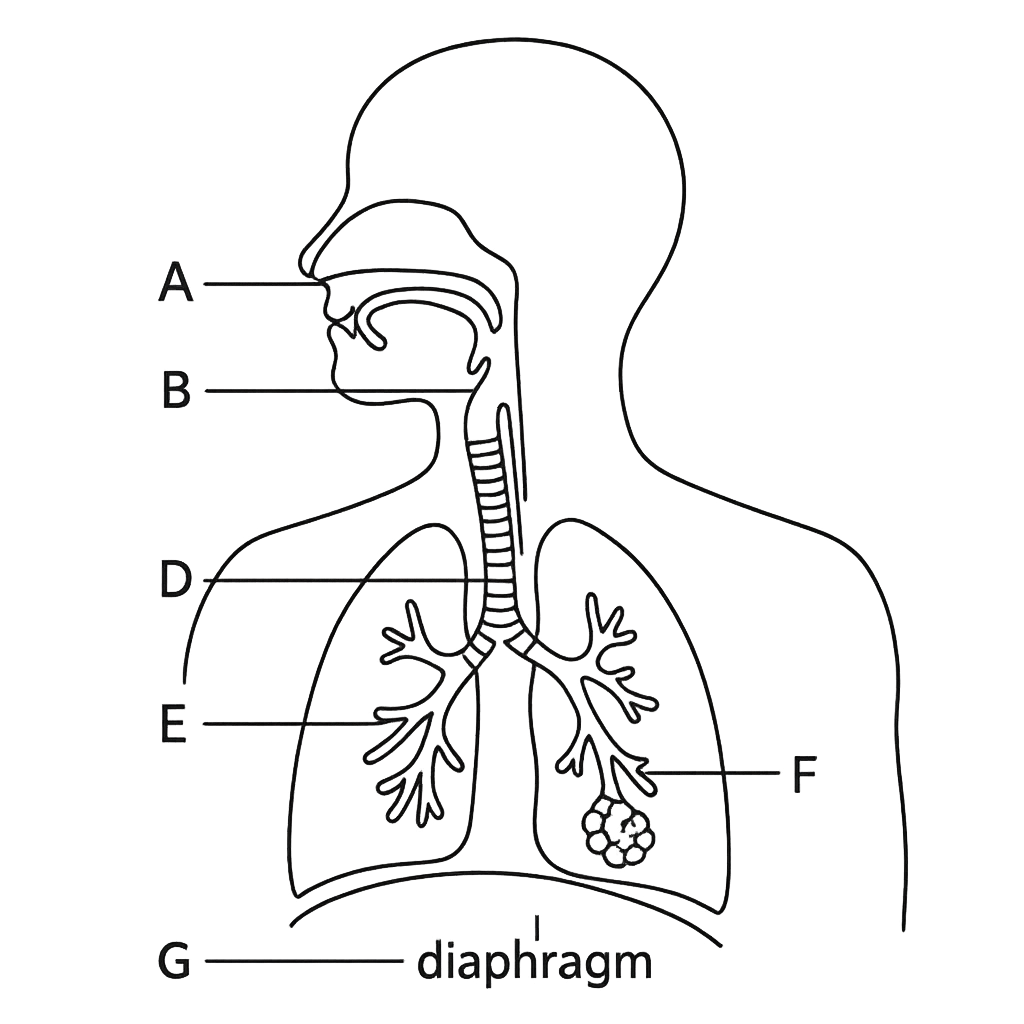
The labelled diagram shows the major structures of the human respiratory system, with the diaphragm marked as label G. During quiet inhalation the diaphragm contracts, increasing thoracic volume by 0.5 L. If the lung compliance is 0.2 L·kPa⁻¹, calculate the resulting decrease in intrapulmonary pressure (ΔP) in kPa. (Use \(\Delta P = \Delta V / C\).)
Correct A. 2.5 kPa
B. 0.1 kPa
C. 1.25 kPa
D. 5.0 kPa

Correct Answer: A

Want to see the full step-by-step solution? Unlock AI Explanation & Analytics
Question 11 View Details
A human somatic cell has a diploid chromosome number of \(46\). After DNA replication during the S phase of interphase, how many chromosomes and how many chromatids are present in the cell?
A. 92 chromosomes and 184 chromatids
B. 46 chromosomes and 46 chromatids
C. 46 chromosomes and 184 chromatids
Correct D. 46 chromosomes and 92 chromatids

Correct Answer: D

Want to see the full step-by-step solution? Unlock AI Explanation & Analytics
Question 12 View Details
A desert shrub (Plant A) has a leaf surface area of \(150\ \text{cm}^2\) and a stomatal density of \(200\) stomata per \(\text{mm}^2\). Another desert plant (Plant B) has a leaf area of \(80\ \text{cm}^2\) and a stomatal density of \(120\) stomata per \(\text{mm}^2\). Water loss per hour is proportional to the product of leaf area (in \(\text{mm}^2\)) and stomatal density. If Plant A loses \(0.90\ \text{g}\) of water per hour, estimate the water loss of Plant B in grams per hour (to two decimal places).
A. 0.35 g h^{-1}
Correct B. 0.29 g h^{-1}
C. 0.54 g h^{-1}
D. 0.48 g h^{-1}

Correct Answer: B

Want to see the full step-by-step solution? Unlock AI Explanation & Analytics
Question 13 View Details
In peas, gene \(A\) (tall) is dominant over \(a\) (short) and gene \(B\) (purple flower) is dominant over \(b\) (white flower). The two genes are linked with a recombination frequency of \(10\%\). A plant heterozygous for both genes in the coupling phase (genotype \(AB/ab\)) is crossed with a homozygous recessive plant (genotype \(aabb\)). What percentage of the offspring will be tall and have white flowers (phenotype \(A_\,b_\))?
A. 0%
Correct B. 5%
C. 10%
D. 2.5%

Correct Answer: B

Want to see the full step-by-step solution? Unlock AI Explanation & Analytics
Question 14 View Details
A culture of *E. coli* starts with \(1\times10^{3}\) cells. Under optimal conditions the generation time is 20 min. After 2 hours an antibiotic is added that doubles the generation time for the remaining period. If the culture is observed for a total of 5 hours, how many cells are present at the end (express your answer in scientific notation to two significant figures)?
A. 2.0×10^6
B. 7.5×10^5
C. 3.0×10^6
Correct D. 1.5×10^6

Correct Answer: D

Want to see the full step-by-step solution? Unlock AI Explanation & Analytics
Question 15 View Details
A stretch reflex involves a sensory neuron that conducts impulses 0.5 m to the spinal cord at 80 m s\(^{-1}\), a synaptic delay of 0.5 ms, a motor neuron that conducts 0.4 m to the muscle at 60 m s\(^{-1}\), and an excitation‑contraction coupling delay of 2 ms. Calculate the total time from the onset of muscle stretch to the beginning of muscle contraction (in milliseconds, to one decimal place).
A. 16.2 ms
Correct B. 15.4 ms
C. 14.9 ms
D. 13.8 ms

Correct Answer: B

Want to see the full step-by-step solution? Unlock AI Explanation & Analytics
Question 16 View Details
A plant cell contains a large central organelle that occupies about 80% of the cell volume, stores an acidic solution, and is bounded by a membrane that actively pumps protons to maintain low pH. Which organelle is being described?
Correct A. large central vacuole
B. central vacuole
C. large central chloroplast
D. large central mitochondrion

Correct Answer: A

Want to see the full step-by-step solution? Unlock AI Explanation & Analytics
Question 17 View Details
At time zero a person's blood glucose concentration is 5.5 mmol L⁻¹. The pancreas secretes insulin at a rate of 0.8 units min⁻¹, each unit lowering glucose by 0.05 mmol L⁻¹ per minute. Simultaneously, glucagon is released at 0.3 units min⁻¹, each unit raising glucose by 0.07 mmol L⁻¹ per minute. Assuming the rates remain constant, what is the blood glucose concentration after 10 minutes?
A. 5.21
B. 5.50
Correct C. 5.31
D. 5.41

Correct Answer: C

Want to see the full step-by-step solution? Unlock AI Explanation & Analytics
Question 18 View Details
In a cultured cell population, 20 % of the cells are in interphase, 5 % in prophase, 3 % in metaphase, 2 % in anaphase and 1 % in telophase. What percentage of the cells are currently in any stage of mitosis?
Correct A. 11
B. 14
C. 10
D. 12

Correct Answer: A

Want to see the full step-by-step solution? Unlock AI Explanation & Analytics
Question 19 View Details
A diploid human somatic cell has 46 chromosomes. After the S‑phase of the cell cycle, how many chromatids are present in the nucleus?
A. 100
B. 48
C. 94
Correct D. 92

Correct Answer: D

Want to see the full step-by-step solution? Unlock AI Explanation & Analytics
Question 20 View Details
An unknown multicellular organism shows the following characteristics: (i) cells have cellulose cell walls, (ii) chloroplasts contain chlorophyll a and b, (iii) starch is stored as a reserve, (iv) the life cycle includes alternation of generations, (v) sperm are flagellated, and (vi) the organism lacks true vascular tissue. Based on these traits, state the kingdom and the most specific phylum to which the organism belongs.
A. Kingdom Plantae, Phylum Anthophyta
B. Kingdom Fungi, Phylum Bryophyta
Correct C. Kingdom Plantae, Phylum Bryophyta
D. Kingdom Plantae, Phylum Pteridophyta

Correct Answer: C

Want to see the full step-by-step solution? Unlock AI Explanation & Analytics
Question 21 View Details
A resting adult produces 200 mL of \(\mathrm{CO_2}\) per minute at STP. Assuming the respiratory quotient (\(\mathrm{RQ}\)) for their mixed diet is 0.85, calculate (a) the volume of \(\mathrm{O_2}\) consumed per minute, (b) the number of moles of \(\mathrm{O_2}\) consumed per minute, and (c) the number of moles of ATP generated per minute, given that complete oxidation of one molecule of glucose yields 38 ATP and consumes 6 \(\mathrm{O_2}\) molecules.
A. 170 mL; 0.0076 mol; 0.0482 mol ATP
B. 235.3 mL; 0.0098 mol; 0.0621 mol ATP
C. 235.3 mL; 0.0105 mol; 0.0525 mol ATP
Correct D. 235.3 mL; 0.0105 mol; 0.0665 mol ATP

Correct Answer: D

Want to see the full step-by-step solution? Unlock AI Explanation & Analytics
Question 22 View Details
In a lake ecosystem the primary producers generate 5 000 kcal of energy per day. Energy is transferred to the next trophic level with an efficiency of 10 %, from primary consumers to secondary consumers with 15 % efficiency, and from secondary to tertiary consumers with 5 % efficiency. A particular tertiary‑consumer fish species requires 0.8 kcal per individual per day and currently has a population of 200 individuals. (a) Calculate the total energy available at the tertiary level, (b) determine whether this energy can meet the population's demand, and (c) if not, compute the maximum number of individuals of this fish species that could be sustainably supported.
Correct A. 3.75 kcal; insufficient (deficit 156.25 kcal); maximum 4 individuals
B. 3.0 kcal; insufficient (deficit 157 kcal); maximum 3 individuals
C. 7.5 kcal; insufficient (deficit 152.5 kcal); maximum 9 individuals
D. 3.75 kcal; insufficient (deficit 150 kcal); maximum 5 individuals

Correct Answer: A

Want to see the full step-by-step solution? Unlock AI Explanation & Analytics
Question 23 View Details
A terrestrial plant exhibits the following characteristics: (i) true roots, (ii) a dominant sporophyte generation, (iii) seeds enclosed within a fruit, (iv) alternate leaves with netted venation, and (v) pentamerous (five‑part) flowers. Using the hierarchical classification system (kingdom → division → class → order → family), state the most specific taxonomic rank that can be assigned with confidence based on these traits, and justify your choice.
A. Division Magnoliophyta (flowering plants)
B. Order Rosales (rose order)
Correct C. Class Magnoliopsida (dicotyledons)
D. Family Rosaceae (rose family)

Correct Answer: C

Want to see the full step-by-step solution? Unlock AI Explanation & Analytics
Question 24 View Details
A diet provides 2 500 kcal per day with the macronutrient distribution 55 % carbohydrate, 30 % fat and 15 % protein. (a) Determine the grams of carbohydrate, fat and protein supplied each day. (b) Assuming each gram of carbohydrate yields 4 kcal and that oxidation of one molecule of glucose (C₆H₁₂O₆, molar mass 180 g mol⁻¹) produces 30 ATP, calculate the total moles of ATP generated per day from carbohydrate oxidation.
Correct A. Carbohydrate 343.8 g, Fat 83.3 g, Protein 93.8 g; ATP from carbohydrate oxidation ≈ 57.3 mol
B. Carbohydrate 340.0 g, Fat 85.0 g, Protein 95.0 g; ATP from carbohydrate oxidation ≈ 60.0 mol
C. Carbohydrate 345.0 g, Fat 82.0 g, Protein 92.0 g; ATP from carbohydrate oxidation ≈ 58.0 mol
D. Carbohydrate 350.0 g, Fat 80.0 g, Protein 90.0 g; ATP from carbohydrate oxidation ≈ 55.0 mol

Correct Answer: A

Want to see the full step-by-step solution? Unlock AI Explanation & Analytics
Question 25 View Details
In a beetle population the allele G (green) has an initial frequency \(p_{0}=0.60\). After five generations of random mating the observed frequency is \(p_{5}=0.48\). Assuming the change is caused solely by genetic drift, estimate the effective population size \(N_{e}\) using the drift variance formula \(\operatorname{Var}(p)=\frac{p(1-p)}{2N_{e}}\) per generation. Approximate \(N_{e}\) by treating the observed change (\(\Delta p = 0.12\)) as one standard deviation after five generations.
A. Nₑ ≈ 30 individuals
Correct B. Nₑ ≈ 42 individuals
C. Nₑ ≈ 60 individuals
D. Nₑ ≈ 84 individuals

Correct Answer: B

Want to see the full step-by-step solution? Unlock AI Explanation & Analytics

Master the Exam!

You've seen a preview, but there are thousands more questions plus AI tutor to break down complex solutions.

Unlock Full Access Available for Android & Windows
Help others prepare! Share this practice hub:
Chat with Support