gce model questions vol1 2019 physics | Objective

Prepare for your exams with gce model questions vol1 questions? Reviewing past/model questions is one of the most effective ways to guarantee a high score. This practice hub features authentic 2019 physics (Objective) questions designed to simulate the real exam environment.

Practice these randomly selected questions to test your readiness.

Question 1 View Details
An ideal gas is sealed in a rigid cylindrical container whose walls are made of a metal that expands uniformly in all directions with a linear expansion coefficient \( \alpha = 1.2 \times 10^{-5}\ \text{K}^{-1} \). Initially the gas is at temperature \( T_1 = 300\ \text{K} \) and pressure \( P_1 = 1.0 \times 10^{5}\ \text{Pa} \). The gas is heated until its pressure doubles. Assuming the volume of the container changes according to the metal's expansion (so the fractional change in volume is \( 3\alpha\Delta T \)), determine the final temperature of the gas (in kelvin, to the nearest kelvin).
A. 580
B. 600
Correct C. 607
D. 620

Correct Answer: C

Want to see the full step-by-step solution? Unlock AI Explanation & Analytics
Question 2 View Details
A long solenoid has \( n = 2.0 \times 10^{4}\ \text{turns m}^{-1} \) and carries a current \( I = 5.0\ \text{A} \). The magnetic field inside the solenoid is therefore uniform. A rectangular conducting loop of width \( w = 0.30\ \text{m} \) and resistance \( R = 0.5\ \Omega \) is pulled out of the field region at a constant speed \( v = 0.80\ \text{m s}^{-1} \), the side of length \( w \) being parallel to the field direction. Determine the electrical power dissipated in the loop while it is being pulled out, giving your answer in watts to three significant figures.
A. 2.10e-3
B. 9.00e-4
C. 1.45e-3
Correct D. 1.82e-3

Correct Answer: D

Want to see the full step-by-step solution? Unlock AI Explanation & Analytics
Question 3 View Details
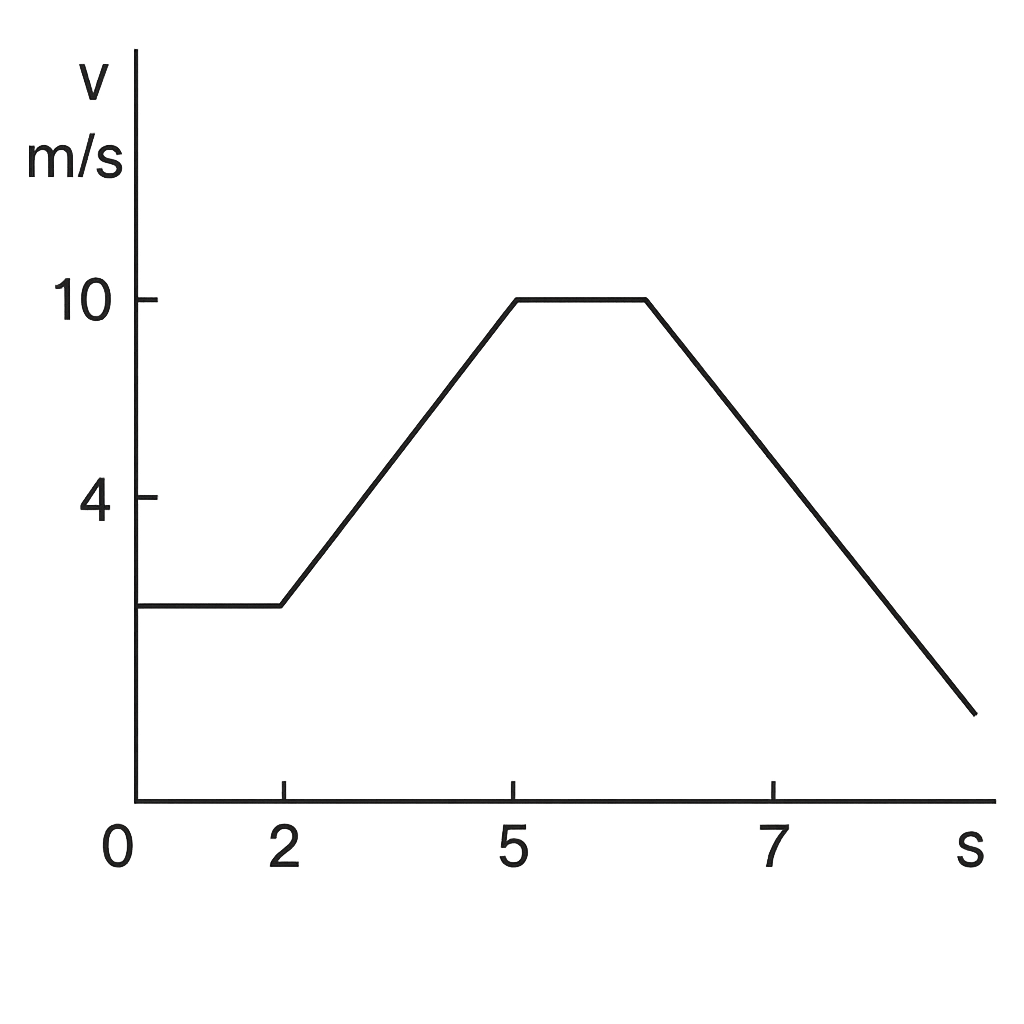
The velocity-time diagram for a particle moving in a straight line is described as follows: from \( t = 0\ \text{s} \) to \( t = 2\ \text{s} \) the particle moves with constant velocity \( 4\ \text{m s}^{-1} \); from \( t = 2\ \text{s} \) to \( t = 5\ \text{s} \) its velocity increases uniformly to \( 10\ \text{m s}^{-1} \); from \( t = 5\ \text{s} \) to \( t = 7\ \text{s} \) it continues at constant velocity \( 10\ \text{m s}^{-1} \); and from \( t = 7\ \text{s} \) to \( t = 9\ \text{s} \) its velocity decreases uniformly to zero. Using this information, calculate the total distance travelled by the particle between \( t = 0 \) and \( t = 9\ \text{s} \).
A. 55
B. 71
C. 63
Correct D. 59

Correct Answer: D

Want to see the full step-by-step solution? Unlock AI Explanation & Analytics
Question 4 View Details
A block of mass \( m = 5.0\ \text{kg} \) rests on a rough inclined plane that makes an angle \( \theta = 30^{\circ} \) with the horizontal. The coefficient of static friction between the block and the plane is \( \mu_s = 0.40 \). The block is prevented from sliding by a horizontal force \( P \) applied to the block (the force is directed up the plane). Determine the magnitude of the horizontal force \( P \) (in newtons, to two significant figures) required to keep the block in equilibrium.
Correct A. 7.1
B. 6.5
C. 9.0
D. 8.3

Correct Answer: A

Want to see the full step-by-step solution? Unlock AI Explanation & Analytics
Question 5 View Details
A metal block of mass \( 0.80\ \text{kg} \) and specific heat capacity \( c_{\text{m}} = 0.35\ \text{kJ kg}^{-1}\text{K}^{-1} \) is initially at \( 150^{\circ}\text{C} \). It is placed into an insulated calorimeter containing \( 0.50\ \text{kg} \) of water at \( 20^{\circ}\text{C} \). The specific heat capacity of water is \( c_{\text{w}} = 4.18\ \text{kJ kg}^{-1}\text{K}^{-1} \). After the system reaches thermal equilibrium the final temperature is \( 30^{\circ}\text{C} \). Assuming no heat loss to the surroundings, calculate the heat capacity of the calorimeter (in \(\text{kJ K}^{-1}\), to two decimal places).
A. 2.10
B. 0.85
Correct C. 1.27
D. 1.50

Correct Answer: C

Want to see the full step-by-step solution? Unlock AI Explanation & Analytics
Question 6 View Details
An observer moving towards a sound source notes that successive wave crests arrive at intervals of \(0.0018\ \text{s}\). The source is moving away from the observer at \(20\ \text{m s}^{-1}\). The speed of sound in air is \(340\ \text{m s}^{-1}\) and the relative speed of approach between observer and source is \(10\ \text{m s}^{-1}\). Determine the frequency of the sound emitted by the source (in Hz).
A. 500 Hz
B. 460 Hz
C. 520 Hz
Correct D. 480 Hz

Correct Answer: D

Want to see the full step-by-step solution? Unlock AI Explanation & Analytics
Question 7 View Details
A pipe open at both ends has length \(0.60\ \text{m}\). At an initial temperature \(T_{1}\) the fundamental frequency observed is \(340\ \text{Hz}\). After heating, the pipe resonates at its first overtone (second harmonic) with a measured frequency of \(720\ \text{Hz}\). The speed of sound in air varies with temperature as \(v = 331 + 0.6\,T\) (with \(v\) in \(\text{m s}^{-1}\) and \(T\) in \(^\circ\text{C}\)). Calculate the temperature increase \(\Delta T = T_{2} - T_{1}\) in degrees Celsius.
A. 30 \(^\circ\text{C}\)
B. 50 \(^\circ\text{C}\)
Correct C. 40 \(^\circ\text{C}\)
D. 45 \(^\circ\text{C}\)

Correct Answer: C

Want to see the full step-by-step solution? Unlock AI Explanation & Analytics
Question 8 View Details
A \(150\ \text{g}\) metal block at \(120^\circ\text{C}\) is placed into \(250\ \text{g}\) of water at \(25^\circ\text{C}\) in an insulated container. The final equilibrium temperature is \(30^\circ\text{C}\). Assuming no heat loss to the surroundings and that the specific heat capacity of water is \(4.18\ \text{J g}^{-1}\, ^\circ\text{C}^{-1}\), determine the specific heat capacity of the metal. If the metal were replaced by a different metal under the same initial conditions and the final equilibrium temperature rose to \(35^\circ\text{C}\), what would be the specific heat capacity of this second metal? Give both values in \(\text{J g}^{-1}\, ^\circ\text{C}^{-1}\) to two significant figures.
A. 0.45 J g^{-1} °C^{-1}, 0.70 J g^{-1} °C^{-1}
B. 0.50 J g^{-1} °C^{-1}, 0.75 J g^{-1} °C^{-1}
Correct C. 0.39 J g^{-1} °C^{-1}, 0.82 J g^{-1} °C^{-1}
D. 0.33 J g^{-1} °C^{-1}, 0.90 J g^{-1} °C^{-1}

Correct Answer: C

Want to see the full step-by-step solution? Unlock AI Explanation & Analytics
Question 9 View Details
A rigid sealed container of volume \(2.0\ \text{L}\) initially contains \(0.050\ \text{mol}\) of an ideal gas at \(300\ \text{K}\) and pressure \(P_{1}\). An identical empty container of the same volume is connected to it by a valve. The valve is opened, allowing the gas to expand isothermally until the pressures equalise, then the valve is closed. The combined system is subsequently heated to \(450\ \text{K}\). Determine the final pressure in each container (in atm). Use \(R = 0.0821\ \text{L atm mol}^{-1}\,\text{K}^{-1}\).
Correct A. 0.462 atm
B. 0.600 atm
C. 0.350 atm
D. 0.525 atm

Correct Answer: A

Want to see the full step-by-step solution? Unlock AI Explanation & Analytics
Question 10 View Details
In a hydrogen discharge tube the wavelength of the Balmer line corresponding to the transition \(n=3 \rightarrow n=2\) is measured as \(656.3\ \text{nm}\). Using this information, calculate the wavelength of the Lyman line for the transition \(n=2 \rightarrow n=1\). Use the Rydberg formula \( \frac{1}{\lambda}=R\left(\frac{1}{n_{1}^{2}}-\frac{1}{n_{2}^{2}}\right) \) and give your answer in nanometres to one decimal place.
A. 131.0 nm
B. 102.5 nm
Correct C. 121.5 nm
D. 115.8 nm

Correct Answer: C

Want to see the full step-by-step solution? Unlock AI Explanation & Analytics
Question 11 View Details
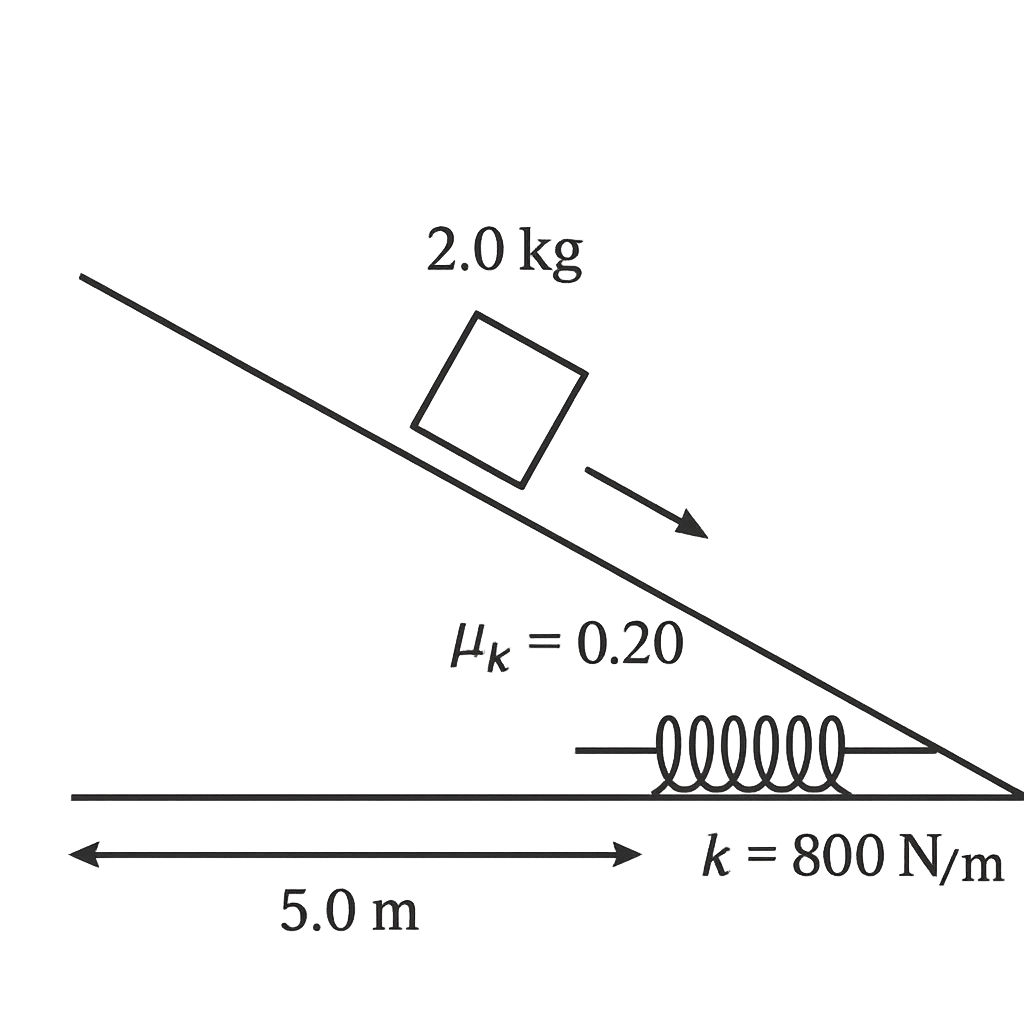
A block of mass \(2.0\ \text{kg}\) starts from rest at the top of a rough inclined plane of length \(5.0\ \text{m}\) making an angle of \(30^{\circ}\) with the horizontal. The coefficient of kinetic friction between the block and the plane is \(0.20\). At the bottom of the incline a horizontal spring of spring constant \(800\ \text{N m}^{-1}\) is attached, initially uncompressed. The block compresses the spring by \(0.10\ \text{m}\). Using the diagram, calculate the speed of the block at the instant it has compressed the spring by \(0.10\ \text{m}\).
A. 4.85 m/s
B. 5.80 m/s
C. 6.20 m/s
Correct D. 5.30 m/s

Correct Answer: D

Want to see the full step-by-step solution? Unlock AI Explanation & Analytics
Question 12 View Details
An isotope A (atomic mass \(60\ \text{u}\)) decays by \(\beta^{-}\) emission with a half‑life of \(30\ \text{min}\). Each decay releases on average \(0.5\ \text{MeV}\) of kinetic energy (beta particle plus antineutrino). A detector records a total released energy of \(1.2\times10^{6}\ \text{J}\) over a period of \(2\ \text{h}\). Assuming all decays occur within the sample, determine the initial mass of isotope A present at the start of the measurement.
A. 2.0×10⁻⁶ kg (≈2.0 mg)
B. 1.8×10⁻⁶ kg (≈1.8 mg)
C. 1.2×10⁻⁶ kg (≈1.2 mg)
Correct D. 1.6×10⁻⁶ kg (≈1.6 mg)

Correct Answer: D

Want to see the full step-by-step solution? Unlock AI Explanation & Analytics
Question 13 View Details
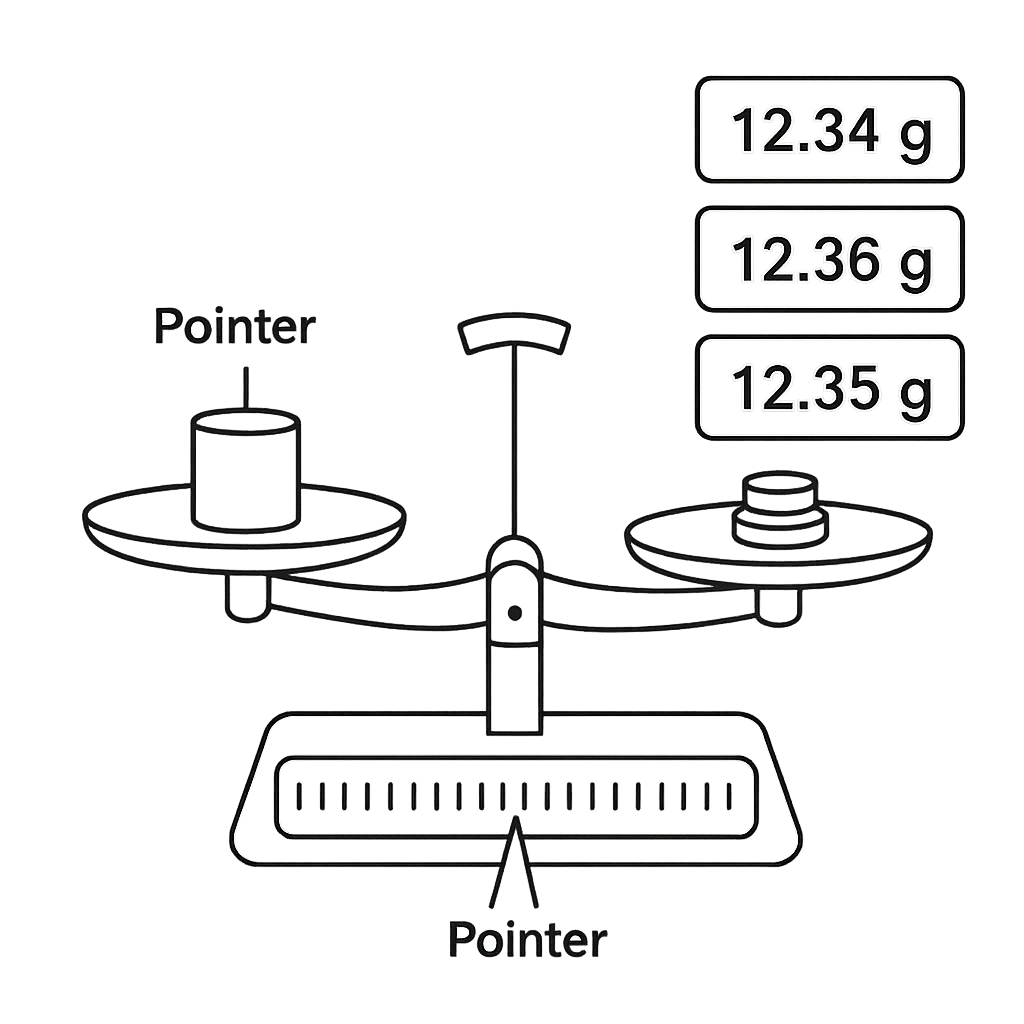
Using the balance shown in the diagram, a student records three successive mass readings of a metal cylinder: \(12.34\ \text{g}\), \(12.36\ \text{g}\) and \(12.35\ \text{g}\). The balance reads to the nearest \(0.01\ \text{g}\). Calculate the mean mass of the cylinder and the absolute uncertainty, taken as half the range of the readings.
Correct A. 12.35 ± 0.01 g
B. 12.35 ± 0.02 g
C. 12.34 ± 0.01 g
D. 12.36 ± 0.01 g

Correct Answer: A

Want to see the full step-by-step solution? Unlock AI Explanation & Analytics
Question 14 View Details
In a circuit a battery of emf \(E\) and internal resistance \(r\) is connected to an external resistor \(R\). When \(R = 5.0\ \Omega\) the current measured is \(2.0\ \text{A}\) and the terminal voltage across the resistor is \(8.0\ \text{V}\). When \(R\) is changed to \(10.0\ \Omega\) the current falls to \(1.5\ \text{A}\). Determine the emf \(E\) of the battery and its internal resistance \(r\).
Correct A. E = 36 V, r = 14 Ω
B. E = 30 V, r = 10 Ω
C. E = 40 V, r = 12 Ω
D. E = 34 V, r = 16 Ω

Correct Answer: A

Want to see the full step-by-step solution? Unlock AI Explanation & Analytics
Question 15 View Details
A \(500\ \text{g}\) copper block (specific heat capacity \(c_{\text{Cu}} = 0.385\ \text{J g}^{-1}\text{K}^{-1}\)) at \(150^{\circ}\text{C}\) is placed into a calorimeter containing \(2.0\ \text{kg}\) of water at \(20^{\circ}\text{C}\). The calorimeter itself has a heat capacity of \(100\ \text{J K}^{-1}\). Assuming no heat loss to the surroundings, calculate the final equilibrium temperature of the system (to one decimal place).
A. 24.1 °C
B. 19.8 °C
C. 27.3 °C
Correct D. 22.9 °C

Correct Answer: D

Want to see the full step-by-step solution? Unlock AI Explanation & Analytics
Question 16 View Details
A hydraulic press consists of two pistons connected by an incompressible fluid. The small piston has an area of \(0.01\ \text{m}^2\) and the large piston has an area of \(0.20\ \text{m}^2\). A mass of \(5\ \text{kg}\) is placed on the small piston, and a downward force of \(150\ \text{N}\) is applied in addition to the weight. The system is open to the atmosphere, whose pressure is \(1.01\times10^{5}\ \text{Pa}\). Determine the upward force exerted by the large piston on the load it lifts.
A. 2.10e4
Correct B. 2.42e4
C. 2.70e4
D. 1.95e4

Correct Answer: B

Want to see the full step-by-step solution? Unlock AI Explanation & Analytics
Question 17 View Details
A car starts from rest and moves with a constant acceleration. In the first \(5\ \text{s}\) it travels a distance of \(100\ \text{m}\). It continues to accelerate at the same rate for a further \(5\ \text{s}\). Find the speed of the car after the total \(10\ \text{s}\).
Correct A. 80
B. 90
C. 70
D. 100

Correct Answer: A

Want to see the full step-by-step solution? Unlock AI Explanation & Analytics
Question 18 View Details
An electron (mass \(9.11\times10^{-31}\ \text{kg}\), charge magnitude \(e = 1.60\times10^{-19}\ \text{C}\)) enters a uniform magnetic field of magnitude \(0.8\ \text{T}\) directed into the page. Its initial speed is \(3.0\times10^{5}\ \text{m s}^{-1}\) and the velocity makes an angle of \(30^{\circ}\) with the field direction. Determine the radius of the resulting helical trajectory of the electron.
Correct A. 1.07e-6
B. 2.14e-6
C. 1.07e-5
D. 5.3e-7

Correct Answer: A

Want to see the full step-by-step solution? Unlock AI Explanation & Analytics
Question 19 View Details
A sealed metal cylinder contains air at a pressure of \(1.00\ \text{atm}\) and temperature \(300\ \text{K}\). The internal volume of the cylinder at \(300\ \text{K}\) is \(1.00\ \text{L}\). The cylinder is heated uniformly to \(400\ \text{K}\). Its material expands linearly by \(0.5\%\) for every \(100\ \text{K}\) rise in temperature (the same fractional change applies to the volume). Assuming the amount of gas remains constant and the gas behaves ideally, calculate the new pressure inside the cylinder (in atm).
Correct A. 1.33
B. 1.20
C. 0.80
D. 1.50

Correct Answer: A

Want to see the full step-by-step solution? Unlock AI Explanation & Analytics
Question 20 View Details
Two large parallel plates each of area \(0.020\ \text{m}^2\) are separated by a total distance of \(5.0\ \text{mm}\). Between them a slab of dielectric material with relative permittivity \(\varepsilon_{r}=4\) fills the lower \(3.0\ \text{mm}\) of the gap, leaving a vacuum gap of \(2.0\ \text{mm}\) above the slab. The capacitor is connected to a \(12\ \text{V}\) battery. Determine the overall capacitance of this arrangement (in farads).
A. 9.1e-11
B. 5.3e-11
Correct C. 6.4e-11
D. 7.8e-11

Correct Answer: C

Want to see the full step-by-step solution? Unlock AI Explanation & Analytics
Question 21 View Details
A ^{226}_{88}Ra nucleus decays by emitting an \(\alpha\) particle to form ^{222}_{86}Rn, which subsequently undergoes a \(\beta^{+}\) decay to ^{222}_{85}At while emitting a positron. The atomic masses are: \(m(^{226}_{88}\text{Ra}) = 226.02541\ \text{u}\), \(m(^{222}_{86}\text{Rn}) = 222.01758\ \text{u}\), \(m(^{222}_{85}\text{At}) = 222.01850\ \text{u}\), \(m_{\alpha}=4.002603\ \text{u}\), and the positron mass \(m_{e^{+}} = 0.00054858\ \text{u}\). Using \(1\ \text{u}=931.5\ \text{MeV}\), calculate the total energy released in the combined decay sequence.
Correct A. 3.5 MeV
B. 4.1 MeV
C. 2.8 MeV
D. 5.0 MeV

Correct Answer: A

Want to see the full step-by-step solution? Unlock AI Explanation & Analytics
Question 22 View Details
A length is measured as \(12.34\ \text{cm}\) with an absolute uncertainty of \(\pm 0.05\ \text{cm}\). Express the measurement in metres with the appropriate uncertainty, using correct significant figures.
A. 0.1240 m ± 0.0005 m
B. 0.1234 m ± 0.005 m
C. 0.123 m ± 0.0005 m
Correct D. 0.1234 m ± 0.0005 m

Correct Answer: D

Want to see the full step-by-step solution? Unlock AI Explanation & Analytics
Question 23 View Details
A \(4.0\ \text{kg}\) block rests on an incline that makes an angle of \(25^{\circ}\) with the horizontal. The coefficient of kinetic friction between the block and the plane is \(\mu_k = 0.15\). The block is attached to a light inextensible rope that passes over a frictionless pulley to a hanging mass \(m\). Determine the value of \(m\) (in kilograms) that will cause the block to move up the incline with constant speed.
A. 1.85 kg
B. 3.10 kg
Correct C. 2.23 kg
D. 2.50 kg

Correct Answer: C

Want to see the full step-by-step solution? Unlock AI Explanation & Analytics
Question 24 View Details
A proton enters the region between two parallel plates that are \(2.0\ \text{cm}\) apart and have a potential difference of \(200\ \text{V}\). The length of the field region along the direction of motion is \(4.0\ \text{cm}\). The proton enters at the midpoint between the plates with an initial speed of \(2.0\times10^{5}\ \text{m s}^{-1}\) directed parallel to the plates. Assuming the electric field is uniform, calculate the vertical deflection of the proton when it leaves the field region. Give your answer in centimetres, to two significant figures.
A. 0.95 cm
B. 3.8 cm
C. 2.5 cm
Correct D. 1.9 cm

Correct Answer: D

Want to see the full step-by-step solution? Unlock AI Explanation & Analytics
Question 25 View Details
A car starts from rest and accelerates uniformly at \(2.0\ \text{m s}^{-2}\) for \(5.0\ \text{s}\). It then travels at the speed attained for a further \(10.0\ \text{s}\) before decelerating uniformly to rest in \(4.0\ \text{s}\). Find the total distance covered by the car during the whole motion.
A. 155 m
Correct B. 145 m
C. 125 m
D. 135 m

Correct Answer: B

Want to see the full step-by-step solution? Unlock AI Explanation & Analytics

Master the Exam!

You've seen a preview, but there are thousands more questions plus AI tutor to break down complex solutions.

Unlock Full Access Available for Android & Windows
Help others prepare! Share this practice hub:
Chat with Support