gce model questions vol1 2018 geography | Objective

Prepare for your exams with gce model questions vol1 questions? Reviewing past/model questions is one of the most effective ways to guarantee a high score. This practice hub features authentic 2018 geography (Objective) questions designed to simulate the real exam environment.

Practice these randomly selected questions to test your readiness.

Question 1 View Details
A region is exposed to three types of environmental hazards: flood, earthquake and landslide. The monetary loss per event is £(200{,}000) for a flood, £(150{,}000) for an earthquake and £(100{,}000) for a landslide. Let the annual probabilities of occurrence be (p) (flood), (q) (earthquake) and (r) (landslide). The expected annual loss is £(120{,}000). It is known that the flood contribution to the total loss is twice that of the earthquake, and that the landslide probability is half the flood probability. Calculate the annual probability (p) of a flood (expressed as a decimal to three significant figures).
A. 0.500
B. 0.400
C. 0.250
Correct D. 0.343

Correct Answer: D

Want to see the full step-by-step solution? Unlock AI Explanation & Analytics
Question 2 View Details
Town A is located at (3^{circ}30'\) S, (15^{circ}00'\) E and Town B at (2^{circ}45'\) N, (14^{circ}30'\) W. Which town is nearer to the Equator?
Correct A. Town B
B. Town A
C. Town D
D. Town C

Correct Answer: A

Want to see the full step-by-step solution? Unlock AI Explanation & Analytics
Question 3 View Details
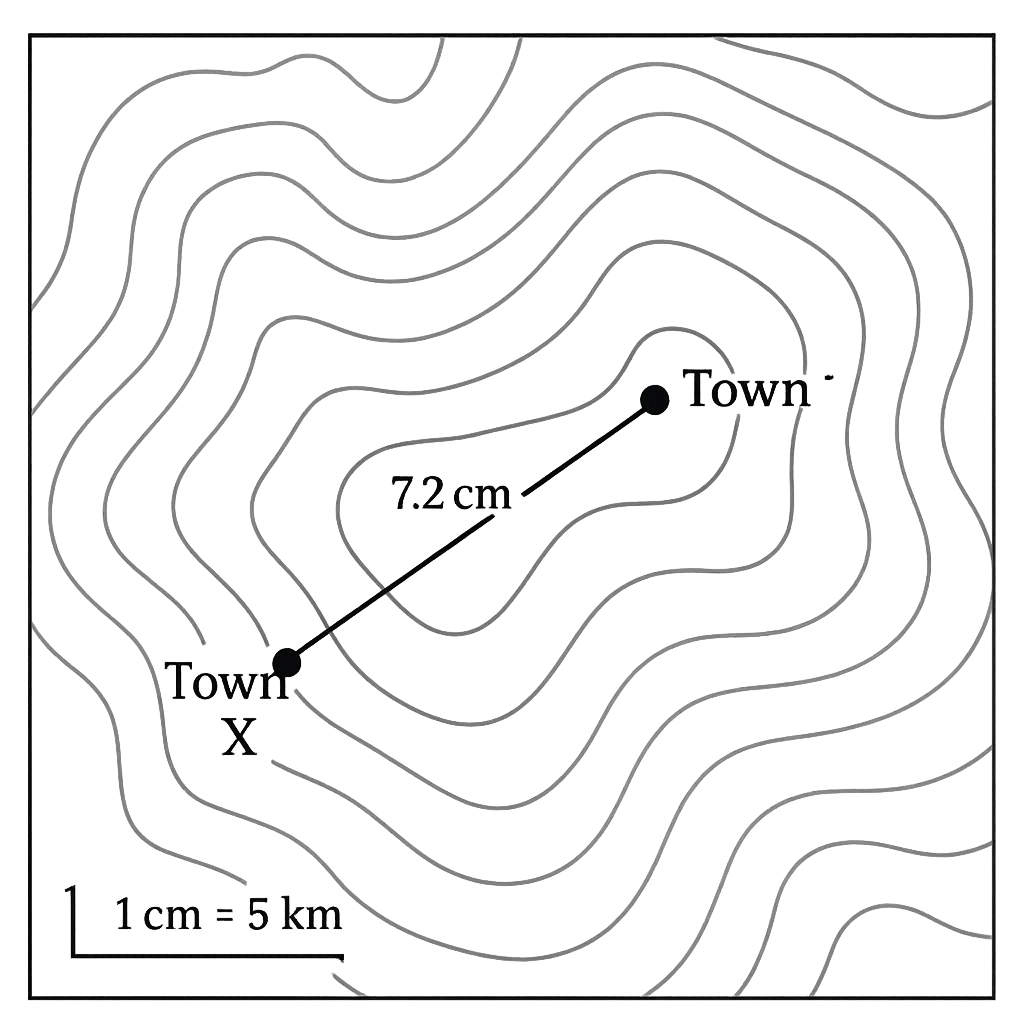
A topographic map shows Town X and Town Y. The map scale is 1 cm : 5 km. The straight‑line distance between the two towns measures 7.2 cm on the map. Contour lines are drawn at 20 m intervals; Town X lies on the 120 m contour and Town Y on the 200 m contour. Determine the actual straight‑line distance between the towns in kilometres and the average gradient (percentage) of the line joining them.
A. Distance = 38 km; Gradient = 0.20 %
B. Distance = 35 km; Gradient = 0.23 %
Correct C. Distance = 36 km; Gradient = 0.22 %
D. Distance = 36 km; Gradient = 0.25 %

Correct Answer: C

Want to see the full step-by-step solution? Unlock AI Explanation & Analytics
Question 4 View Details
A 1000 kg sample of sedimentary rock consists of 40 % quartz, 30 % calcite, 20 % feldspar and 10 % clay by mass. Densities are: quartz 2.65 g cm⁻³, calcite 2.71 g cm⁻³, feldspar 2.55 g cm⁻³, clay 2.30 g cm⁻³. During metamorphism, quartz and feldspar retain their densities, calcite transforms to marble (density 2.70 g cm⁻³) and clay transforms to mica (density 2.80 g cm⁻³). Assuming mass of each component is conserved, what percentage of the total volume of the metamorphosed rock is occupied by mica? Give your answer to one decimal place.
A. 10.2
B. 8.7
C. 11.0
Correct D. 9.5

Correct Answer: D

Want to see the full step-by-step solution? Unlock AI Explanation & Analytics
Question 5 View Details
A town currently has a population of 50 000 and provides a hospital, a university and a railway station. To be classified as a regional centre it must (i) have a population exceeding 40 000 and (ii) offer at least three of the following services: hospital, university, airport, major shopping centre, railway station. A major shopping centre is scheduled to open in two years, and the population is expected to increase by 8 % as a result of the new centre. Will the town satisfy the regional‑centre criteria after the shopping centre opens?
Correct A. Yes
B. No
C. Nope
D. Negative

Correct Answer: A

Want to see the full step-by-step solution? Unlock AI Explanation & Analytics
Question 6 View Details
A soil sample consists of 60 % sand, 30 % silt and 10 % clay by weight. The field capacity (FC) can be estimated by \(FC = 0.2S + 0.4Si + 0.5C\) where S, Si and C are the percentages of sand, silt and clay respectively. The sample also contains 5 % stones by volume, which do not hold water. Calculate the effective volumetric field capacity of the soil (as a decimal fraction of total soil volume).
A. 0.300
B. 0.252
Correct C. 0.276
D. 0.240

Correct Answer: C

Want to see the full step-by-step solution? Unlock AI Explanation & Analytics
Question 7 View Details
Two factories produce the same product and sell each unit for £35. Factory A has fixed costs of £120,000 and a variable cost of £15 per unit for the first 5,000 units; for any production above 5,000 units the variable cost falls by 20 % because of bulk purchasing. Factory B has fixed costs of £80,000 and a constant variable cost of £20 per unit. Determine the smallest whole number of units that must be produced for Factory A to achieve a higher profit than Factory B, and state the profit advantage (in £) of Factory A at that output level.
A. 4,999 units; £12
B. 5,002 units; £5
C. 5,000 units; £10
Correct D. 5,001 units; £8

Correct Answer: D

Want to see the full step-by-step solution? Unlock AI Explanation & Analytics
Question 8 View Details
A homogeneous soil layer 1.5 m thick drains vertically under gravity with a unit hydraulic gradient. The upper 0.5 m of the layer has hydraulic conductivity \(K_1 = 1.2\times10^{-5}\,\text{m\,s}^{-1}\); the lower 1.0 m has conductivity \(K_2 = 0.8\times10^{-5}\,\text{m\,s}^{-1}\). The initial volumetric water content is the saturation value \(\theta_s = 0.45\) and the desired final water content is the field‑capacity value \(\theta_{fc}=0.25\). Assuming drainage proceeds uniformly, estimate the time required (in hours) for the water content to fall from saturation to field capacity.
A. 7.4
B. 12.3
Correct C. 8.9
D. 10.1

Correct Answer: C

Want to see the full step-by-step solution? Unlock AI Explanation & Analytics
Question 9 View Details
A field rests on a homogeneous soil with hydraulic conductivity \(K = 2.0\times10^{-5}\,\text{m\,s}^{-1}\). The impermeable layer lies at a depth \(D = 2.0\) m below the surface. The design requires that the steady‑state rise of the water table above the impermeable layer not exceed \(H = 0.8\) m. Using Hooghoudt's equation for parallel tile drains spaced a distance \(L\) metres apart,\n\[\nq = \frac{4K H\,(2D+H)}{L^{2}},\n\]\nwhere \(q\) is the discharge per unit length of drain. If each drain can safely convey a maximum discharge of \(q_{\max}=1.5\times10^{-4}\,\text{m}^{3}\text{s}^{-1}\) per metre of drain, calculate the maximum allowable spacing \(L\) (in metres) between drains.
A. 1.78
B. 1.20
Correct C. 1.43
D. 2.05

Correct Answer: C

Want to see the full step-by-step solution? Unlock AI Explanation & Analytics
Question 10 View Details
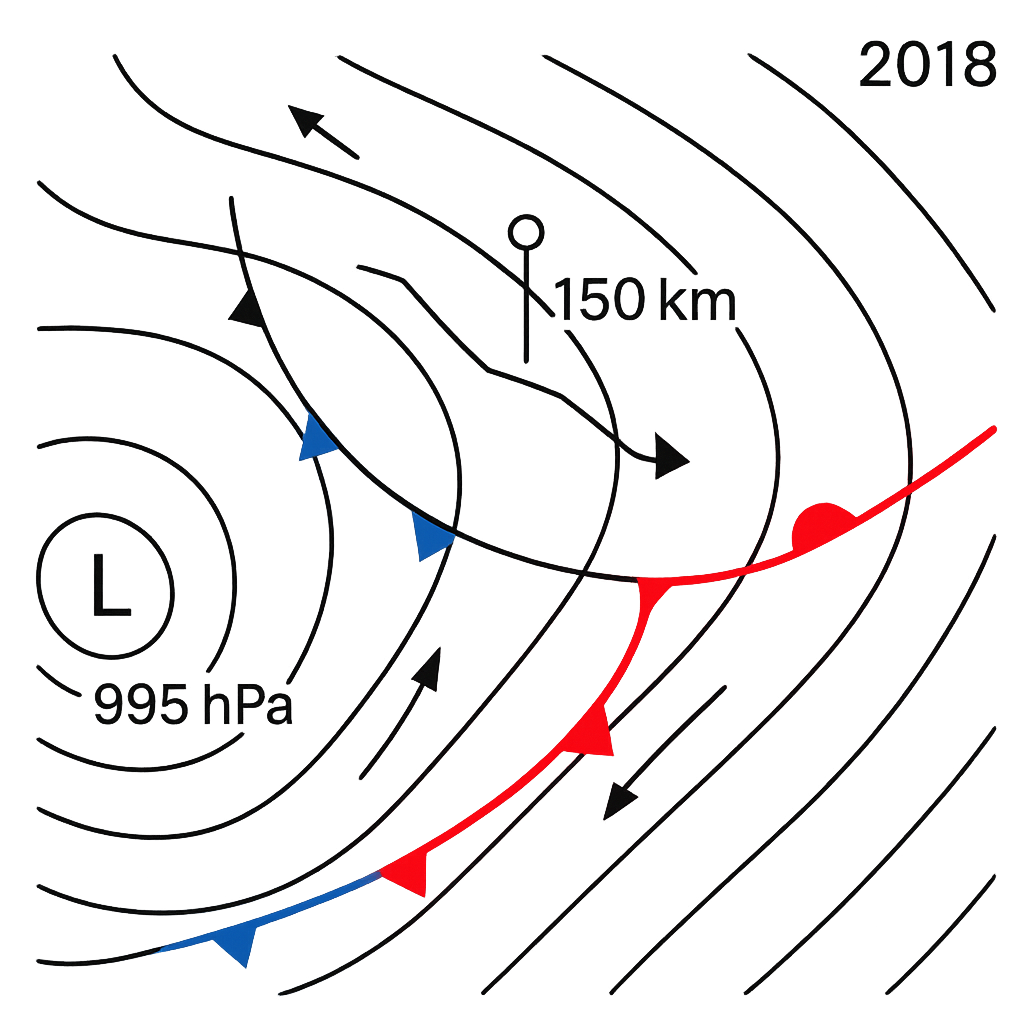
The weather map shows isobars with a central low pressure of 995 hPa. A warm front (red line) extends eastward from the low, with wind symbols indicating flow from the south‑south‑east ahead of the front. A cold front (blue line) approaches from the north, with wind symbols showing flow from the north‑north‑west ahead of the front. At a station located 150 km north of the low centre, the wind is currently from the south‑south‑east. Based on the map, describe the sequence of weather changes that the station will experience as the cold front passes, specifying the conditions before the front arrives, during the passage, and after the front has moved through.
A. Before: cool, dry, clear skies, wind from the north‑north‑west. During: temperature rises gradually, light rain, wind shifts to south‑south‑east. After: warm, humid, overcast, wind from the south‑south‑east.
B. Before: warm, humid, partly cloudy with light rain, wind from the south‑south‑east. During: temperature rises slightly, moderate rain, wind remains from the south‑south‑east. After: cooler, drier, clear skies, wind shifts to south‑south‑east.
Correct C. Before: warm, humid, partly cloudy with light rain, wind from the south‑south‑east. During: temperature drops sharply, heavy rain or thunderstorms, wind shifts to north‑north‑west. After: cooler, drier, clear skies, wind from north‑north‑west.
D. Before: warm, humid, partly cloudy with light rain, wind from the south‑south‑east. During: temperature drops sharply, heavy snow, wind shifts to east‑north‑east. After: colder, drier, foggy, wind from the east‑north‑east.

Correct Answer: C

Want to see the full step-by-step solution? Unlock AI Explanation & Analytics
Question 11 View Details
A town had a population of 1,200,000 in 2010. By 2015 the population had risen to 1,260,000. During this period the crude birth rate was constant at 18 per 1,000 population per year and the crude death rate was constant at 9 per 1,000 population per year. Assuming the rates applied to the average population over the five‑year period, calculate the average net migration per year (in persons) for the town between 2010 and 2015.
A. 720
B. 1080
C. 450
Correct D. 930

Correct Answer: D

Want to see the full step-by-step solution? Unlock AI Explanation & Analytics
Question 12 View Details
City A is at sea level (0 m) and latitude \(30^{\circ}\) N, with an average annual temperature of \(22^{\circ}\)C. City B lies on the same longitude but at latitude \(45^{\circ}\) N and an altitude of 1500 m. Using a standard environmental lapse rate of \(6.5^{\circ}\)C per 1000 m and assuming that temperature decreases by \(0.5^{\circ}\)C for each degree of latitude north of \(30^{\circ}\) N, estimate the average annual temperature of City B (to one decimal place).
A. 5.3
Correct B. 4.8
C. 3.9
D. 6.2

Correct Answer: B

Want to see the full step-by-step solution? Unlock AI Explanation & Analytics
Question 13 View Details
A sedimentary rock sample has a volumetric composition of 40 % quartz, 30 % calcite, 20 % feldspar and 10 % clay minerals. During diagenesis the quartz volume is reduced by 10 % of its original amount, while calcite volume increases by 5 % of its original amount. The total rock volume remains constant, with the remaining minerals adjusting proportionally to preserve the total. What is the new percentage of calcite in the rock (to one decimal place)?
A. 30.0
B. 28.7
C. 32.5
Correct D. 31.5

Correct Answer: D

Want to see the full step-by-step solution? Unlock AI Explanation & Analytics
Question 14 View Details
A location has a mean annual temperature of \(15^{\circ}\)C, with the warmest month averaging \(25^{\circ}\)C and the coldest month \(5^{\circ}\)C. The total annual precipitation is 800 mm, of which 70 % falls in the summer half‑year (April-September). Using the Köppen climate classification criteria, determine the first two letters of the climate type for this location.
Correct A. Cf
B. Cs
C. Cw
D. Df

Correct Answer: A

Want to see the full step-by-step solution? Unlock AI Explanation & Analytics
Question 15 View Details
An industrial plant manufactures 2000 tonnes of product per year. Its labour productivity is 0.5 tonne per worker per year. The plant purchases raw material from local suppliers; for every 100 tonnes of raw material purchased, 2 full‑time equivalent (FTE) jobs are created in the supply sector. In addition, for every 10 direct workers employed by the plant, 3 jobs are created in ancillary services. Assuming the plant requires one tonne of raw material for each tonne of product, calculate the total employment (direct plus indirect) associated with the plant.
A. 4240
B. 5280
Correct C. 5240
D. 5440

Correct Answer: C

Want to see the full step-by-step solution? Unlock AI Explanation & Analytics
Question 16 View Details
Station A records a pressure of 1015 hPa and Station B, located 300 km east of A, records 1005 hPa. Assuming air density 1.2 kg m⁻³ and a Coriolis parameter of \(1.0\times10^{-4}\,\text{s}^{-1}\) (Northern Hemisphere), calculate the approximate geostrophic wind speed in m s⁻¹ and state its cardinal direction (e.g., northerly).
Correct A. ≈28 m s⁻¹ northerly
B. ≈35 m s⁻¹ southerly
C. ≈22 m s⁻¹ easterly
D. ≈30 m s⁻¹ westerly

Correct Answer: A

Want to see the full step-by-step solution? Unlock AI Explanation & Analytics
Question 17 View Details
A drainage catchment consists of two sub‑catchments. Sub‑catchment A has an area of 5 km², runoff coefficient 0.4 and a main channel length of 2 km on a 5 % slope. Sub‑catchment B has an area of 3 km², runoff coefficient 0.6 and a main channel length of 1.5 km on an 8 % slope. The design storm intensity is obtained from the IDF relation \(I = \frac{200}{(t_c+5)^{0.6}}\) (mm h⁻¹), where \(t_c\) is the time of concentration in minutes calculated by Kirpich's formula \(t_c = 0.0195\,L^{0.77}S^{-0.385}\). Using these data, compute the peak discharge from each sub‑catchment (in m³ s⁻¹) and the total peak discharge. A proposed culvert has two capacity options: 30 m³ s⁻¹ (Option 1) and 35 m³ s⁻¹ (Option 2). Which option satisfies the design requirement?
A. Option 1 (35 m³ s⁻¹ capacity)
B. Option 2 (30 m³ s⁻¹ capacity)
C. Option 1 (30 m³ s⁻¹ capacity)
Correct D. Option 2 (35 m³ s⁻¹ capacity)

Correct Answer: D

Want to see the full step-by-step solution? Unlock AI Explanation & Analytics
Question 18 View Details
Two possible road routes connect Town X to Town Y. - Route A: distance 120 km, average speed 60 km h⁻¹, vehicle operating cost £0.30 km⁻¹, toll £5 per trip, no environmental surcharge. - Route B: distance 150 km, average speed 75 km h⁻¹, vehicle operating cost £0.25 km⁻¹, no toll, but an environmental cost of £0.10 km⁻¹. The monetary value of travel time is £8 per hour. Assuming a single vehicle makes one trip, calculate the total cost per trip for each route (including operating, toll/environmental, and time costs). If 200 trips are made per year, determine the annual cost for each route and state which route should be selected on economic grounds.
A. Route B
B. Route C
Correct C. Route A
D. Route D

Correct Answer: C

Want to see the full step-by-step solution? Unlock AI Explanation & Analytics
Question 19 View Details
In a region three settlements are located as follows: - Town A: population 45 000, services - regional hospital, university, airport. - Town B: population 12 000, services - secondary school, district hospital. - Village C: population 3 500, services - primary school only. Distances: A-B = 30 km, B-C = 20 km, A-C = 45 km. A new railway reduces travel time between B and C by 50 % and between A and B by 20 %. Using central‑place theory (considering thresholds and ranges of services), re‑evaluate the functional hierarchy of the settlements after the railway improvement. Identify the rank of each settlement (e.g., regional centre, secondary centre, local centre).
A. Town A - secondary centre; Town B - regional centre; Village C - local centre
Correct B. Town A - regional centre; Town B - secondary centre; Village C - local centre
C. Town A - regional centre; Town B - local centre; Village C - secondary centre
D. Town A - local centre; Town B - secondary centre; Village C - regional centre

Correct Answer: B

Want to see the full step-by-step solution? Unlock AI Explanation & Analytics
Question 20 View Details
A town's population was 80 000 in the year 2000. It follows logistic growth with a carrying capacity of 200 000 and an intrinsic growth rate of 0.04 year⁻¹. Using the logistic formula \(P(t)=\frac{K}{1+ \left(\frac{K-P_0}{P_0}\right)e^{-rt}}\), determine the first calendar year in which the population will exceed 150 000.
A. 2040
B. 2035
C. 2025
Correct D. 2038

Correct Answer: D

Want to see the full step-by-step solution? Unlock AI Explanation & Analytics
Question 21 View Details
A cuesta consists of a plateau that is 150 m high above the base, a vertical escarpment, and a dip‑slope that makes an angle of \(5^{\circ}\) with the horizontal. The plateau extends horizontally 200 m beyond the top of the dip‑slope. Determine (a) the horizontal distance from the base of the escarpment to the foot of the dip‑slope and (b) the total area of the cross‑section (the rectangle of the plateau plus the right‑triangle of the dip‑slope). Give your answers to the nearest metre and square metre respectively.
A. Horizontal distance ≈ 1,630 m; total area ≈ 152,400 m²
B. Horizontal distance ≈ 1,750 m; total area ≈ 160,200 m²
Correct C. Horizontal distance ≈ 1,715 m; total area ≈ 158,588 m²
D. Horizontal distance ≈ 1,800 m; total area ≈ 165,000 m²

Correct Answer: C

Want to see the full step-by-step solution? Unlock AI Explanation & Analytics
Question 22 View Details
A terminal moraine has a cross‑section that can be approximated by an isosceles trapezoid. The lower base measures 120 m, the upper base 80 m, and the moraine extends 500 m along the valley. The bulk density of the moraine material is \(2.2\) t m\(^{-3}\) and the total mass of material in the moraine is \(1.76\) million tonnes. Calculate the average thickness (height) of the moraine in metres.
A. Average thickness ≈ 14 m
B. Average thickness ≈ 20 m
C. Average thickness ≈ 18 m
Correct D. Average thickness ≈ 16 m

Correct Answer: D

Want to see the full step-by-step solution? Unlock AI Explanation & Analytics
Question 23 View Details
A farmer has 12 ha of land that can be planted with wheat or legumes. Wheat yields \(3.5\) t ha\(^{-1}\) and requires \(120\) kg of nitrogen per ha; legumes yield \(2.0\) t ha\(^{-1}\) and require \(30\) kg of nitrogen per ha (the rest is fixed from the atmosphere). Synthetic nitrogen costs \(\$0.80\) per kg. Market prices are \(\$250\) per tonne of wheat and \(\$300\) per tonne of legumes. The farmer has a budget of \(\$800\) for nitrogen fertilizer and must spend the whole budget. Determine the area (to one decimal place) to allocate to wheat and to legumes that maximises profit, and give the maximum profit (to the nearest dollar).
A. Wheat ≈ 6.5 ha, Legumes ≈ 5.5 ha; maximum profit ≈ \$7,900
B. Wheat ≈ 5.0 ha, Legumes ≈ 7.0 ha; maximum profit ≈ \$7,200
Correct C. Wheat ≈ 7.1 ha, Legumes ≈ 4.9 ha; maximum profit ≈ \$8,356
D. Wheat ≈ 8.0 ha, Legumes ≈ 4.0 ha; maximum profit ≈ \$8,800

Correct Answer: C

Want to see the full step-by-step solution? Unlock AI Explanation & Analytics
Question 24 View Details
A field has a soil with field capacity \(0.35\) cm³ cm\(^{-3}\) and wilting point \(0.15\) cm³ cm\(^{-3}\). The bulk density is \(1.3\) g cm\(^{-3}\) and the root‑zone depth is 60 cm. The farmer wishes to raise the soil moisture from wilting point to field capacity over an area of 5 ha. Assuming 15 % of the applied water is lost to percolation, calculate (a) the volume of water that must be applied (in cubic metres) and (b) the mass of this water (in tonnes). Give answers to the nearest whole number.
A. Water to apply ≈ 8,200 m³; mass ≈ 8,200 tonnes
Correct B. Water to apply ≈ 7,059 m³; mass ≈ 7,059 tonnes
C. Water to apply ≈ 6,500 m³; mass ≈ 6,500 tonnes
D. Water to apply ≈ 7,500 m³; mass ≈ 7,500 tonnes

Correct Answer: B

Want to see the full step-by-step solution? Unlock AI Explanation & Analytics
Question 25 View Details
Region A covers 45,000 km², had a 2020 population of 12 million and an urbanisation rate of 68 %. Its annual population growth rate is 1.2 %. Region B covers 30,000 km², had a 2020 population of 9 million and an urbanisation rate of 55 %. Its annual growth rate is 1.8 %. Both regions plan to increase urban housing by 10 % of the projected 2025 urban population, assuming the proportion of people living in urban areas remains constant. Assuming an average household size of 4 persons, calculate for each region: (a) the projected total population in 2025, (b) the projected urban population in 2025, (c) the additional number of urban dwellings required. Finally, state which region will need the larger increase in urban housing.
A. Region A: projected 2025 population ≈ 12.80 million, urban ≈ 8.70 million, additional dwellings ≈ 218,000. Region B: projected 2025 population ≈ 9.90 million, urban ≈ 5.45 million, additional dwellings ≈ 136,500. Region B needs the larger increase.
B. Region A: projected 2025 population ≈ 12.74 million, urban ≈ 8.66 million, additional dwellings ≈ 210,000. Region B: projected 2025 population ≈ 9.84 million, urban ≈ 5.41 million, additional dwellings ≈ 140,000. Region A needs the larger increase.
Correct C. Region A: projected 2025 population ≈ 12.74 million, urban ≈ 8.66 million, additional dwellings ≈ 216,459. Region B: projected 2025 population ≈ 9.84 million, urban ≈ 5.41 million, additional dwellings ≈ 135,321. Region A needs the larger increase.
D. Region A: projected 2025 population ≈ 12.74 million, urban ≈ 9.00 million, additional dwellings ≈ 225,000. Region B: projected 2025 population ≈ 9.84 million, urban ≈ 5.20 million, additional dwellings ≈ 130,000. Region A needs the larger increase.

Correct Answer: C

Want to see the full step-by-step solution? Unlock AI Explanation & Analytics

Master the Exam!

You've seen a preview, but there are thousands more questions plus AI tutor to break down complex solutions.

Unlock Full Access Available for Android & Windows
Help others prepare! Share this practice hub:
Chat with Support