gce model questions vol1 2017 geography | Objective

Prepare for your exams with gce model questions vol1 questions? Reviewing past/model questions is one of the most effective ways to guarantee a high score. This practice hub features authentic 2017 geography (Objective) questions designed to simulate the real exam environment.

Practice these randomly selected questions to test your readiness.

Question 1 View Details
A river drops from an elevation of \(800\) m at its source to \(200\) m at its mouth over a total length of \(120\) km. Along its course there is a waterfall that drops \(30\) m over a \(2\) km stretch. Calculate the average gradient (in m km⁻¹) of the remaining stretch of the river (excluding the waterfall) and state whether the overall average gradient of the river exceeds \(5\) m km⁻¹.
A. Yes; the average gradient is approximately 4.50 m km⁻¹, which is less than 5 m km⁻¹.
Correct B. No; the average gradient is approximately 4.83 m km⁻¹, which is less than 5 m km⁻¹.
C. No; the average gradient is approximately 5.00 m km⁻¹, which is equal to 5 m km⁻¹.
D. Yes; the average gradient is approximately 5.12 m km⁻¹, which is greater than 5 m km⁻¹.

Correct Answer: B

Want to see the full step-by-step solution? Unlock AI Explanation & Analytics
Question 2 View Details
In a region, 40 % of the land is covered by forest, 35 % by grassland and 20 % by wetland. Overlaps occur as follows: 10 % is both forest and grassland, 5 % is both forest and wetland, 8 % is both grassland and wetland, and 2 % is covered by all three vegetation types. What percentage of the region is covered by at least one of these vegetation types?
A. 72 %
Correct B. 74 %
C. 70 %
D. 78 %

Correct Answer: B

Want to see the full step-by-step solution? Unlock AI Explanation & Analytics
Question 3 View Details
A map has a scale of 1 : 50 000. If the distance between two towns measures \(7\) cm on the map, what is the actual distance between the towns in kilometres?
A. 35 km
B. 0.35 km
C. 5 km
Correct D. 3.5 km

Correct Answer: D

Want to see the full step-by-step solution? Unlock AI Explanation & Analytics
Question 4 View Details
From point A to point B the bearing is \(135^{\circ}\) and the distance is \(12\) km. From point B to point C the bearing is \(045^{\circ}\) and the distance is \(5\) km. Assuming straight lines, calculate the straight‑line distance from A to C (in km).
A. 14 km
B. 10 km
Correct C. 13 km
D. 12 km

Correct Answer: C

Want to see the full step-by-step solution? Unlock AI Explanation & Analytics
Question 5 View Details
A town has a current population of \(150{,}000\). The natural increase (births minus deaths) is \(1.2\)% per year, and net migration adds \(800\) people each year. What will be the population after five years? (Round to the nearest whole person.)
A. 164,500
Correct B. 163,316
C. 163,000
D. 159,219

Correct Answer: B

Want to see the full step-by-step solution? Unlock AI Explanation & Analytics
Question 6 View Details
A mixed‑farm of 120 ha grows wheat, maize and beans. Yields per hectare are 3.2 t wheat, 2.8 t maize and 1.5 t beans. Market prices are £150 / t wheat, £120 / t maize and £200 / t beans. Variable costs per hectare are £180 wheat, £150 maize and £210 beans, and fixed overheads for the whole farm are £12 000. The farmer wants a total profit of at least £15 000 and must allocate at least 20 % of the land to beans. What is the minimum whole‑hectare area that must be planted to wheat to meet the profit target?
A. 58
Correct B. 62
C. 65
D. 70

Correct Answer: B

Want to see the full step-by-step solution? Unlock AI Explanation & Analytics
Question 7 View Details
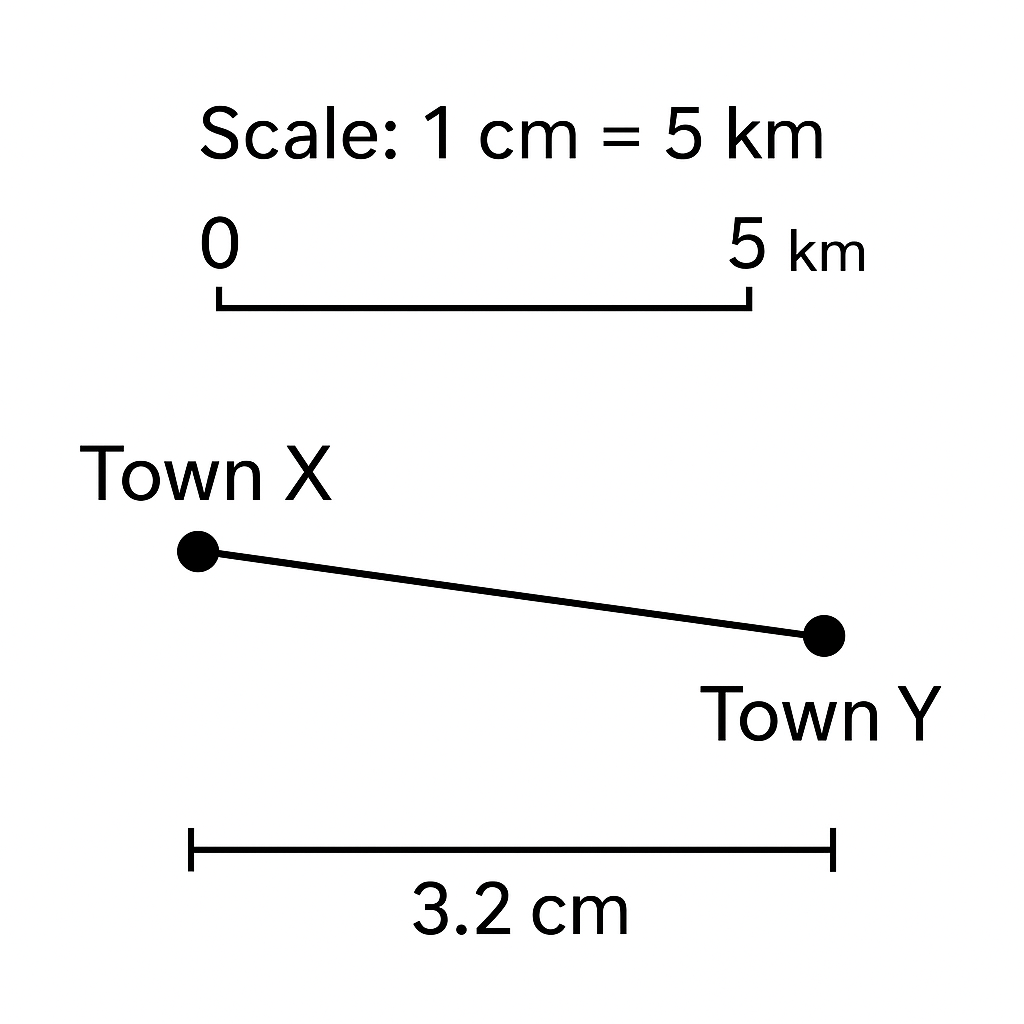
On the map the straight‑line distance between Town X and Town Y measures 3.2 cm. The map scale is 1 cm : 5 km. What is the actual distance between the towns in kilometres?
A. 24
B. 20
C. 12
Correct D. 16

Correct Answer: D

Want to see the full step-by-step solution? Unlock AI Explanation & Analytics
Question 8 View Details
The table below gives data for three regions.\n\n\begin{tabular}{lccc}\nRegion & Rainfall (mm) & Mean temperature (°C) & Population density (people/km\^2)\\\nA & 450 & 22 & 80\\\nB & 800 & 25 & 150\\\nC & 400 & 18 & 60\\n\end{tabular}\n\nA suitability score S for a new irrigation scheme is calculated as\n\[ S = 0.4R + 0.3T + 0.3P \]\nwhere\n\[ R = \frac{500-\text{rainfall}}{500}\ \text{if rainfall}\le500\ \text{mm, otherwise }0,\]\n\[ T = \frac{30-|\text{temp}-25|}{30}\ \text{if 20\le\text{temp}\le30, otherwise }0,\]\n\[ P = \frac{100-\text{density}}{100}\ \text{if density}\le100, otherwise }0.\]\nWhich region obtains the highest suitability score?
A. Region C
Correct B. Region A
C. Region B
D. Region D

Correct Answer: B

Want to see the full step-by-step solution? Unlock AI Explanation & Analytics
Question 9 View Details
City M lies at 12°30' N latitude and City N at 5°15' S latitude. What is the angular distance between the two cities in degrees (to two decimal places)?
A. 18.00
B. 12.75
C. 17.50
Correct D. 17.75

Correct Answer: D

Want to see the full step-by-step solution? Unlock AI Explanation & Analytics
Question 10 View Details
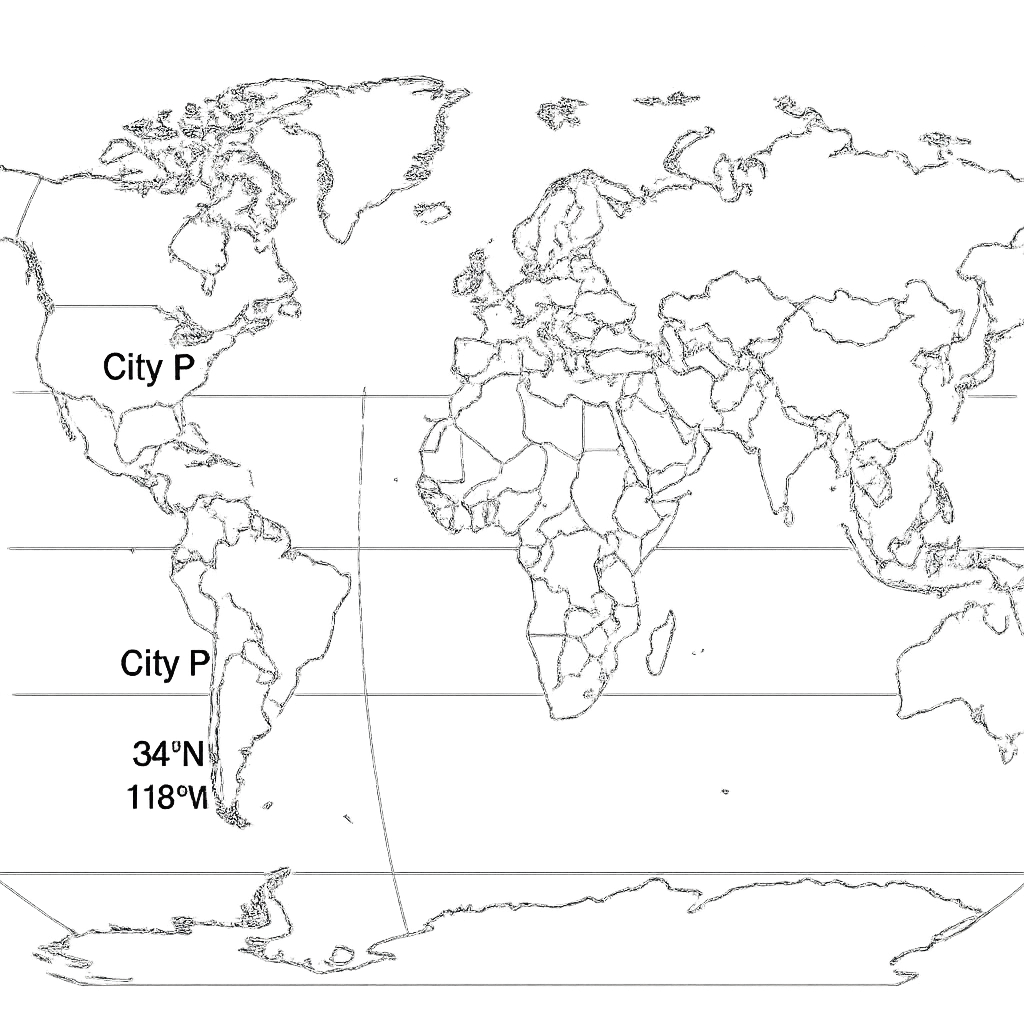
A world map shows two marked cities. City P is at 34° N, 118° W and City Q is at 40° N, 73° W. Which city is situated farther north?
A. City P
B. City R
Correct C. City Q
D. City S

Correct Answer: C

Want to see the full step-by-step solution? Unlock AI Explanation & Analytics
Question 11 View Details
Town A has 1200 houses arranged in a regular rectangular grid with \(40\) m spacing between adjacent houses in both east‑west and north‑south directions. The grid consists of \(30\) rows each containing \(40\) houses. Each household has an average of \(4\) persons and the town contains a single central market that serves the whole population. (a) Calculate the population density of the town in persons per square kilometre. (b) Using the calculated density, decide whether the settlement pattern is more likely to be nucleated or dispersed, assuming a density above \(2000\) persons km⁻² indicates a nucleated pattern.
A. Population density ≈ 3000 persons km⁻²; pattern is dispersed.
B. Population density ≈ 1800 persons km⁻²; pattern is nucleated.
Correct C. Population density ≈ 2654 persons km⁻²; pattern is nucleated.
D. Population density ≈ 2100 persons km⁻²; pattern is dispersed.

Correct Answer: C

Want to see the full step-by-step solution? Unlock AI Explanation & Analytics
Question 12 View Details
From point A to point B a traveller can choose between two multimodal routes. Route 1: a bus travels \(30\) km at an average speed of \(60\) km h⁻¹, then the traveller walks the remaining \(5\) km at \(5\) km h⁻¹. No waiting time is incurred. Route 2: a train covers \(20\) km at \(80\) km h⁻¹, after which the traveller takes a taxi for \(10\) km at \(40\) km h⁻¹. A transfer waiting time of \(12\) minutes occurs between the train and the taxi. The taxi costs £0.50 per kilometre, the bus costs £0.30 per kilometre and the train ticket costs a flat £5.00. The traveller values time twice as much as money, using the utility function \(U = 2 \times (\text{total travel time in minutes}) + (\text{total monetary cost in pounds})\). Which route gives the lower utility value and what is that value?
A. Route 2; utility = 100
B. Route 1; utility = 94
Correct C. Route 2; utility = 94
D. Route 1; utility = 189

Correct Answer: C

Want to see the full step-by-step solution? Unlock AI Explanation & Analytics
Question 13 View Details
A farmer has \(10\) ha of land to allocate between two crops, X and Y. Crop X: yield = \(3\) tonnes ha⁻¹, profit = £150 per tonne, labour requirement = \(2\) days ha⁻¹, water use = \(5\) units ha⁻¹. Crop Y: yield = \(2\) tonnes ha⁻¹, profit = £300 per tonne, labour requirement = \(3\) days ha⁻¹, water use = \(4\) units ha⁻¹. The farmer has at most \(24\) labour‑days and \(44\) water units available. Determine the allocation of hectares to X and Y that maximises total profit, and state the maximum profit.
Correct A. X ≈ 5.14 ha, Y ≈ 4.57 ha; maximum profit ≈ £5 057
B. X ≈ 4.50 ha, Y ≈ 5.50 ha; maximum profit ≈ £5 200
C. X ≈ 5.14 ha, Y ≈ 4.57 ha; maximum profit ≈ £4 900
D. X ≈ 6.00 ha, Y ≈ 4.00 ha; maximum profit ≈ £4 800

Correct Answer: A

Want to see the full step-by-step solution? Unlock AI Explanation & Analytics
Question 14 View Details
A new textile factory creates \(500\) direct jobs. The regional employment multiplier is \(2.5\) (including indirect and induced jobs). However, for each full \(100\) direct jobs above \(300\), the effective multiplier is reduced by \(10\)% of the original multiplier. Calculate the total employment impact (direct + indirect + induced) of the factory.
A. 950 total jobs
Correct B. 1000 total jobs
C. 1 250 total jobs
D. 1 100 total jobs

Correct Answer: B

Want to see the full step-by-step solution? Unlock AI Explanation & Analytics
Question 15 View Details
An igneous rock originally consists of 40 % quartz, 35 % feldspar, 15 % mica and 10 % other minerals (by weight). Weathering removes 20 % of the original feldspar content. (a) What is the new percentage of quartz in the remaining rock? (b) Based on the new mineral proportions, suggest the most appropriate rock name.
A. Quartz ≈ 30 %; rock remains a diorite‑type (weathered diorite).
B. Quartz ≈ 38 %; rock remains a basalt‑type (weathered basaltic rock).
Correct C. Quartz ≈ 43 %; rock remains a granite‑type (weathered granite/granitic gneiss).
D. Quartz ≈ 50 %; rock remains a rhyolite‑type (weathered rhyolite).

Correct Answer: C

Want to see the full step-by-step solution? Unlock AI Explanation & Analytics
Question 16 View Details
Two adjacent plateaus were formed from the uplift of a former plain that lay at \(300\ \text{m}\) above sea level. After uplift, both plateaus experienced erosion at constant rates: Plateau A erodes at \(0.2\ \text{mm\ yr}^{-1}\) and Plateau B at \(0.35\ \text{mm\ yr}^{-1}\). The present surface elevations are \(1200\ \text{m}\) for Plateau A and \(950\ \text{m}\) for Plateau B. Assuming the uplift occurred at the same time for both plateaus and that erosion has acted continuously since then, calculate (a) the time elapsed since uplift (in years, to the nearest thousand) and (b) the amount of uplift (in metres, to the nearest metre).
Correct A. Time ≈ 1 667 000 years; uplift ≈ 1 233 m
B. Time ≈ 1 200 000 years; uplift ≈ 1 100 m
C. Time ≈ 1 667 000 years; uplift ≈ 1 300 m
D. Time ≈ 2 000 000 years; uplift ≈ 1 500 m

Correct Answer: A

Want to see the full step-by-step solution? Unlock AI Explanation & Analytics
Question 17 View Details
Soil X has a texture of 40 % sand, 30 % silt and 30 % clay, while Soil Y contains 20 % sand, 50 % silt and 30 % clay. Using the empirical relations \[\text{FC}=0.2\,\%\text{clay}+0.1\,\%\text{silt}+0.05\,\%\text{sand},\qquad \text{WP}=0.1\,\%\text{clay}+0.05\,\%\text{silt}+0.02\,\%\text{sand},\] where FC and WP are expressed as percentages of water content, determine which soil has the greater available water capacity (AWC = FC - WP) and state the difference in AWC between the two soils (in percentage points, to one decimal place).
A. Soil Y; difference = 0.6 percentage points
B. Soil X; difference = 0.2 percentage points
Correct C. Soil Y; difference = 0.4 percentage points
D. Soil X; difference = 0.4 percentage points

Correct Answer: C

Want to see the full step-by-step solution? Unlock AI Explanation & Analytics
Question 18 View Details
An unconfined aquifer has hydraulic conductivity \(K = 2.5 \times 10^{-5}\ \text{m\ s}^{-1}\) and a hydraulic gradient \(i = 0.0015\). The effective porosity is \(n = 0.35\). The straight‑line distance from a recharge zone to a spring is \(3.2\ \text{km}\). Assuming flow follows the hydraulic gradient directly, calculate the travel time for a water molecule from recharge to the spring, expressing your answer in years (rounded to the nearest whole year).
Correct A. 948 years
B. 1050 years
C. 950 years
D. 820 years

Correct Answer: A

Want to see the full step-by-step solution? Unlock AI Explanation & Analytics
Question 19 View Details
A textile firm is choosing between two sites for a new factory.\n\nSite A: fixed capital cost £2.5 million, variable production cost £45 t⁻¹, distance to main market 120 km.\nSite B: fixed capital cost £2.0 million, variable production cost £48 t⁻¹, distance to market 80 km.\n\nTransport cost is £0.12 per tonne per kilometre. The plant is expected to produce 30 000 tonnes per year and the capital cost is amortised over 20 years (ignore discounting). Determine which site gives the lower average total cost per tonne (including fixed, variable and transport costs). State the chosen site and the corresponding average cost per tonne (to two decimal places).
A. Site A; £60.93 per tonne
B. Site A; £61.45 per tonne
C. Site B; £62.10 per tonne
Correct D. Site B; £60.93 per tonne

Correct Answer: D

Want to see the full step-by-step solution? Unlock AI Explanation & Analytics
Question 20 View Details
A shipment of 10 tonnes must be moved from City X to City Y.\n\nRoute 1: road only, distance 250 km, average speed 80 km h⁻¹, cost £0.25 per km per tonne, no transfers.\n\nRoute 2: rail for 150 km (speed 100 km h⁻¹, cost £0.18 per km per tonne) then road for 120 km (speed 70 km h⁻¹, cost £0.22 per km per tonne). A transfer penalty of £15 per tonne is incurred at the rail‑road interchange.\n\nThe value of time is £0.05 per tonne per hour of transport.\n\nCalculate the total cost per tonne for each route (including transport cost, time cost and any transfer penalty) and indicate which route is cheaper. Give the costs to two decimal places.
A. Route 1; £63.12 per tonne
B. Route 2; £71.20 per tonne
Correct C. Route 1; £62.66 per tonne
D. Route 2; £68.56 per tonne

Correct Answer: C

Want to see the full step-by-step solution? Unlock AI Explanation & Analytics
Question 21 View Details
Given a soil layer 0-30 cm deep with a bulk density of 1.4 g\,cm⁻³ and a porosity of 45 %, the field capacity occupies 60 % of the pore space and the wilting point occupies 30 % of the pore space. Calculate the plant‑available water (PAW) for this layer in millimetres (mm) of water depth per square metre.
Correct A. ≈ 41 mm
B. ≈ 35 mm
C. ≈ 55 mm
D. ≈ 48 mm

Correct Answer: A

Want to see the full step-by-step solution? Unlock AI Explanation & Analytics
Question 22 View Details
An urban planner wants to locate a new supermarket that requires a minimum of 8 000 customers per week to be viable. In the town each resident shops once per week and the residential population density is 2 000 persons per km². Assuming the supermarket draws customers uniformly from a circular catchment area, determine the minimum radius (in km, to two decimal places) of this catchment. Then, if a second identical supermarket is opened 12 km away from the first, decide whether their catchment areas overlap.
Correct A. Radius ≈ 1.13 km; no overlap
B. Radius ≈ 1.30 km; no overlap
C. Radius ≈ 0.95 km; overlap
D. Radius ≈ 1.13 km; overlap

Correct Answer: A

Want to see the full step-by-step solution? Unlock AI Explanation & Analytics
Question 23 View Details
A metamorphic rock contains both garnet and staurolite. Experimental phase diagrams show that garnet is stable at pressures ≥ 5 kbar and temperatures ≥ 550 °C, while staurolite is stable at pressures ≥ 4 kbar and temperatures ≥ 500 °C. (a) What are the minimum pressure and temperature conditions that the rock must have experienced? (b) Assuming a lithostatic pressure gradient of 0.27 kbar km⁻¹, estimate the minimum depth (in km, to one decimal place) at which these conditions were met.
A. (a) ≥ 6 kbar and ≥ 550 °C; (b) ≈ 22.5 km
Correct B. (a) ≥ 5 kbar and ≥ 550 °C; (b) ≈ 18.5 km
C. (a) ≥ 5 kbar and ≥ 600 °C; (b) ≈ 20.0 km
D. (a) ≥ 4 kbar and ≥ 500 °C; (b) ≈ 15.0 km

Correct Answer: B

Want to see the full step-by-step solution? Unlock AI Explanation & Analytics
Question 24 View Details
In 2000 a town had a population of 80 000. From 2000 to 2010 it grew at an annual compound rate of 2.5 %. From 2010 to 2020 the annual growth rate fell linearly from 2.5 % to 1.5 %. After 2020 the rate remained constant at 1.5 % per year. Estimate the town's population in 2025 (rounded to the nearest thousand).
A. 128 000
B. 150 000
C. 140 000
Correct D. 134 000

Correct Answer: D

Want to see the full step-by-step solution? Unlock AI Explanation & Analytics
Question 25 View Details
A country has a total land area of 150 000 km², of which 60 000 km² is forest. The government plans a programme that (i) reduces the annual deforestation rate from 2 % to 0.5 % after five years, and (ii) plants 800 km² of new forest each year throughout the whole period. Assuming the deforestation each year applies to the forest area existing at the start of that year, calculate the total forest area after ten years. Give your answer to the nearest hundred km².
A. 61 200 km²
B. 62 400 km²
Correct C. 60 600 km²
D. 59 400 km²

Correct Answer: C

Want to see the full step-by-step solution? Unlock AI Explanation & Analytics

Master the Exam!

You've seen a preview, but there are thousands more questions plus AI tutor to break down complex solutions.

Unlock Full Access Available for Android & Windows
Help others prepare! Share this practice hub:
Chat with Support