gce model questions vol1 2017 biology | Objective

Prepare for your exams with gce model questions vol1 questions? Reviewing past/model questions is one of the most effective ways to guarantee a high score. This practice hub features authentic 2017 biology (Objective) questions designed to simulate the real exam environment.

Practice these randomly selected questions to test your readiness.

Question 1 View Details
Data on a hypothetical population are given below. - Survival probability from birth to age 1: 0.80 - Survival probability from age 1 to age 2: 0.60 - Survival probability from age 2 to age 3: 0.40 - Average number of female offspring produced per female at ages 1, 2 and 3 are respectively 1.2, 2.5 and 1.0. Assuming no reproduction after age 3, calculate the net reproductive rate \(R_0\) for the population and state whether the population is expected to increase, decrease or remain stable.
A. R_0 = 2.80 (approximately) and the population will increase.
B. R_0 = 3.10 (approximately) and the population will increase.
Correct C. R_0 = 2.35 (approximately) and the population will increase.
D. R_0 = 1.90 (approximately) and the population will decrease.

Correct Answer: C

Want to see the full step-by-step solution? Unlock AI Explanation & Analytics
Question 2 View Details
A 30‑year‑old female weighing 70 kg and 165 cm tall leads a moderately active lifestyle (activity factor 1.55). Using the Harris‑Benedict equation, first calculate her basal metabolic rate (BMR). Then determine her total daily energy expenditure (TDEE). She wishes to lose 5 kg over 8 weeks. Assuming 1 kg of body fat corresponds to 7700 kcal, calculate the average daily caloric deficit required and state whether this deficit is within the generally accepted safe limit of 1000 kcal per day.
A. Average daily deficit ≈ 500 kcal; this is within the safe limit.
B. Average daily deficit ≈ 950 kcal; this exceeds the safe limit.
C. Average daily deficit ≈ 1 200 kcal; this exceeds the safe limit.
Correct D. Average daily deficit ≈ 688 kcal; this is within the safe limit.

Correct Answer: D

Want to see the full step-by-step solution? Unlock AI Explanation & Analytics
Question 3 View Details
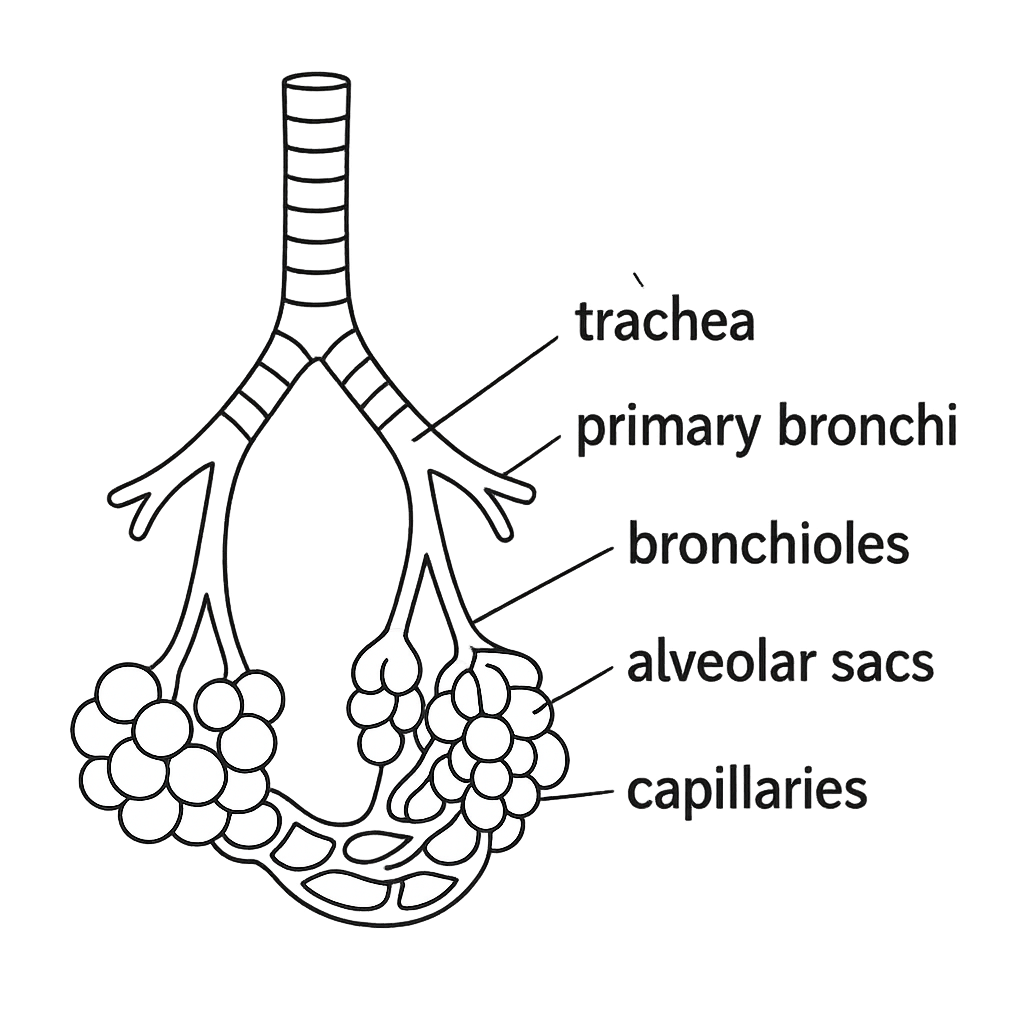
The labelled diagram shows the main parts of the human respiratory system, including the trachea, primary bronchi, bronchioles, alveolar sacs and the surrounding capillary network where gas exchange occurs. If each alveolus is approximated as a sphere of diameter 0.2 mm and the lungs contain 480 million alveoli, calculate the total external surface area of all alveoli available for gas exchange. Express your answer in square metres (\(\text{m}^2\)).
A. Approximately 45 m² of total alveolar surface area.
B. Approximately 75 m² of total alveolar surface area.
C. Approximately 90 m² of total alveolar surface area.
Correct D. Approximately 60 m² of total alveolar surface area.

Correct Answer: D

Want to see the full step-by-step solution? Unlock AI Explanation & Analytics
Question 4 View Details
In a branch of an artery the radius narrows from 2.0 mm to 1.5 mm while the length of the segment and the blood viscosity remain unchanged. Assuming the pressure gradient driving the flow is constant, use Poiseuille's law to determine: a) the percentage increase in vascular resistance, b) the percentage change in blood flow rate through the segment.
A. Resistance increases by about 150 %; blood flow decreases by about 40 %.
B. Resistance increases by about 180 %; blood flow decreases by about 60 %.
Correct C. Resistance increases by about 216 %; blood flow decreases by about 68 %.
D. Resistance increases by about 250 %; blood flow decreases by about 75 %.

Correct Answer: C

Want to see the full step-by-step solution? Unlock AI Explanation & Analytics
Question 5 View Details
During mitosis, at which stage are the chromosomes aligned at the cell's equatorial plate before being separated?
Correct A. Metaphase
B. Anaphase
C. Prophase
D. Telophase

Correct Answer: A

Want to see the full step-by-step solution? Unlock AI Explanation & Analytics
Question 6 View Details
A cactus stem functions as a leaf. If a typical leaf of the same volume would have a surface area of 120 cm\(^2\), the cactus spine arrangement reduces the effective surface area by 60%. The cuticle on the cactus is three times thicker than that of a typical leaf, halving the water loss per unit area. In addition, the stomatal density is only 40% of that of a typical leaf, further reducing water loss proportionally. A typical leaf loses 0.8 mg of water per hour per cm\(^2\). Calculate the total water loss per hour from the cactus stem (in mg, to two decimal places).
A. 5.12
B. 11.52
Correct C. 7.68
D. 15.36

Correct Answer: C

Want to see the full step-by-step solution? Unlock AI Explanation & Analytics
Question 7 View Details
The glomerular filtration rate (GFR) in a healthy adult is 125 mL\(\,\)min\(^{-1}\). A drug reduces GFR by 15% and increases tubular reabsorption of urea by 20% relative to the normal reabsorption fraction of 50%. If the plasma urea concentration is 0.25 g\(\,\)L\(^{-1}\), calculate the amount of urea excreted per minute (in mg\(\,\)min\(^{-1}\), to two decimal places).
A. 12.50
B. 13.28
Correct C. 10.63
D. 7.97

Correct Answer: C

Want to see the full step-by-step solution? Unlock AI Explanation & Analytics
Question 8 View Details
A mountain goat lives at high altitude. Its alveolar surface area is 1.8 times that of a lowland goat, and the alveolar membrane thickness is reduced to 0.8 times the lowland value. According to Fick's law, the diffusion rate of O\(_2\) is proportional to \(\dfrac{\text{area}}{\text{thickness}}\times\Delta P\). The partial pressure difference of O\(_2\) between alveolus and blood is the same (30 mmHg) in both goats, but the mountain goat's haemoglobin has a 10% higher affinity, effectively increasing \(\Delta P\) by 10%. By what factor is the O\(_2\) diffusion rate in the mountain goat greater than in the lowland goat? Give your answer to two decimal places.
Correct A. 2.48
B. 1.92
C. 2.24
D. 2.80

Correct Answer: A

Want to see the full step-by-step solution? Unlock AI Explanation & Analytics
Question 9 View Details
A meal contains 30 g protein, 50 g carbohydrate and 20 g fat. The digestibility of protein, carbohydrate and fat are 80%, 90% and 95% respectively. The carbohydrate portion also contains 5 g of fibre which reduces the net carbohydrate absorption by 5% of the total carbohydrate amount. Using the Atwater factors (protein 4 kcal·g\(^{-1}\), carbohydrate 4 kcal·g\(^{-1}\), fat 9 kcal·g\(^{-1}\)), calculate the metabolizable energy supplied by the meal (in kcal, to the nearest whole number).
A. 410
B. 452
Correct C. 438
D. 425

Correct Answer: C

Want to see the full step-by-step solution? Unlock AI Explanation & Analytics
Question 10 View Details
A sealed chamber of 2.0 L contains air at 21% O\(_2\) and 0.04% CO\(_2\). A person at rest consumes O\(_2\) at a rate of 250 mL·min\(^{-1}\) (STP) and produces CO\(_2\) at 200 mL·min\(^{-1}\). Assuming perfect mixing and that the total volume of gas in the chamber remains constant, how many seconds will elapse before the O\(_2\) concentration falls to 15%? (Ignore the small change in CO\(_2\) concentration.)
Correct A. 29
B. 33
C. 41
D. 25

Correct Answer: A

Want to see the full step-by-step solution? Unlock AI Explanation & Analytics
Question 11 View Details
In a closed community of 10 000 people, an infectious disease spreads as follows: each infected individual makes on average 12 potentially infectious contacts per day, and the probability of transmission per contact is 0.02 for symptomatic cases. Thirty percent of infected individuals are asymptomatic and transmit at half the rate of symptomatic individuals; their infectious period lasts 7 days, whereas symptomatic individuals are infectious for 5 days. Calculate the basic reproduction number \(R_0\) for the disease and then determine the minimum proportion of the population that must be immunised with a perfectly effective vaccine to prevent an outbreak. Give your answer as a whole‑number percentage.
A. 7 %
Correct B. 9 %
C. 15 %
D. 12 %

Correct Answer: B

Want to see the full step-by-step solution? Unlock AI Explanation & Analytics
Question 12 View Details
A cell culture starts with a single cell. The cells undergo three successive rounds of mitosis. After the second mitotic division, one of the four daughter cells fails to enter the third mitosis, while the other three divide normally. How many cells are present after the third mitotic round?
A. 6
B. 8
C. 9
Correct D. 7

Correct Answer: D

Want to see the full step-by-step solution? Unlock AI Explanation & Analytics
Question 13 View Details
The normal fasting blood glucose concentration is \(5.0\) mmol L\(^{-1}\). Under basal conditions the liver releases glucose at a rate of \(0.05\) mmol L\(^{-1}\) min\(^{-1}\) and peripheral muscle uptake removes glucose at \(0.03\) mmol L\(^{-1}\) min\(^{-1}\). After a carbohydrate‑rich meal, insulin secretion increases muscle uptake to \(0.08\) mmol L\(^{-1}\) min\(^{-1}\) and simultaneously reduces hepatic release to \(0.02\) mmol L\(^{-1}\) min\(^{-1}\) for a period of 30 minutes. Assuming no other changes, what is the blood glucose concentration at the end of the 30‑minute period? Give your answer to one decimal place (mmol L\(^{-1}\)).
Correct A. 6.8
B. 8.1
C. 7.4
D. 5.2

Correct Answer: A

Want to see the full step-by-step solution? Unlock AI Explanation & Analytics
Question 14 View Details
In a laboratory culture there are \(10^{6}\) susceptible bacteria and \(10^{4}\) donor bacteria that each carry a plasmid conferring antibiotic resistance. Conjugation occurs at a rate of \(2\times10^{-9}\) successful transfer events per donor‑recipient pair per hour. No bacterial growth occurs during the experiment. After 5 hours, how many bacteria are expected to be resistant, and what proportion of the total bacterial population does this represent? Express the proportion as a percentage rounded to one decimal place.
A. 2.0 %
B. 0.2 %
C. 0.5 %
Correct D. 1.0 %

Correct Answer: D

Want to see the full step-by-step solution? Unlock AI Explanation & Analytics
Question 15 View Details
A bacterial culture contains \(2\times10^{7}\) cells mL\(^{-1}\). Bacteriophage is added at a multiplicity of infection (MOI) of 0.05, resulting in adsorption of \(1\times10^{6}\) phage particles mL\(^{-1}\) and infection of the same number of bacteria (one phage per infected cell). After the latent period and subsequent rise period, the phage titre rises to \(4\times10^{8}\) PFU mL\(^{-1}\). Assuming no new infections occur during the rise period, calculate the average burst size, i.e. the number of new virions produced per infected cell. Give your answer as the nearest whole number.
A. 500
B. 200
C. 20
Correct D. 400

Correct Answer: D

Want to see the full step-by-step solution? Unlock AI Explanation & Analytics
Question 16 View Details
A beetle species has a per‑generation nucleotide mutation rate of \(2\times10^{-8}\) per base pair. Its haploid genome size is \(1.2\times10^{9}\) bp. The average generation time is 0.5 year. Assuming mutations accumulate linearly, estimate the average number of nucleotide differences expected between two individuals that diverged 5 million years ago. If a related species has a generation time of 1 year but the same mutation rate, how many times more nucleotide differences would you expect between two individuals of that species that also diverged 5 million years ago?
A. Approximately \(4.8\times10^{8}\) nucleotide differences; the species with a 1‑year generation time would have the same number, i.e. the ratio is 1.
Correct B. Approximately \(4.8\times10^{8}\) nucleotide differences; the species with a 1‑year generation time would have half as many, i.e. the first species has twice as many differences (ratio = 2).
C. Approximately \(2.4\times10^{8}\) nucleotide differences; the species with a 1‑year generation time would have twice as many, i.e. the first species has half as many differences (ratio = 0.5).
D. Approximately \(4.8\times10^{9}\) nucleotide differences; the species with a 1‑year generation time would have half as many, i.e. the first species has twice as many differences (ratio = 2).

Correct Answer: B

Want to see the full step-by-step solution? Unlock AI Explanation & Analytics
Question 17 View Details
In a particular plant cell the total cell‑cycle time is 24 h. The G1 phase occupies 40 % of the cycle, S phase 30 %, G2 phase 20 % and M phase 10 %. Calculate the duration (in hours) of each phase.
Correct A. G1 = 9.6 h, S = 7.2 h, G2 = 4.8 h, M = 2.4 h.
B. G1 = 10.0 h, S = 7.0 h, G2 = 4.0 h, M = 3.0 h.
C. G1 = 9.0 h, S = 8.0 h, G2 = 4.0 h, M = 3.0 h.
D. G1 = 8.0 h, S = 6.0 h, G2 = 5.0 h, M = 5.0 h.

Correct Answer: A

Want to see the full step-by-step solution? Unlock AI Explanation & Analytics
Question 18 View Details
A desert rodent is approximated as a sphere. Its body mass (in grams) equals its volume in cm³ (density ≈ 1 g cm⁻³). Metabolic heat production is \(P = 0.02\,\text{W\,g}^{-1}\times m\). Heat is lost by convection with coefficient \(h = 10\;\text{W\,m}^{-2}\text{K}^{-1}\) from the surface area \(A = 4\pi r^{2}\) (r in cm, converted to m²). The ambient temperature is 30 °C and the rodent maintains a core temperature of 38 °C. (a) Determine the maximum radius \(r_{\max}\) (in cm) for which heat production equals heat loss at steady state. (b) If a fur layer reduces the effective convection coefficient by 30 %, calculate the new permissible body mass and express the percentage change relative to the original permissible mass.
A. Maximum radius \(r_{\max}\) ≈ 1.0 cm (permissible mass ≈ 6.0 g). With a 30 % reduction in h, the permissible radius becomes ≈ 0.70 cm (mass ≈ 2.1 g), i.e. a ≈ 65 % decrease (the new mass is about 35 % of the original).
B. Maximum radius \(r_{\max}\) ≈ 0.9 cm (permissible mass ≈ 5.4 g). With a 30 % reduction in h, the permissible radius becomes ≈ 0.63 cm (mass ≈ 1.8 g), i.e. a ≈ 67 % decrease (the new mass is about 33 % of the original).
C. Maximum radius \(r_{\max}\) ≈ 1.5 cm (permissible mass ≈ 9.0 g). With a 30 % reduction in h, the permissible radius becomes ≈ 1.05 cm (mass ≈ 3.5 g), i.e. a ≈ 61 % decrease (the new mass is about 39 % of the original).
Correct D. Maximum radius \(r_{\max}\) ≈ 1.2 cm (permissible mass ≈ 7.2 g). With a 30 % reduction in h, the permissible radius becomes ≈ 0.84 cm (mass ≈ 2.5 g), i.e. a ≈ 66 % decrease (the new mass is about 34 % of the original).

Correct Answer: D

Want to see the full step-by-step solution? Unlock AI Explanation & Analytics
Question 19 View Details
A novel viral infection has a basic reproduction number \(R_{0}=3.5\). A vaccine is 80 % effective at preventing infection. (a) Calculate the theoretical herd‑immunity threshold (the proportion of the population that must be immune) assuming perfect immunity. (b) Taking the vaccine efficacy into account, determine the minimum proportion of the total population that must be vaccinated to achieve herd immunity. (c) In a population of 2 million, 10 % are already immune due to prior infection. How many additional individuals need to be vaccinated to reach herd immunity?
Correct A. (a) 71.4 %; (b) about 89.3 % of the population must be vaccinated; (c) roughly 1.54 × 10⁶ additional individuals need vaccination.
B. (a) 75.0 %; (b) about 88.0 % of the population must be vaccinated; (c) roughly 1.45 × 10⁶ additional individuals need vaccination.
C. (a) 68.6 %; (b) about 85.0 % of the population must be vaccinated; (c) roughly 1.30 × 10⁶ additional individuals need vaccination.
D. (a) 71.4 %; (b) about 92.0 % of the population must be vaccinated; (c) roughly 1.60 × 10⁶ additional individuals need vaccination.

Correct Answer: A

Want to see the full step-by-step solution? Unlock AI Explanation & Analytics
Question 20 View Details
A leaf cell transports glucose from the cytosol (concentration 5 mM) to the vacuole (concentration 1 mM) by (i) passive diffusion through channels with permeability \(P = 1.2\times10^{-6}\;\text{m\,s}^{-1}\) across a membrane area of \(2\times10^{-9}\;\text{m}^{2}\), and (ii) active transport via a proton‑glucose symporter that moves glucose against the gradient at a rate of \(2\times10^{-9}\;\text{mol\,s}^{-1}\) per cell, consuming one ATP per glucose molecule (\(\Delta G_{\text{ATP}} = 30.5\;\text{kJ\,mol}^{-1}\)). (a) Calculate the net molar flux of glucose into the vacuole by passive diffusion (in mol\,s⁻¹). (b) Determine the energy cost per second (in kJ\,s⁻¹) for the active transport pathway. (c) If the cell requires a total glucose import rate of \(5\times10^{-9}\;\text{mol\,s}^{-1}\), what proportion of this must be supplied by active transport?
Correct A. (a) 9.6×10⁻¹⁵ mol s⁻¹; (b) 6.1×10⁻⁸ kJ s⁻¹; (c) ≈ 99.9998 % of the required import must be provided by active transport.
B. (a) 1.2×10⁻¹⁴ mol s⁻¹; (b) 9.2×10⁻⁸ kJ s⁻¹; (c) ≈ 99.5 % of the required import must be provided by active transport.
C. (a) 8.0×10⁻¹⁵ mol s⁻¹; (b) 4.5×10⁻⁸ kJ s⁻¹; (c) ≈ 95.0 % of the required import must be provided by active transport.
D. (a) 5.0×10⁻¹⁵ mol s⁻¹; (b) 1.2×10⁻⁷ kJ s⁻¹; (c) ≈ 90.0 % of the required import must be provided by active transport.

Correct Answer: A

Want to see the full step-by-step solution? Unlock AI Explanation & Analytics
Question 21 View Details
A multicellular eukaryote has cell walls composed of chitin, lacks chloroplasts, obtains nutrients by absorption, and during its reproductive cycle forms a macroscopic fruiting body that releases spores from club‑shaped structures called basidia. Using the standard classification hierarchy, identify its kingdom and phylum.
A. Kingdom Fungi; Phylum Ascomycota
Correct B. Kingdom Fungi; Phylum Basidiomycota
C. Kingdom Plantae; Phylum Basidiomycota
D. Kingdom Protista; Phylum Zygomycota

Correct Answer: B

Want to see the full step-by-step solution? Unlock AI Explanation & Analytics
Question 22 View Details
An adult's aorta normally has an internal radius of \(12\ \text{mm}\). In a disease, a plaque reduces the radius uniformly by \(30\%\) over a \(5\ \text{cm}\) segment. Assuming laminar flow and unchanged blood viscosity, by what factor does the resistance to flow through that segment increase compared with the normal segment?
A. ≈ 3.0
B. ≈ 5.6
Correct C. ≈ 4.2
D. ≈ 2.5

Correct Answer: C

Want to see the full step-by-step solution? Unlock AI Explanation & Analytics
Question 23 View Details
An individual consumes \(20\ \text{g}\) of protein in a meal. Protein contains \(16\%\) nitrogen by weight. Of the absorbed nitrogen, \(85\%\) is converted to urea and excreted in the urine. The total urine volume produced over the next 24 h is \(1.5\ \text{L}\). Given that the molecular weight of urea is \(60\ \text{g·mol}^{-1}\) and each urea molecule contains two nitrogen atoms (atomic weight \(14\ \text{g·mol}^{-1}\)), calculate the concentration of urea in the urine in \(\text{g·L}^{-1}\).
A. ≈ 4.2 g·L⁻¹
B. ≈ 5.0 g·L⁻¹
Correct C. ≈ 3.9 g·L⁻¹
D. ≈ 3.2 g·L⁻¹

Correct Answer: C

Want to see the full step-by-step solution? Unlock AI Explanation & Analytics
Question 24 View Details
A stretch reflex involves an afferent sensory neuron of length \(0.8\ \text{m}\) conducting impulses at \(80\ \text{m·s}^{-1}\), and an efferent motor neuron of length \(0.6\ \text{m}\) conducting at \(60\ \text{m·s}^{-1}\). The synaptic delay at the spinal cord is \(0.5\ \text{ms}\) and the muscle contraction delay is \(5\ \text{ms}\). Calculate the total reaction time of the reflex in milliseconds.
A. 27.0 ms
B. 24.5 ms
C. 22.0 ms
Correct D. 25.5 ms

Correct Answer: D

Want to see the full step-by-step solution? Unlock AI Explanation & Analytics
Question 25 View Details
In a beetle population, allele \(A\) (green) is dominant over allele \(a\) (brown). The initial allele frequencies are \(p=0.6\) for \(A\) and \(q=0.4\) for \(a\). Before reproduction, \(20\%\) of the brown (\(aa\)) beetles are removed by predators. Assuming random mating among the survivors, calculate the new allele frequencies \(p'\) and \(q'\) in the breeding pool.
A. p' ≈ 0.60, q' ≈ 0.40
B. p' ≈ 0.87, q' ≈ 0.13
C. p' ≈ 0.63, q' ≈ 0.37
Correct D. p' ≈ 0.62, q' ≈ 0.38

Correct Answer: D

Want to see the full step-by-step solution? Unlock AI Explanation & Analytics

Master the Exam!

You've seen a preview, but there are thousands more questions plus AI tutor to break down complex solutions.

Unlock Full Access Available for Android & Windows
Help others prepare! Share this practice hub:
Chat with Support