gce model questions vol1 2017 agricultural_science | Objective

Prepare for your exams with gce model questions vol1 questions? Reviewing past/model questions is one of the most effective ways to guarantee a high score. This practice hub features authentic 2017 agricultural_science (Objective) questions designed to simulate the real exam environment.

Practice these randomly selected questions to test your readiness.

Question 1 View Details
A farmer can choose between two maize varieties. Variety A yields 0.8 kg per plant and is planted at 0.25 m between rows and 0.20 m within rows. Variety B yields 0.6 kg per plant and is planted at 0.20 m between rows and 0.15 m within rows. Fertiliser requirements are 150 kg ha⁻¹ for A at ₦0.30 kg⁻¹ and 120 kg ha⁻¹ for B at ₦0.35 kg⁻¹. The market price of maize is ₦2 kg⁻¹. Calculate the net profit per hectare for each variety and state which variety gives the higher profit.
A. Variety A, net profit ≈ ₦350 000 per hectare
Correct B. Variety B, net profit ≈ ₦399 958 per hectare
C. Variety B, net profit ≈ ₦420 000 per hectare
D. Variety A, net profit ≈ ₦399 958 per hectare

Correct Answer: B

Want to see the full step-by-step solution? Unlock AI Explanation & Analytics
Question 2 View Details
A farmer harvests 10 000 kg of maize with a moisture content of 25 % (wet basis). The desired storage moisture is 13 % (wet basis). Drying removes water at a cost of ₦0.05 per kilogram of water removed. After drying, the grain is stored in a silo that loses 2 % of the dry weight each month because of pests. The farmer plans to store the grain for 4 months before sale. The market price of dry maize is ₦0.30 per kilogram. If the farmer sells the grain immediately at harvest moisture, the price is reduced proportionally to the dry‑matter fraction of the grain. Determine the net revenue for (i) drying to 13 % moisture and storing for 4 months, and (ii) selling immediately without drying. Which option gives the higher net revenue?
A. Sell immediately; net revenue ≈ ₦2 100 (lower than the drying option)
B. Dry and store; net revenue ≈ ₦2 250 (same as selling immediately)
C. Dry and store; net revenue ≈ ₦2 300 (higher than the drying option)
Correct D. Sell immediately; net revenue ≈ ₦2 250 (higher than the drying option)

Correct Answer: D

Want to see the full step-by-step solution? Unlock AI Explanation & Analytics
Question 3 View Details
A tractor must pull a 1.5‑m‑wide moldboard plough at a speed of 5 km h⁻¹ to a depth of 15 cm. The soil draft coefficient is 150 N m⁻¹ cm⁻¹. The tractor's axle load is 2.5 t and the rolling‑resistance coefficient of the wheels is 0.02 times the axle load. (i) Calculate the total draw‑bar pull required (in newtons). (ii) Determine the minimum engine power rating (in kW) needed, assuming a drivetrain efficiency of 85 %. Round the answer up to the nearest whole kilowatt.
Correct A. 7 kW (minimum engine power)
B. 8 kW (minimum engine power)
C. 10 kW (minimum engine power)
D. 6 kW (minimum engine power)

Correct Answer: A

Want to see the full step-by-step solution? Unlock AI Explanation & Analytics
Question 4 View Details
A wheat field shows symptoms of leaf rust. The disease triangle requires (i) a susceptible host, (ii) a virulent pathogen, and (iii) a favourable environment. The average nightly temperature is 18 °C, relative humidity is 85 % for 8 h, and leaf‑wetness lasts 6 h per day. The pathogen needs a minimum temperature of 15 °C, relative humidity > 80 % for at least 5 h, and leaf‑wetness > 4 h to infect. (a) Are the present conditions conducive for infection? (b) If the probability that each individual condition occurs on a given day is 30 % for temperature, 25 % for humidity, and 20 % for leaf‑wetness, assuming independence, calculate the overall daily infection risk as a percentage. (c) Recommend one cultural control measure that targets the most influential condition.
A. a) No, conditions are not conducive. b) 3.0 % daily infection risk. c) Increase fertilizer application to boost plant vigor (targets the host condition).
B. a) No, conditions are not conducive. b) 5.0 % daily infection risk. c) Reduce irrigation frequency to lower leaf‑wetness (targets the leaf‑wetness condition).
C. a) Yes, conditions are conducive. b) 0.8 % daily infection risk. c) Apply a fungicide spray at early growth stage (targets the pathogen condition).
Correct D. a) Yes, conditions are conducive. b) 1.5 % daily infection risk. c) Adjust sowing date to avoid the favourable temperature period (targets the temperature condition).

Correct Answer: D

Want to see the full step-by-step solution? Unlock AI Explanation & Analytics
Question 5 View Details
A soil test shows available nutrients of N = 40 kg ha⁻¹, P₂O₅ = 20 kg ha⁻¹ and K₂O = 30 kg ha⁻¹. The target levels for optimal maize yield are N = 120 kg ha⁻¹, P₂O₅ = 60 kg ha⁻¹ and K₂O = 80 kg ha⁻¹. The farmer wishes to apply a single blended fertilizer containing urea (46 % N), triple superphosphate (46 % P₂O₅) and muriate of potash (60 % K₂O) in the weight ratio 3 : 2 : 1 (urea : TSP : MOP). Determine the maximum amount of this blended fertilizer (kg ha⁻¹) that can be applied without exceeding any of the three nutrient targets by more than 5 %. Identify the limiting nutrient and give the quantities of urea, TSP and MOP in the blend at this application rate.
Correct A. Maximum blend ≈ 280 kg ha⁻¹; limiting nutrient = P₂O₅; urea ≈ 140 kg, TSP ≈ 93 kg, MOP ≈ 47 kg per hectare
B. Maximum blend ≈ 300 kg ha⁻¹; limiting nutrient = N; urea ≈ 150 kg, TSP ≈ 100 kg, MOP ≈ 50 kg per hectare
C. Maximum blend ≈ 250 kg ha⁻¹; limiting nutrient = K₂O; urea ≈ 125 kg, TSP ≈ 83 kg, MOP ≈ 42 kg per hectare
D. Maximum blend ≈ 260 kg ha⁻¹; limiting nutrient = P₂O₅; urea ≈ 130 kg, TSP ≈ 86 kg, MOP ≈ 44 kg per hectare

Correct Answer: A

Want to see the full step-by-step solution? Unlock AI Explanation & Analytics
Question 6 View Details
A farmer rears two breeds of goats. Breed A gains an average of 120 g per day on a diet of 150 g dry matter (DM) containing 16 % crude protein (CP). Breed B gains 150 g per day on a diet of 180 g DM containing 14 % CP. The farmer wishes to formulate a mixed concentrate using two ingredients: Ingredient X (20 % CP, cost $0.30 kg⁻¹) and Ingredient Y (12 % CP, cost $0.20 kg⁻¹). The goal is to achieve the same average daily gain as Breed B (i.e. a feed conversion ratio of 1.2 kg DM per kg gain) while minimising the daily feed cost and ensuring the diet supplies at least 14 % CP. What proportion (by weight) of Ingredient X must be used in the mixed concentrate? Express your answer as a percentage to the nearest whole number.
Correct A. 25 %
B. 20 %
C. 35 %
D. 30 %

Correct Answer: A

Want to see the full step-by-step solution? Unlock AI Explanation & Analytics
Question 7 View Details
The respiration rate of mangoes, R (mg CO₂ kg⁻¹ h⁻¹), follows a Q₁₀ relationship. Between 5 °C and 15 °C the Q₁₀ value is 2.5, and between 15 °C and 25 °C the Q₁₀ value is 1.8. At 5 °C the respiration rate is 10 mg CO₂ kg⁻¹ h⁻¹. The maximum acceptable respiration rate for safe storage is 30 mg CO₂ kg⁻¹ h⁻¹. Determine the highest temperature (in °C, to one decimal place) at which the respiration rate does not exceed the limit.
A. 20.3 °C
B. 16.5 °C
Correct C. 18.1 °C
D. 22.0 °C

Correct Answer: C

Want to see the full step-by-step solution? Unlock AI Explanation & Analytics
Question 8 View Details
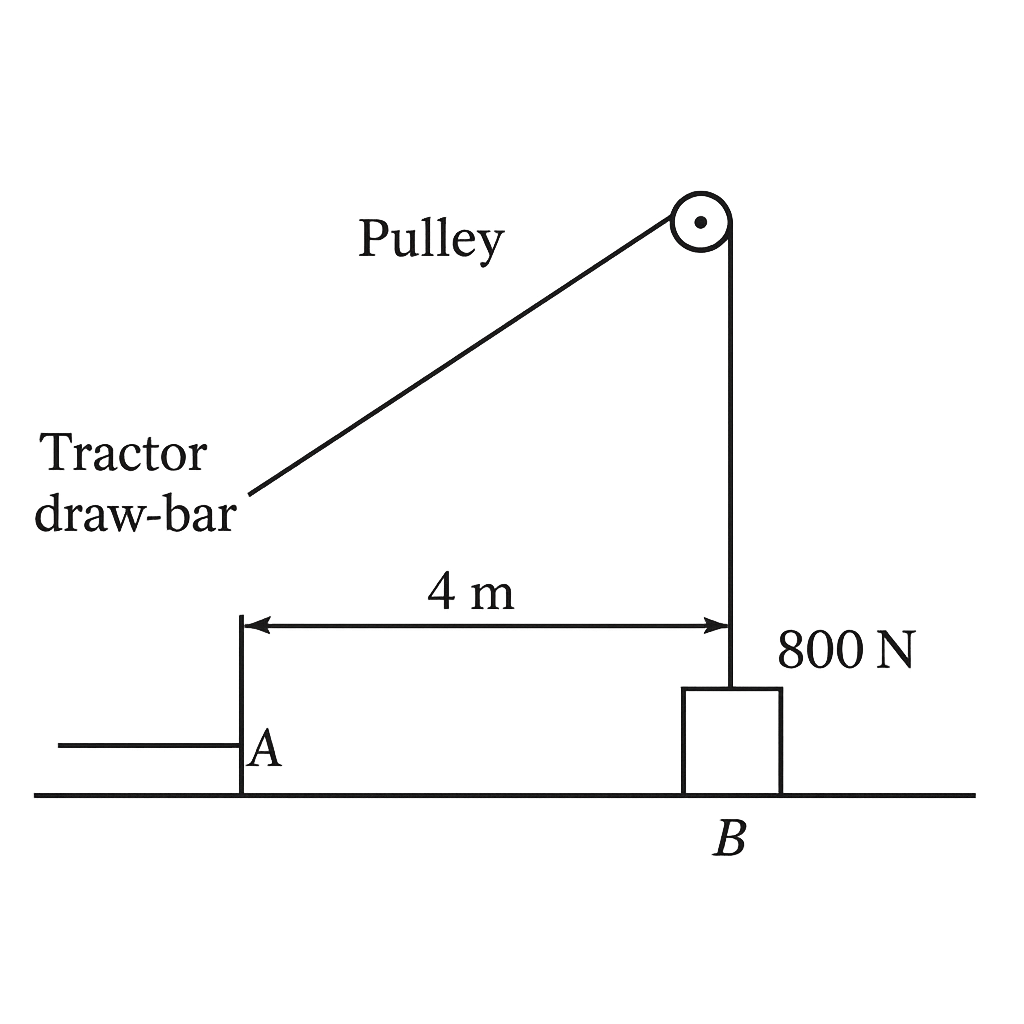
In the diagram, a tractor's draw‑bar (point A) is at ground level. A fixed pulley is positioned 2.0 m above the ground and 4.0 m ahead of the tractor. A cable runs from A to the pulley and then down to a load (point B) on the ground 6.0 m ahead of the tractor. The load weight is 800 N. The cable and pulley are mass‑less and frictionless. Determine the horizontal pulling force that the tractor must exert on the cable (in newtons, to the nearest whole number).
A. 950 N
B. 1080 N
Correct C. 1012 N
D. 1150 N

Correct Answer: C

Want to see the full step-by-step solution? Unlock AI Explanation & Analytics
Question 9 View Details
A mixed forest stand of species X has an initial basal area of 24 m² ha⁻¹ at age 20 years. Its basal‑area growth follows the logistic equation \(\dfrac{d\text{BA}}{dt}=r\,\text{BA}\bigl(1-\dfrac{\text{BA}}{K}\bigr)\) with \(r=0.04\,\text{yr}^{-1}\) and carrying capacity \(K=48\,\text{m}^2\,\text{ha}^{-1}\). Natural mortality removes 0.5 % of the basal area each year. The manager wishes to keep the basal area constant at its present level (24 m² ha⁻¹) by harvesting the amount of basal area that exactly offsets net growth and mortality. Merchantable timber volume \(V\) (m³ ha⁻¹) is related to basal area by \(V = 0.5\,\text{BA}^{1.5}\). What is the maximum sustainable timber volume that can be harvested each year (in m³ ha⁻¹, to one decimal place)?
A. 0.5 m³ ha⁻¹
Correct B. 0.1 m³ ha⁻¹
C. 0.9 m³ ha⁻¹
D. 0.2 m³ ha⁻¹

Correct Answer: B

Want to see the full step-by-step solution? Unlock AI Explanation & Analytics
Question 10 View Details
A forest of species Z follows the volume growth function \(V(t)=12t-0.1t^{2}\) (m³ ha⁻¹) for ages \(0\le t\le60\) years. Each year the stand loses 2 % of its standing volume due to natural mortality (assumed to act continuously, i.e. the volume after \(t\) years is \(V(t)\times0.98^{t}\)). Timber sells for $150 per m³ and the discount rate is 6 % per annum (discrete). The manager wishes to choose a rotation age that maximises the present value of net timber revenue from a single rotation. Determine the optimal integer rotation age (in years).
Correct A. 11 years
B. 10 years
C. 13 years
D. 12 years

Correct Answer: A

Want to see the full step-by-step solution? Unlock AI Explanation & Analytics
Question 11 View Details
A farmer intends to grow maize on \(2\) ha. Fixed costs (land rent and machinery depreciation) total ₦150,000. Variable costs per hectare are seed ₦5,000, fertilizer ₦8,000 and labour ₦6,000. The market price of maize is ₦20,000 per tonne. The expected base yield is \(3\) tonnes ha\(^{-1}\) when \(8,000\) N of fertilizer per hectare is applied. For each additional \(1,000\) N of fertilizer per hectare (up to a maximum of \(10,000\) N extra), the yield increases by \(0.2\) tonne ha\(^{-1}\). Determine the minimum extra fertilizer (in multiples of \(1,000\) N per hectare) that the farmer must apply to break even (profit ≥ 0).
A. 10000
Correct B. 7000
C. 6000
D. 8000

Correct Answer: B

Want to see the full step-by-step solution? Unlock AI Explanation & Analytics
Question 12 View Details
A wheat field of 5 ha shows rectangular brown leaf lesions 2-4 cm long with a yellow halo. Laboratory analysis identifies a wind‑dispersed fungus that produces conidia. The disease has a latent period of 7 days and an infectious period of 14 days. The initial infected area is 0.1 ha and the basic reproduction number \(R_{0}\) is 2.5 per infectious period. Assuming the infected area multiplies by \(R_{0}\) at the end of each infectious period and that there is no overlap, calculate the percentage of the field that will be infected after 28 days.
Correct A. Septoria leaf blotch; 12.5%
B. Powdery mildew; 5%
C. Tan spot; 20%
D. Leaf rust; 30%

Correct Answer: A

Want to see the full step-by-step solution? Unlock AI Explanation & Analytics
Question 13 View Details
A farmer must plough a 3 ha field of heavy clay (moisture content 20 %). Two ploughs are available:\n\n- Moldboard plough: draft requirement \(15\) kN ha\(^{-1}\), effective width \(0.30\) m.\n- Disc plough: draft requirement \(10\) kN ha\(^{-1}\), effective width \(0.25\) m, but on heavy clay its effective working width is reduced by 30 %.\n\nThe tractor can deliver a maximum continuous draft of \(30\) kN and can travel at a constant speed of \(5\) km h\(^{-1}\). Assuming an 8‑hour working day, determine which plough (if any) allows the farmer to complete the whole field in a single day.
Correct A. Only the disc plough meets the draft limit, but it would require about 34.3 hours, so the field cannot be completed in one 8‑hour day.
B. Neither plough meets the draft limit, so the field cannot be completed in a single day.
C. Both ploughs meet the draft limit, and the disc plough would finish the field in about 7.5 hours, so it can be completed in one 8‑hour day.
D. Only the moldboard plough meets the draft limit, and it would require about 6.2 hours, so the field can be completed in one day.

Correct Answer: A

Want to see the full step-by-step solution? Unlock AI Explanation & Analytics
Question 14 View Details
An agricultural extension officer has a budget of ₦1,200,000 to promote integrated pest management (IPM) for cotton. Two programmes are available:\n\n- Programme A: group meetings costing ₦150,000 per session, each reaching 25 farmers. After attending, a farmer adopts IPM with probability 0.48.\n- Programme B: farm visits costing ₦30,000 per visit, each reaching one farmer. Adoption probability after a visit is 0.78.\n\nThe officer can organise any whole number of sessions of A and any whole number of visits of B, provided the total cost does not exceed the budget. Determine the allocation of sessions and visits that maximises the expected number of adopters, and state that maximum expected number.
A. 5 sessions of Programme A and 6 visits of Programme B, expected adopters = 78
B. 7 sessions of Programme A and 2 visits of Programme B, expected adopters = 90
Correct C. 8 sessions of Programme A and 0 visits of Programme B, expected adopters = 96
D. 6 sessions of Programme A and 4 visits of Programme B, expected adopters = 84

Correct Answer: C

Want to see the full step-by-step solution? Unlock AI Explanation & Analytics
Question 15 View Details
In a soybean field the aphid density (number of aphids per plant) is monitored. The relationship between density \(D\) and yield loss is \(\text{Loss %}=0.05\,D^{0.8}\). The average yield is 2.5 t ha\(^{-1}\) and the market value of soybeans is ₦300 per tonne. The cost of an insecticide application is ₦150 ha\(^{-1}\). Calculate the aphid density per plant at which the economic threshold is reached (i.e., the value of the loss equals the control cost). Give your answer rounded to the nearest whole aphid.
Correct A. 1800
B. 2000
C. 2100
D. 1500

Correct Answer: A

Want to see the full step-by-step solution? Unlock AI Explanation & Analytics
Question 16 View Details
A farmer applies \(120\) kg of nitrogen fertilizer to a field. \(30\)% of the applied nitrogen is lost by leaching. Of the nitrogen that remains in the soil, \(20\)% is subsequently lost by volatilisation. How many kilograms of nitrogen remain in the soil after these two loss processes?
A. 96
Correct B. 67.2
C. 60
D. 84

Correct Answer: B

Want to see the full step-by-step solution? Unlock AI Explanation & Analytics
Question 17 View Details
A crop field receives an average solar radiation of \(2000\) MJ m\(^{-2}\) during the growing season. If \(10\)% of this radiation is converted into chemical energy by photosynthesis and \(60\)% of the captured energy is used for plant growth (the rest is lost as respiration), calculate the net primary productivity (NPP) in MJ m\(^{-2}\) for the field.
A. 100
B. 200
C. 140
Correct D. 120

Correct Answer: D

Want to see the full step-by-step solution? Unlock AI Explanation & Analytics
Question 18 View Details
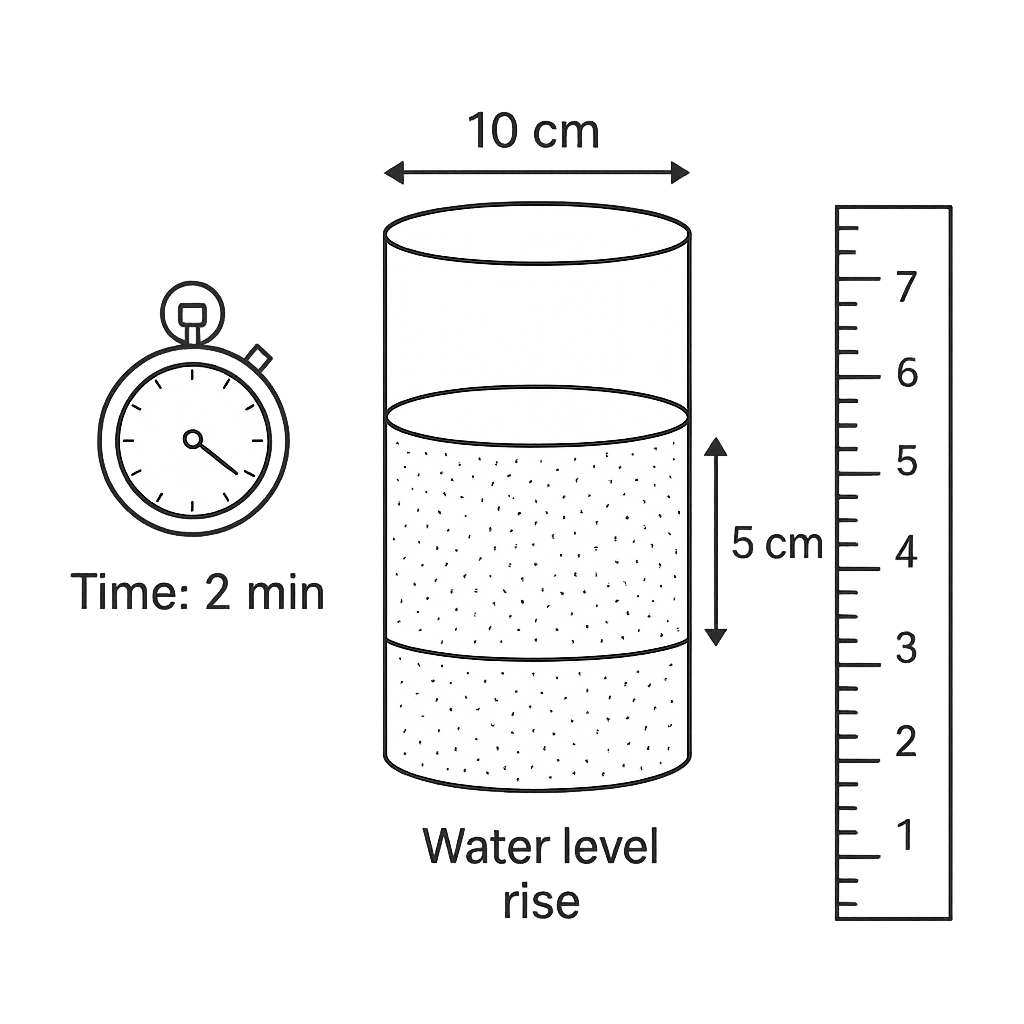
In the diagram of a soil infiltration test, a cylindrical soil column of diameter \(10\) cm is placed vertically. Water is added and the water level rises \(5\) cm in \(2\) minutes. Assuming the water fully infiltrates the soil column, determine the infiltration rate in litres per minute.
A. 0.30
B. 0.25
C. 0.10
Correct D. 0.20

Correct Answer: D

Want to see the full step-by-step solution? Unlock AI Explanation & Analytics
Question 19 View Details
A farmer has a 5‑ha plot that can be planted with wheat or maize, or a mixture of both. Fixed costs per hectare are: land rent £100, fertilizer £30, seed £20. Variable costs per tonne of yield are: wheat £50, maize £40. Expected yields are: wheat 3.5 t ha\(^{-1}\), maize 4.0 t ha\(^{-1}\). Market prices are: wheat £150 t\(^{-1}\) (but if total wheat production exceeds 10 t, the price falls by 10 %), maize £120 t\(^{-1}\). Determine the allocation of hectares to wheat (x) and maize (5 - x) that maximises profit, and state the maximum profit (to the nearest pound).
A. Wheat 3.00 ha, Maize 2.00 ha; maximum profit £900
Correct B. Wheat 2.86 ha, Maize 2.14 ha; maximum profit £936
C. Wheat 1.86 ha, Maize 3.14 ha; maximum profit £880
D. Wheat 2.50 ha, Maize 2.50 ha; maximum profit £950

Correct Answer: B

Want to see the full step-by-step solution? Unlock AI Explanation & Analytics
Question 20 View Details
A combine harvester has a cutting width of \(6\) m. To allow for a 3 % overlap on each side, the effective working width is reduced. The machine operates at a forward speed of \(5\) km h\(^{-1}\) in a rectangular field, and the field efficiency is \(80\) %. Calculate the theoretical field capacity of the combine in hectares per hour, rounded to two decimal places.
Correct A. 2.26
B. 2.10
C. 2.78
D. 2.45

Correct Answer: A

Want to see the full step-by-step solution? Unlock AI Explanation & Analytics
Question 21 View Details
A farmer needs to till a \(5\) ha field using a tractor‑mounted rotavator. The operator can choose one of three speeds:\n\n- \(8\) km h\(^{-1}\): tillage rate \(0.7\) ha h\(^{-1}\), fuel consumption \(5\) L h\(^{-1}\)\n- \(10\) km h\(^{-1}\): tillage rate \(0.8\) ha h\(^{-1}\), fuel consumption \(6\) L h\(^{-1}\)\n- \(12\) km h\(^{-1}\): tillage rate \(0.85\) ha h\(^{-1}\), fuel consumption \(8\) L h\(^{-1}\)\n\nLabour cost is ₦150 per hour and fuel costs ₦200 per litre. Which speed gives the lowest total cost (labour + fuel) for completing the whole field? Give the total cost in naira, rounded to the nearest naira.
Correct A. 8214
B. 7900
C. 10294
D. 8438

Correct Answer: A

Want to see the full step-by-step solution? Unlock AI Explanation & Analytics
Question 22 View Details
An agricultural extension officer has a total budget of ₦500 000 for a programme. The programme consists of two activities:\n\n1. A farmer‑training component. Each farmer who attends a workshop incurs a variable cost of ₦2 500 (materials, venue) and a follow‑up visit costing ₦1 200. Every farmer must receive exactly one follow‑up visit.\n\n2. A radio‑broadcast component. The cost is ₦5 000 for every 1 000 listeners reached.\n\nA 10 % administrative overhead is applied to the total variable cost of the farmer‑training component (i.e. 10 % of the sum of the workshop and follow‑up costs for all farmers).\n\nThe officer must serve at least 50 farmers. Determine the combination of the number of farmers served (\(n\)) and the number of listeners reached (in thousands, \(m\)) that maximises the total number of beneficiaries (farmers + listeners) while staying within the budget. State the optimal values of \(n\) and the total number of listeners (not in thousands).
A. 50 farmers, 58000 listeners
B. 55 farmers, 59000 listeners
C. 50 farmers, 60000 listeners
Correct D. 50 farmers, 59000 listeners

Correct Answer: D

Want to see the full step-by-step solution? Unlock AI Explanation & Analytics
Question 23 View Details
In a grassland ecosystem the net primary productivity (NPP) is \(800\) g C m\(^{-2}\) yr\(^{-1}\). Herbivores convert \(10\%\) of the plant biomass they consume into their own biomass, and carnivores convert \(20\%\) of the herbivore biomass they consume. Calculate the amount of carbon (in g C m\(^{-2}\) yr\(^{-1}\)) stored in the herbivore biomass and in the carnivore biomass.
A. Herbivores: 80 g C/m²/yr; Carnivores: 20 g C/m²/yr
B. Herbivores: 70 g C/m²/yr; Carnivores: 14 g C/m²/yr
Correct C. Herbivores: 80 g C/m²/yr; Carnivores: 16 g C/m²/yr
D. Herbivores: 100 g C/m²/yr; Carnivores: 20 g C/m²/yr

Correct Answer: C

Want to see the full step-by-step solution? Unlock AI Explanation & Analytics
Question 24 View Details
A flock of 200 unvaccinated sheep experiences 30 cases of pneumonia in a year. In a separate group of 150 sheep that were vaccinated against the disease, 9 cases occurred in the same period.\n\n(a) Calculate the incidence of pneumonia in each group.\n(b) Determine the relative risk (RR) of disease in unvaccinated versus vaccinated sheep.\n(c) Using the formula \( \text{Vaccine efficacy} = \bigl(1 - \frac{I_v}{I_u}\bigr)\times 100\% \), where \(I_v\) and \(I_u\) are the incidences in the vaccinated and unvaccinated groups respectively, calculate the vaccine efficacy.
A. Incidence unvaccinated 0.15, vaccinated 0.06; RR = 0.4; Vaccine efficacy = 40 %
B. Incidence unvaccinated 0.12, vaccinated 0.06; RR = 2.0; Vaccine efficacy = 50 %
Correct C. Incidence unvaccinated 0.15, vaccinated 0.06; RR = 2.5; Vaccine efficacy = 60 %
D. Incidence unvaccinated 0.15, vaccinated 0.045; RR = 3.33; Vaccine efficacy = 70 %

Correct Answer: C

Want to see the full step-by-step solution? Unlock AI Explanation & Analytics
Question 25 View Details
A wheat farmer aims to produce \(5\) t ha\(^{-1}\) of grain. Wheat removes \(20\) kg N per tonne of grain harvested. The soil test shows an available nitrogen supply of \(80\) kg N ha\(^{-1}\). To compensate for expected nitrogen losses, the recommended fertilizer application is to supply \(120\%\) of the nitrogen removed by the crop.\n\n(a) How many kilograms of nitrogen must be supplied by fertilizer per hectare?\n(b) If the fertilizer used is urea, which contains \(46\%\) nitrogen by weight, how many kilograms of urea should be applied per hectare? Round the answer to the nearest kilogram.
A. Fertiliser N required: 32 kg ha⁻¹; Urea required: 70 kg ha⁻¹
B. Fertiliser N required: 48 kg ha⁻¹; Urea required: 104 kg ha⁻¹
Correct C. Fertiliser N required: 40 kg ha⁻¹; Urea required: 87 kg ha⁻¹
D. Fertiliser N required: 40 kg ha⁻¹; Urea required: 80 kg ha⁻¹

Correct Answer: C

Want to see the full step-by-step solution? Unlock AI Explanation & Analytics

Master the Exam!

You've seen a preview, but there are thousands more questions plus AI tutor to break down complex solutions.

Unlock Full Access Available for Android & Windows
Help others prepare! Share this practice hub:
Chat with Support