WAEC 2022 Physics | Practical

Prepare for your exams with WAEC questions? Reviewing past/model questions is one of the most effective ways to guarantee a high score. This practice hub features authentic 2022 Physics (Practical) questions designed to simulate the real exam environment.

Practice these randomly selected questions to test your readiness.
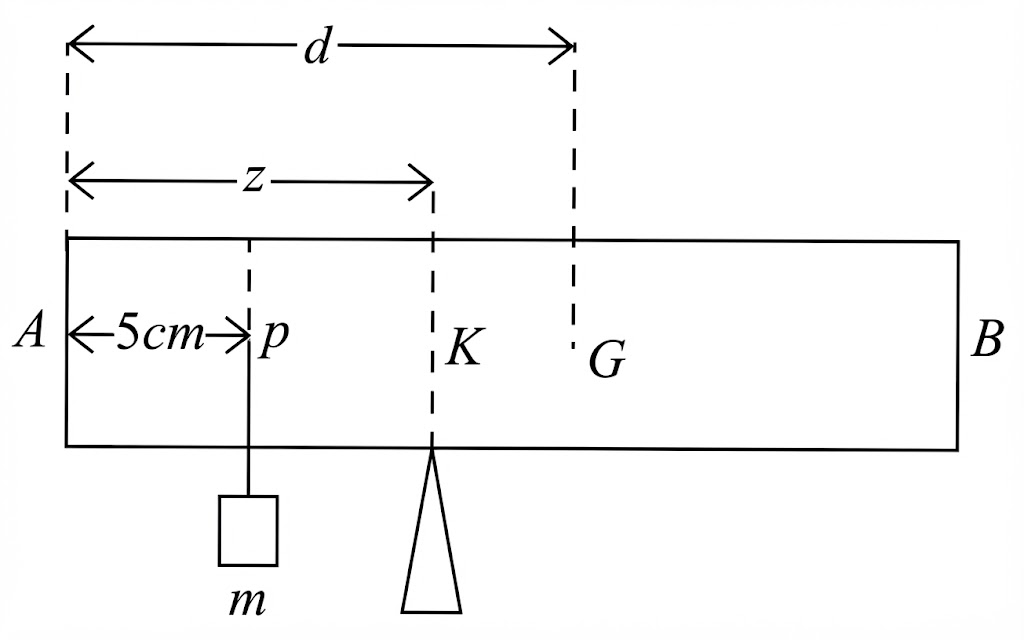
Question 1 View Details
Question Parts
(a)
You are provided with a metre rule, a weight hanger, slotted masses, M, a piece of string, a weighing balance and a knife edge. Use the diagram above as a guide to perform the experiment. (i) Using the weighing balance, determine and record the mass, M0, of the unloaded metre rule. (ii) Determine and record the mass, m, of the weight lianger. (iii) Suspend the metre rule horizontally on the knife edge. Adjust the knife edge to a point G on the metre rule where it balances horizontally. (iv) Record the distance, d=AG. (v) Suspend the weight hanger securely at a point, P, on the metre rule such that AP=5 cm. Keep the hanger at this point throughout the experiment. (vi) Add a mass, M=20 g to the hanger, adjust the knife edge to a point K on the metre rule such that it balances horizontally as shown in the diagram above. (vii) Determine and record the distance z=AK. (viii) Record M and evaluate y=(z-5), x=(d-z) and v=\frac{x}{y}. (ix) Repeat the experiment for M=40 g, 60 g, 80 g and 100 g. In each case, evaluate y, x and v. (x) Tabulate the results. (xi) Plot a graph with M on the vertical axis and v on the horizontal axis, starting both axes from the origin (0, 0). (xii) Determine the slope, s, of the graph. (xiii) Determine the intercept, c, on the vertical axis. (xiv) State two precautions taken to ensure accurate results.
(b)
(i) Under what condition is an object said to be in a stable equilibrium? (ii) A uniform beam of weight 50 N has a body of weight 100 N hung at one end of it. If the beam is 12 m long, determine the distance of a support from a 100 N body for it to balance horizontally.
Detailed Essay Solution & Marking Scheme Available

Get the step-by-step mathematical proofs, key points required by examiners, and a comprehensive breakdown from our AI Tutor.
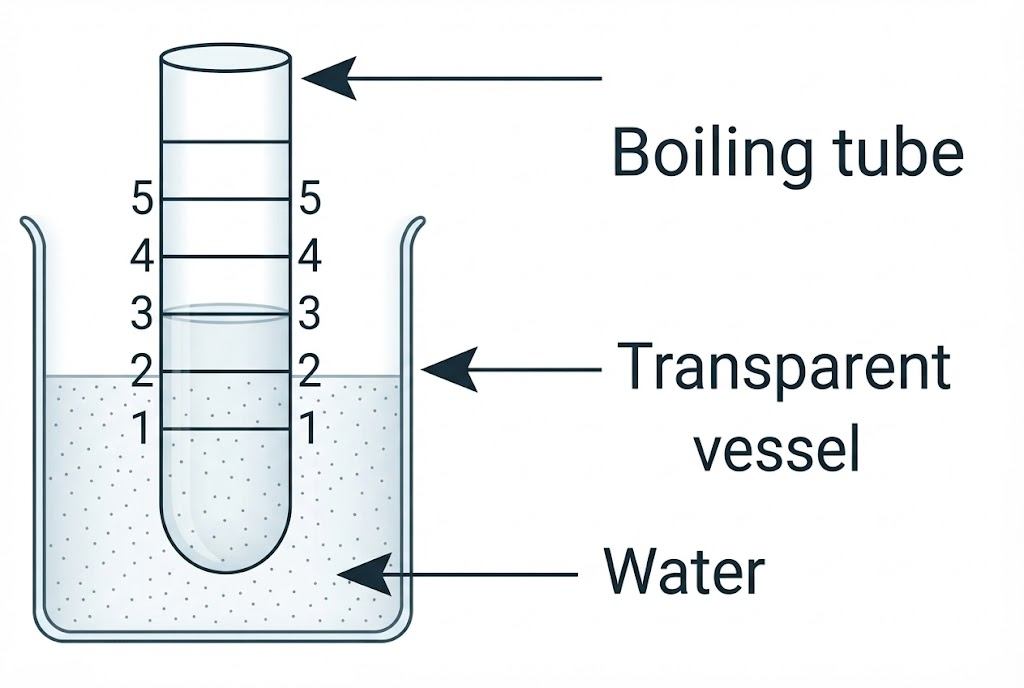
Question 2 View Details
Question Parts
(a)
You are provided with a loaded boiling tube with a centimeter scale fixed inside it, a transparent vessel filled with water, standard masses 2 g, 5 g and 10 g and a slide vernier caliper. Use the diagram above as a guide to perform the experiment. (i) Use the slide vernier caliper to measure and record the external diameter, D, of the boiling tube. (ii) Evaluate A=0.25 \( \pi D^{2} \), where \( \pi=3.14 \). (iii) Place the loaded boiling tube gently in the water in the transparent vessel such that it floats vertically. (iv) Read and record the depth of immersion, y, from the zero mark of the scale fixed inside the boiling tube. (v) Add a mass, m=2 g to the boiling tube. Read and record the new depth of immersion, y, from the zero mark of the scale. (vi) Evaluate h=(-y), \( \log h \) and \( \log m \). (vii) Repeat the experiment for four other values of m=5 g, 7 g, 10 g and 12 g. In each case, record y and evaluate h, \( \log h \) and \( \log m \). (viii) Tabulate the results. (ix) Plot a graph with \( \log m \) on the vertical axis and \( \log h \) on the horizontal axis starting both axes from the origin (0, 0). (x) Determine the slope, s, of the graph. (xi) Determine the intercept, c, on the vertical axis. (xii) Given that \( \log (A P)=c \), calculate P. (xiii) State two precautions taken to ensure accurate results.
(b)
(i) State in full the law on which the experiment in 2(a) is based. (ii) A uniform cylindrical rod is 0.63 m long and it has a cross-sectional area of \( 0.1 m^{2} \). Calculate the depth of immersion of the rod if it floats vertically in a liquid of relative density 1.2 [density of rod \( 720 kg m^{-3} \), g=10 m].
Detailed Essay Solution & Marking Scheme Available

Get the step-by-step mathematical proofs, key points required by examiners, and a comprehensive breakdown from our AI Tutor.
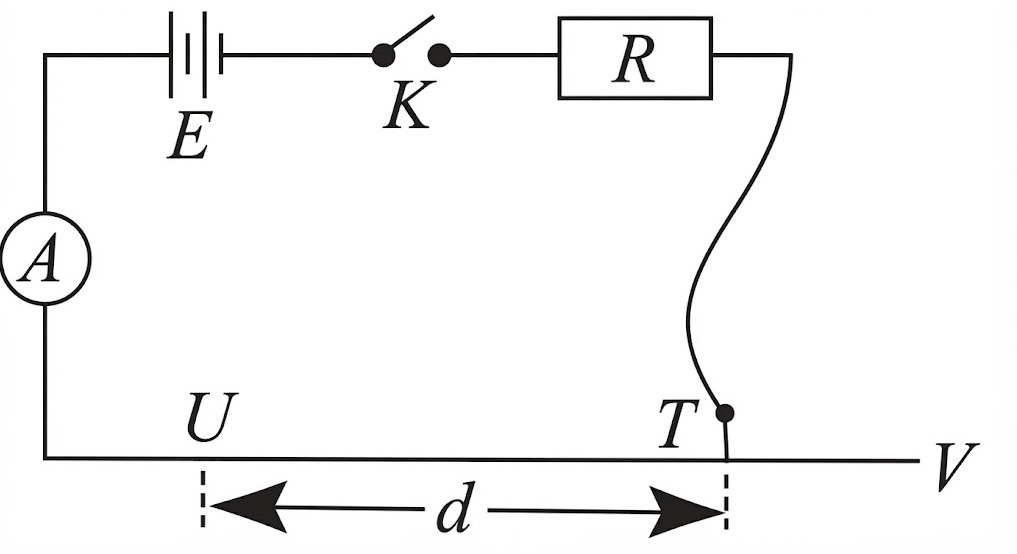
Question 3 View Details
Question Parts
(a)
You are provided with a battery of emf, E, a standard resistor, R, of resistance 2 \( \Omega \), a key, K, an ammeter, A, a jockey, J, a potentiometer, UV, and some connecting wires. (i) Measure and record the emf, E, of the battery. (ii) Set up the circuit as shown in the diagram above with the key open. (iii) Place the jockey at the point, U, of the potentiometer wire. Close the key and record the reading, i, of the ammeter. (iv) Place the jockey at a point T on the potentiometer wire UV such that d=UT=30.0 cm. (v) Close the circuit, read and record the current, I, on the ammeter. (vi) Evaluate I. (vii) Repeat the experiment for four other values of d=40.0 cm, 50.0 cm, 60.0 cm and 70.0 cm. In each case, record I and evaluate. (viii) Tabulate the results. (ix) Plot a graph with d on the vertical axis and \( I^{-1} \) on the horizontal axis starting both axes from the origin (0,0). (x) Determine the slope, s, of the graph. (xi) From the graph determine the value \( I_{0} \) of I when d=0. (xii) Given that \( \frac{E}{\delta}=s \), calculate \( \delta \). (xiii) State two precautions taken to ensure accurate results.
(b)
(i) Write down the equation that connects the resistance, R, of a wire and the factors on which it depends. State the meaning of each of the symbols. (ii) An electric fan draws a current of 0.75 A in a 240 V circuit. Calculate the cost of using the fan for 10 hours if the utility rate is $0.50 per kWh.
Detailed Essay Solution & Marking Scheme Available

Get the step-by-step mathematical proofs, key points required by examiners, and a comprehensive breakdown from our AI Tutor.

Master the Exam!

You've seen a preview, but there are thousands more questions plus AI tutor to break down complex solutions.

Unlock Full Access Available for Android & Windows
Help others prepare! Share this practice hub:
Chat with Support