(
a
)
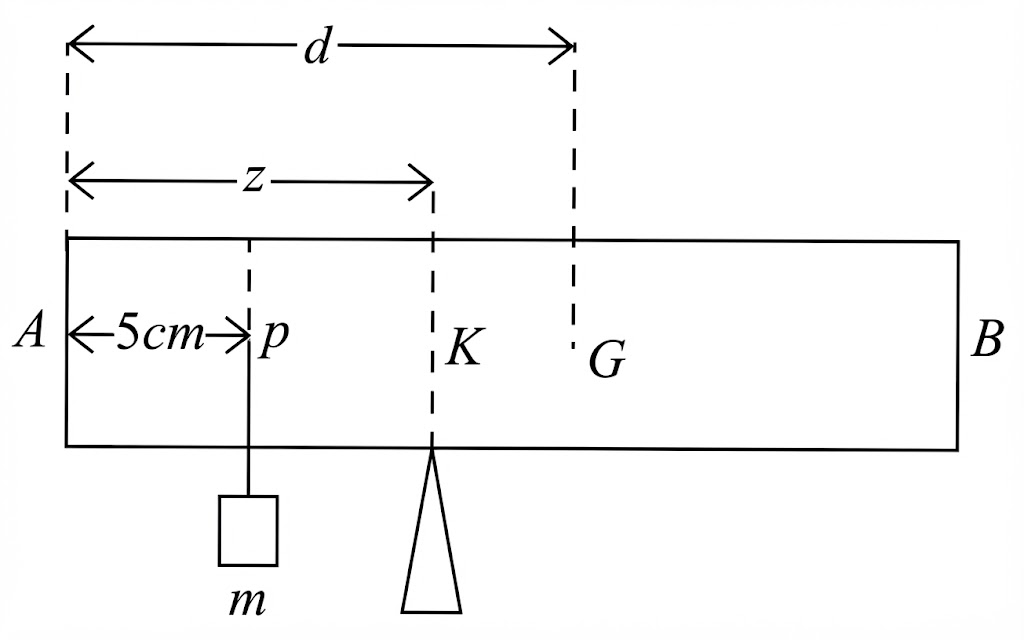
You are provided with a metre rule, a weight hanger, slotted masses, M, a piece of string, a weighing balance and a knife edge. Use the diagram above as a guide to perform the experiment. (i) Using the weighing balance, determine and record the mass, M0, of the unloaded metre rule. (ii) Determine and record the mass, m, of the weight lianger. (iii) Suspend the metre rule horizontally on the knife edge. Adjust the knife edge to a point G on the metre rule where it balances horizontally. (iv) Record the distance, d=AG. (v) Suspend the weight hanger securely at a point, P, on the metre rule such that AP=5 cm. Keep the hanger at this point throughout the experiment. (vi) Add a mass, M=20 g to the hanger, adjust the knife edge to a point K on the metre rule such that it balances horizontally as shown in the diagram above. (vii) Determine and record the distance z=AK. (viii) Record M and evaluate y=(z-5), x=(d-z) and v=\frac{x}{y}. (ix) Repeat the experiment for M=40 g, 60 g, 80 g and 100 g. In each case, evaluate y, x and v. (x) Tabulate the results. (xi) Plot a graph with M on the vertical axis and v on the horizontal axis, starting both axes from the origin (0, 0). (xii) Determine the slope, s, of the graph. (xiii) Determine the intercept, c, on the vertical axis. (xiv) State two precautions taken to ensure accurate results.
(
b
)
(i) Under what condition is an object said to be in a stable equilibrium? (ii) A uniform beam of weight 50 N has a body of weight 100 N hung at one end of it. If the beam is 12 m long, determine the distance of a support from a 100 N body for it to balance horizontally.