UTME 2022 Chemistry | Objective

Prepare for your exams with UTME questions? Reviewing past/model questions is one of the most effective ways to guarantee a high score. This practice hub features authentic 2022 Chemistry (Objective) questions designed to simulate the real exam environment.

Practice these randomly selected questions to test your readiness.

Question 1 View Details
The flame used by welders in cutting metals is
A. butane gas flame
B. acetylene flame
C. kerosine flame
Correct D. oxy-acetylene flame
E. oxygen flame

Correct Answer: D

Want to see the full step-by-step solution? Unlock AI Explanation & Analytics
Question 2 View Details
Consecutive members of an alkane homologous series differ by
A. CH
Correct B. \( \mathrm{CH}_{2} \)
C. \( \mathrm{CH}_{3} \)
D. \( \mathrm{CnHn} \quad \)
E. \( \mathrm{CnH}_{2 n+2} \)

Correct Answer: B

Want to see the full step-by-step solution? Unlock AI Explanation & Analytics
Question 3 View Details
If an element has the electronic configuration \( I s^{2} s^{2} p^{6} \mathrm{Ss}^{2} \mathrm{Sp}^{4} \), it is
A. a metal
B. an alkaline-earth metal
C. an s-block element
Correct D. a p-block element
E. a transition element

Correct Answer: D

Want to see the full step-by-step solution? Unlock AI Explanation & Analytics
Question 4 View Details
Some copper(II) sulphate pentahydrate ( \( \mathrm{CuSO}_{4}.5 \mathrm{H}_{2} \mathrm{O} \) ), was heated at \( 120^{\circ} \mathrm{C} \) with the following results: Weight of crucible \( =10.00 \mathrm{~g} \); Weight of crucible + \( \mathrm{CuSO}_{4}.\mathrm{5H}_{2} \mathrm{O}=14.98 \mathrm{~g} \); Weight of crucible + residue \( =13.54 \mathrm{~g} \). How many molecules of water of crystallization were lost? \( [\mathrm{H}=1, \mathrm{Cu}=63.5, \mathrm{O}=16, \mathrm{~S}=32] \)
A. 1
B. 2
C. 3
Correct D. 4
E. 5

Correct Answer: D

Want to see the full step-by-step solution? Unlock AI Explanation & Analytics
Question 5 View Details
The three dimensional shape of methane is
A. hexagonal
B. trigonal
C. linear
Correct D. tetrahedral
E. cubical

Correct Answer: D

Want to see the full step-by-step solution? Unlock AI Explanation & Analytics
Question 6 View Details
PASSAGE - P1
Use the following to answer Questions 6-8: An unknown organic compound \( X \) has a relative molecular mass of 180. It is a colourless crystalline solid, readily soluble in water. X contains the elements \( \mathrm{C}, \mathrm{H}, \) and \( O \) in the atomic ratio \( 1: 2: 1 \). The compound has a sweet taste and melts on heating. In the presence of yeast and in the absence of air, \( X \) is converted to compound \( Y \) and a colourless gas. Compound \( Y \) reacts with sodium metal to produce a gas \( Z \). which gives a 'pop' sound with a glowing splint. \( Y \) also reacts with ethanoic acid to give a sweet smelling compound W.
Compound W is
A. a soap
B. an oil
C. an alkane
Correct D. an ester
E. sucrose

Correct Answer: D

Want to see the full step-by-step solution? Unlock AI Explanation & Analytics
Question 7 View Details
PASSAGE - P1
Use the following to answer Questions 6-8: An unknown organic compound \( X \) has a relative molecular mass of 180. It is a colourless crystalline solid, readily soluble in water. X contains the elements \( \mathrm{C}, \mathrm{H}, \) and \( O \) in the atomic ratio \( 1: 2: 1 \). The compound has a sweet taste and melts on heating. In the presence of yeast and in the absence of air, \( X \) is converted to compound \( Y \) and a colourless gas. Compound \( Y \) reacts with sodium metal to produce a gas \( Z \). which gives a 'pop' sound with a glowing splint. \( Y \) also reacts with ethanoic acid to give a sweet smelling compound W.
The molecular formula of X is
A. \( \mathrm{C}_{12} \mathrm{H}_{22} \mathrm{O}_{11} \)
Correct B. \( \mathrm{C}_{6} \mathrm{H}_{12} \mathrm{O}_{6} \)
C. \( \mathrm{C}_{3} \mathrm{H}_{6} \mathrm{O}_{3} \)
D. \( \mathrm{C}_{2} \mathrm{H}_{14} \mathrm{~A}_{7} \)
E. \( \mathrm{C}_{4} \mathrm{H}_{8} \mathrm{~A}_{4} \)

Correct Answer: B

Want to see the full step-by-step solution? Unlock AI Explanation & Analytics
Question 8 View Details
PASSAGE - P1
Use the following to answer Questions 6-8: An unknown organic compound \( X \) has a relative molecular mass of 180. It is a colourless crystalline solid, readily soluble in water. X contains the elements \( \mathrm{C}, \mathrm{H}, \) and \( O \) in the atomic ratio \( 1: 2: 1 \). The compound has a sweet taste and melts on heating. In the presence of yeast and in the absence of air, \( X \) is converted to compound \( Y \) and a colourless gas. Compound \( Y \) reacts with sodium metal to produce a gas \( Z \). which gives a 'pop' sound with a glowing splint. \( Y \) also reacts with ethanoic acid to give a sweet smelling compound W.
Reaction of \( X \) with yeast forms the basis of the
A. plaster industry
B. textile industry
Correct C. brewing industry
D. soap industry

Correct Answer: C

Want to see the full step-by-step solution? Unlock AI Explanation & Analytics
Question 9 View Details
A mixture of common salt, ammonium chloride and barium sulphate can best be separated by
A. addition of water followed by filtration then sublimation
B. addition of water followed by sublimation then filtration
Correct C. sublimation followed by addition of water then filtration
D. fractional distillation
E. fractional crystallation

Correct Answer: C

Want to see the full step-by-step solution? Unlock AI Explanation & Analytics
Question 10 View Details
Which of the following relationships between the pressure P, the volume-V and the temperature T, represents an ideal gas behaviour?
A. paVT
B. p TaT/N
C. pTaV
D. pval/T
Correct E. paV/T

Correct Answer: E

Want to see the full step-by-step solution? Unlock AI Explanation & Analytics
Question 11 View Details
What volume of 0.5 M \( \text{ } \mathrm{H}_{2} \mathrm{SO}_{4} \) will exactly neutralize \( 20 \mathrm{~cm}^{3} \) of 0.1 M NaOH solution?
Correct A. \( 2.0 \mathrm{~cm}^{3} \)
B. \( 5.0 \mathrm{~cm}^{3} \)
C. \( 6.8 \mathrm{~cm}^{3} \)
D. \( 8.3 \mathrm{~cm}^{3} \)

Correct Answer: A

Want to see the full step-by-step solution? Unlock AI Explanation & Analytics
Question 12 View Details
In which of the following reaction does hydrogen peroxide act as a reducing agent?
A. \( \text{H}_2\text{S} + \text{H}_2\text{O}_2 \rightarrow \text{S} + 2\text{H}_2\text{O} \\ \)
B. \( \text{PbSO}_3 + \text{H}_2\text{O}_2 \rightarrow \text{PbSO}_4 + \text{H}_2\text{O} \\ \)
C. \( 2\text{I}^- + 2\text{H}^+ + \text{H}_2\text{O}_2 \rightarrow \text{I}_2 + 2\text{H}_2\text{O} \\\)
Correct D. \( \text{PbO}_2 + 2\text{HNO}_3 + \text{H}_2\text{O}_2 \rightarrow \text{Pb}(\text{NO}_3)_2 + 2\text{H}_2\text{O} + \text{O}_2 \\ \)

Correct Answer: D

Want to see the full step-by-step solution? Unlock AI Explanation & Analytics
Question 13 View Details
For the reaction \( 2\text{Fe}^{3+} + 2\text{I}^- \rightarrow 2\text{Fe}^{2+} + \text{I}_2 \) which of the following statements is TRUE?
A. Fe is oxidized to \( \mathrm{Fe}^{3+} \)
B. \( \mathrm{Fe}^{3+} \) is oxidized to \( \mathrm{Fe}^{2+} \)
Correct C. \( \text{I}^- \) is oxidized to \( \text{I}_2 \)
D. \( \text{I}^- \) is reduced to \( \text{I}_2 \)

Correct Answer: C

Want to see the full step-by-step solution? Unlock AI Explanation & Analytics
Question 14 View Details
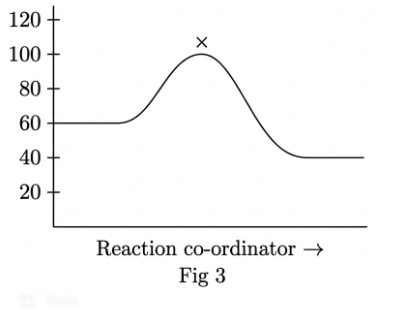
The diagram shows the energy profile for the reaction \( \mathrm{A} + \mathrm{B} = \mathrm{C} + \mathrm{D} \). From this diagram, it is clear that the reaction is
A. spontaneous
B. isothermal
C. adiabatic
Correct D. exothermic

Correct Answer: D

Want to see the full step-by-step solution? Unlock AI Explanation & Analytics
Question 15 View Details
In dilute solution the heat of the reaction \( 2 \mathrm{NaOH} + \mathrm{HCl} \rightarrow \mathrm{NaCl} + \mathrm{H}_{2} \mathrm{O} \) is -57.3 kJ. Therefore the heat of the reaction \( 2 \mathrm{NaOH} + \mathrm{H}_{2} \mathrm{SO}_{4} \rightarrow \mathrm{Na}_{2} \mathrm{SO}_{4} + 2 \mathrm{H}_{2} \mathrm{O} \) is
A. +28.65 kJ
B. -28.65 kJ
C. +57.3 kJ
Correct D. -114.6 kJ

Correct Answer: D

Want to see the full step-by-step solution? Unlock AI Explanation & Analytics
Question 16 View Details
For the reactions: I. \( \text{Melon oil} + \text{NaOH} \rightarrow \text{Soap} + \text{Glycerol} \) II. \( 3\text{Fe} + 4\text{H}_2\text{O} \rightleftharpoons \text{Fe}_3\text{O}_4 + 4\text{H}_2 \) III. \( \text{N}_2\text{O}_4 \rightleftharpoons 2\text{NO}_2 \) Which of the following statements is true?
A. Each of the three reactions requires a catalyst
Correct B. All the reactions demonstrate Le Chaterlier's principle
C. The presence of a catalyst will increase the yields of the products
D. Increase in presence will result in higher yields of the products in I and II only

Correct Answer: B

Want to see the full step-by-step solution? Unlock AI Explanation & Analytics
Question 17 View Details
Which of the following methods may be used to prepare tritoxonitrate (V) acid (nitric acid) in the laboratory?
A. Heating ammonia gas with tetraoxosulphate (VI) acid
Correct B. Heating ammonium trioxonitrate (V) with tetraoxo-sulphate (VI) acid
C. Heating sodium trioxonitrate (V) with calcium tetraoxosulphate (VI) acid
D. Heating potassium trioxonitrate(V) with calcium hydroxide

Correct Answer: B

Want to see the full step-by-step solution? Unlock AI Explanation & Analytics
Question 18 View Details
Lime water which is used in the laboratory detection of carbon(IV) oxide is an aqueous solution of
Correct A. \( \mathrm{Ca} (\mathrm{OH})_{2} \)
B. \( \mathrm{CaCO}_{2} \)
C. \( \mathrm{CaHCO}_{2} \)
D. \( \mathrm{CaSO}_{2} \)

Correct Answer: A

Want to see the full step-by-step solution? Unlock AI Explanation & Analytics
Question 19 View Details
If an excess of a liquid hydrocarbon is poured into a jar of chlorine, and the sealed jar is then exposed for several hours to bright sunlight, all the chlorine gas is consumed. The hydrocarbon is said to have undergone.
A. a polymerization reaction
B. an isomerization reaction
C. an addition reaction
Correct D. a substitution reaction

Correct Answer: D

Want to see the full step-by-step solution? Unlock AI Explanation & Analytics
Question 20 View Details
The function of conc. \( \mathrm{H}_{2} \mathrm{SO}_{4} \) in the esterification of ethanoic acid with ethanol is to
A. serve as a dehydrating agent
B. serve as a solvent
Correct C. act as a catalyst
D. prevent any side reaction

Correct Answer: C

Want to see the full step-by-step solution? Unlock AI Explanation & Analytics
Question 21 View Details
A piece of sea shell, when dropped into a dilute solution of hydrochloric acid, produces a colourless, odourless gas which turns clear lime-water milky. The sea shell contains
A. sodium chloride
B. ammonium nitrate
Correct C. calcium carbonate
D. calcium chloride

Correct Answer: C

Want to see the full step-by-step solution? Unlock AI Explanation & Analytics
Question 22 View Details
Which of the following electrodes is used in the electrolysis of bauxite \( \left( \mathrm{Al}_{2} \mathrm{O}_{3} \right) \) in molten cryolite?
A. Steel electrodes
Correct B. Carbon electrodes
C. Mercury electrodes
D. Carbon anode and steel cathode

Correct Answer: B

Want to see the full step-by-step solution? Unlock AI Explanation & Analytics
Question 23 View Details
An aqueous solution of a metal salt, M, gives a white precipitate with NaOH, which dissolves in excess NaOH. With aqueous ammonia, the solution of M also gives a white precipitate which dissolves in excess ammonia. Therefore, the cation in M is:
Correct A. \( \mathrm{Zn}^{2+} \)
B. \( \mathrm{Ca}^{2+} \)
C. \( \mathrm{Al}^{3+} \)
D. \( \mathrm{Pb}^{2+} \)

Correct Answer: A

Want to see the full step-by-step solution? Unlock AI Explanation & Analytics
Question 24 View Details
\( \begin{array}{ccccccc} & & CH & & & & \\ & & \big| & & & & \\ CH_3 & - & C & - & CH_2 & - & CH_3 \\ & & \big| & & & & \\ & & CH_3 & & & & \end{array} \) The I.U.P.A.C. name for the compound above is
A. is isopropylethene
B. acetylene
C. methylbutane
Correct D. 2-methylbutane

Correct Answer: D

Want to see the full step-by-step solution? Unlock AI Explanation & Analytics
Question 25 View Details
Hydrogen is not liberated when trioxonitrate (V) acid reacts with zinc because
A. zinc is rendered passive by the acid
B. hydrogen produced is oxidized to water
Correct C. oxides of nitrogen are produced
D. all nitrates are soluble in water

Correct Answer: C

Want to see the full step-by-step solution? Unlock AI Explanation & Analytics

Master the Exam!

You've seen a preview, but there are thousands more questions plus AI tutor to break down complex solutions.

Unlock Full Access Available for Android & Windows
Help others prepare! Share this practice hub:
Chat with Support