waec model questions vol1 2025 physics | Practical

Are you preparing for waec model questions vol1 exams? Reviewing past questions is one of the most effective ways to guarantee a high score. This practice hub features authentic 2025 physics (Practical) questions designed to simulate the real exam environment.

Practice these randomly selected questions to test your readiness.

Question 1
A student conducts an experiment to determine the density of an irregularly shaped object. The mass of the object is measured to be 250 grams. The object is submerged in a graduated cylinder containing water, and the initial water level is 300 mL. After submerging the object, the water level rises to 360 mL. Calculate the density of the object. Additionally, discuss the potential sources of error in this experiment and how they could affect the results.
Question Parts
(a)
Calculate the density of the object.
(b)
Discuss two potential sources of error in this experiment.
Detailed Essay Solution & Marking Scheme Available

Get the step-by-step mathematical proofs, key points required by examiners, and a comprehensive breakdown from our AI Tutor.
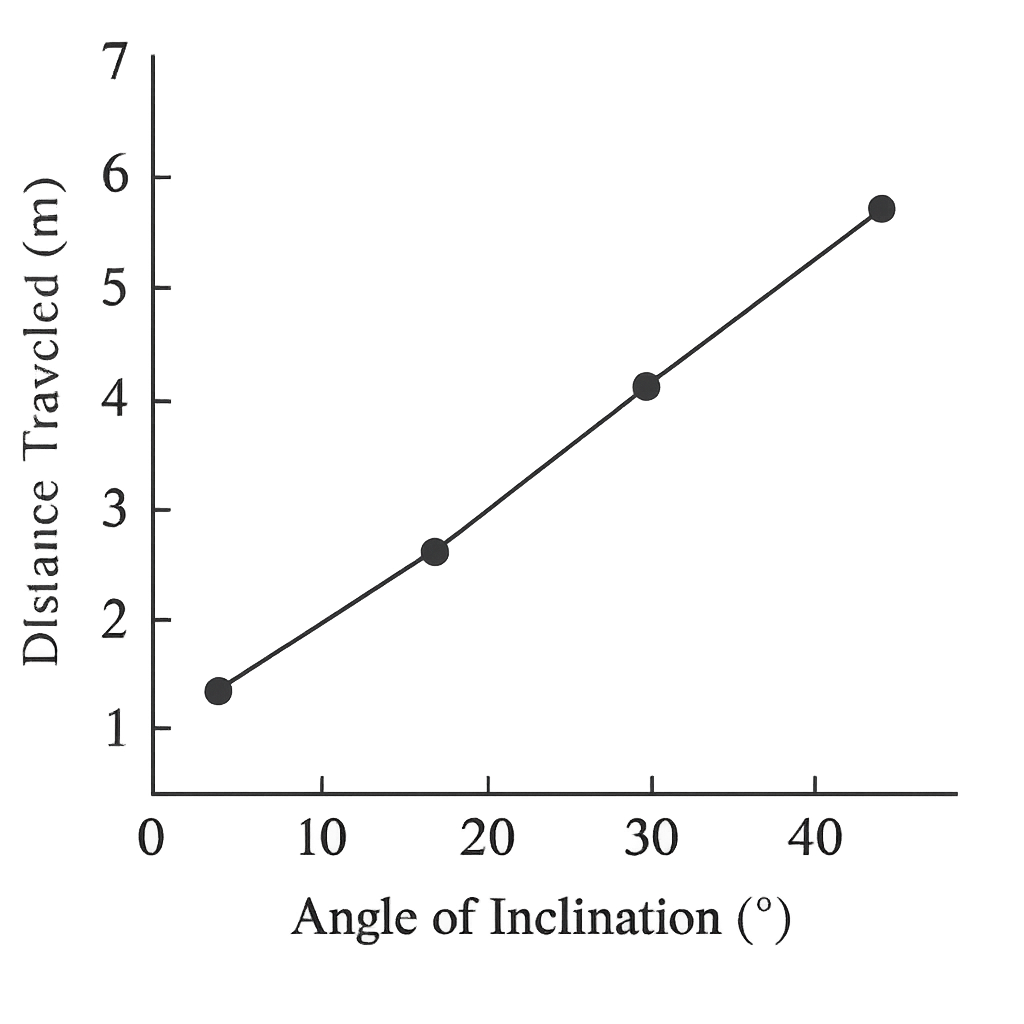
Question 2
A student is investigating the relationship between the angle of inclination of a ramp and the distance traveled by a toy car rolling down the ramp. The ramp is set at angles of 10°, 20°, 30°, and 40°. The distances traveled by the car for each angle are recorded as follows: 10° - 1.5 m, 20° - 2.8 m, 30° - 4.0 m, and 40° - 5.5 m. Plot a graph of distance traveled against angle of inclination. Based on the graph, determine the angle at which the car would theoretically travel 6 m if the trend continues, and explain the method used to find this value.
Question Parts
(a)
Plot the graph of distance traveled against angle of inclination.
(b)
Using the graph, determine the angle at which the car would theoretically travel 6 m.
(c)
Explain the method used to find the angle at which the car would travel 6 m.
Detailed Essay Solution & Marking Scheme Available

Get the step-by-step mathematical proofs, key points required by examiners, and a comprehensive breakdown from our AI Tutor.

Question 3
A student conducts an experiment to investigate the motion of a toy car on a ramp. The ramp is inclined at an angle of 30 degrees to the horizontal. The car is released from rest at the top of the ramp, which is 1.5 meters long. The student measures the time taken for the car to reach the bottom of the ramp and records it as 2.5 seconds. Using this data, determine the acceleration of the car down the ramp. Additionally, calculate the speed of the car just before it reaches the bottom of the ramp. Assume no friction acts on the car.
Question Parts
(a)
Calculate the acceleration of the car down the ramp.
(b)
Determine the speed of the car just before it reaches the bottom of the ramp.
Detailed Essay Solution & Marking Scheme Available

Get the step-by-step mathematical proofs, key points required by examiners, and a comprehensive breakdown from our AI Tutor.

Question 4
A block of wood is placed on a horizontal surface. The block has a mass of 5 kg. A force of 20 N is applied horizontally to the block, and it moves a distance of 4 meters before coming to a stop after the force is removed. Calculate the work done on the block while the force was applied. After the force is removed, if the block comes to a stop in a distance of 2 meters, calculate the frictional force acting on the block.
Question Parts
(a)
Calculate the work done on the block while the force was applied.
(b)
Determine the frictional force acting on the block after the force is removed.
Detailed Essay Solution & Marking Scheme Available

Get the step-by-step mathematical proofs, key points required by examiners, and a comprehensive breakdown from our AI Tutor.

Master the Exam!

You've seen a preview, but there are thousands more questions plus AI tutor to break down complex solutions.

Unlock Full Access Available for Android & Windows
Help others prepare! Share this practice hub:
Chat with Support