waec model questions vol1 2025 physics | Essay

Are you preparing for waec model questions vol1 exams? Reviewing past questions is one of the most effective ways to guarantee a high score. This practice hub features authentic 2025 physics (Essay) questions designed to simulate the real exam environment.

Practice these randomly selected questions to test your readiness.
Question 1
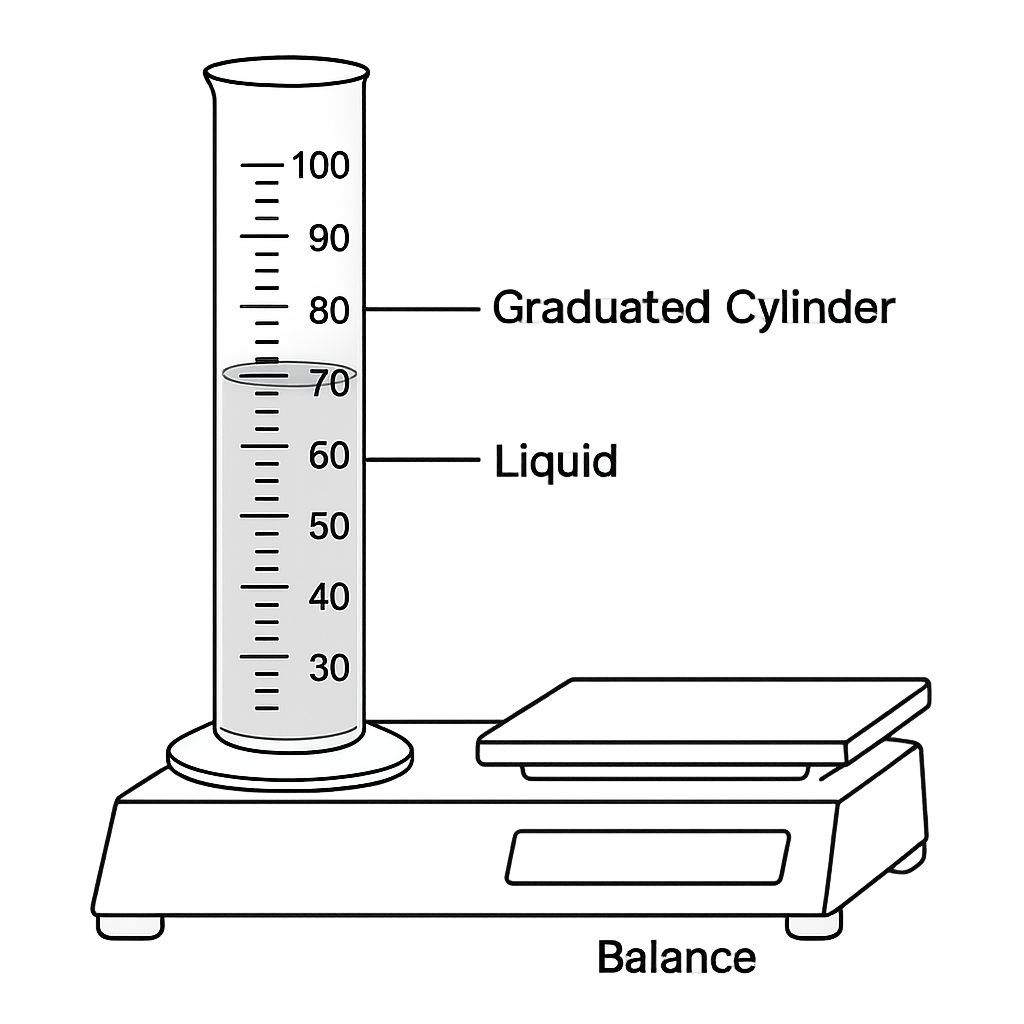
A student conducts an experiment to determine the density of a liquid. The student measures the mass of an empty graduated cylinder as 150 grams and the mass of the cylinder filled with the liquid as 250 grams. The volume of the liquid is measured to be 100 mL. Using this information, answer the following questions:
Question Parts
(a)
Calculate the mass of the liquid alone.
(b)
Using your answer from part (a), calculate the density of the liquid in grams per milliliter (g/mL).
(c)
Discuss how temperature might affect the density of the liquid and the implications this has for the experiment.
Detailed Essay Solution & Marking Scheme Available

Get the step-by-step mathematical proofs, key points required by examiners, and a comprehensive breakdown from our AI Tutor.
Question 2
A student is studying the concepts of scalars and vectors. They measure the displacement of a car moving from point A to point B, which is 50 meters east. The car then moves from point B to point C, which is 30 meters north. Using this information, answer the following questions:
Question Parts
(a)
Calculate the total displacement of the car from point A to point C.
(b)
Discuss the difference between scalar and vector quantities, providing examples.
Detailed Essay Solution & Marking Scheme Available

Get the step-by-step mathematical proofs, key points required by examiners, and a comprehensive breakdown from our AI Tutor.
Question 3
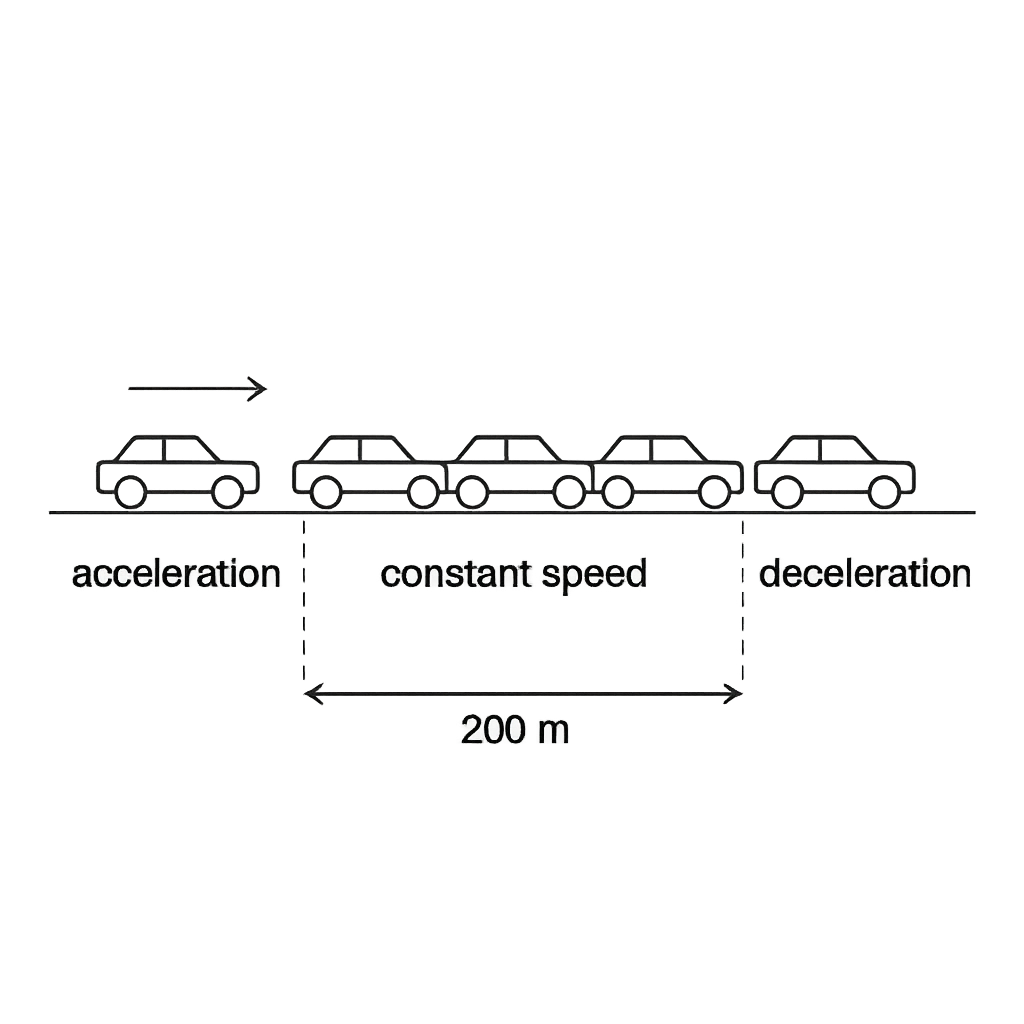
A car accelerates uniformly from rest to a speed of 25 m/s over a distance of 100 meters. After reaching this speed, it continues to move at a constant speed for a distance of 200 meters before coming to a stop. (a) Calculate the time taken for the car to reach the speed of 25 m/s. (b) Determine the total time taken for the car to travel the entire distance of 300 meters. (c) If the car were to decelerate uniformly to a stop over the last distance of 200 meters, calculate the deceleration of the car.
Question Parts
(a)
Calculate the time taken for the car to reach the speed of 25 m/s.
(b)
Determine the total time taken for the car to travel the entire distance of 300 meters.
(c)
If the car were to decelerate uniformly to a stop over the last distance of 200 meters, calculate the deceleration of the car.
Detailed Essay Solution & Marking Scheme Available

Get the step-by-step mathematical proofs, key points required by examiners, and a comprehensive breakdown from our AI Tutor.
Question 4
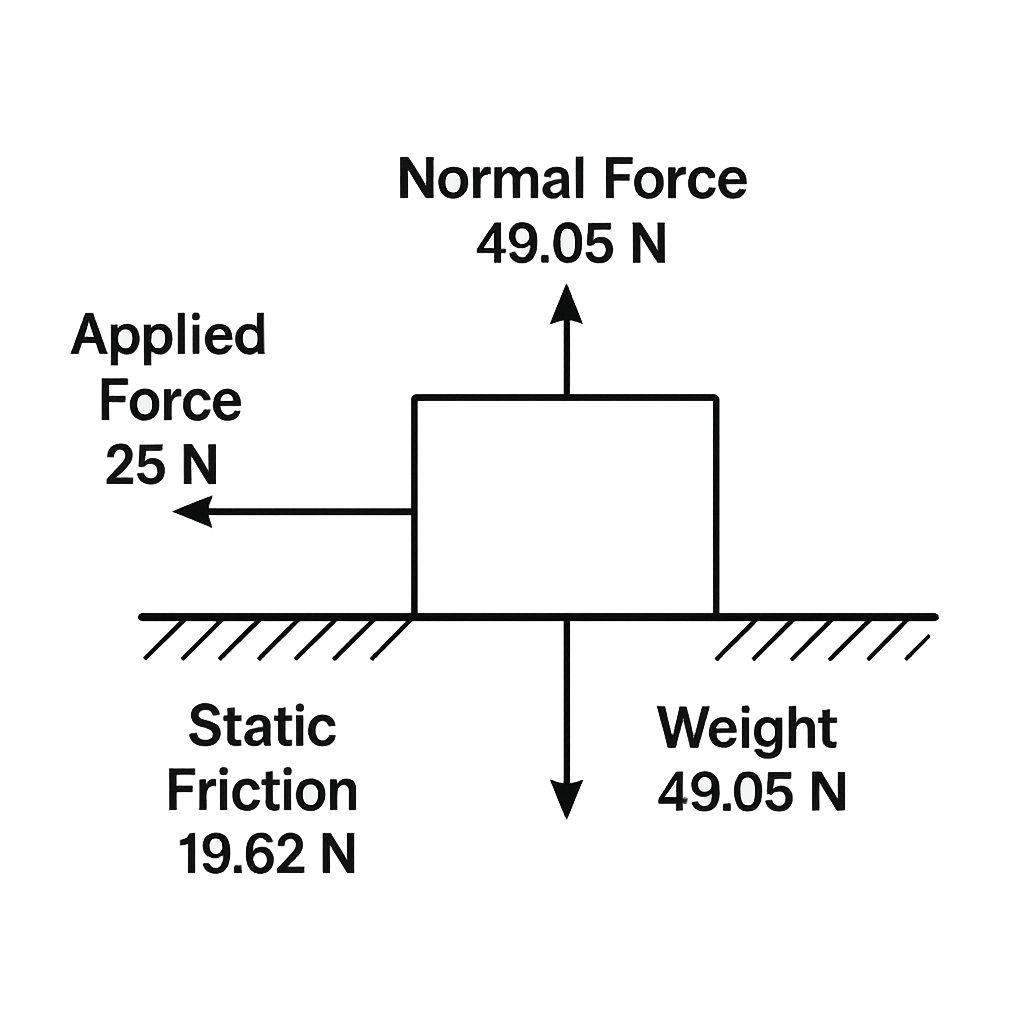
A block of mass 5 kg is resting on a horizontal surface. A horizontal force of 20 N is applied to the block, but the block does not move. The coefficient of static friction between the block and the surface is 0.4. (a) Calculate the maximum static frictional force acting on the block. (b) Discuss the factors that affect the static friction between the block and the surface. (c) If the applied force is increased to 25 N, determine whether the block will move or remain at rest. Justify your answer with calculations.
Question Parts
(a)
Calculate the maximum static frictional force acting on the block.
(b)
Discuss the factors that affect the static friction between the block and the surface.
(c)
If the applied force is increased to 25 N, determine whether the block will move or remain at rest. Justify your answer with calculations.
Detailed Essay Solution & Marking Scheme Available

Get the step-by-step mathematical proofs, key points required by examiners, and a comprehensive breakdown from our AI Tutor.

Question 5
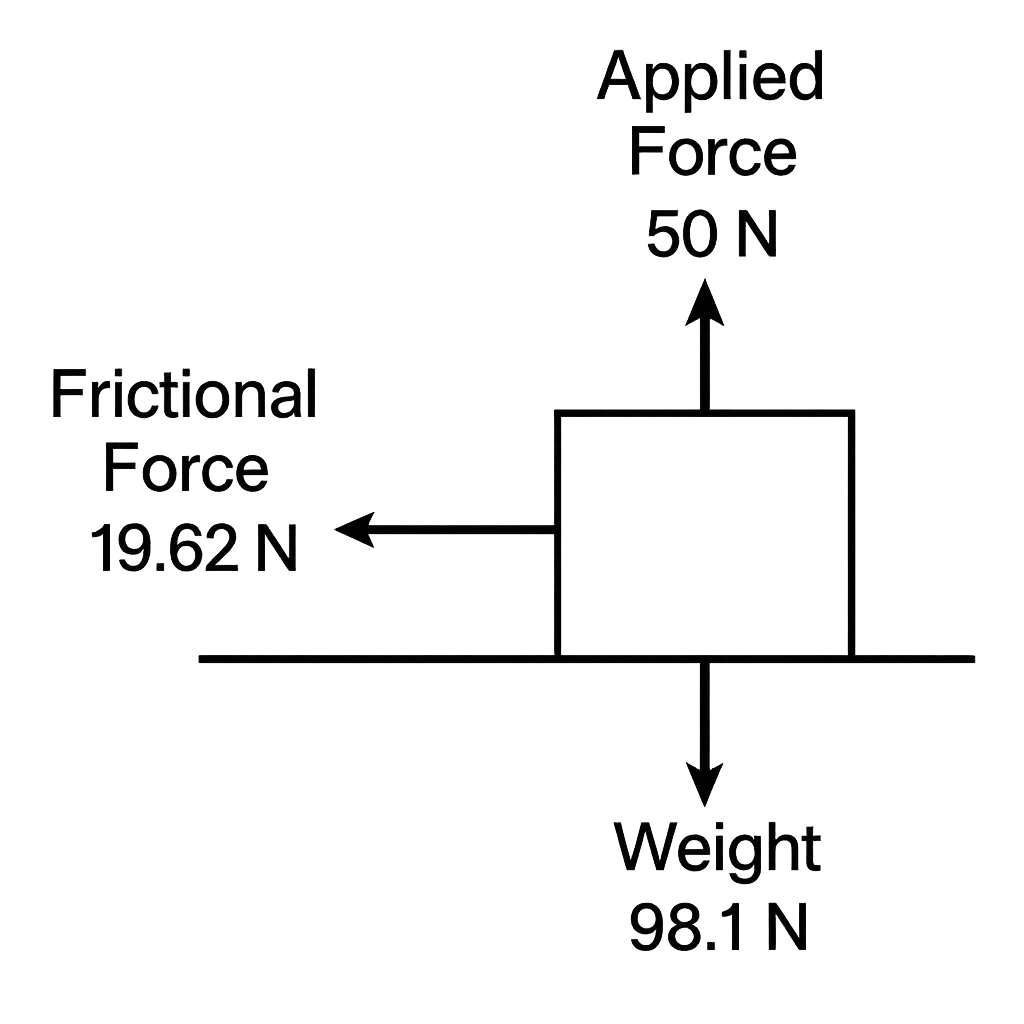
A block of mass 10 kg is placed on a horizontal surface and is pushed by a force of 50 N. The coefficient of kinetic friction between the block and the surface is 0.2. Analyze the motion of the block by determining the following:
Question Parts
(a)
Calculate the frictional force acting on the block.
(b)
Determine the net force acting on the block and its acceleration.
(c)
If the block is pushed for a distance of 5 meters, calculate the work done by the applied force and the work done against friction.
(d)
Discuss the implications of the calculated work done against friction in terms of energy transfer.
Detailed Essay Solution & Marking Scheme Available

Get the step-by-step mathematical proofs, key points required by examiners, and a comprehensive breakdown from our AI Tutor.

Question 6
A pulley system consists of a fixed pulley and a movable pulley. If a weight of 50 N is suspended from the movable pulley, calculate the force required to lift the weight using the fixed pulley. Then, analyze how the mechanical advantage of the system affects the force required.
Question Parts
(a)
Calculate the force required to lift the weight using the fixed pulley.
(b)
Discuss how the mechanical advantage of the pulley system influences the force required.
Detailed Essay Solution & Marking Scheme Available

Get the step-by-step mathematical proofs, key points required by examiners, and a comprehensive breakdown from our AI Tutor.

Question 7
A container holds a gas at a pressure of 200 kPa and a temperature of 300 K. The volume of the gas is 0.5 m³. The gas is then compressed isothermally to a volume of 0.25 m³. (a) Calculate the final pressure of the gas after compression. (b) If the gas is then allowed to expand adiabatically to its original volume, calculate the final temperature of the gas. (c) Explain the differences between isothermal and adiabatic processes in terms of heat exchange and temperature change.
Question Parts
(a)
Calculate the final pressure of the gas after compression.
(b)
If the gas is then allowed to expand adiabatically to its original volume, calculate the final temperature of the gas.
(c)
Explain the differences between isothermal and adiabatic processes in terms of heat exchange and temperature change.
Detailed Essay Solution & Marking Scheme Available

Get the step-by-step mathematical proofs, key points required by examiners, and a comprehensive breakdown from our AI Tutor.

Question 8
A metal block of mass 2 kg is heated from 20 °C to 100 °C. The specific heat capacity of the metal is 400 J/kg°C. (a) Calculate the amount of heat energy supplied to the block. (b) If the block is then placed in 1 kg of water at 25 °C, calculate the final equilibrium temperature of the system. (c) Discuss the concept of thermal equilibrium and its significance in heat transfer.
Question Parts
(a)
Calculate the amount of heat energy supplied to the block.
(b)
If the block is then placed in 1 kg of water at 25 °C, calculate the final equilibrium temperature of the system.
(c)
Discuss the concept of thermal equilibrium and its significance in heat transfer.
Detailed Essay Solution & Marking Scheme Available

Get the step-by-step mathematical proofs, key points required by examiners, and a comprehensive breakdown from our AI Tutor.

Master the Exam!

You've seen a preview, but there are thousands more questions plus AI tutor to break down complex solutions.

Unlock Full Access Available for Android & Windows
Help others prepare! Share this practice hub:
Chat with Support