waec model questions vol1 2025 geography | Objective

Are you preparing for waec model questions vol1 exams? Reviewing past questions is one of the most effective ways to guarantee a high score. This practice hub features authentic 2025 geography (Objective) questions designed to simulate the real exam environment.

Practice these randomly selected questions to test your readiness.

Question 1
A region experiences a significant increase in temperature over a decade, with an average rise of 1.5°C per year. If the initial average temperature was 22°C, what will be the average temperature at the end of the decade?
A. 35°C
B. 40°C
C. 30°C
Correct D. 37°C

Correct Answer: D

Want to see the full step-by-step solution? Unlock AI Explanation & Analytics
Question 2
In a certain region, the vegetation cover is classified into three types: forest, grassland, and shrubland. If the area of forest is twice that of grassland and the area of shrubland is 50% of the grassland area, and the total area covered by vegetation is 600 hectares, what is the area of each type of vegetation?
A. Grassland: 180 hectares, Forest: 360 hectares, Shrubland: 90 hectares
Correct B. Grassland: 171.43 hectares, Forest: 342.86 hectares, Shrubland: 85.71 hectares
C. Grassland: 200 hectares, Forest: 400 hectares, Shrubland: 100 hectares
D. Grassland: 150 hectares, Forest: 300 hectares, Shrubland: 75 hectares

Correct Answer: B

Want to see the full step-by-step solution? Unlock AI Explanation & Analytics
Question 3
A region has a tropical climate characterized by distinct wet and dry seasons. If the average rainfall during the wet season is 1200 mm and during the dry season is 300 mm, what is the ratio of rainfall in the wet season to that in the dry season?
A. 5:1
Correct B. 4:1
C. 3:1
D. 2:1

Correct Answer: B

Want to see the full step-by-step solution? Unlock AI Explanation & Analytics
Question 4
A geographical study shows that a mountain range has an average height of 2500 meters. If the height of the highest peak is 3000 meters and the lowest peak is 2000 meters, what is the range of heights of the peaks in the mountain range?
A. 2000 meters
Correct B. 1000 meters
C. 1500 meters
D. 500 meters

Correct Answer: B

Want to see the full step-by-step solution? Unlock AI Explanation & Analytics
Question 5
An environmental hazard assessment indicates that a coastal area is at risk of flooding. If the area is 50 square kilometers and the average elevation is 2 meters above sea level, what is the volume of water that would cover the area if the sea level rises by 1 meter?
A. 100,000,000 cubic meters
B. 25,000,000 cubic meters
Correct C. 50,000,000 cubic meters
D. 75,000,000 cubic meters

Correct Answer: C

Want to see the full step-by-step solution? Unlock AI Explanation & Analytics
Question 6
A country has a population of 50 million people, with a growth rate of 2% per annum. If the population continues to grow at this rate, what will be the population in 5 years?
A. 53000000
Correct B. 55204000
C. 58000000
D. 60000000

Correct Answer: B

Want to see the full step-by-step solution? Unlock AI Explanation & Analytics
Question 7
A point is located at 30°N latitude and 45°E longitude. If this point moves 10 degrees south and 15 degrees west, what are the new coordinates of the point?
Correct A. 20°N, 30°E
B. 15°N, 60°E
C. 30°N, 60°E
D. 25°N, 35°E

Correct Answer: A

Want to see the full step-by-step solution? Unlock AI Explanation & Analytics
Question 8
A factory produces 1,000 units of a product daily. If the factory operates 6 days a week and 50 weeks a year, calculate the total production for the year. If the factory increases its production by 20% for the next year, what will be the new total production for that year?
A. 400000
B. 320000
C. 300000
Correct D. 360000

Correct Answer: D

Want to see the full step-by-step solution? Unlock AI Explanation & Analytics
Question 9
On a map, the distance between two towns is represented as 5 cm. If the scale of the map is 1:100,000, what is the actual distance between the two towns in kilometers?
A. 10
B. 0.5
Correct C. 5
D. 2

Correct Answer: C

Want to see the full step-by-step solution? Unlock AI Explanation & Analytics
Question 10
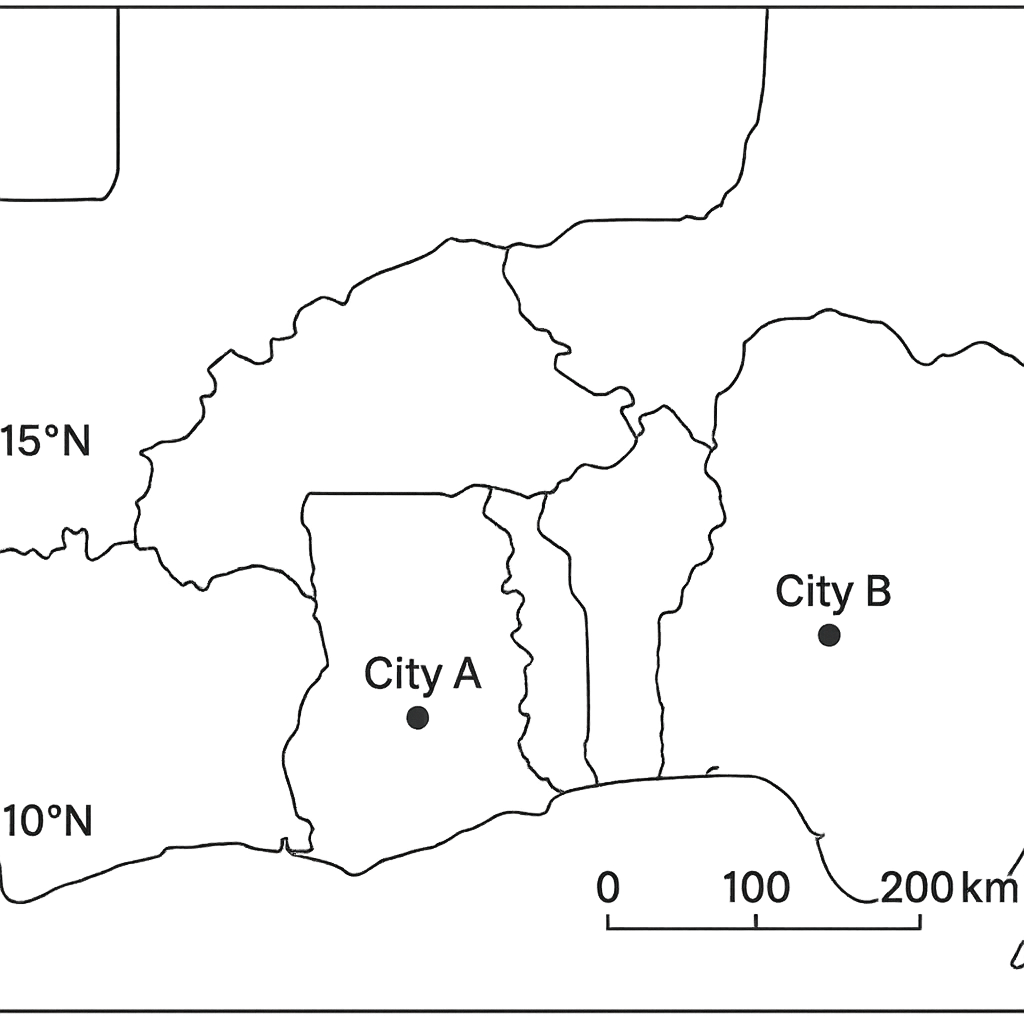
The diagram shows a map with two cities, A and B. City A is located at 10°N, 20°E, and City B is at 15°N, 25°E. Calculate the approximate distance between the two cities in kilometers, assuming each degree of latitude is approximately 111 kilometers and each degree of longitude at this latitude is approximately 96 kilometers.
A. 960
B. 840
Correct C. 720
D. 600

Correct Answer: C

Want to see the full step-by-step solution? Unlock AI Explanation & Analytics
Question 11
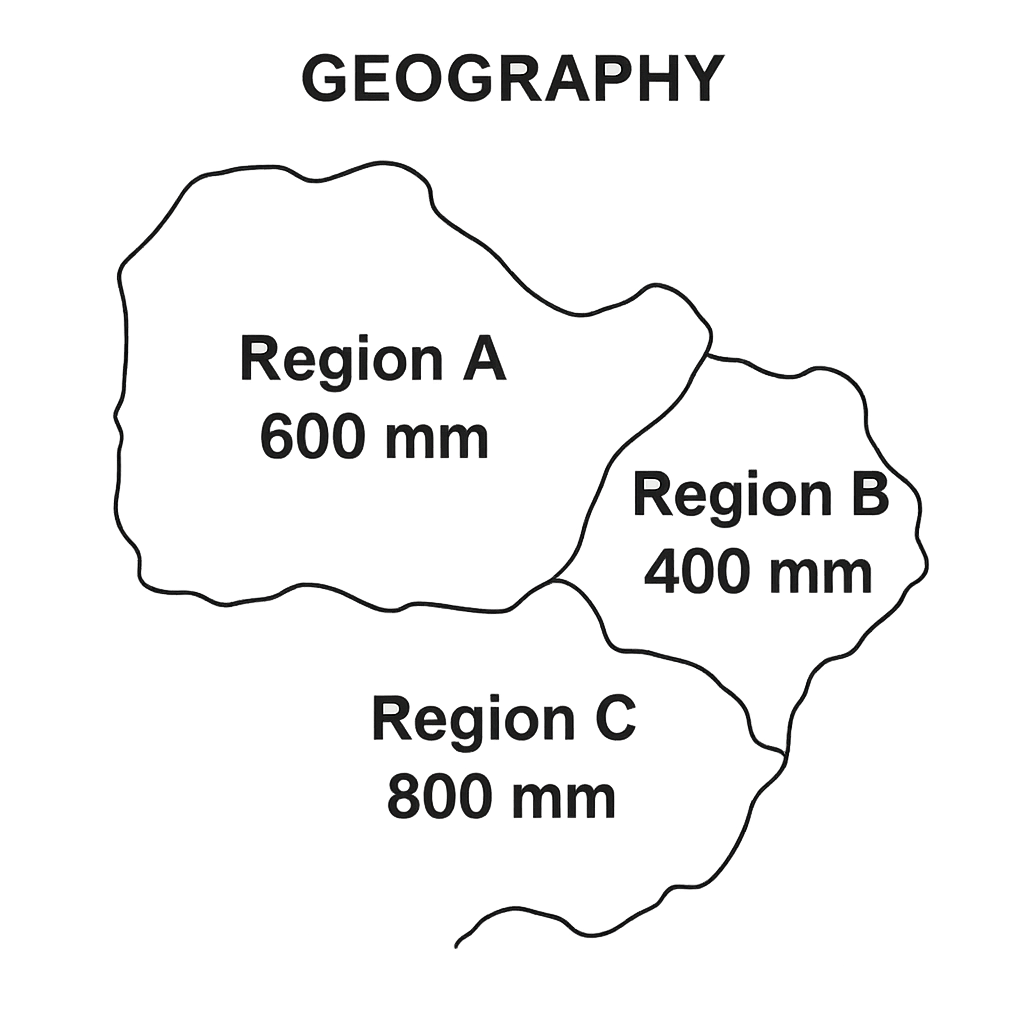
The diagram illustrates the distribution of rainfall across different regions of a country. If Region A receives 600 mm of rainfall, Region B receives 400 mm, and Region C receives 800 mm, calculate the average rainfall across these three regions. Then, determine what percentage of the total rainfall is contributed by Region C.
A. 33.33
Correct B. 44.44
C. 50.00
D. 25.00

Correct Answer: B

Want to see the full step-by-step solution? Unlock AI Explanation & Analytics
Question 12
A transport company operates two types of vehicles: buses and vans. Buses can carry 50 passengers each, while vans can carry 10 passengers each. If the company has a total of 200 passengers to transport and wants to use a combination of 3 buses and some vans, how many vans are needed to transport all passengers?
A. 8
Correct B. 5
C. 10
D. 3

Correct Answer: B

Want to see the full step-by-step solution? Unlock AI Explanation & Analytics
Question 13
A river basin has a total area of 500 km². If 60% of this area is used for agriculture, and the remaining area is divided equally between residential and industrial use, calculate the area allocated for residential use.
A. 150
B. 120
Correct C. 100
D. 80

Correct Answer: C

Want to see the full step-by-step solution? Unlock AI Explanation & Analytics
Question 14
A geologist is studying a rock formation that contains three types of rocks: igneous, sedimentary, and metamorphic. If the ratio of igneous to sedimentary rocks is 3:2 and the ratio of sedimentary to metamorphic rocks is 4:5, determine the ratio of igneous to metamorphic rocks.
A. 5:4
B. 8:5
Correct C. 6:5
D. 3:4

Correct Answer: C

Want to see the full step-by-step solution? Unlock AI Explanation & Analytics
Question 15
A map has a scale of 1:50,000. If the distance between two towns on the map is measured to be 4 cm, what is the actual distance between the towns in kilometers?
Correct A. 2
B. 1
C. 3
D. 5

Correct Answer: A

Want to see the full step-by-step solution? Unlock AI Explanation & Analytics
Question 16
A city has a population of 1,200,000 people and covers an area of 300 square kilometers. If the population density is expected to increase by 20% over the next decade, what will be the new population density in people per square kilometer?
A. 5200
B. 4000
C. 6000
Correct D. 4800

Correct Answer: D

Want to see the full step-by-step solution? Unlock AI Explanation & Analytics
Question 17
A rural settlement is experiencing rapid growth due to the establishment of a new factory. If the current population is 5,000 and it is projected to grow by 15% annually, how many years will it take for the population to reach at least 10,000?
A. 7
B. 8
Correct C. 6
D. 5

Correct Answer: C

Want to see the full step-by-step solution? Unlock AI Explanation & Analytics
Question 18
A geologist is studying a rock formation that contains three types of rocks: igneous, sedimentary, and metamorphic. If the ratio of igneous to sedimentary rocks is 3:5, and the ratio of sedimentary to metamorphic rocks is 4:3, what is the ratio of igneous to metamorphic rocks?
Correct A. 4:5
B. 3:4
C. 5:6
D. 2:3

Correct Answer: A

Want to see the full step-by-step solution? Unlock AI Explanation & Analytics
Question 19
A river flows through a valley with a width of 200 meters and a depth of 5 meters. If the flow velocity is 3 meters per second, calculate the discharge of the river in cubic meters per second. Additionally, if the river's discharge increases by 25% due to rainfall, what will be the new discharge?
A. 4500
B. 5000
Correct C. 3750
D. 3000

Correct Answer: C

Want to see the full step-by-step solution? Unlock AI Explanation & Analytics
Question 20
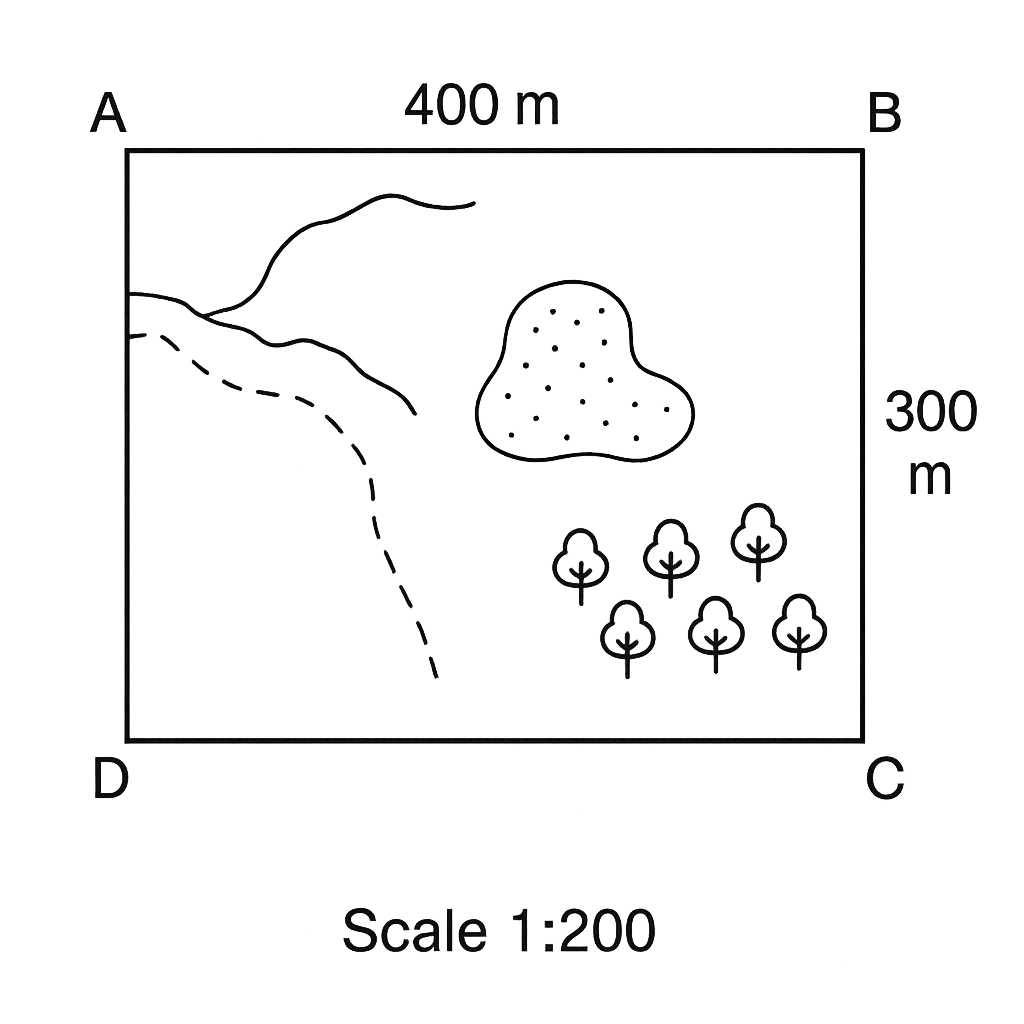
The map shows a rectangular area of land measuring 400 meters by 300 meters. If a scale of 1:200 is used, what will be the length of the rectangle on the map in centimeters?
Correct A. 200
B. 300
C. 150
D. 250

Correct Answer: A

Want to see the full step-by-step solution? Unlock AI Explanation & Analytics
Question 21
A region experiences a significant increase in temperature over a decade, leading to a 15% reduction in annual rainfall. If the average annual rainfall was initially 1200 mm, what is the new average annual rainfall after the reduction? Additionally, discuss how this change in climate could impact local agriculture.
A. 900 mm
B. 800 mm
Correct C. 1020 mm
D. 1100 mm

Correct Answer: C

Want to see the full step-by-step solution? Unlock AI Explanation & Analytics
Question 22
A soil sample contains 40% sand, 30% silt, and 30% clay. If the total weight of the soil sample is 500 grams, calculate the weight of each component. Discuss how the composition of this soil might affect its drainage and fertility.
A. 300g sand, 100g silt, 100g clay
B. 200g sand, 200g silt, 100g clay
C. 250g sand, 100g silt, 150g clay
Correct D. 200g sand, 150g silt, 150g clay

Correct Answer: D

Want to see the full step-by-step solution? Unlock AI Explanation & Analytics
Question 23
A region is characterized by a series of hills and valleys formed through erosion and deposition. If the height of the highest hill is 150 meters and the lowest valley is 30 meters, calculate the total elevation change between the highest and lowest points. Discuss how such landforms can influence local climate and biodiversity.
A. 150 meters
B. 130 meters
Correct C. 120 meters
D. 100 meters

Correct Answer: C

Want to see the full step-by-step solution? Unlock AI Explanation & Analytics
Question 24
A city has a population of 1 million people and a transportation network that includes 200 buses and 100 taxis. If each bus can carry 50 passengers and each taxi can carry 4 passengers, calculate the total passenger capacity of the transportation network. Discuss the implications of this capacity on urban mobility and traffic congestion.
A. 15000 passengers
B. 12000 passengers
Correct C. 10400 passengers
D. 8000 passengers

Correct Answer: C

Want to see the full step-by-step solution? Unlock AI Explanation & Analytics
Question 25
In a region with diverse ecosystems, the introduction of a new species has led to a decline in native species populations. If the native species had a population of 5000 before the introduction and decreased by 30% after, calculate the new population of the native species. Discuss the ecological consequences of introducing non-native species.
A. 4000
B. 3000
C. 4500
Correct D. 3500

Correct Answer: D

Want to see the full step-by-step solution? Unlock AI Explanation & Analytics

Master the Exam!

You've seen a preview, but there are thousands more questions plus AI tutor to break down complex solutions.

Unlock Full Access Available for Android & Windows
Help others prepare! Share this practice hub:
Chat with Support