waec model questions vol1 2025 chemistry | Objective

Are you preparing for waec model questions vol1 exams? Reviewing past questions is one of the most effective ways to guarantee a high score. This practice hub features authentic 2025 chemistry (Objective) questions designed to simulate the real exam environment.

Practice these randomly selected questions to test your readiness.

Question 1 View Details
A 25.0 mL sample of ferrous ammonium sulfate solution containing exactly 0.0200 mol of Fe²⁺ is titrated with a standard KMnO₄ solution in acidic medium. The titration requires 18.5 mL of the KMnO₄ solution. Using this information, calculate the mass of KMnO₄ present in a 250.0 mL bottle of the same solution. (Molar mass of KMnO₄ = 158.04 g mol⁻¹)
A. 10.2 g
B. 9.13 g
Correct C. 8.54 g
D. 7.62 g

Correct Answer: C

Want to see the full step-by-step solution? Unlock AI Explanation & Analytics
Question 2 View Details
A galvanic cell consists of the half‑reactions Zn²⁺ + 2e⁻ → Zn(s) (E° = -0.76 V) and Cu²⁺ + 2e⁻ → Cu(s) (E° = +0.34 V). The cell EMF measured at 298 K is 1.10 V and at 318 K is 1.07 V. Assuming the reaction Zn(s) + Cu²⁺ → Zn²⁺ + Cu(s) and that ΔCₚ ≈ 0, determine the standard enthalpy change ΔH° for the cell reaction (in kJ mol⁻¹).
A. -260 kJ\/mol
B. -285 kJ\/mol
Correct C. -298 kJ/mol
D. -310 kJ\/mol

Correct Answer: C

Want to see the full step-by-step solution? Unlock AI Explanation & Analytics
Question 3 View Details
The standard reduction potentials are: Cu²⁺ + e⁻ → Cu⁺ E° = +0.153 V and Cu⁺ + e⁻ → Cu(s) E° = +0.521 V. Using these data, calculate the equilibrium constant K at 25 °C for the disproportionation reaction 2 Cu⁺ (aq) ⇌ Cu²⁺ (aq) + Cu(s).
A. 1.2×10^11
B. 5.0×10^10
Correct C. 2.5×10^11
D. 3.8×10^12

Correct Answer: C

Want to see the full step-by-step solution? Unlock AI Explanation & Analytics
Question 4 View Details
A steel structure (Fe) is immersed in seawater that contains 0.010 M Mg²⁺ and 0.050 M Fe²⁺. The standard reduction potentials are: Mg²⁺ + 2e⁻ → Mg(s) E° = -2.37 V and Fe²⁺ + 2e⁻ → Fe(s) E° = -0.44 V. Using the Nernst equation, calculate the emf of the galvanic cell that would be set up between Mg and Fe under these conditions. Based on the sign of the emf, state whether Mg can be used as a sacrificial anode to protect the steel.
A. Ecell ≈ -0.12 V; Mg cannot be used as a sacrificial anode to protect the steel.
Correct B. Ecell ≈ 1.95 V; Mg can be used as a sacrificial anode to protect the steel.
C. Ecell ≈ 0.85 V; Mg cannot be used as a sacrificial anode to protect the steel.
D. Ecell ≈ 2.30 V; Mg can be used as a sacrificial anode to protect the steel.

Correct Answer: B

Want to see the full step-by-step solution? Unlock AI Explanation & Analytics
Question 5 View Details
An alloy pipe (brass) contains 70 % Cu and 30 % Zn by mass and has a total mass of 2.00 kg. The pipe is a solid cylinder 1.20 m long with an outer diameter of 5.0 cm. When immersed in 0.10 M HCl, only the zinc component corrodes according to Zn + 2H⁺ → Zn²⁺ + H₂. The corrosion proceeds at a current density of 0.00025 A cm⁻² over the entire external surface. Assuming 100 % current efficiency, calculate (a) the mass of zinc lost after 10 days and (b) the percentage loss of the total pipe mass. (F = 96485 C mol⁻¹, atomic weight Zn = 65.38 g mol⁻¹)
A. a) 130 g of Zn lost; b) 6.5 % of total mass
Correct B. a) 138 g of Zn lost; b) 6.9 % of total mass
C. a) 115 g of Zn lost; b) 5.8 % of total mass
D. a) 145 g of Zn lost; b) 7.2 % of total mass

Correct Answer: B

Want to see the full step-by-step solution? Unlock AI Explanation & Analytics
Question 6 View Details
The diatomic molecule CO has a force constant of 1900 N·m⁻¹ and a bond length of 113 pm. Given atomic masses C = 12.01 u and O = 16.00 u (1 u = 1.6605×10⁻²⁷ kg), calculate the vibrational wavenumber (in cm⁻¹) of CO and state whether the bond is more characteristic of a double or a triple bond.
A. ≈2.50×10³ cm⁻¹, indicating a double‑bond character
B. ≈1.85×10³ cm⁻¹, indicating a double‑bond character
Correct C. ≈2.17×10³ cm⁻¹, indicating a triple‑bond character
D. ≈1.95×10³ cm⁻¹, indicating a triple‑bond character

Correct Answer: C

Want to see the full step-by-step solution? Unlock AI Explanation & Analytics
Question 7 View Details
Standard enthalpies of formation (Δ_fH°) are: P₄O₁₀(s) = -2984 kJ·mol⁻¹, SO₃(g) = -395.7 kJ·mol⁻¹. For each oxide, calculate the heat released per gram of oxygen when the oxide is formed from its elements, and state which oxide releases more heat per gram of oxygen.
A. P₄O₁₀ releases less heat per gram of oxygen than SO₃
B. SO₃ releases more heat per gram of oxygen
Correct C. P₄O₁₀ releases more heat per gram of oxygen
D. Both oxides release the same amount of heat per gram of oxygen

Correct Answer: C

Want to see the full step-by-step solution? Unlock AI Explanation & Analytics
Question 8 View Details
A factory discharges effluent at 200 L·min⁻¹ containing 0.05 mol·L⁻¹ phenol. The river flow is 5000 L·min⁻¹ and phenol degrades in the river by first‑order kinetics with k = 0.03 min⁻¹. Assuming instantaneous mixing, what is the phenol concentration (mol·L⁻¹) 30 minutes downstream?
A. 6.5×10⁻⁴ mol·L⁻¹
B. 1.2×10⁻³ mol·L⁻¹
Correct C. 7.8×10⁻⁴ mol·L⁻¹
D. 3.9×10⁻⁴ mol·L⁻¹

Correct Answer: C

Want to see the full step-by-step solution? Unlock AI Explanation & Analytics
Question 9 View Details
A 100 mL equimolar mixture of the four C₄H₁₀O isomers (n‑butanol, sec‑butanol, isobutanol, tert‑butanol) is subjected to fractional distillation. The boiling points are: n‑butanol 117.7 °C, sec‑butanol 99.5 °C, isobutanol 108 °C, tert‑butanol 82 °C. The temperature of the vapor phase when the first 25 % of the distillate (by volume) is collected is 105 °C. Which isomer(s) are present in that first fraction?
Correct A. tert‑butanol
B. isobutanol
C. n‑butanol
D. sec‑butanol

Correct Answer: A

Want to see the full step-by-step solution? Unlock AI Explanation & Analytics
Question 10 View Details
A buffer is prepared by dissolving 0.250 mol acetic acid (CH₃COOH, Ka = 1.8×10⁻⁵) and 0.150 mol sodium acetate (CH₃COONa) in 1.00 L water. (a) Calculate the initial pH of the buffer. (b) If 0.100 M HCl is added and the pH drops by exactly 0.10 unit, what volume of the acid solution was added (in mL)?
A. 215
B. 225
Correct C. 210
D. 200

Correct Answer: C

Want to see the full step-by-step solution? Unlock AI Explanation & Analytics
Question 11 View Details
A 20.0 g sample of an unknown hydrocarbon is combusted completely in excess oxygen, producing 66.0 g of CO₂ and 27.0 g of H₂O. The hydrocarbon is known to have a molar mass of 112 g·mol⁻¹. (a) Determine its empirical formula. (b) Write its molecular formula. (c) Calculate the volume of O₂ gas at STP required for the complete combustion of 1.00 mol of this hydrocarbon.
A. Empirical formula C₃H₆; molecular formula C₁₂H₂₄; O₂ volume = 3.00×10² L
B. Empirical formula C₂H₄; molecular formula C₁₀H₂₀; O₂ volume = 2.55×10² L
C. Empirical formula CH₃; molecular formula C₉H₁₈; O₂ volume = 2.80×10² L
Correct D. Empirical formula CH₂; molecular formula C₈H₁₆; O₂ volume = 2.69×10² L

Correct Answer: D

Want to see the full step-by-step solution? Unlock AI Explanation & Analytics
Question 12 View Details
When 12.0 g of potassium chlorate (KClO₃) is thermally decomposed according to 2 KClO₃(s) → 2 KCl(s) + 3 O₂(g), the oxygen gas is collected over water at 25 °C and a total pressure of 750 mm Hg. The vapor pressure of water at this temperature is 23.8 mm Hg, and the volume of dry O₂ collected is 3.20 L. Calculate the percent yield of O₂ based on the theoretical yield.
Correct A. 85 % (approximately)
B. 78 % (approximately)
C. 92 % (approximately)
D. 65 % (approximately)

Correct Answer: A

Want to see the full step-by-step solution? Unlock AI Explanation & Analytics
Question 13 View Details
State the type of hybridisation of the carbon atom in methane (CH₄) and give the ideal bond angle between the C-H bonds.
A. sp hybridisation; 180°
Correct B. sp³ hybridisation; 109.5°
C. sp³ hybridisation; 90°
D. sp² hybridisation; 120°

Correct Answer: B

Want to see the full step-by-step solution? Unlock AI Explanation & Analytics
Question 14 View Details
In a sealed 1.00 L container at 350 K, the solid ammonium chloride (NH₄Cl) establishes the equilibrium NH₄Cl(s) ⇌ NH₃(g) + HCl(g). The equilibrium constant Kp at this temperature is 0.10. Assuming ideal gas behaviour, calculate the total pressure in the container at equilibrium.
A. 1.00 atm (approximately)
Correct B. 0.63 atm (approximately)
C. 0.80 atm (approximately)
D. 0.45 atm (approximately)

Correct Answer: B

Want to see the full step-by-step solution? Unlock AI Explanation & Analytics
Question 15 View Details
In a 1.00 L flask at 25 °C, 0.500 mol of acetic acid (CH₃COOH) is mixed with 0.500 mol of ethanol (CH₃CH₂OH). They undergo esterification: CH₃COOH + CH₃CH₂OH ⇌ CH₃COOCH₂CH₃ + H₂O, with an equilibrium constant Kc = 4.0 at this temperature. Assuming ideal behaviour, (a) determine the equilibrium concentration of ethyl acetate, and (b) calculate the percent conversion of acetic acid.
A. Equilibrium [ethyl acetate] = 0.200 M; percent conversion of acetic acid = 40.0 %
B. Equilibrium [ethyl acetate] = 0.400 M; percent conversion of acetic acid = 80.0 %
Correct C. Equilibrium [ethyl acetate] = 0.333 M; percent conversion of acetic acid = 66.7 %
D. Equilibrium [ethyl acetate] = 0.250 M; percent conversion of acetic acid = 50.0 %

Correct Answer: C

Want to see the full step-by-step solution? Unlock AI Explanation & Analytics
Question 16 View Details
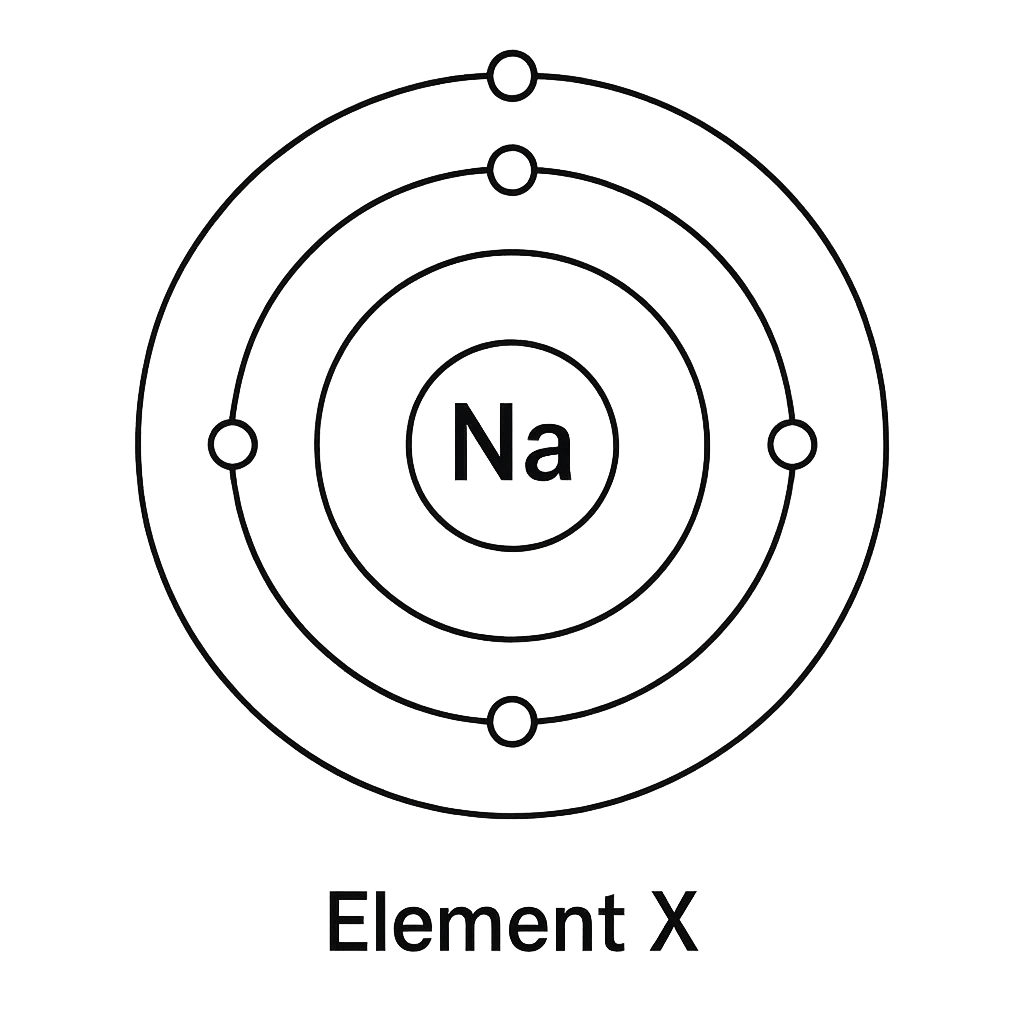
The diagram shows a Bohr model of an atom of element X. The nucleus is labelled X and three electron shells are drawn. The innermost shell contains 2 electrons, the second shell 8 electrons and the outermost shell 1 electron. Determine the atomic number of element X.
A. 12
B. 10
C. 13
Correct D. 11

Correct Answer: D

Want to see the full step-by-step solution? Unlock AI Explanation & Analytics
Question 17 View Details
The solubility of potassium nitrate (KNO₃) is 32 g per 100 g water at 25 °C and 65 g per 100 g water at 60 °C. A 250.0 g sample of water at 25 °C is saturated with KNO₃. Then 20.0 g of solid KNO₃ is added and the mixture is heated to 60 °C. After cooling back to 25 °C, excess solid precipitates. What mass of KNO₃ crystallises out on cooling?
A. 10 g
B. 40 g
C. 30 g
Correct D. 20 g

Correct Answer: D

Want to see the full step-by-step solution? Unlock AI Explanation & Analytics
Question 18 View Details
A 2.00 g mixture of two hydrocarbons is completely combusted. Hydrocarbon A is an alkane with formula CₙH₂ₙ₊₂ and hydrocarbon B is an alkene with formula CₘH₂ₘ. The combustion produces 5.28 g of CO₂ and 5.04 g of H₂O. Determine the mass percent of the alkane (hydrocarbon A) in the original mixture.
Correct A. 16 %
B. 12 %
C. 20 %
D. 14 %

Correct Answer: A

Want to see the full step-by-step solution? Unlock AI Explanation & Analytics
Question 19 View Details
The reaction 2 Al + 3 Cl₂ → 2 AlCl₃ is carried out using 5.0 g of aluminium and 10.0 L of chlorine gas at 25 °C and 1 atm. After the reaction, the mixture is cooled and 10 % of the aluminium chloride formed is lost during handling. Calculate the mass of AlCl₃ finally recovered.
A. 24.5 g
B. 20.0 g
Correct C. 22.2 g
D. 19.8 g

Correct Answer: C

Want to see the full step-by-step solution? Unlock AI Explanation & Analytics
Question 20 View Details
A compound contains 40.0 % C, 6.7 % H and 53.3 % O by mass and has a molar mass of 180 g mol⁻¹. Determine its molecular formula and the number of moles present in a 45.0 g sample.
A. C6H12O6; 0.30 mol
B. C5H10O5; 0.25 mol
Correct C. C6H12O6; 0.25 mol
D. C7H14O7; 0.25 mol

Correct Answer: C

Want to see the full step-by-step solution? Unlock AI Explanation & Analytics
Question 21 View Details
An isotope of an element has atomic number 15 and mass number 31. How many neutrons are present in this isotope?
A. 15
B. 14
Correct C. 16
D. 17

Correct Answer: C

Want to see the full step-by-step solution? Unlock AI Explanation & Analytics
Question 22 View Details
Calcium fluoride (CaF₂) has a solubility product Ksp = 3.9×10⁻¹¹ at 25 °C. In a solution that already contains 0.010 M NaF, calculate the solubility of CaF₂ (in mol L⁻¹).
Correct A. 3.9×10⁻⁷ M
B. 1.3×10⁻⁷ M
C. 7.8×10⁻⁸ M
D. 3.9×10⁻⁶ M

Correct Answer: A

Want to see the full step-by-step solution? Unlock AI Explanation & Analytics
Question 23 View Details
A buffer solution is prepared by mixing 0.250 mol of acetic acid (CH₃COOH, Ka = 1.8×10⁻⁵) with 0.150 mol of sodium acetate (CH₃COONa) in 1.00 L of water. Calculate the pH of the buffer.
Correct A. 4.52
B. 4.12
C. 5.02
D. 3.98

Correct Answer: A

Want to see the full step-by-step solution? Unlock AI Explanation & Analytics
Question 24 View Details
Element Z belongs to period 3 and group 16 of the periodic table. What is the chemical symbol of element Z?
Correct A. S
B. Cl
C. Se
D. O

Correct Answer: A

Want to see the full step-by-step solution? Unlock AI Explanation & Analytics
Question 25 View Details
The combustion of octane (C₈H₁₈) follows the equation C₈H₁₈ + a O₂ → b CO₂ + c H₂O. (i) Determine the coefficients a, b and c. (ii) Using the balanced equation, calculate the volume of CO₂ (in litres) produced at STP when 2.00 g of octane is completely burnt. (Molar volume at STP = 22.4 L).
A. 3.50 L
B. 4.12 L
Correct C. 3.14 L
D. 2.85 L

Correct Answer: C

Want to see the full step-by-step solution? Unlock AI Explanation & Analytics

Master the Exam!

You've seen a preview, but there are thousands more questions plus AI tutor to break down complex solutions.

Unlock Full Access Available for Android & Windows
Help others prepare! Share this practice hub:
Chat with Support