waec model questions vol1 2025 biology | Objective

Prepare for your exams with waec model questions vol1 questions? Reviewing past/model questions is one of the most effective ways to guarantee a high score. This practice hub features authentic 2025 biology (Objective) questions designed to simulate the real exam environment.

Practice these randomly selected questions to test your readiness.

Question 1 View Details
In a 28‑day menstrual cycle the concentration of estradiol (E) in the follicular phase follows the exponential model E = 30·e^{k·d}, where d is the day number (d = 1 for the first day of the cycle). On day 7 the measured estradiol concentration is 80 pg·mL⁻¹, and ovulation occurs 2 days after estradiol first reaches the threshold value of 200 pg·mL⁻¹. On which day of the cycle does ovulation occur?
A. Day 20
B. Day 18
Correct C. Day 16
D. Day 14

Correct Answer: C

Want to see the full step-by-step solution? Unlock AI Explanation & Analytics
Question 2 View Details
A desert trekker loses water at a constant rate of 1 L h⁻¹ (combined sweating and respiration) and drinks 0.4 L h⁻¹ of water. Each litre of water deficit raises his plasma osmolality by 5 mOsm·kg⁻¹. His initial plasma osmolality is 285 mOsm·kg⁻¹. Antidiuretic hormone (ADH) secretion starts only when osmolality exceeds 295 mOsm·kg⁻¹, and for every 1 mOsm·kg⁻¹ above this threshold the kidneys reabsorb an additional 0.1 L h⁻¹ of water. How many hours will elapse before his plasma osmolality reaches 300 mOsm·kg⁻¹?
Correct A. ≈ 6.9 hours
B. ≈ 5.4 hours
C. ≈ 8.2 hours
D. ≈ 7.5 hours

Correct Answer: A

Want to see the full step-by-step solution? Unlock AI Explanation & Analytics
Question 3 View Details
During the first four weeks of an outbreak of disease X in a community of 10 000 people, the number of new cases each week was 80, 120, 180 and 270 respectively. Assuming the epidemic grows exponentially with a generation time of 7 days, (a) estimate the basic reproduction number R₀, and (b) if a vaccine with 80 % efficacy is introduced, what minimum proportion of the population must be vaccinated to achieve herd immunity? Express your answer as a percentage.
A. R₀ ≈ 0.9; minimum vaccination coverage ≈ 20 %
B. R₀ ≈ 1.8; minimum vaccination coverage ≈ 70 %
C. R₀ ≈ 2.2; minimum vaccination coverage ≈ 60 %
Correct D. R₀ ≈ 1.5; minimum vaccination coverage ≈ 42 %

Correct Answer: D

Want to see the full step-by-step solution? Unlock AI Explanation & Analytics
Question 4 View Details
An unknown aquatic organism is observed to (i) possess a notochord at some stage of its life cycle, (ii) have a dorsal hollow nerve cord, (iii) contain pharyngeal slits, and (iv) lack a true coelom in the adult form. Based on these characteristics, identify the most appropriate phylum for this organism and give a brief justification.
A. Phylum Hemichordata (subphylum Enteropneusta)
B. Phylum Echinodermata (subphylum Crinoidea)
Correct C. Phylum Chordata (subphylum Tunicata/Urochordata)
D. Phylum Chordata (subphylum Cephalochordata)

Correct Answer: C

Want to see the full step-by-step solution? Unlock AI Explanation & Analytics
Question 5 View Details
Using the alveolar gas equation PAO₂ = FiO₂ (Patm - PH₂O) - PaCO₂ ⁄ R, calculate the alveolar partial pressure of oxygen (PAO₂) for a healthy adult at sea level (Patm = 760 mmHg) and again at an altitude where Patm = 600 mmHg. Assume FiO₂ = 0.21, PH₂O = 47 mmHg, arterial CO₂ pressure PaCO₂ = 40 mmHg and respiratory quotient R = 0.8. Give your answers to the nearest whole mmHg.
A. Sea‑level PAO₂ ≈ 95 mmHg; at 600 mmHg Patm, PAO₂ ≈ 60 mmHg
B. Sea‑level PAO₂ ≈ 105 mmHg; at 600 mmHg Patm, PAO₂ ≈ 70 mmHg
C. Sea‑level PAO₂ ≈ 90 mmHg; at 600 mmHg Patm, PAO₂ ≈ 55 mmHg
Correct D. Sea‑level PAO₂ ≈ 100 mmHg; at 600 mmHg Patm, PAO₂ ≈ 66 mmHg

Correct Answer: D

Want to see the full step-by-step solution? Unlock AI Explanation & Analytics
Question 6 View Details
A fish population in a lake follows the logistic growth model dN/dt = rN(1 - N/K) - H, where r is the intrinsic growth rate (per month) and K is the carrying capacity (fish). The intrinsic rate is r = 0.4 per month and the carrying capacity is K = 5 000 fish. (a) Determine the maximum constant harvest H_max (fish per month) that still allows a non‑zero equilibrium population. (b) If the actual harvest is set at 800 fish per month, calculate the equilibrium population size (if any). (c) Based on your results, state whether the harvest of 800 fish per month is sustainable.
A. Maximum sustainable harvest = 600 fish per month; with a harvest of 800 fish per month the equilibrium population is 200 fish; therefore the harvest is not sustainable.
B. Maximum sustainable harvest = 500 fish per month; with a harvest of 800 fish per month the equilibrium population is 100 fish; therefore the harvest is sustainable.
C. Maximum sustainable harvest = 400 fish per month; with a harvest of 800 fish per month the equilibrium population is 0 (extinction); therefore the harvest is not sustainable.
Correct D. Maximum sustainable harvest = 500 fish per month; with a harvest of 800 fish per month the equilibrium population is 0 (extinction); therefore the harvest is not sustainable.

Correct Answer: D

Want to see the full step-by-step solution? Unlock AI Explanation & Analytics
Question 7 View Details
In a diploid population a single gene has two alleles: dominant D and recessive r. The fitnesses of the genotypes are: w_DD = 1.0, w_Dr = 0.9, w_rr = 0.6. Initially the allele frequencies are p(D) = 0.4 and q(r) = 0.6. Assuming random mating and selection only, what is the frequency of allele D after one generation of selection? Give your answer to two decimal places.
A. 0.40
B. 0.55
Correct C. 0.50
D. 0.45

Correct Answer: C

Want to see the full step-by-step solution? Unlock AI Explanation & Analytics
Question 8 View Details
A bacterial culture grows according to the logistic equation N(t) = K / [1 + ((K - N₀)/N₀) e^{-rt}] where N(t) is the cell number at time t (hours), N₀ is the initial cell number, K is the carrying capacity and r is the intrinsic growth rate (h⁻¹). The culture is started with N₀ = 2 × 10³ cells, the carrying capacity is K = 1 × 10⁹ cells, and after t = 5 h the cell number is N = 5 × 10⁵ cells. (i) Determine the intrinsic growth rate r (h⁻¹) to two decimal places. (ii) Using this r, calculate the time required for the culture to reach half of the carrying capacity (N = K/2). Give your answer in hours to one decimal place.
A. r = 1.25 h⁻¹; time to reach half of K = 10.4 h
Correct B. r = 1.10 h⁻¹; time to reach half of K = 11.9 h
C. r = 1.05 h⁻¹; time to reach half of K = 12.6 h
D. r = 0.95 h⁻¹; time to reach half of K = 13.2 h

Correct Answer: B

Want to see the full step-by-step solution? Unlock AI Explanation & Analytics
Question 9 View Details
A couple attempts to conceive. During the first three months each month the probability of conception is 15 %. If conception has not occurred, during the next three months each month the probability rises to 25 %. Assuming independence of monthly attempts, what is the probability that the couple will conceive at least once within the six‑month period? Express your answer as a decimal rounded to three places.
A. 0.592
B. 0.658
C. 0.823
Correct D. 0.741

Correct Answer: D

Want to see the full step-by-step solution? Unlock AI Explanation & Analytics
Question 10 View Details
In a mixed bacterial culture of total size N = 1 × 10⁸ cells, a donor strain D carrying a plasmid for antibiotic resistance constitutes 0.1 % of the population. The remaining cells are recipients R that lack the plasmid. Conjugation occurs with a mass‑action rate constant β = 2 × 10⁻⁹ h⁻¹ per donor‑recipient pair. No plasmid loss occurs. Calculate the expected number of transconjugant cells after 24 h. Also give the proportion of the total population that is resistant after this period. Present the number of transconjugants as an integer and the proportion as a decimal to four places.
A. 47952 transconjugants; proportion = 0.0005
B. 4795200 transconjugants; proportion = 0.0480
C. 239760 transconjugants; proportion = 0.0024
Correct D. 479520 transconjugants; proportion = 0.0048

Correct Answer: D

Want to see the full step-by-step solution? Unlock AI Explanation & Analytics
Question 11 View Details
A reflex arc consists of a sensory neuron whose axon length from the receptor to the spinal cord is 0.8 m and a motor neuron whose axon length from the spinal cord to the effector muscle is 0.5 m. The sensory impulse travels at 80 m/s in myelinated fibres and at 20 m/s in unmyelinated fibres. The motor impulse always travels at 70 m/s (myelinated). Each synapse in the reflex adds a delay of 0.5 ms. The total observed latency from stimulus to muscle contraction is 0.025 s. Based on these data, decide whether the sensory neuron is myelinated or unmyelinated.
A. Unmyelinated
B. Partially myelinated
Correct C. Myelinated
D. Nonmyelinated

Correct Answer: C

Want to see the full step-by-step solution? Unlock AI Explanation & Analytics
Question 12 View Details
Which organelle is primarily responsible for the synthesis of proteins that are destined for secretion outside the cell?
Correct A. Rough endoplasmic reticulum
B. Smooth endoplasmic reticulum
C. Golgi apparatus
D. Mitochondria

Correct Answer: A

Want to see the full step-by-step solution? Unlock AI Explanation & Analytics
Question 13 View Details
A bacterial culture is inoculated with 10³ cells at 30 °C. At this temperature the bacteria exhibit a lag phase of 2 h followed by exponential growth with a generation time of 30 min. At 40 °C the lag phase shortens to 1 h but the generation time lengthens to 45 min. After 4 h of incubation at 30 °C the culture is shifted to 40 °C and then incubated for a further 4 h. Assuming no cell death and that the temperature shift does not affect cells already in exponential phase, calculate the total number of cells present after the full 8 h period. Give your answer in scientific notation to two significant figures.
A. 4.2×10⁵
B. 8.1×10⁵
C. 5.9×10⁴
Correct D. 6.5×10⁵

Correct Answer: D

Want to see the full step-by-step solution? Unlock AI Explanation & Analytics
Question 14 View Details
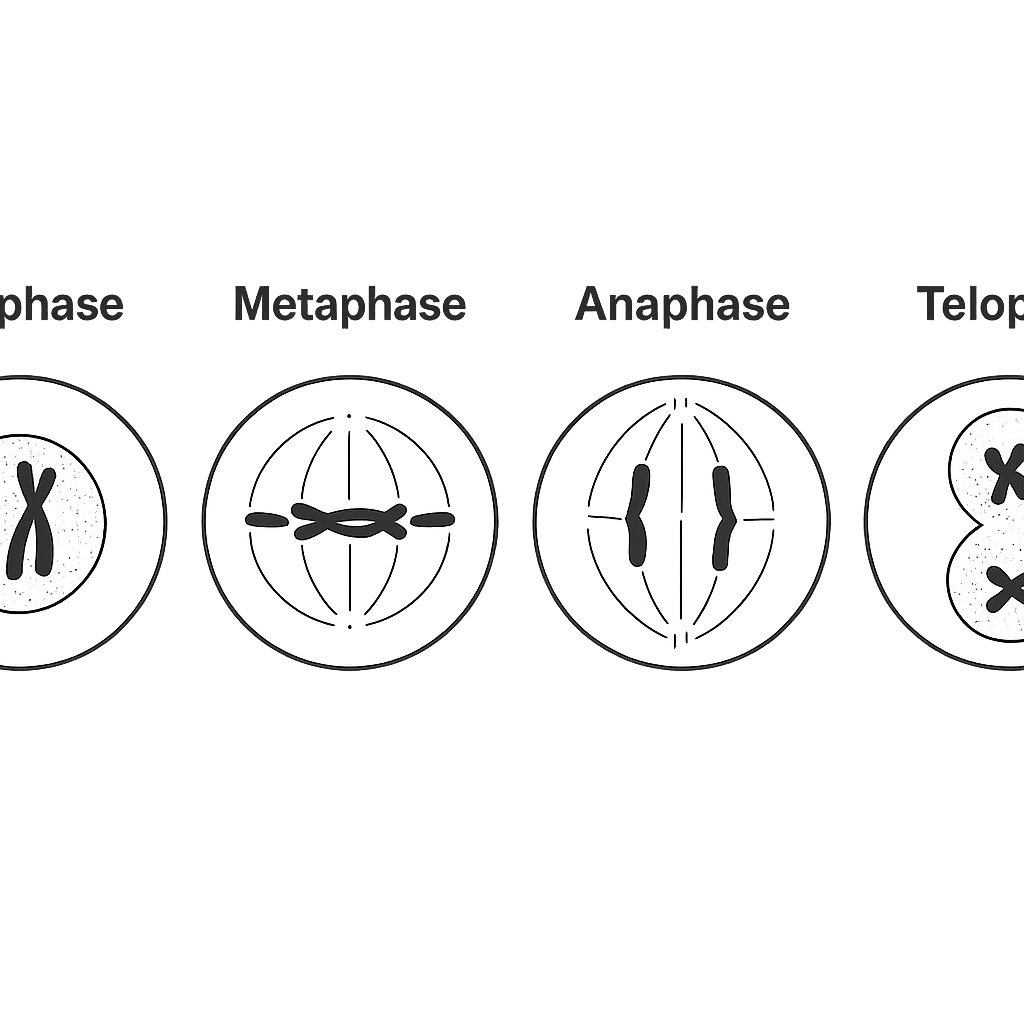
In the labelled diagram of mitosis, which phase is characterized by the chromosomes being aligned at the cell's equatorial plate?
A. Telophase
B. Anaphase
Correct C. Metaphase
D. Prophase

Correct Answer: C

Want to see the full step-by-step solution? Unlock AI Explanation & Analytics
Question 15 View Details
In a plant species two traits are studied: flower colour (R = red dominant, r = white recessive) and plant height (T = tall dominant, t = dwarf recessive). A true‑breeding red‑tall plant (RR TT) is crossed with a white‑dwarf plant (rr tt) to produce F₁. Two F₁ individuals are then crossed to obtain F₂. Among 200 F₂ offspring the observed numbers are: 48 white‑dwarf, 52 white‑tall, 68 red‑dwarf and the remainder red‑tall. Using a chi‑square test at the 5 % significance level, determine whether the observed phenotypic distribution fits the expected 9:3:3:1 ratio.
A. χ² ≈ 0.5; deviation is not significant - the observed ratio fits 9:3:3:1
Correct B. χ² ≈ 189; deviation is significant - the observed ratio does not fit 9:3:3:1
C. χ² ≈ 3.84; deviation is not significant - the observed ratio fits 9:3:3:1
D. χ² ≈ 12.5; deviation is significant - the observed ratio does not fit 9:3:3:1

Correct Answer: B

Want to see the full step-by-step solution? Unlock AI Explanation & Analytics
Question 16 View Details
A couple has two children. Their first child has cystic fibrosis, an autosomal recessive disorder. Their second child has hemophilia, an X‑linked recessive disorder. Both parents are phenotypically normal. Assuming the next child will be a boy, what is the probability that he will be affected by either cystic fibrosis or hemophilia? Express your answer as a reduced fraction.
A. 3/8
B. 1/2
Correct C. 5/8
D. 7/8

Correct Answer: C

Want to see the full step-by-step solution? Unlock AI Explanation & Analytics
Question 17 View Details
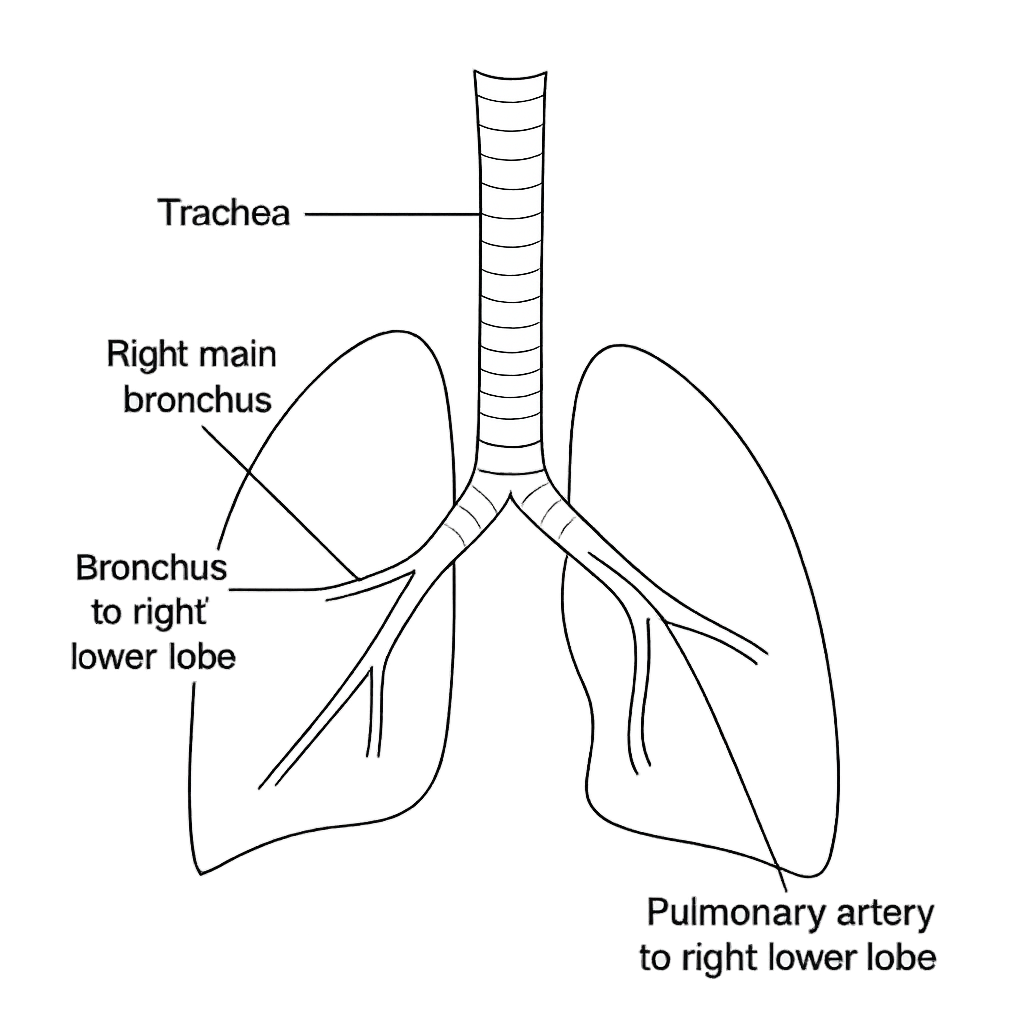
The diagram shows the branching of the right lung, including the right main bronchus, the bronchus to the right lower lobe, the right lower lobe itself, and the pulmonary artery that supplies that lobe. If the bronchus to the right lower lobe becomes constricted while the pulmonary artery remains patent, what will be the effect on the ventilation‑perfusion (V/Q) ratio of the right lower lobe? State whether the V/Q ratio will increase, decrease, or remain unchanged, and give a brief justification.
Correct A. Decrease
B. Increase
C. Remain unchanged
D. No change

Correct Answer: A

Want to see the full step-by-step solution? Unlock AI Explanation & Analytics
Question 18 View Details
A newly isolated microorganism displays the following characteristics: (i) prokaryotic cell organization with no membrane‑bound nucleus, (ii) cell wall composed of peptidoglycan, (iii) reproduces by binary fission, (iv) contains internal thylakoid‑like membranes that house photosynthetic pigments, and (v) thrives in highly saline environments. Classify this organism by stating its Domain, Kingdom (or equivalent high‑level taxon), and Phylum. Justify each taxonomic rank based on the given traits.
A. Domain: Archaea; Kingdom: Archaea; Phylum: Halobacteria
B. Domain: Bacteria; Kingdom: Bacteria (Monera); Phylum: Firmicutes
Correct C. Domain: Bacteria; Kingdom: Bacteria (Monera); Phylum: Cyanobacteria
D. Domain: Bacteria; Kingdom: Bacteria (Monera); Phylum: Proteobacteria

Correct Answer: C

Want to see the full step-by-step solution? Unlock AI Explanation & Analytics
Question 19 View Details
In a test cross involving two genes A and B, a total of 200 offspring were recorded with the following phenotypes: 80 showing the parental type AB, 70 showing the parental type ab, 30 showing recombinant type Ab, and 20 showing recombinant type aB. Calculate the recombination frequency between the two genes and express the map distance in map units (centiMorgans). Based on the map distance, state whether the genes are linked.
A. 25 map units; the genes are not linked
Correct B. 25 map units; the genes are linked
C. 30 map units; the genes are linked
D. 20 map units; the genes are linked

Correct Answer: B

Want to see the full step-by-step solution? Unlock AI Explanation & Analytics
Question 20 View Details
In a closed community of 10 000 individuals, an infectious disease follows the SIR model with a transmission rate β = 0.3 day⁻¹ and a recovery rate γ = 0.1 day⁻¹. (a) Compute the basic reproduction number R₀. (b) Using the formula for the herd‑immunity threshold H = 1 - 1/R₀, determine the proportion of the population that must be immune to stop transmission. (c) If a vaccine available for this disease has an efficacy of 85 %, what minimum vaccination coverage (as a percentage of the total population) is required to achieve herd immunity? Present your answer to one decimal place.
A. 66.7%
Correct B. 78.4%
C. 73.5%
D. 80.0%

Correct Answer: B

Want to see the full step-by-step solution? Unlock AI Explanation & Analytics
Question 21 View Details
A desert shrub has three leaf adaptations: (i) small leaf area of 20 cm², (ii) a thick cuticle that reduces transpiration by 40%, and (iii) sunken stomata that reduce transpiration by 30%. A typical leaf transpires at 5 mg H₂O per hour per cm². The shrub opens its stomata only at night, limiting effective transpiration to 6 h per day, whereas a typical plant without these adaptations has a leaf area of 50 cm² and transpires for 12 h per day. Calculate the total water loss (in grams) per day for the shrub and for the typical plant, and state how much more water the typical plant loses than the shrub.
A. 2.500 g
B. 3.000 g
Correct C. 2.748 g
D. 3.120 g

Correct Answer: C

Want to see the full step-by-step solution? Unlock AI Explanation & Analytics
Question 22 View Details
A human somatic cell (diploid 2n = 46) is in metaphase of mitosis. How many chromosomes and how many chromatids are present in the cell at this stage?
A. 92 chromosomes and 184 chromatids
Correct B. 46 chromosomes and 92 chromatids
C. 23 chromosomes and 46 chromatids
D. 46 chromosomes and 46 chromatids

Correct Answer: B

Want to see the full step-by-step solution? Unlock AI Explanation & Analytics
Question 23 View Details
In a mammal the glomerular filtration rate (GFR) is 120 mL·min⁻¹. Plasma Na⁺ concentration is 145 mEq·L⁻¹ and plasma glucose concentration is 5 mmol·L⁻¹. Ninety‑nine percent of the filtered Na⁺ and eighty‑five percent of the filtered glucose are reabsorbed. Calculate the amount of Na⁺ (in mEq·min⁻¹) and glucose (in mmol·min⁻¹) that appear in the urine each minute, and indicate which solute contributes more to the osmolar load of the urine per minute.
A. Na⁺ 0.176 mEq·min⁻¹, glucose 0.09 mmol·min⁻¹; Na⁺ contributes more
B. Na⁺ 0.174 mEq·min⁻¹, glucose 0.09 mmol·min⁻¹; glucose contributes more
C. Na⁺ 0.174 mEq·min⁻¹, glucose 0.10 mmol·min⁻¹; Na⁺ contributes more
Correct D. Na⁺ 0.174 mEq·min⁻¹, glucose 0.09 mmol·min⁻¹; Na⁺ contributes more

Correct Answer: D

Want to see the full step-by-step solution? Unlock AI Explanation & Analytics
Question 24 View Details
Two beetle species show a mitochondrial DNA sequence divergence of 4.5 %. Assuming a constant mutation rate of 1.5 % per million years per lineage, estimate the time (in million years) since they shared a common ancestor. The fossil record indicates that the earliest known beetle dates to 300 million years ago. Discuss whether the molecular estimate is consistent with the fossil evidence.
A. 3.0 million years; consistent because the fossil record provides only a minimum age, not a contradiction
Correct B. 1.5 million years; consistent because the fossil record provides only a minimum age, not a contradiction
C. 0.75 million years; consistent because the fossil record provides only a minimum age, not a contradiction
D. 1.5 million years; inconsistent because the fossil record shows beetles existed 300 million years ago, far older than the molecular estimate

Correct Answer: B

Want to see the full step-by-step solution? Unlock AI Explanation & Analytics
Question 25 View Details
Mountain goat Species A lives at 3000 m altitude and has a hemoglobin P₅₀ of 26 mmHg. Species B lives at 4500 m and has a P₅₀ of 20 mmHg. Both have the same hemoglobin concentration and a Hill coefficient n = 2.5. Using the Hill equation SaO₂ = PO₂ⁿ / (P₅₀ⁿ + PO₂ⁿ), calculate the arterial oxygen saturation (SaO₂) for each species when arterial PO₂ is 60 mmHg. Then, assuming tissue PO₂ is 30 mmHg and cardiac output is identical, determine which species delivers more oxygen to its tissues.
Correct A. SaO₂ ≈ 89 % for Species A and ≈ 94 % for Species B; Species B delivers more oxygen
B. SaO₂ ≈ 89 % for Species A and ≈ 94 % for Species B; Species A delivers more oxygen
C. SaO₂ ≈ 85 % for Species A and ≈ 90 % for Species B; Species A delivers more oxygen
D. SaO₂ ≈ 92 % for Species A and ≈ 88 % for Species B; Species B delivers more oxygen

Correct Answer: A

Want to see the full step-by-step solution? Unlock AI Explanation & Analytics

Master the Exam!

You've seen a preview, but there are thousands more questions plus AI tutor to break down complex solutions.

Unlock Full Access Available for Android & Windows
Help others prepare! Share this practice hub:
Chat with Support