waec model questions vol1 2025 agricultural_science | Objective

Prepare for your exams with waec model questions vol1 questions? Reviewing past/model questions is one of the most effective ways to guarantee a high score. This practice hub features authentic 2025 agricultural_science (Objective) questions designed to simulate the real exam environment.

Practice these randomly selected questions to test your readiness.
Question 1 View Details
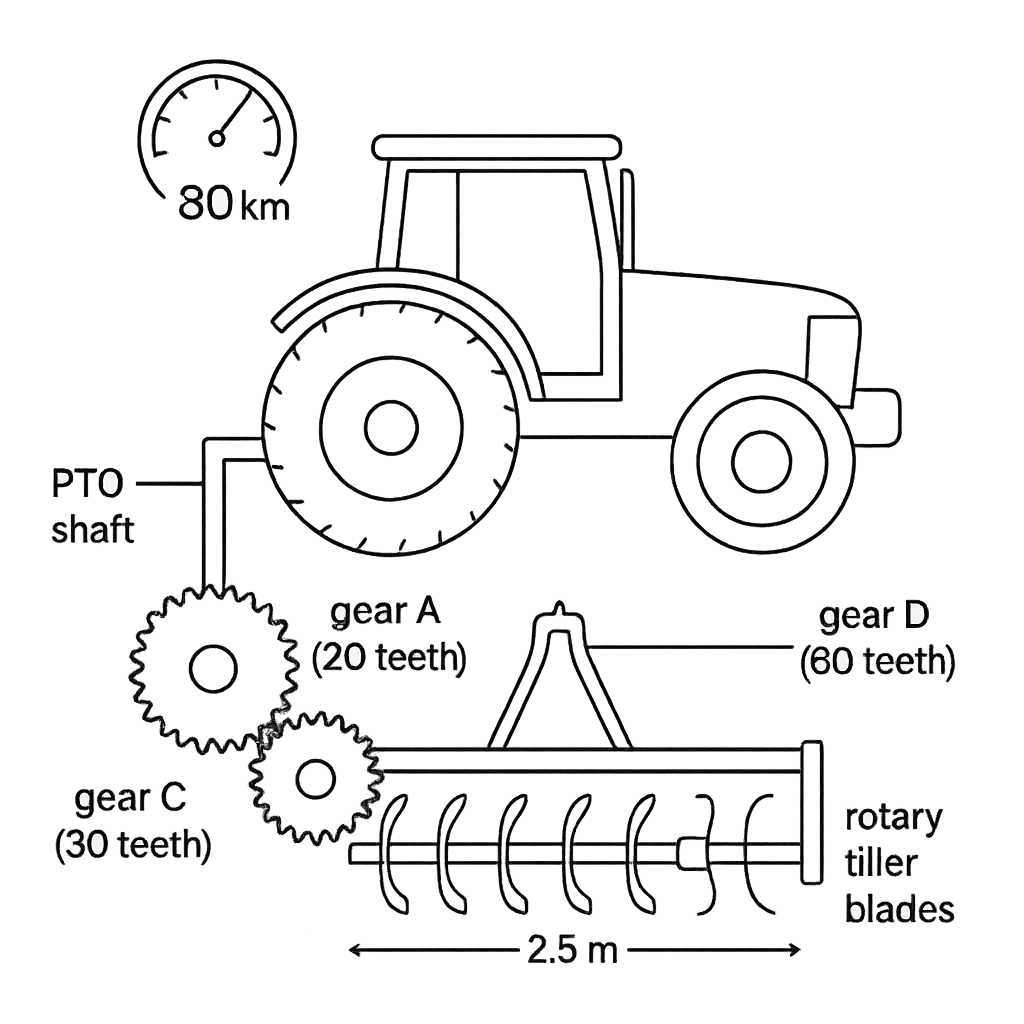
The diagram shows a tractor equipped with a PTO that rotates at 540 rpm. The PTO drives a two‑stage gear train: gear A (20 teeth) meshes with gear B (40 teeth), and gear C (30 teeth) meshes with gear D (60 teeth) which is fixed on the rotary tiller shaft. The tiller has a working width of 2.5 m and the tractor moves at 30 km h⁻¹. Assuming no slip, calculate the total number of revolutions of the tiller blades required to cultivate one hectare.
A. 960
Correct B. 1080
C. 1200
D. 1350

Correct Answer: B

Want to see the full step-by-step solution? Unlock AI Explanation & Analytics
Question 2 View Details
A farmer cultivates 4 ha of maize. Initially, a fungal disease affects 12 % of the area. After applying a fungicide, the disease incidence is reduced by 40 % of the original incidence. The fungicide costs ₦100 per hectare. The yield loss avoided on the area saved from disease is 1.5 t ha⁻¹, and the market price of maize is ₦2 500 per tonne. Calculate the net monetary benefit (in naira) of applying the fungicide.
A. 400
B. 280
Correct C. 320
D. 340

Correct Answer: C

Want to see the full step-by-step solution? Unlock AI Explanation & Analytics
Question 3 View Details
A soil sample contains 2 % organic matter and 20 % clay. The cation exchange capacity (CEC) contributed by organic matter is 0.5 cmolc kg⁻¹ per 1 % organic matter, while that contributed by clay is 0.2 cmolc kg⁻¹ per 1 % clay. Calculate the total CEC of the soil (in cmolc kg⁻¹).
A. 6.0
B. 4.0
C. 5.5
Correct D. 5.0

Correct Answer: D

Want to see the full step-by-step solution? Unlock AI Explanation & Analytics
Question 4 View Details
An agricultural extension officer has a total budget of ₦300 000 for a three‑month outreach programme. Fixed overheads for publicity amount to ₦50 000. Each village meeting (including transport, materials and facilitator fees) costs ₦8 000 and reaches 20 farmers. The officer wants to maximise the number of villages visited while staying within budget. Determine (a) the maximum number of villages that can be visited, (b) the total number of farmers reached, and (c) the average cost per farmer contacted under this plan (rounded to the nearest naira).
A. 32 villages, 640 farmers, ₦475 per farmer
B. 28 villages, 560 farmers, ₦540 per farmer
Correct C. 31 villages, 620 farmers, ₦481 per farmer
D. 30 villages, 600 farmers, ₦500 per farmer

Correct Answer: C

Want to see the full step-by-step solution? Unlock AI Explanation & Analytics
Question 5 View Details
A hand hoe works as a first‑class lever. The soil resistance (load) of 150 N acts 0.20 m from the fulcrum, while the farmer applies effort at a point 0.80 m from the fulcrum. Because the effort is applied at an angle, only 70 % of the applied force contributes to lifting the load. What is the minimum effort force (in newtons, rounded to the nearest whole number) the farmer must exert?
A. 26
Correct B. 54
C. 53
D. 38

Correct Answer: B

Want to see the full step-by-step solution? Unlock AI Explanation & Analytics
Question 6 View Details
A farmer intends to cultivate cassava on 3 hectares. The fixed cost for the enterprise is N5,000 and the variable cost is N1,500 per hectare. The expected yield is 20 tonnes per hectare. He will sell half of the total produce in the local market at a price P per tonne and the other half to a processor who pays a 10% discount on the market price (i.e., 0.9P per tonne). Transport costs are N30 per tonne to the local market and N50 per tonne to the processor. The farmer wants to earn a profit of at least N8,000. What is the minimum market price P (in Naira per tonne) he must obtain?
A. 250
B. 300
Correct C. 350
D. 400

Correct Answer: C

Want to see the full step-by-step solution? Unlock AI Explanation & Analytics
Question 7 View Details
A certain insect pest causes a 0.2% yield loss per insect per plant. A field contains 10,000 plants, each normally yielding 0.5 kg of crop. The market price of the crop is N600 per kilogram. The cost of applying an insecticide is N1,200 per hectare, and the insecticide is 80% effective in reducing the pest population. Determine the economic threshold, i.e., the minimum number of insects per plant at which applying the insecticide becomes profitable.
Correct A. 0.3
B. 0.2
C. 0.1
D. 0.5

Correct Answer: A

Want to see the full step-by-step solution? Unlock AI Explanation & Analytics
Question 8 View Details
During a disease survey of 120 plants, a 0-5 rating scale is used (0 = healthy, 5 = dead). The observed frequencies are: rating 0 - 30 plants, rating 1 - 40 plants, rating 2 - 20 plants, rating 3 - 15 plants, rating 4 - 10 plants, rating 5 - 5 plants. Calculate the Disease Severity Index (DSI) using the formula DSI = (Σ (rating × number of plants)) ÷ (5 × total plants) × 100. Express your answer to one decimal place.
A. 35.2
Correct B. 31.7
C. 28.5
D. 30.0

Correct Answer: B

Want to see the full step-by-step solution? Unlock AI Explanation & Analytics
Question 9 View Details
A farmer wishes to pull a moldboard plough that has a total working width of 1.2 m. The soil draft required at the desired speed is 1,500 N per metre of width. The tractor will operate at 5 km/h. Assuming an overall mechanical efficiency of 85%, calculate the minimum engine power (in kilowatts) the tractor must have. Use the relation Power (W) = (draft × width × speed) ÷ efficiency. Round your answer to the nearest whole kilowatt.
A. 5
B. 4
C. 2
Correct D. 3

Correct Answer: D

Want to see the full step-by-step solution? Unlock AI Explanation & Analytics
Question 10 View Details
A soil test shows that the available nitrogen in a wheat field is 60 kg/ha. The crop requires a total of 120 kg of nitrogen per hectare for optimum yield. The farmer plans to use urea, which contains 46% nitrogen by weight, and the nitrogen use efficiency of urea is 70%. How many kilograms of urea should be applied per hectare to meet the nitrogen requirement?
A. 150
B. 130
Correct C. 186
D. 200

Correct Answer: C

Want to see the full step-by-step solution? Unlock AI Explanation & Analytics
Question 11 View Details
A tractor is required to pull a plough weighing 25 kN up a 5 % gradient at a speed of 6 km h⁻¹. The coefficient of rolling resistance between the plough and the soil is 0.04. If the drivetrain efficiency is 85 %, what minimum engine power in kilowatts must the tractor develop? Give your answer to one decimal place.
A. 3.9 kW
B. 5.2 kW
Correct C. 4.4 kW
D. 6.1 kW

Correct Answer: C

Want to see the full step-by-step solution? Unlock AI Explanation & Analytics
Question 12 View Details
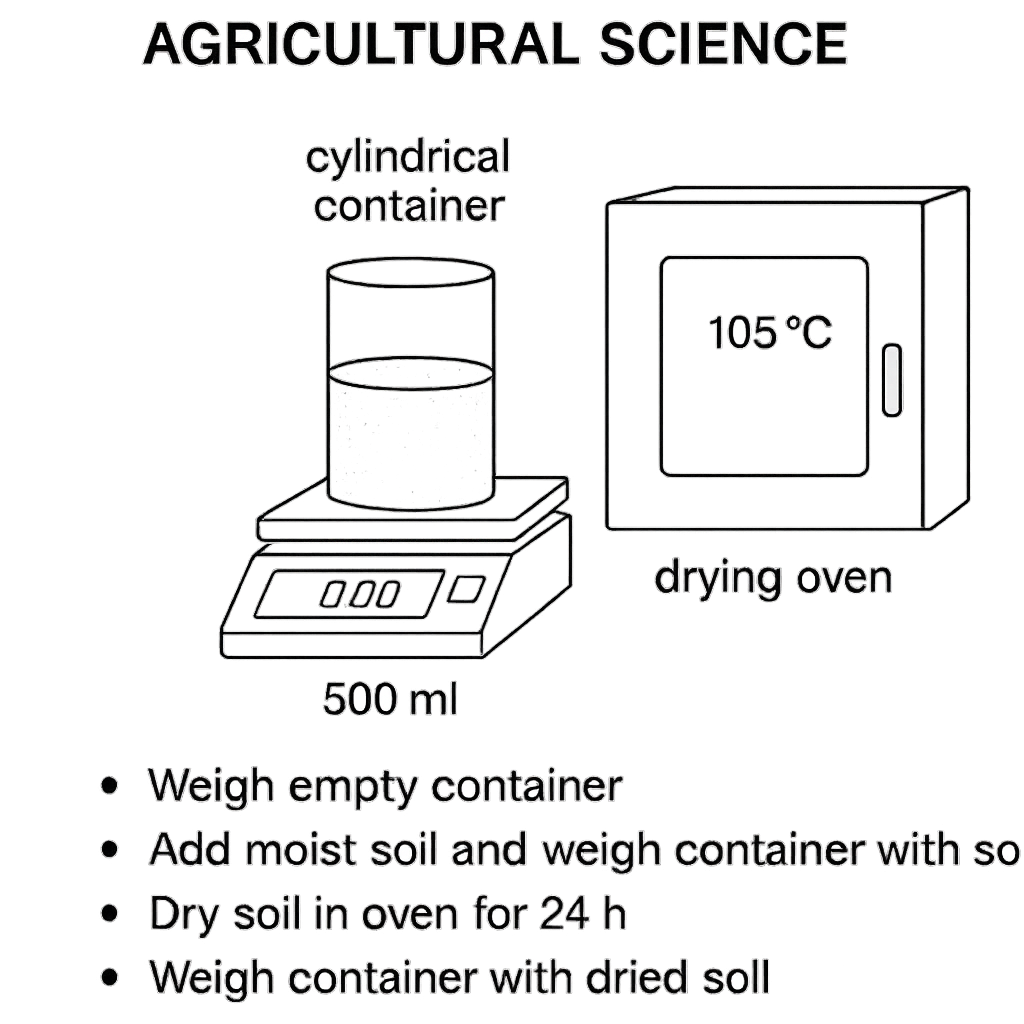
The diagram shows a laboratory set‑up for determining the gravimetric water content of a soil sample. The empty cylindrical container (capacity 500 mL) weighs 0.500 kg. After placing the moist soil, the container plus soil weighs 2.350 kg. After drying the soil in the oven, the container plus dried soil weighs 2.150 kg. Using this set‑up, calculate the gravimetric water content of the soil sample as a percentage, correct to one decimal place.
A. 9.2 %
B. 13.8 %
Correct C. 12.1 %
D. 10.5 %

Correct Answer: C

Want to see the full step-by-step solution? Unlock AI Explanation & Analytics
Question 13 View Details
A farmer intends to plant maize and cowpea in alternating rows on a rectangular field that is 500 m long and 100 m wide (area = 5 ha). Maize rows are spaced 75 cm apart and seeds are spaced 25 cm along the row. Cowpea rows are spaced 45 cm apart and seeds are spaced 15 cm along the row. The farmer can demonstrate to 150 farmers each week, and each demonstration farmer influences two other farmers per week to adopt the same practice. Assuming the program runs for the whole field and that all demonstrated farmers adopt immediately, calculate the total quantity of seed required for each crop (maize and cowpea) before accounting for a 5 % loss during sowing. Express the answer in kilograms, using seed weights of 0.3 g per maize seed and 0.15 g per cowpea seed. Round each answer to one decimal place.
A. Maize: 52.3 kg; Cowpea: 44.1 kg
B. Maize: 45.2 kg; Cowpea: 38.7 kg
Correct C. Maize: 49.8 kg; Cowpea: 41.5 kg
D. Maize: 48.0 kg; Cowpea: 39.9 kg

Correct Answer: C

Want to see the full step-by-step solution? Unlock AI Explanation & Analytics
Question 14 View Details
A forest covering 10 ha contains two species. Species A has an average DBH of 30 cm, height 20 m, wood density 0.55 t m⁻³ and 400 trees per ha. Species B has an average DBH of 45 cm, height 25 m, wood density 0.65 t m⁻³ and 250 trees per ha. Approximating each tree as a cone, its volume is V = (π/12) × DBH² × Height (DBH in metres).\n(a) Compute the total standing timber volume (in cubic metres) for the whole forest.\n(b) If a sustainable annual allowable cut is 2 % of the total volume, what is the maximum volume that may be harvested each year? Give your answer to the nearest whole cubic metre.
Correct A. 104 m³
B. 108 m³
C. 97 m³
D. 112 m³

Correct Answer: A

Want to see the full step-by-step solution? Unlock AI Explanation & Analytics
Question 15 View Details
An extension officer plans a series of farmer field days (FFDs) to promote a new pest‑resistant maize variety to a community of 2 000 farmers. Adoption follows the logistic model P(t) = 1 / (1 + e^{-(k(t‑t₀))}), where k = 0.3 week⁻¹ and t₀ = 8 weeks. Each week the officer can directly demonstrate to 150 farmers, who adopt immediately. Every farmer who has adopted influences two other farmers per week; those influenced may adopt in the same week according to the logistic proportion P(t). The programme runs for 12 weeks. Estimate the total number of farmers who will have adopted the variety by the end of week 12. Give your answer as an integer (round down).
Correct A. 2000
B. 1900
C. 1750
D. 1500

Correct Answer: A

Want to see the full step-by-step solution? Unlock AI Explanation & Analytics
Question 16 View Details
A herd of 120 goats is at risk of a contagious disease whose basic reproduction number (R₀) is 3. A vaccine available for the disease has an efficacy of 80 %. What is the minimum number of goats that must be vaccinated to achieve herd immunity in the herd?
A. 120
Correct B. 100
C. 84
D. 96

Correct Answer: B

Want to see the full step-by-step solution? Unlock AI Explanation & Analytics
Question 17 View Details
A rabbit farm intends to produce at least 500 kg of rabbit meat within a 6‑month production cycle. Each rabbit is weaned at 1.2 kg and reaches a market weight of 2.5 kg. The average daily gain is constant and the feed conversion ratio (FCR) is 3.5 kg feed per kg live‑weight gain. Assuming all rabbits survive to market weight, what is the minimum total amount of feed (in kilograms) that must be purchased for the cycle?
Correct A. 1752
B. 1300
C. 2000
D. 1500

Correct Answer: A

Want to see the full step-by-step solution? Unlock AI Explanation & Analytics
Question 18 View Details
A batch of 1 000 kg of mangoes is stored in a controlled‑atmosphere room for 4 weeks. The weekly weight loss due to respiration is L_r = 0.02 T % where T is the storage temperature in °C (valid for 10 °C ≤ T ≤ 20 °C). In addition, fungal decay causes an extra weekly loss of L_f = 0.5 (T - 12) % for temperatures above 12 °C and zero otherwise. What is the highest whole‑degree temperature (in °C) that can be used so that the total weight loss after 4 weeks does not exceed 8 %?
A. 13
B. 16
Correct C. 15
D. 14

Correct Answer: C

Want to see the full step-by-step solution? Unlock AI Explanation & Analytics
Question 19 View Details
Fresh cassava chips have an initial moisture content of 60 % (wet basis). They are to be dried in a solar dryer until the moisture content reaches 12 % (wet basis). The equilibrium moisture content under the drying conditions is 10 % (wet basis) and the drying follows first‑order kinetics described by MR = e^{‑k t}, where MR = (M - M_eq)/(M₀ - M_eq) and k = 0.15 day⁻¹. To two decimal places, how many days are required to reach the target moisture content?
A. 19.95
B. 20.12
C. 22.78
Correct D. 21.46

Correct Answer: D

Want to see the full step-by-step solution? Unlock AI Explanation & Analytics
Question 20 View Details
A lake stocked with tilapia follows logistic growth described by dN/dt = r N (1 - N/K), where the intrinsic growth rate r = 0.6 year⁻¹ and the carrying capacity K = 200 000 fish. The fishery harvests a constant number H of fish each year. To ensure that the population never falls below 50 000 fish, what is the maximum sustainable annual harvest H_max (in fish) that can be taken indefinitely?
Correct A. 22500
B. 25000
C. 20000
D. 30000

Correct Answer: A

Want to see the full step-by-step solution? Unlock AI Explanation & Analytics
Question 21 View Details
A herd of 200 cattle is at risk of anthrax. The probability of infection per animal without vaccination is 0.04. A vaccine reduces the infection probability by 85% and costs ₦150 per animal. The farmer can spend at most ₦30,000 on vaccination. What is the minimum number of cattle that must be vaccinated so that the expected number of infected animals in the herd does not exceed 3?
A. 150
B. 145
Correct C. 148
D. 138

Correct Answer: C

Want to see the full step-by-step solution? Unlock AI Explanation & Analytics
Question 22 View Details
A rabbit farm has 500 weanlings. Each rabbit currently receives 0.9 kg of protein per month from a diet containing 18 % protein. The farmer wants to raise the protein intake to 1.2 kg per rabbit per month by adding a protein concentrate that is 45 % protein and costs ₦200 per kilogram. What is the minimum amount of concentrate (in kilograms) that must be added each month for the whole herd, and what is the additional cost incurred?
A. 300 kg of concentrate costing ₦60,000
B. 320 kg of concentrate costing ₦64,000
Correct C. 334 kg of concentrate costing ₦66,800
D. 350 kg of concentrate costing ₦70,000

Correct Answer: C

Want to see the full step-by-step solution? Unlock AI Explanation & Analytics
Question 23 View Details
A 2‑hectare pond is stocked with tilapia fingerlings at a density of 5,000 fingerlings per hectare. After six months the survival rate is 78 %. The surviving fish gain an average of 0.35 g per day. Fingerlings have an initial average weight of 5 g. The farmer plans to harvest after 180 days. Market price is ₦400 per kilogram, production cost (excluding fingerlings) is ₦15,000 per hectare, and fingerlings cost ₦12 each. Calculate the net profit per hectare from this culture.
Correct A. ₦31,080 profit per hectare
B. ₦25,000 profit per hectare
C. ₦28,500 profit per hectare
D. ₦33,200 profit per hectare

Correct Answer: A

Want to see the full step-by-step solution? Unlock AI Explanation & Analytics
Question 24 View Details
A field has a soil pH of 5.2. To raise the pH to 6.5, the lime requirement is 2.5 tonnes per hectare for each 0.5‑unit increase in pH. How many tonnes of lime are needed per hectare?
Correct A. 6.5 tonnes per hectare
B. 4.0 tonnes per hectare
C. 5.0 tonnes per hectare
D. 7.5 tonnes per hectare

Correct Answer: A

Want to see the full step-by-step solution? Unlock AI Explanation & Analytics
Question 25 View Details
An extension officer wants to disseminate a new pest‑management technique to 120 smallholder farmers. Two communication channels are available: (i) group demonstrations costing ₦8,000 per session and reaching up to 15 farmers per session; (ii) radio broadcasts costing ₦12,000 per broadcast and reaching an estimated 40 farmers per broadcast. The officer has a budget of ₦100,000 and wants at least 90 % of the farmers (i.e., 108 farmers) to receive the information, with each farmer reached by at least one channel. Assuming the audiences of the two channels do not overlap, determine the minimum total number of activities (sessions + broadcasts) required, and give the optimal allocation of sessions and broadcasts that meets the budget and coverage constraints while minimizing total cost.
A. 2 group sessions and 2 radio broadcasts (total cost ₦40,000)
Correct B. 0 group sessions and 3 radio broadcasts (total cost ₦36,000)
C. 1 group session and 2 radio broadcasts (total cost ₦32,000)
D. 0 group sessions and 4 radio broadcasts (total cost ₦48,000)

Correct Answer: B

Want to see the full step-by-step solution? Unlock AI Explanation & Analytics

Master the Exam!

You've seen a preview, but there are thousands more questions plus AI tutor to break down complex solutions.

Unlock Full Access Available for Android & Windows
Help others prepare! Share this practice hub:
Chat with Support