waec model questions vol1 2024 physics | Essay

Prepare for your exams with waec model questions vol1 questions? Reviewing past/model questions is one of the most effective ways to guarantee a high score. This practice hub features authentic 2024 physics (Essay) questions designed to simulate the real exam environment.

Practice these randomly selected questions to test your readiness.
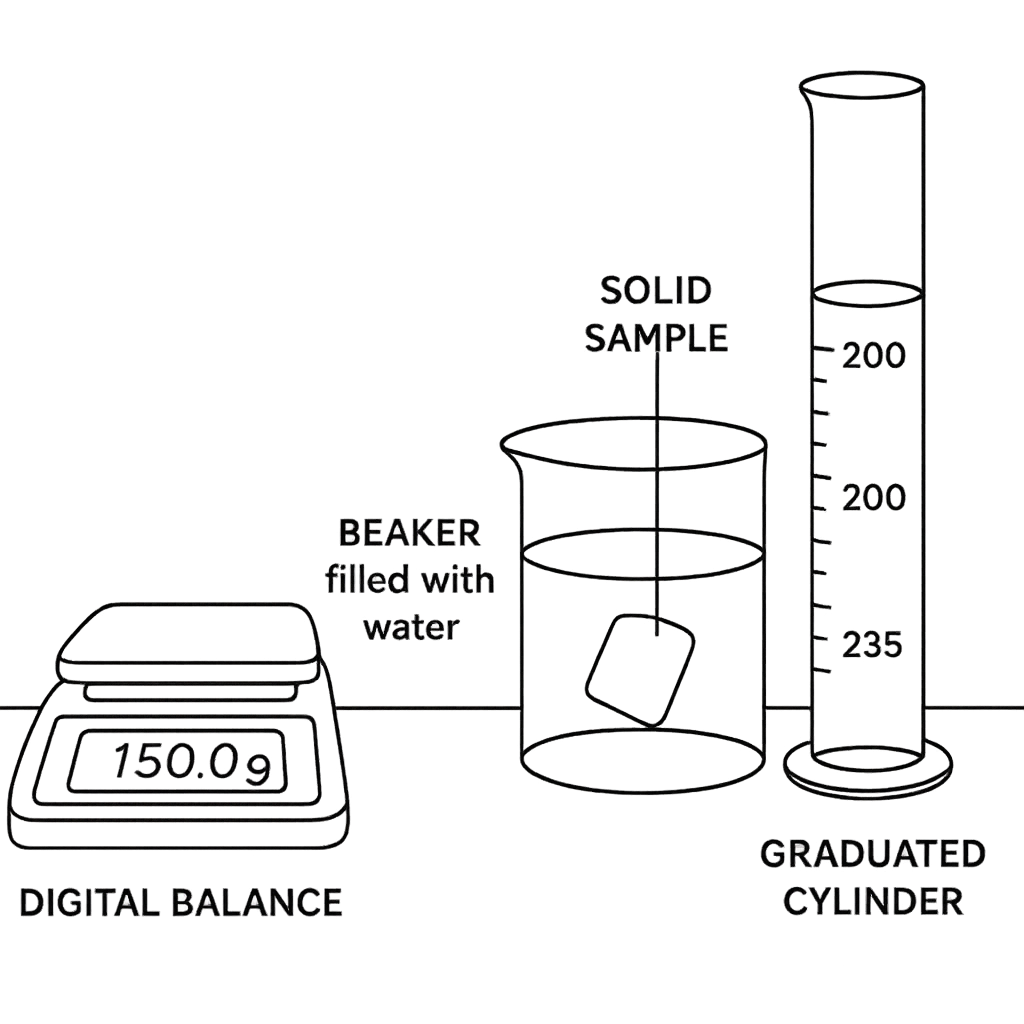
Question 1 View Details
A student is required to determine the density of an unknown solid using the water‑displacement method. The apparatus consists of a digital balance, a beaker filled with water, and a graduated cylinder. The mass of the solid measured on the balance is 150.0 g. The initial water level in the graduated cylinder reads 200.0 mL and after the solid is completely immersed the level rises to 235.0 mL.
Question Parts
(a)
Calculate the volume of the solid in cubic centimetres.
(b)
Using the mass obtained, determine the density of the solid in g·cm⁻³ (give answer to two decimal places).
(c)
Comment on whether the material is likely to be a metal, given that typical metal densities lie between 7.0 and 19.0 g·cm⁻³.
(d)
Identify one possible source of systematic error in this experiment and explain qualitatively how it would affect the calculated density.
Detailed Essay Solution & Marking Scheme Available

Get the step-by-step mathematical proofs, key points required by examiners, and a comprehensive breakdown from our AI Tutor.

Question 2 View Details
A projectile is launched from ground level. The motion diagram shown represents its position at equal time intervals of 0.5 s.
Question Parts
(a)
Determine the magnitude of the initial speed of the projectile and the angle of projection with the horizontal.
(b)
Calculate the maximum height attained by the projectile.
(c)
Find the time taken for the projectile to travel a horizontal distance of 5.0 m from the launch point.
(d)
A steady wind exerts a constant horizontal acceleration of 1.0 m s⁻² opposite to the motion. Assuming the initial speed and angle remain unchanged, determine the new horizontal range of the projectile.
Detailed Essay Solution & Marking Scheme Available

Get the step-by-step mathematical proofs, key points required by examiners, and a comprehensive breakdown from our AI Tutor.

Question 3 View Details
A projectile is launched from ground level. Its maximum height is 12.5 m and the total time of flight is 5.0 s. Neglect air resistance and take g = 10 m s⁻².
Question Parts
(a)
Determine the initial speed of the projectile.
(b)
Find the angle of projection θ.
Detailed Essay Solution & Marking Scheme Available

Get the step-by-step mathematical proofs, key points required by examiners, and a comprehensive breakdown from our AI Tutor.

Question 4 View Details
A 5.0 kg block rests on a rough inclined plane that makes an angle of 30° with the horizontal. The coefficient of static friction between the block and the plane is 0.20. The block is pulled up the plane by a light string parallel to the surface.
Question Parts
(a)
Calculate the minimum force required to start moving the block up the plane.
(b)
If a constant pull of 40 N is applied, determine the acceleration of the block up the plane.
Detailed Essay Solution & Marking Scheme Available

Get the step-by-step mathematical proofs, key points required by examiners, and a comprehensive breakdown from our AI Tutor.

Question 5 View Details
A smooth inclined plane makes an angle of 30° with the horizontal. A 2.0 kg block is released from rest at the top of the plane and slides down a length of 10.0 m to the bottom. The coefficient of kinetic friction between the block and the plane is 0.20. Take g = 9.8 m s⁻². Answer the following:
Question Parts
(a)
Determine the magnitude of the block’s acceleration down the plane.
(b)
Find the speed of the block after it has travelled 5.0 m down the plane.
(c)
Calculate (i) the work done by friction, (ii) the work done by gravity over the whole 10.0 m descent, (iii) the net work on the block, and (iv) the average power delivered to the block during its motion.
Detailed Essay Solution & Marking Scheme Available

Get the step-by-step mathematical proofs, key points required by examiners, and a comprehensive breakdown from our AI Tutor.

Question 6 View Details
A uniform rigid beam AB of length 2.0 m is pivoted at a fulcrum O such that OA = 0.60 m and OB = 1.40 m. A load of 200 N is suspended vertically downward at end B. An effort is applied at end A making an angle of 30° above the beam (the beam is horizontal). The fulcrum exerts a resisting frictional torque of 10 N·m opposing the rotation caused by the load. Neglect the mass of the beam and the rope. Using the diagram provided, answer the following:
Question Parts
(a)
Calculate the magnitude of the effort required to keep the lever in equilibrium.
Detailed Essay Solution & Marking Scheme Available

Get the step-by-step mathematical proofs, key points required by examiners, and a comprehensive breakdown from our AI Tutor.

Question 7 View Details
A sealed rigid container of volume 2.0 × 10⁻³ m³ contains dry air at 300 K and a pressure of 1.00 × 10⁵ Pa. The container is placed in a water bath whose temperature is gradually increased to 350 K. After heating, a friction‑less piston of cross‑sectional area 5.0 × 10⁻⁴ m² is fitted to the container and released so that the gas expands until its internal pressure equals the constant external atmospheric pressure of 1.01 × 10⁵ Pa. Assume air behaves as an ideal gas and that atmospheric pressure does not change during the experiment.
Question Parts
(a)
Determine the mass of air initially present in the container.
(b)
Find the final volume of the gas when the pressure has equalised with atmospheric pressure after heating to 350 K.
(c)
During the expansion the piston moves a distance d. Using the piston area given, calculate the work done by the gas on the piston.
(d)
Discuss qualitatively how the final state would differ if the container were not rigid but allowed the gas to expand freely while being heated to 350 K, keeping the external pressure constant at 1.01 × 10⁵ Pa.
Detailed Essay Solution & Marking Scheme Available

Get the step-by-step mathematical proofs, key points required by examiners, and a comprehensive breakdown from our AI Tutor.

Question 8 View Details
A 0.250 kg metal block is heated in a furnace until its temperature rises uniformly to 200 °C. It is then quickly transferred and immersed in a well‑insulated calorimeter containing 0.500 kg of water at 25 °C. The calorimeter itself has a heat capacity of 45 J·°C⁻¹. The final equilibrium temperature of the system is 30.0 °C. Assume that no heat is lost to the surroundings during the process.
Question Parts
(a)
Calculate the specific heat capacity of the metal block.
(b)
If the metal were instead a copper block (c = 385 J·kg⁻¹·K⁻¹), determine the expected equilibrium temperature under the same initial conditions and assuming no heat loss.
(c)
In practice some heat is lost to the surroundings. If the measured equilibrium temperature in part (a) was actually 29.0 °C, estimate the percentage of the total heat released by the metal that was lost to the surroundings.
(d)
Explain two experimental methods that could be employed to minimise heat loss in such calorimetry experiments.
Detailed Essay Solution & Marking Scheme Available

Get the step-by-step mathematical proofs, key points required by examiners, and a comprehensive breakdown from our AI Tutor.

Master the Exam!

You've seen a preview, but there are thousands more questions plus AI tutor to break down complex solutions.

Unlock Full Access Available for Android & Windows
Help others prepare! Share this practice hub:
Chat with Support