waec model questions vol1 2024 chemistry | Objective

Prepare for your exams with waec model questions vol1 questions? Reviewing past/model questions is one of the most effective ways to guarantee a high score. This practice hub features authentic 2024 chemistry (Objective) questions designed to simulate the real exam environment.

Practice these randomly selected questions to test your readiness.

Question 1 View Details
A wastewater stream of 500 L has a pH of 4.0 and contains 0.02 M bicarbonate (HCO₃⁻). The plant wants to raise the pH to 7.0 by adding solid calcium hydroxide, Ca(OH)₂. Assuming the bicarbonate acts as a buffer that consumes one mole of OH⁻ per mole of HCO₃⁻ to form CO₃²⁻, calculate the mass of Ca(OH)₂ required (in grams).
A. ≈ 310 g of Ca(OH)₂
B. ≈ 420 g of Ca(OH)₂
Correct C. ≈ 372 g of Ca(OH)₂
D. ≈ 250 g of Ca(OH)₂

Correct Answer: C

Want to see the full step-by-step solution? Unlock AI Explanation & Analytics
Question 2 View Details
Methyl crotonate (CH₃‑CH=CH‑COOCH₃) is first hydrogenated over a Pt catalyst and then subjected to acidic hydrolysis. Write the molecular formula of the organic acid obtained after the two steps.
Correct A. C₄H₈O₂
B. C₅H₈O₂
C. C₄H₈O₃
D. C₄H₁₀O₂

Correct Answer: A

Want to see the full step-by-step solution? Unlock AI Explanation & Analytics
Question 3 View Details
A buffer solution of total concentration 0.20 M is to be prepared at pH 5.00 using acetic acid (CH₃COOH, Ka = 1.8 × 10⁻⁵) and sodium acetate (CH₃COONa). Calculate the masses of acetic acid and sodium acetate required to prepare 1.00 L of this buffer.
A. 4.3 g CH₃COOH and 9.0 g CH₃COONa (for 1 L)
Correct B. 4.3 g CH₃COOH and 10.6 g CH₃COONa (for 1 L)
C. 3.9 g CH₃COOH and 9.8 g CH₃COONa (for 1 L)
D. 5.0 g CH₃COOH and 12.0 g CH₃COONa (for 1 L)

Correct Answer: B

Want to see the full step-by-step solution? Unlock AI Explanation & Analytics
Question 4 View Details
Aluminium metal reacts with chlorine gas according to the equation 2 Al + 3 Cl₂ → 2 AlCl₃. If 5.0 g of Al and 10.0 g of Cl₂ are mixed, calculate (a) the theoretical mass of AlCl₃ formed and (b) the percent yield when 6.0 g of AlCl₃ are actually obtained.
A. (a) 12.5 g AlCl₃ (theoretical) (b) 55 % yield
B. (a) 10.0 g AlCl₃ (theoretical) (b) 60 % yield
C. (a) 14.2 g AlCl₃ (theoretical) (b) 42 % yield
Correct D. (a) 12.5 g AlCl₃ (theoretical) (b) 48 % yield

Correct Answer: D

Want to see the full step-by-step solution? Unlock AI Explanation & Analytics
Question 5 View Details
Calcium carbonate decomposes on heating according to CaCO₃(s) → CaO(s) + CO₂(g). If 10.0 g of CaCO₃ are heated, (a) calculate the theoretical volume of CO₂ produced at 25 °C and 1 atm, and (b) determine the percent yield if 1.9 L of CO₂ are actually collected.
A. (a) 2.30 L CO₂ (theoretical) (b) 68 % yield
B. (a) 2.20 L CO₂ (theoretical) (b) 70 % yield
Correct C. (a) 2.44 L CO₂ (theoretical) (b) 78 % yield
D. (a) 2.60 L CO₂ (theoretical) (b) 85 % yield

Correct Answer: C

Want to see the full step-by-step solution? Unlock AI Explanation & Analytics
Question 6 View Details
A free‑radical copolymer is prepared from monomer A (C4H6, M = 54 g·mol⁻¹) and monomer B (C3H4, M = 40 g·mol⁻¹). The initial molar ratio of A:B is 3:2. In Sample 1, 80 % of A and 70 % of B are converted; in Sample 2, 70 % of A and 80 % of B are converted. Both samples give a number‑average degree of polymerisation (DPₙ) of 5 000. (i) Calculate the number‑average molecular weight (Mₙ) of the copolymer in Sample 1 (expressed to three significant figures in g·mol⁻¹). (ii) Which sample will have the higher tensile strength, assuming tensile strength is directly proportional to Mₙ? State the answer as "Sample 1" or "Sample 2".
A. 2.30×10^5 g·mol⁻¹; Sample 2
Correct B. 2.44×10^5 g·mol⁻¹; Sample 1
C. 2.60×10^5 g·mol⁻¹; Sample 1
D. 2.44×10^5 g·mol⁻¹; Sample 2

Correct Answer: B

Want to see the full step-by-step solution? Unlock AI Explanation & Analytics
Question 7 View Details
A copper plating bath contains Cu²⁺ ions. An electrolytic cell passes a current of 0.5 A for 2 h. Because of a side reaction, only 85 % of the total charge is used for copper deposition. (i) Calculate the mass of copper deposited (in grams, to three significant figures). (ii) If the same total charge were used to deposit silver (Ag⁺ → Ag) with 100 % efficiency, what mass of silver would be deposited? Give your answer as "mass of Cu; mass of Ag".
A. 0.95 g; 3.90 g
Correct B. 1.01 g; 4.03 g
C. 1.20 g; 4.50 g
D. 0.85 g; 3.80 g

Correct Answer: B

Want to see the full step-by-step solution? Unlock AI Explanation & Analytics
Question 8 View Details
Identify the element that has atomic number 26 and give its group number in the periodic table (IUPAC numbering).
A. Fe; 7
B. Mn; 7
Correct C. Fe; 8
D. Co; 8

Correct Answer: C

Want to see the full step-by-step solution? Unlock AI Explanation & Analytics
Question 9 View Details
The standard enthalpies of formation are: ΔH_f°(C₈H₁₈) = -250 kJ·mol⁻¹, ΔH_f°(CO₂) = -393.5 kJ·mol⁻¹, ΔH_f°(H₂O, l) = -285.8 kJ·mol⁻¹. Using Hess's law, calculate the heat released when 2.5 mol of octane (C₈H₁₈) combust completely in excess O₂. Express your answer in kilojoules, to three significant figures, and include the sign.
Correct A. -1.37×10^4 kJ
B. -1.37×10^3 kJ
C. -1.25×10^4 kJ
D. -1.50×10^4 kJ

Correct Answer: A

Want to see the full step-by-step solution? Unlock AI Explanation & Analytics
Question 10 View Details
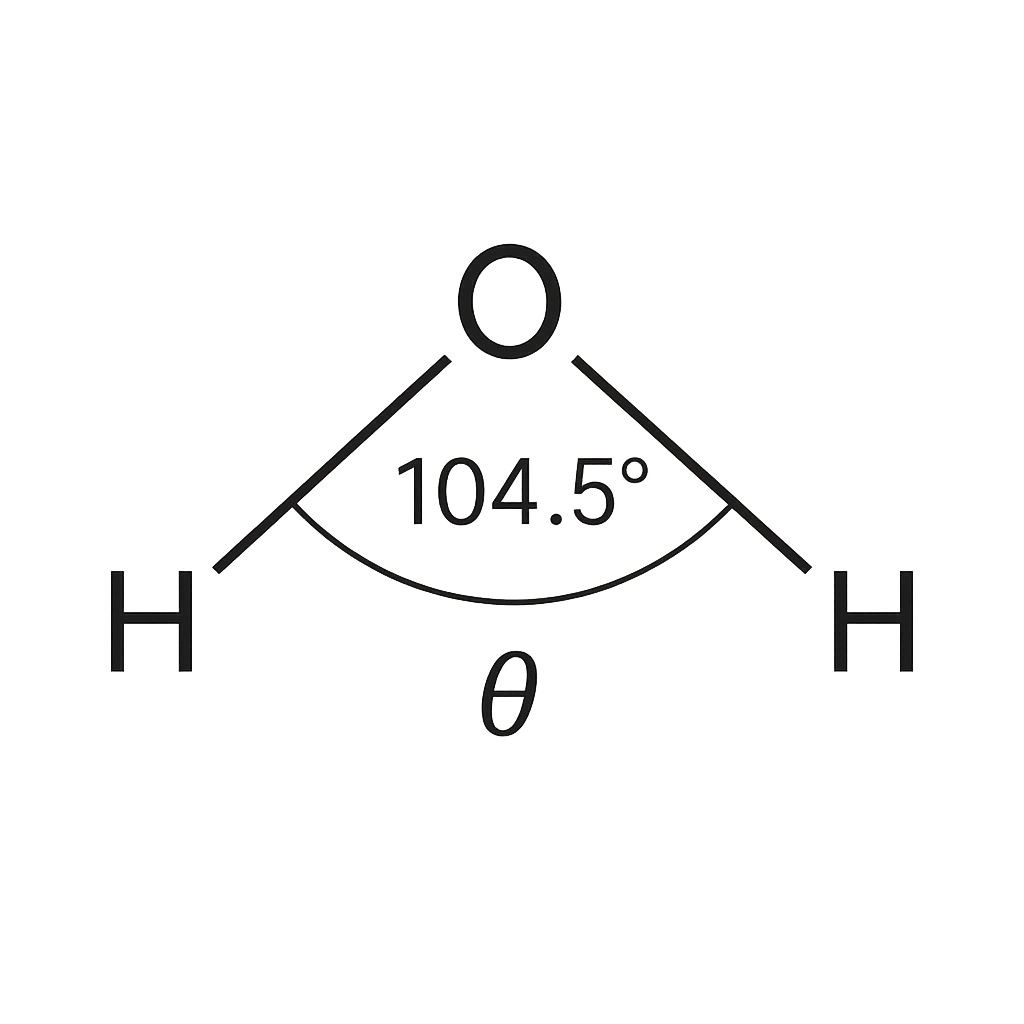
The diagram shows a water molecule with the H-O-H bond angle indicated. State the bond angle (in degrees) shown in the diagram.
A. 109.5
B. 120.0
C. 90.0
Correct D. 104.5

Correct Answer: D

Want to see the full step-by-step solution? Unlock AI Explanation & Analytics
Question 11 View Details
A 5.0 g sample of impure aluminium contains 90 % aluminium by mass. The sample is reacted with excess chlorine gas to form aluminium chloride according to 2 Al + 3 Cl₂ → 2 AlCl₃. After the reaction, 7.5 g of AlCl₃ is obtained. Calculate the percent yield of AlCl₃ based on the pure aluminium present in the sample.
A. 27.5 %
B. 45.2 %
Correct C. 33.7 %
D. 60.0 %

Correct Answer: C

Want to see the full step-by-step solution? Unlock AI Explanation & Analytics
Question 12 View Details
The solubility product of silver chloride at 25 °C is Ksp = 1.8×10⁻¹⁰. A solution already contains 0.010 M NaCl. If 5.0×10⁻⁵ mol of Ag⁺ ions are added to 250 mL of this solution, how many milligrams of AgCl will precipitate?
Correct A. 7.2 mg
B. 9.8 mg
C. 5.4 mg
D. 12.0 mg

Correct Answer: A

Want to see the full step-by-step solution? Unlock AI Explanation & Analytics
Question 13 View Details
A factory discharges effluent into a river. The effluent flow rate is 200 L s⁻¹ and contains phenol at 0.50 mg L⁻¹. The river flow rate is 2.0×10⁵ L s⁻¹ and its upstream phenol concentration is 0.05 mg L⁻¹. The river velocity is 0.4 m s⁻¹. After travelling 8 km downstream, the phenol concentration is measured as 0.030 mg L⁻¹. Assuming first‑order degradation of phenol during the travel, determine (a) the percentage removal of phenol over the 8 km stretch, (b) the first‑order rate constant k (in h⁻¹), and (c) the mass of phenol removed per day (in kg).
Correct A. 40.6 % removal, k = 0.094 h⁻¹, 354.6 kg per day
B. 45.0 % removal, k = 0.120 h⁻¹, 400.5 kg per day
C. 35.2 % removal, k = 0.080 h⁻¹, 300.0 kg per day
D. 50.1 % removal, k = 0.150 h⁻¹, 500.2 kg per day

Correct Answer: A

Want to see the full step-by-step solution? Unlock AI Explanation & Analytics
Question 14 View Details
A rigid 10.0 L container at 298 K initially contains 0.500 mol of nitrogen gas and oxygen gas at a pressure of 0.800 atm. Then 2.00 g of hydrogen gas is introduced and the mixture is allowed to react according to 2 H₂ + O₂ → 2 H₂O. Assuming the reaction goes to completion, calculate (a) the total pressure in the container after the reaction and (b) the partial pressure of the water vapour formed.
A. 3.10 atm total pressure, 2.00 atm water vapour pressure
B. 2.85 atm total pressure, 0.95 atm water vapour pressure
C. 4.20 atm total pressure, 1.20 atm water vapour pressure
Correct D. 3.65 atm total pressure, 1.60 atm water vapour pressure

Correct Answer: D

Want to see the full step-by-step solution? Unlock AI Explanation & Analytics
Question 15 View Details
A 10.0 g sample of ethylene glycol (C₂H₆O₂) is mixed with 12.0 g of acetic anhydride (C₄H₆O₃) and heated with a few drops of concentrated H₂SO₄. The reaction proceeds as follows: \[\text{HO-CH₂-CH₂-OH} + (\text{CH₃CO})₂\text{O} \rightarrow \text{CH₃COO-CH₂-CH₂-OH} + \text{CH₃COOH}.\] Determine the limiting reagent, the theoretical mass of mono‑acetylated ethylene glycol that can be formed, and the percent yield if 9.0 g of the product is actually obtained.
A. Limiting reagent: ethylene glycol; theoretical mass 10.5 g; percent yield 73.5 %
B. Limiting reagent: acetic anhydride; theoretical mass 13.4 g; percent yield 68.2 %
C. Limiting reagent: acetic anhydride; theoretical mass 12.2 g; percent yield 80.1 %
Correct D. Limiting reagent: acetic anhydride; theoretical mass 12.2 g; percent yield 73.5 %

Correct Answer: D

Want to see the full step-by-step solution? Unlock AI Explanation & Analytics
Question 16 View Details
A sample of ferrous ammonium sulfate hexahydrate, FeSO4·7H2O, weighing 3.55 g is dissolved and diluted to 250.0 mL. From this solution, 20.0 mL is taken and titrated with KMnO4 solution in acidic medium. The reaction is: \(\mathrm{MnO_4^- + 5Fe^{2+} + 8H^+ \rightarrow Mn^{2+} + 5Fe^{3+} + 4H_2O}\). If 18.2 mL of the KMnO4 solution is required for the titration, calculate the concentration of the KMnO4 solution in mol·L⁻¹.
A. 0.0135 M
B. 0.0150 M
C. 0.0098 M
Correct D. 0.0112 M

Correct Answer: D

Want to see the full step-by-step solution? Unlock AI Explanation & Analytics
Question 17 View Details
A galvanic cell is constructed as follows: Fe(s) | Fe²⁺ (unknown concentration) || Cu²⁺ (0.050 M) | Cu(s). The standard reduction potentials are E°(Fe²⁺/Fe) = -0.44 V and E°(Cu²⁺/Cu) = +0.34 V. At 25 °C the cell emf is measured to be 0.73 V. Determine the concentration of Fe²⁺ in the cell solution.
A. 1.23 M
B. 0.245 M
C. 4.90 M
Correct D. 2.45 M

Correct Answer: D

Want to see the full step-by-step solution? Unlock AI Explanation & Analytics
Question 18 View Details
A binary compound XY₄ is known to be tetrahedral in shape. Its molar mass is 240 g·mol⁻¹ and the atomic mass of element X is 60 g·mol⁻¹. Determine (a) the oxidation state of X, (b) the hybridisation of the central X atom, and (c) the X-Y bond length if the ionic radius of X is 0.075 nm and that of Y is 0.140 nm. Assume the bond length equals the sum of the two ionic radii.
Correct A. Oxidation state of X = +4; hybridisation = sp³; bond length = 0.215 nm
B. Oxidation state of X = +2; hybridisation = sp³; bond length = 0.215 nm
C. Oxidation state of X = +4; hybridisation = sp²; bond length = 0.215 nm
D. Oxidation state of X = +4; hybridisation = sp³; bond length = 0.225 nm

Correct Answer: A

Want to see the full step-by-step solution? Unlock AI Explanation & Analytics
Question 19 View Details
The apparatus shown is used to collect a gas over water. A volume of 125.0 mL of hydrogen gas is collected at 25 °C and a total pressure of 1.00 atm. The vapor pressure of water at 25 °C is 23.8 mm Hg. Calculate the number of moles of hydrogen gas collected.
A. 5.40×10⁻³ mol
Correct B. 4.95×10⁻³ mol
C. 5.11×10⁻³ mol
D. 1.60×10⁻⁴ mol

Correct Answer: B

Want to see the full step-by-step solution? Unlock AI Explanation & Analytics
Question 20 View Details
The diagram depicts a Bohr model of an atom with 2 electrons in the first shell and 8 electrons in the second shell. Identify the element and write its electron configuration.
Correct A. Neon; electron configuration: 1s² 2s² 2p⁶
B. Fluorine; electron configuration: 1s² 2s² 2p⁵
C. Magnesium; electron configuration: 1s² 2s² 2p⁶ 3s²
D. Sodium; electron configuration: 1s² 2s² 2p⁶ 3s¹

Correct Answer: A

Want to see the full step-by-step solution? Unlock AI Explanation & Analytics
Question 21 View Details
The standard Gibbs free energy change for the formation of a metal oxide M2O3 is given by ΔG° = -500 + 0.15T (kJ·mol⁻¹), where T is the temperature in kelvin. For the reduction of M2O3 by carbon, the relevant reaction is M2O3 + 3C → 2M + 3CO(g). The ΔG° for the formation of CO(g) from C and O2 is ΔG° = -394 + 0.12T (kJ·mol⁻¹). At what temperature (in °C) does the reduction become thermodynamically feasible (i.e., ΔG° for the oxide equals ΔG° for CO)? Give your answer to the nearest ten degrees Celsius.
Correct A. 3260
B. 3100
C. 3400
D. 3000

Correct Answer: A

Want to see the full step-by-step solution? Unlock AI Explanation & Analytics
Question 22 View Details
A flat iron sheet of area 0.5 m² and density 7.87 g cm⁻³ is exposed to a corrosive atmosphere. After 30 days the sheet has lost 12.0 g of iron. Assuming the corrosion proceeds by the reaction Fe → Fe²⁺ + 2e⁻, calculate the average corrosion rate in micrometres per year (µm yr⁻¹). Give your answer to the nearest whole number.
A. 45
B. 25
Correct C. 37
D. 30

Correct Answer: C

Want to see the full step-by-step solution? Unlock AI Explanation & Analytics
Question 23 View Details
When 15.0 g of aluminium reacts with 20.0 g of chlorine gas according to 2Al + 3Cl₂ → 2AlCl₃, 10 % of the aluminium chloride formed subsequently decomposes back into Al and Cl₂. What mass of AlCl₃ remains after the decomposition? Give your answer to one decimal place in grams.
A. 21.0
B. 19.8
C. 24.1
Correct D. 22.6

Correct Answer: D

Want to see the full step-by-step solution? Unlock AI Explanation & Analytics
Question 24 View Details
A compound contains a benzene ring. At carbon‑1 the ring bears a carboxylic acid group (-COOH). At carbon‑3 a methyl group (-CH₃) is attached and at carbon‑5 a nitro group (-NO₂) is attached. Provide the IUPAC name of this compound.
A. 3-ethyl-5-nitrobenzoic acid
B. 3-methyl-4-nitrobenzoic acid
C. 2-methyl-5-nitrobenzoic acid
Correct D. 3-methyl-5-nitrobenzoic acid

Correct Answer: D

Want to see the full step-by-step solution? Unlock AI Explanation & Analytics
Question 25 View Details
A solution is prepared by dissolving 5.00 g of an unknown alcohol in 100.0 g of water. The solution also contains 0.50 g of NaCl, which is non‑volatile and does not affect the boiling point. The observed boiling point of the solution is 100.52 °C. Given the ebullioscopic constant of water K_b = 0.512 °C·kg mol⁻¹, calculate the molar mass of the unknown alcohol. Give your answer to the nearest whole gram per mole.
A. 55
B. 48
Correct C. 44
D. 42

Correct Answer: C

Want to see the full step-by-step solution? Unlock AI Explanation & Analytics

Master the Exam!

You've seen a preview, but there are thousands more questions plus AI tutor to break down complex solutions.

Unlock Full Access Available for Android & Windows
Help others prepare! Share this practice hub:
Chat with Support