waec model questions vol1 2024 biology | Objective

Prepare for your exams with waec model questions vol1 questions? Reviewing past/model questions is one of the most effective ways to guarantee a high score. This practice hub features authentic 2024 biology (Objective) questions designed to simulate the real exam environment.

Practice these randomly selected questions to test your readiness.

Question 1 View Details
In a grassland ecosystem the gross primary productivity (GPP) is 12,000 kJ m⁻² day⁻¹. Plants respire 55 % of the GPP. Herbivores consume an unknown proportion \(x\) of the net primary productivity (NPP). Carnivores eat 25 % of the herbivore biomass and assimilate 80 % of the energy they ingest. The energy that finally reaches the top‑carnivore level is measured as 240 kJ m⁻² day⁻¹. (a) Determine the percentage \(x\) of NPP that is consumed by herbivores. (b) What percentage of the original GPP is ultimately transferred to the top carnivores?
Correct A. Herbivores consume 22.22 % of NPP; 2 % of the original GPP is transferred to top carnivores.
B. Herbivores consume 18.75 % of NPP; 1.5 % of the original GPP is transferred to top carnivores.
C. Herbivores consume 20.00 % of NPP; 2 % of the original GPP is transferred to top carnivores.
D. Herbivores consume 30.00 % of NPP; 2.5 % of the original GPP is transferred to top carnivores.

Correct Answer: A

Want to see the full step-by-step solution? Unlock AI Explanation & Analytics
Question 2 View Details
A fish population in a lake follows the logistic growth model \(\frac{dN}{dt}=rN\left(1-\frac{N}{K}\right)\). Field observations give two pieces of information: when the population size is 2,000 fish, the net increase is 300 fish per month; when the population reaches 5,000 fish, the growth rate becomes zero. Determine the intrinsic rate \(r\) (per month) and the carrying capacity \(K\). Then calculate the maximum sustainable yield (MSY) and the population size at which this yield occurs.
A. Intrinsic rate r = 0.20 month⁻¹; carrying capacity K = 4,800 fish; MSY = 240.0 fish per month occurring at a population of 2,400 fish.
B. Intrinsic rate r = 0.30 month⁻¹; carrying capacity K = 5,500 fish; MSY = 412.5 fish per month occurring at a population of 2,750 fish.
Correct C. Intrinsic rate r = 0.25 month⁻¹; carrying capacity K = 5,000 fish; MSY = 312.5 fish per month occurring at a population of 2,500 fish.
D. Intrinsic rate r = 0.25 month⁻¹; carrying capacity K = 6,000 fish; MSY = 375.0 fish per month occurring at a population of 3,000 fish.

Correct Answer: C

Want to see the full step-by-step solution? Unlock AI Explanation & Analytics
Question 3 View Details
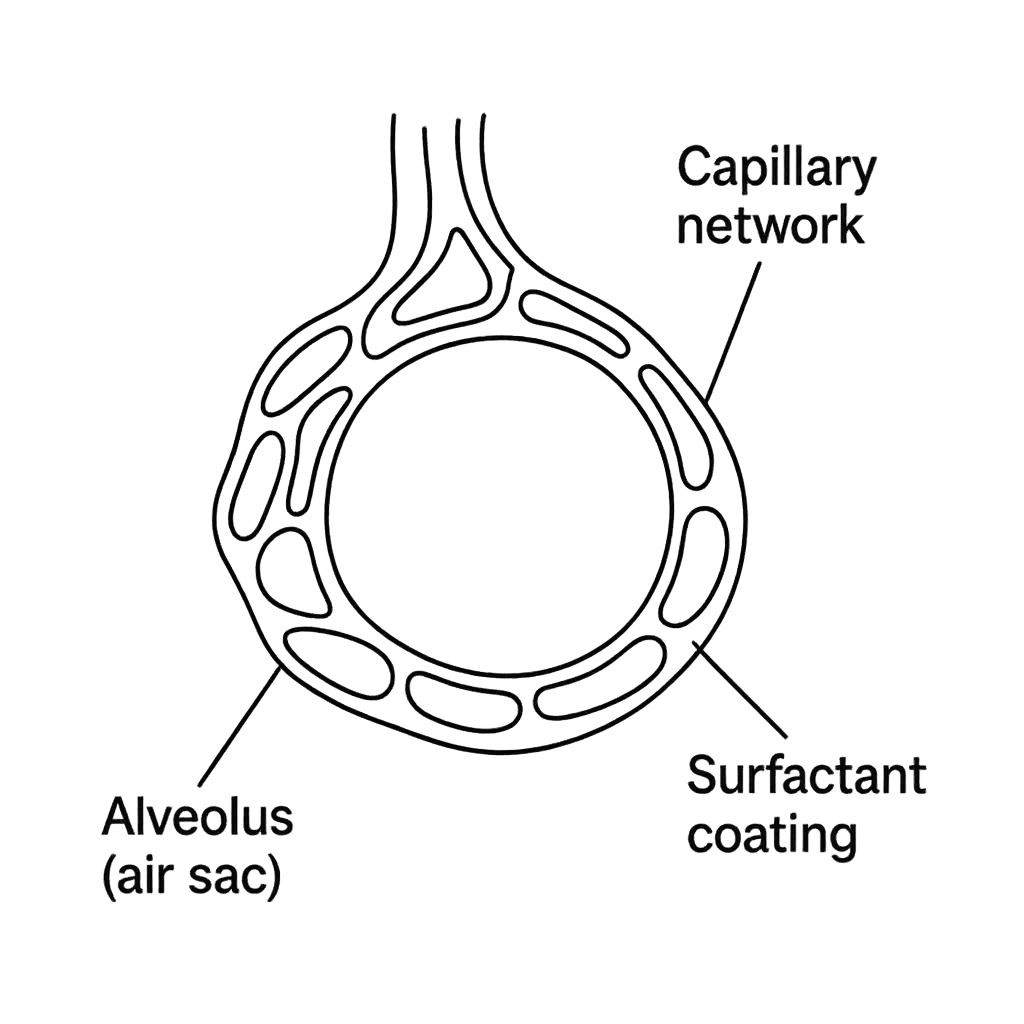
The diagram shows a typical alveolus surrounded by capillaries. The total internal surface area of all alveoli in the lungs is 70 m². Each alveolus has an average internal surface area of 70,000 µm², but only 80 % of this area is available for gas exchange because of surfactant coating. Estimate the total number of alveoli in the lungs.
A. 1250000000
B. 600000000
C. 1000000000
Correct D. 800000000

Correct Answer: D

Want to see the full step-by-step solution? Unlock AI Explanation & Analytics
Question 4 View Details
A molecular‑clock study of three related species gives the following numbers of nucleotide differences: Species A-B: 18 differences; Species B-C: 24 differences; Species A-C: 30 differences. The mutation rate is 3 substitutions per million years per lineage. Assuming a constant molecular clock, estimate the time (in million years) since species A and B diverged from their common ancestor.
A. 2
B. 6
Correct C. 3
D. 4

Correct Answer: C

Want to see the full step-by-step solution? Unlock AI Explanation & Analytics
Question 5 View Details
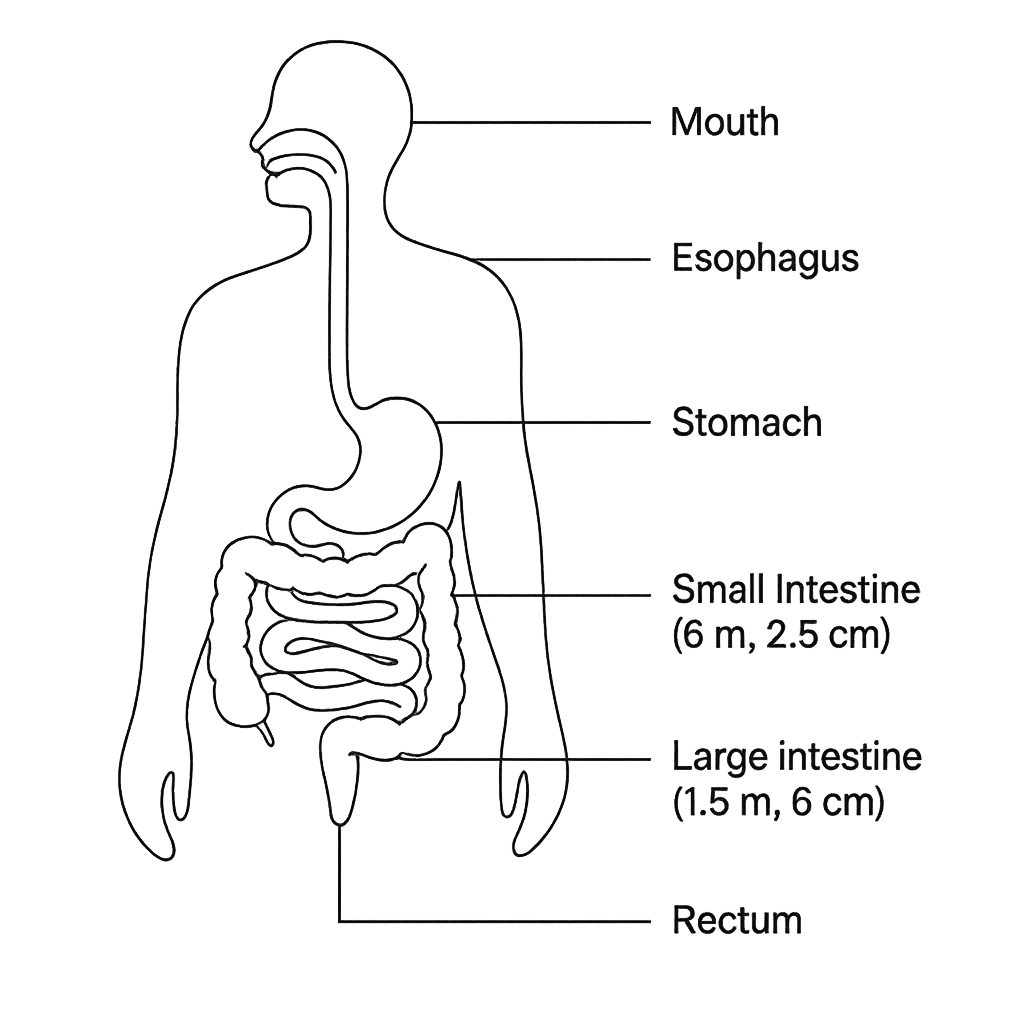
The labelled diagram of the human digestive system shows the lengths and average internal diameters of the small and large intestines. The small intestine is 6 m long with an average internal diameter of 2.5 cm; the large intestine is 1.5 m long with an average internal diameter of 6 cm. Assuming each segment is a perfect cylinder and neglecting the end caps, calculate the percentage of the total inner surface area that is contributed by the small intestine.
A. 40.9
B. 70
Correct C. 62.5
D. 55

Correct Answer: C

Want to see the full step-by-step solution? Unlock AI Explanation & Analytics
Question 6 View Details
In a plant, two genes A/a (seed shape) and B/b (seed colour) are linked on the same chromosome with a recombination frequency of 20 %. The heterozygous parent has the cis configuration AB/ab and is crossed with a homozygous recessive ab/ab plant. What percentage of the progeny will display both dominant traits (seed shape A‑ and seed colour B‑)?
A. 30
B. 50
Correct C. 40
D. 20

Correct Answer: C

Want to see the full step-by-step solution? Unlock AI Explanation & Analytics
Question 7 View Details
A muscle cell metabolises 2.0 g of glucose anaerobically to lactate and 3.0 g of glucose aerobically. Anaerobic glycolysis yields 2 ATP per glucose molecule, while aerobic respiration yields 30 ATP per glucose molecule. How many ATP molecules are produced in total? Express your answer in scientific notation to three significant figures.
A. 4.20e23
B. 3.45e23
Correct C. 3.15e23
D. 2.40e23

Correct Answer: C

Want to see the full step-by-step solution? Unlock AI Explanation & Analytics
Question 8 View Details
In a community a disease has a transmission coefficient β = 0.35 per contact per day, each person makes on average 12 contacts per day, and the infectious period lasts 4 days. (i) Calculate the basic reproduction number R₀. (ii) A vaccination programme immunises 60 % of the population with a vaccine that is 80 % effective. Determine the effective reproduction number Rₑ after vaccination and state whether the outbreak will continue.
A. 10.05
B. 7.30
Correct C. 8.74
D. 9.12

Correct Answer: C

Want to see the full step-by-step solution? Unlock AI Explanation & Analytics
Question 9 View Details
A bacterial culture shows a cell density of 2.0 × 10⁶ cells mL⁻¹ at 2 h and 5.12 × 10⁷ cells mL⁻¹ at 8 h. Assuming exponential growth during this interval, calculate the generation (doubling) time in minutes, rounded to the nearest minute.
A. 85
B. 63
C. 70
Correct D. 77

Correct Answer: D

Want to see the full step-by-step solution? Unlock AI Explanation & Analytics
Question 10 View Details
An action potential travels along a myelinated nerve fibre 0.80 m in 2.0 ms. In an unmyelinated fibre of the same length the conduction speed is reduced by a factor of 4. How long (in milliseconds) does the impulse take to travel the 0.80 m in the unmyelinated fibre?
Correct A. 8
B. 12
C. 2
D. 4

Correct Answer: A

Want to see the full step-by-step solution? Unlock AI Explanation & Analytics
Question 11 View Details
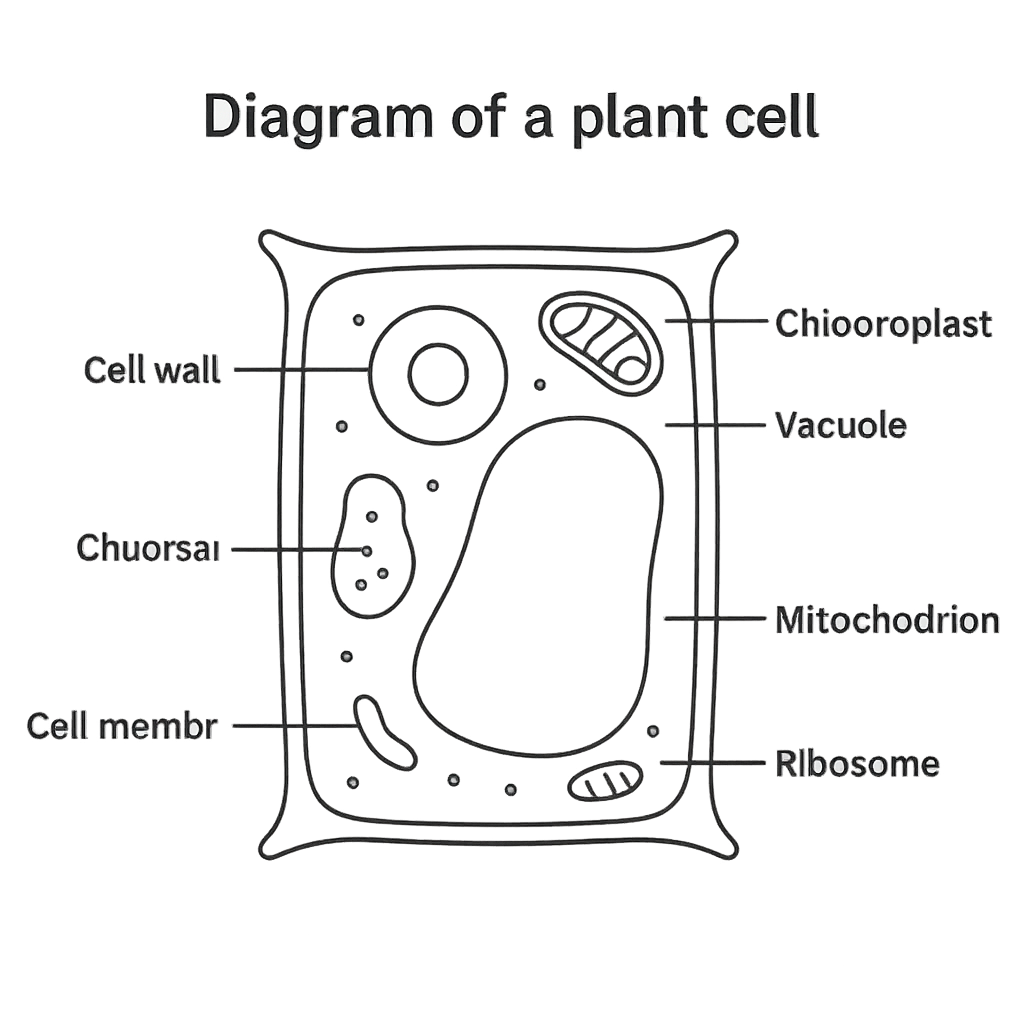
The diagram shows a typical plant cell with labelled parts A-G. Which labelled organelle is the site of photosynthesis?
Correct A. chloroplast
B. nucleus
C. ribosome
D. mitochondrion

Correct Answer: A

Want to see the full step-by-step solution? Unlock AI Explanation & Analytics
Question 12 View Details
Two ecosystems, A and B, have the following net primary productivity (NPP) and energy transfer efficiencies: Ecosystem A: NPP = 120,000 kJ m⁻² yr⁻¹; 10% from producers to primary consumers, 15% from primary to secondary, 20% from secondary to tertiary. Ecosystem B: NPP = 150,000 kJ m⁻² yr⁻¹; 9% from producers to primary consumers, 14% from primary to secondary, 30% from secondary to tertiary. Each tertiary consumer requires 5 kJ per day. Assuming 365 days in a year, which ecosystem can support a larger population of tertiary consumers per square metre?
A. Both ecosystems support equal numbers
B. Ecosystem A
C. Neither ecosystem can support any tertiary consumers
Correct D. Ecosystem B

Correct Answer: D

Want to see the full step-by-step solution? Unlock AI Explanation & Analytics
Question 13 View Details
During which phase of mitosis do sister chromatids separate and move toward opposite poles of the cell?
A. metaphase
B. prophase
Correct C. anaphase
D. telophase

Correct Answer: C

Want to see the full step-by-step solution? Unlock AI Explanation & Analytics
Question 14 View Details
A solute diffuses across a cell membrane with a diffusion coefficient D = 2.5 × 10⁻⁶ cm² s⁻¹. The average distance the solute must travel inside the cell is 20 µm.\n\n(a) Estimate the time required for diffusion using t ≈ L²/(2D).\n(b) An active transport protein moves the same solute at a rate of 5 × 10⁻⁸ mol s⁻¹. If the cell needs to transport 1 × 10⁻⁹ mol of solute, which mechanism delivers the solute faster? State the faster mechanism.
A. diffusion
Correct B. active transport
C. facilitated diffusion
D. osmosis

Correct Answer: B

Want to see the full step-by-step solution? Unlock AI Explanation & Analytics
Question 15 View Details
What is the primary function of ribosomes in a eukaryotic cell?
Correct A. protein synthesis
B. DNA replication
C. cellular respiration
D. lipid metabolism

Correct Answer: A

Want to see the full step-by-step solution? Unlock AI Explanation & Analytics
Question 16 View Details
The estradiol concentration (pg/mL) in a woman's menstrual cycle over ten consecutive days is: Day 1 = 30, Day 2 = 45, Day 3 = 70, Day 4 = 95, Day 5 = 120, Day 6 = 150, Day 7 = 180, Day 8 = 160, Day 9 = 130, Day 10 = 90. An LH surge that triggers ovulation occurs on the day immediately after estradiol has been at least 150 pg/mL for two consecutive days. On which day of the cycle does the LH surge occur?
A. 9
B. 7
Correct C. 8
D. 10

Correct Answer: C

Want to see the full step-by-step solution? Unlock AI Explanation & Analytics
Question 17 View Details
A person is in a 30 °C environment. Their metabolic heat production is 100 W. They sweat at a rate of 0.5 g min⁻¹ (latent heat of vapourisation = 2.43 kJ g⁻¹). Skin blood flow increases to 0.3 L min⁻¹, and each 0.1 L min⁻¹ of flow removes 30 W of heat by convection. Will the person's core temperature rise, fall, or remain stable?
A. core temperature will rise
B. temperature will remain stable
C. temperature will rise
Correct D. temperature will fall

Correct Answer: D

Want to see the full step-by-step solution? Unlock AI Explanation & Analytics
Question 18 View Details
In a particular cell, the duration of prophase is twice that of metaphase, anaphase lasts the same time as metaphase, and telophase lasts three times as long as metaphase. If the total time for mitosis is 70 minutes, how many minutes does metaphase last?
A. 15
Correct B. 10
C. 8
D. 12

Correct Answer: B

Want to see the full step-by-step solution? Unlock AI Explanation & Analytics
Question 19 View Details
Two desert-dwelling mammals employ different adaptations to conserve water. Species A: a thick cuticle reduces transpiration to 40 % of the normal rate, and nocturnal activity reduces the time exposed to the sun by 30 %. Species B: specialized salt‑glands lower the water needed for osmoregulation by 20 %, and burrowing lowers body temperature by 5 °C. The metabolic rate changes with temperature according to Q₁₀ = 2 (i.e., a 10 °C change doubles the rate). Assuming the adaptations act independently and that the baseline water loss is 100 units, which species achieves the greater overall percentage reduction in water loss, and what is that percentage?
A. Species B, 72%
B. Species A, 65%
Correct C. Species A, 72%
D. Species B, 68%

Correct Answer: C

Want to see the full step-by-step solution? Unlock AI Explanation & Analytics
Question 20 View Details
In a plant, a disease‑resistance gene (R) is linked to a visible marker gene (M) with a recombination frequency of 5 %. A heterozygous plant (Rr Mm) has the two dominant alleles in coupling (i.e., on the same chromosome, genotype R M / r m) and is crossed with a homozygous recessive plant (rr mm). A seedling from the cross displays the dominant marker phenotype (M). What is the probability that this seedling also carries the resistance allele (R)?
A. 0.05
Correct B. 0.95
C. 0.90
D. 0.85

Correct Answer: B

Want to see the full step-by-step solution? Unlock AI Explanation & Analytics
Question 21 View Details
The glomerular filtration rate (GFR) in a healthy adult is 120 mL min⁻¹. The plasma concentration of urea is 0.20 g L⁻¹. If 85 % of the filtered urea is re‑absorbed by the renal tubules, how many milligrams of urea are excreted in the urine in one hour?
Correct A. 216 mg per hour
B. 1 440 mg per hour
C. 144 mg per hour
D. 288 mg per hour

Correct Answer: A

Want to see the full step-by-step solution? Unlock AI Explanation & Analytics
Question 22 View Details
A bacterial culture is inoculated with 5 × 10³ cells. After 3 h the population has increased to 8 × 10⁶ cells, and the culture is assumed to grow exponentially after an initial lag phase. (i) Determine the generation time of the bacterium in minutes. (ii) Using this generation time, estimate the number of cells present after 6 h of growth.
Correct A. Generation time ≈ 17 min; cells after 6 h ≈ 1.3 × 10¹⁰
B. Generation time ≈ 20 min; cells after 6 h ≈ 8.0 × 10⁹
C. Generation time ≈ 25 min; cells after 6 h ≈ 5.0 × 10⁹
D. Generation time ≈ 15 min; cells after 6 h ≈ 2.5 × 10¹⁰

Correct Answer: A

Want to see the full step-by-step solution? Unlock AI Explanation & Analytics
Question 23 View Details
Two desert plants employ different adaptations to reduce water loss. Plant A reduces its stomatal density from 300 mm⁻² to 150 mm⁻² (pore area remains 5 µm²). Plant B increases its cuticle thickness from 5 µm to 15 µm. Assume baseline daily transpiration without any adaptation is 10 mL. Stomatal conductance is proportional to stomatal density × pore area, and cuticular water loss is inversely proportional to cuticle thickness. (i) Calculate the daily water loss for each plant after the adaptation. (ii) State which adaptation gives the greater reduction and by how many milliliters per day.
A. Plant B reduces water loss to ≈5.0 mL/day; it saves about 0.5 mL/day more than Plant A.
Correct B. Plant B reduces water loss to ≈3.3 mL/day; it saves about 1.7 mL/day more than Plant A.
C. Plant B reduces water loss to ≈4.0 mL/day; it saves about 1.0 mL/day more than Plant A.
D. Plant B reduces water loss to ≈2.5 mL/day; it saves about 2.5 mL/day more than Plant A.

Correct Answer: B

Want to see the full step-by-step solution? Unlock AI Explanation & Analytics
Question 24 View Details
A woman has a regular menstrual cycle of 28 days. The luteal phase is fixed at 14 days. Ovulation occurs 24-36 h after the luteal‑stimulating hormone (LH) surge. On which day of the cycle is the LH surge most likely to occur?
Correct A. Day 13 of the cycle
B. Day 14 of the cycle
C. Day 15 of the cycle
D. Day 12 of the cycle

Correct Answer: A

Want to see the full step-by-step solution? Unlock AI Explanation & Analytics
Question 25 View Details
A person consumes a diet providing 2500 kcal per day. The diet is composed of 55 % carbohydrates, 30 % fats and the remainder proteins. Due to malabsorption, only 85 % of the carbohydrate calories and 90 % of the protein calories are absorbed, while fat calories are fully absorbed. What is the net caloric intake (in kcal) after accounting for malabsorption?
A. Approximately 2400 kcal per day
B. Approximately 2360 kcal per day
C. Approximately 2190 kcal per day
Correct D. Approximately 2256 kcal per day

Correct Answer: D

Want to see the full step-by-step solution? Unlock AI Explanation & Analytics

Master the Exam!

You've seen a preview, but there are thousands more questions plus AI tutor to break down complex solutions.

Unlock Full Access Available for Android & Windows
Help others prepare! Share this practice hub:
Chat with Support