waec model questions vol1 2024 agricultural_science | Essay

Prepare for your exams with waec model questions vol1 questions? Reviewing past/model questions is one of the most effective ways to guarantee a high score. This practice hub features authentic 2024 agricultural_science (Essay) questions designed to simulate the real exam environment.

Practice these randomly selected questions to test your readiness.

Question 1 View Details
Discuss the role of biodiversity in maintaining soil fertility and pest regulation in a mixed farming system.
Question Parts
(a)
Explain how plant species diversity influences the formation of soil organic matter.
(b)
Describe two ways in which animal diversity (e.g., earthworms, predatory insects) contributes to pest regulation.
(c)
Evaluate the potential impact of monoculture on these ecological services, giving at least two consequences.
Detailed Essay Solution & Marking Scheme Available

Get the step-by-step mathematical proofs, key points required by examiners, and a comprehensive breakdown from our AI Tutor.
Question 2 View Details
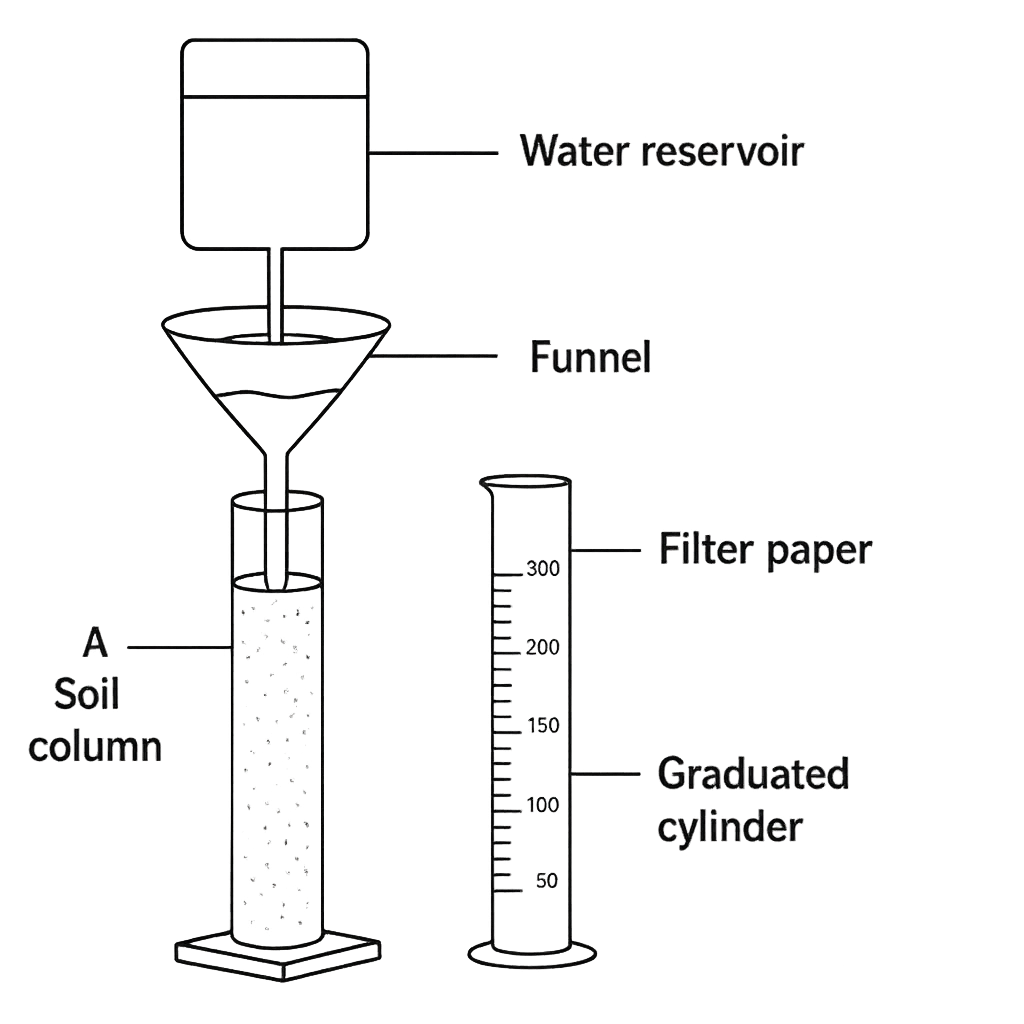
A soil moisture determination experiment is set up as described in the illustration.
Question Parts
(a)
Identify the purpose of each component shown in the setup (soil column, funnel, graduated cylinder, filter paper).
(b)
After saturating the soil column, 250 mL of water is added. When drainage stops, 180 mL of water has been collected in the graduated cylinder. The soil column volume is 500 cm³. Calculate the field capacity of the soil as a percentage by volume.
(c)
Discuss two possible sources of error in this method and suggest one way to minimise each error.
Detailed Essay Solution & Marking Scheme Available

Get the step-by-step mathematical proofs, key points required by examiners, and a comprehensive breakdown from our AI Tutor.
Question 3 View Details
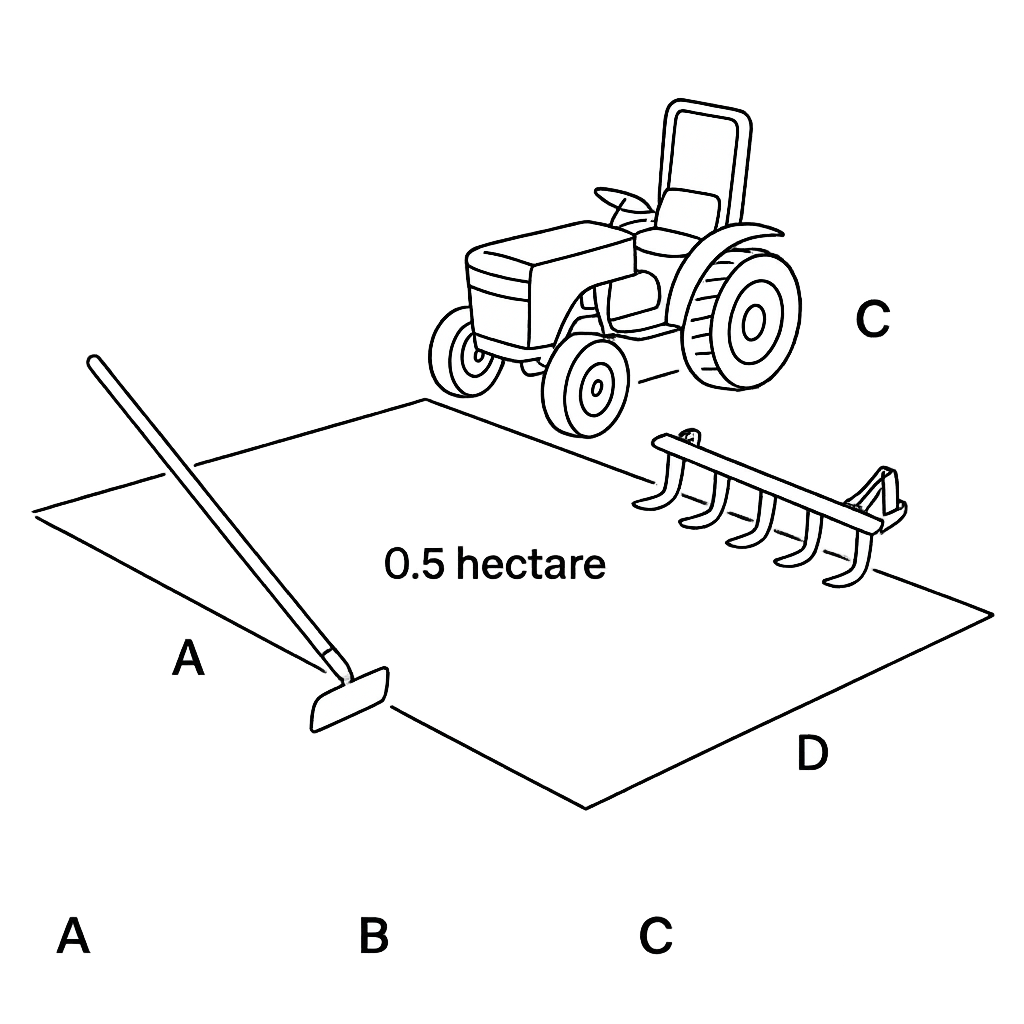
A practical demonstration was carried out to compare the performance of a hand hoe and a mechanical hoe attachment fitted on a small tractor. The set‑up used a rectangular plot of land measuring 0.5 ha. The following observations were recorded:
Question Parts
(a)
Identify and name the four main components shown in the illustration of the set‑up.
(b)
Explain the principle of operation of the mechanical hoe attachment and how it differs from the hand hoe in terms of labour input.
(c)
Using the data recorded, calculate:
() The labour time saved per hectare when the mechanical hoe is used instead of the hand hoe.
() The fuel consumption (in litres) required to till one hectare with the mechanical hoe.
() The monetary cost of fuel for tilling one hectare with the mechanical hoe.
(d)
Based on the calculations and explanations above, recommend which tool is more suitable for a smallholder farmer who cultivates 1–2 ha per season. Justify your recommendation with at least two reasons.
Detailed Essay Solution & Marking Scheme Available

Get the step-by-step mathematical proofs, key points required by examiners, and a comprehensive breakdown from our AI Tutor.

Question 4 View Details
A smallholder farmer is considering the acquisition of a combine harvester for harvesting maize. The model under review has the following specifications:
Question Parts
(a)
List and briefly describe the four major functional components of a combine harvester.
(b)
The engine power rating is 150 kW. The farmer estimates that the combine will operate at an average field speed of 5 km h⁻¹ and a harvesting width of 3.5 m. Assuming a constant power‑speed‑width relationship, estimate the theoretical maximum area (in hectares) that can be harvested in an 8‑hour working day.
(c)
Discuss two major maintenance practices that are essential for sustaining the performance of a combine harvester in a tropical environment.
(d)
If the farmer can purchase the combine on a 5‑year straight‑line depreciation schedule and expects a resale value of ₦250 000 after 5 years, calculate the annual depreciation expense. The purchase price is ₦1 500 000.
Detailed Essay Solution & Marking Scheme Available

Get the step-by-step mathematical proofs, key points required by examiners, and a comprehensive breakdown from our AI Tutor.

Question 5 View Details
A farmer in the savanna zone intends to grow maize on a 2.5 ha field. The farmer plans to use a seed rate of 25 kg ha⁻¹, adopt a row spacing of 0.75 m and an intra‑row spacing of 0.25 m. The target yield is 5.5 t ha⁻¹. The recommended nitrogen (N) fertilizer recommendation is 20 kg N per tonne of maize grain expected.
Question Parts
(a)
Calculate the total quantity of seed required for the whole field and the plant population per hectare (plants m⁻²) based on the given row and intra‑row spacings.
(b)
Determine the total amount of nitrogen fertilizer needed for the whole field to achieve the target yield.
(c)
Discuss two agronomic practices, other than fertilizer application, that the farmer could adopt to improve maize yield under the given conditions. Explain briefly how each practice contributes to higher yield.
Detailed Essay Solution & Marking Scheme Available

Get the step-by-step mathematical proofs, key points required by examiners, and a comprehensive breakdown from our AI Tutor.

Question 6 View Details
A dairy farmer keeps a herd of 20 lactating cows. Each cow produces on average 22 L of milk per day. The cows are fed a total mixed ration (TMR) containing 12 % crude protein (CP) and 2.8 Mcal of metabolizable energy (ME) per kilogram. The maintenance requirement for a cow is 0.045 Mcal ME and 3 g CP per kilogram body weight per day. The average cow weight is 450 kg. The farmer wants each cow to receive an additional 0.5 Mcal ME and 1 g CP per kilogram of milk produced to support lactation.
Question Parts
(a)
Calculate the daily ME and CP requirement per cow for maintenance and for lactation (including the extra requirements for milk production).
Detailed Essay Solution & Marking Scheme Available

Get the step-by-step mathematical proofs, key points required by examiners, and a comprehensive breakdown from our AI Tutor.

Question 7 View Details
A farmer in the savanna zone cultivates maize on a 2.5 ha field. The major pest observed is the stem borer (Busseola fusca). Each infested plant yields on average 0.4 kg less grain than a healthy plant, whose average yield is 0.5 kg per plant. The field contains approximately 80 000 plants per hectare.
Question Parts
(a)
If 12 % of the plants are infested, estimate the total loss in kilograms of grain due to the stem borer.
(b)
The farmer intends to apply a synthetic insecticide that must be mixed at a rate of 0.75 L of concentrate per hectare and then diluted to a total spray volume of 200 L per hectare. The concentrate contains 250 g of active ingredient per litre. Calculate the total amount (in grams) of active ingredient that will be applied to the whole 2.5 ha field.
(c)
Discuss three cultural or biological control methods that could be incorporated into an integrated pest‑management (IPM) programme for stem borer, and explain how each method reduces the pest population.
(d)
Explain two mechanisms by which insects develop resistance to insecticides and suggest one management practice that can delay the onset of resistance in stem borer populations.
Detailed Essay Solution & Marking Scheme Available

Get the step-by-step mathematical proofs, key points required by examiners, and a comprehensive breakdown from our AI Tutor.

Question 8 View Details
A cocoa farmer observes a leaf‑spot disease caused by Phytophthora megakarya. From the lower canopy a random sample of 200 leaves was taken and the severity of each infected leaf was rated on a scale of 1 (mild) to 5 (severe). The recorded data are: 80 leaves with rating 1, 50 leaves with rating 2, 30 leaves with rating 3, 20 leaves with rating 4 and 10 leaves with rating 5.
Question Parts
(a)
Calculate the disease incidence (percentage of leaves infected) in the sample.
(b)
Compute the disease severity index (DSI) using the formula DSI = (Σ (rating × number of leaves)) / (maximum rating × total number of leaves) × 100. Provide the DSI value.
(c)
Based on the DSI obtained, recommend an appropriate chemical control measure, specifying the active ingredient, its mode of action, and the optimal timing of application. Justify your recommendation.
(d)
Outline two cultural practices that can reduce the occurrence of Phytophthora leaf‑spot in cocoa, and explain the principle behind each practice.
Detailed Essay Solution & Marking Scheme Available

Get the step-by-step mathematical proofs, key points required by examiners, and a comprehensive breakdown from our AI Tutor.

Master the Exam!

You've seen a preview, but there are thousands more questions plus AI tutor to break down complex solutions.

Unlock Full Access Available for Android & Windows
Help others prepare! Share this practice hub:
Chat with Support