waec model questions vol1 2023 physics | Essay

Are you preparing for waec model questions vol1 exams? Reviewing past questions is one of the most effective ways to guarantee a high score. This practice hub features authentic 2023 physics (Essay) questions designed to simulate the real exam environment.

Practice these randomly selected questions to test your readiness.
Question 1 View Details
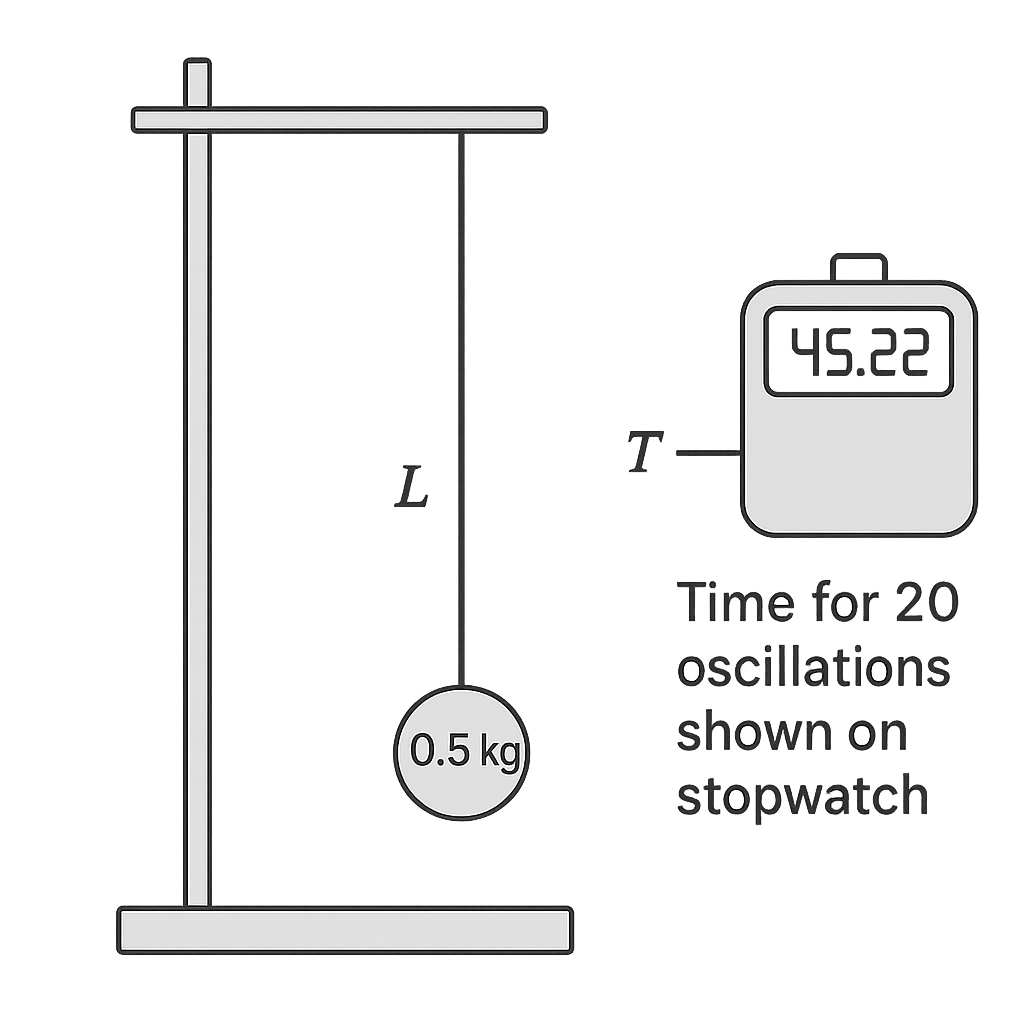
A student sets up a simple pendulum to determine the acceleration due to gravity. The length of the string is measured with a metre rule and recorded as 0.95 m. The student uses a digital stopwatch to time 20 complete oscillations and obtains a total time of 40.2 s. The bob has a mass of 0.50 kg and the amplitude of swing is kept small (≈5°).
Question Parts
(a)
Calculate the period of one oscillation of the pendulum.
(b)
Using the period obtained in part (a), calculate the value of the acceleration due to gravity g. (Take g = 4π²L / T²).
(c)
Identify two possible sources of systematic error in this experiment and explain qualitatively how each would affect the calculated value of g.
Detailed Essay Solution & Marking Scheme Available

Get the step-by-step mathematical proofs, key points required by examiners, and a comprehensive breakdown from our AI Tutor.
Question 2 View Details
A ball is projected from point O with an initial speed of 20.0 m s⁻¹ at an angle θ above the horizontal. The landing platform is 5.0 m higher than the launch point.
Question Parts
(a)
Derive the equation that θ must satisfy for the ball to land on the platform. Show that the equation reduces to a quadratic in tan θ.
(b)
Solve the quadratic obtained in part (a) to find the smaller feasible launch angle (θ). Then calculate the corresponding time of flight and horizontal distance traveled.
(c)
Draw a labelled vector diagram of the initial velocity showing its horizontal and vertical components. Briefly explain how each component influences the subsequent motion of the ball.
Detailed Essay Solution & Marking Scheme Available

Get the step-by-step mathematical proofs, key points required by examiners, and a comprehensive breakdown from our AI Tutor.

Question 3 View Details
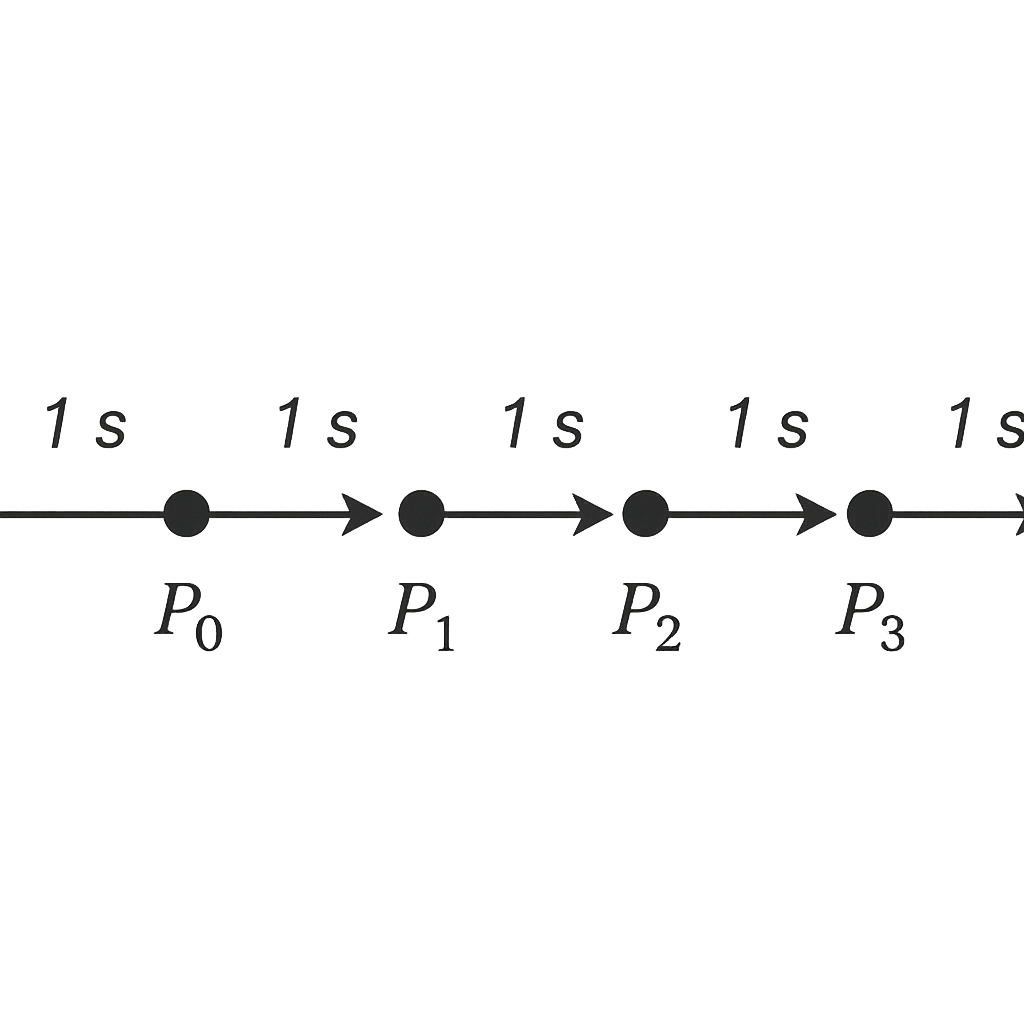
The diagram shows the motion of a car moving in a straight line to the right. The time interval between successive positions is 1 s. The displacement of the car between successive positions is as follows: from P0 to P1 = 2 m, P1 to P2 = 4 m, P2 to P3 = 6 m, P3 to P4 = 8 m.
Question Parts
(a)
Determine the magnitude of the car's constant acceleration.
(b)
State the speed of the car at the instant t = 4 s.
(c)
If the car continues with the same acceleration, calculate the distance it will travel during the next 3 s (from t = 4 s to t = 7 s).
(d)
At t = 4 s the driver sees a red traffic light 150 m ahead. The maximum deceleration the car can achieve is 5 m s⁻². Will the car be able to stop before the light? Show your reasoning.
Detailed Essay Solution & Marking Scheme Available

Get the step-by-step mathematical proofs, key points required by examiners, and a comprehensive breakdown from our AI Tutor.

Question 4 View Details
A 5.0 kg block rests on a smooth inclined plane that makes an angle of 25° with the horizontal. The block is attached to a light string which passes over a frictionless pulley and is connected to a 2.0 kg hanging mass.
Question Parts
(a)
Calculate the acceleration of the system.
(b)
Find the tension in the string.
Detailed Essay Solution & Marking Scheme Available

Get the step-by-step mathematical proofs, key points required by examiners, and a comprehensive breakdown from our AI Tutor.

Question 5 View Details
A 5.0 kg block is released from rest at the top of a smooth inclined plane that makes an angle of 30° with the horizontal and is 8.0 m long. At the bottom of the incline the block reaches a horizontal rough surface whose coefficient of kinetic friction is 0.20. The block continues to move on the rough surface and comes to rest after travelling 2.0 m. A constant horizontal force is applied opposite to the direction of motion during this 2.0‑m travel. (a) Calculate the work done by gravity while the block descends the incline. (b) Calculate the work done by the frictional force on the rough surface. (c) Determine the magnitude of the constant horizontal force required to bring the block to rest exactly after the 2.0 m travel. (d) Find the average power delivered by this horizontal force during the motion on the rough surface.
Question Parts
(a)
Calculate the work done by gravity while the block descends the incline.
(b)
Calculate the work done by the frictional force on the rough surface.
(c)
Determine the magnitude of the constant horizontal force required to bring the block to rest exactly after the 2.0 m travel.
(d)
Find the average power delivered by this horizontal force during the motion on the rough surface.
Detailed Essay Solution & Marking Scheme Available

Get the step-by-step mathematical proofs, key points required by examiners, and a comprehensive breakdown from our AI Tutor.

Question 6 View Details
The diagram shows a compound simple machine used to lift a load. A fixed ceiling pulley (P1) is attached to the ceiling. A rope passes over P1, descends to a movable pulley (P2) which carries a load of weight 200 N, and then ascends to a lever AB. The lever is hinged at point O. The short arm OA (0.1 m) is attached to the rope, while the long effort arm OH (0.5 m) is where a hand applies an upward force F at point H. The rope and pulleys are assumed mass‑less and the pulleys are frictionless unless otherwise stated.
Question Parts
(a)
Determine the ideal mechanical advantage of the whole system, taking into account both the pulley arrangement and the lever.
(b)
Calculate the magnitude of the input force that must be applied at H to raise the 200 N load at constant speed, assuming the rope and both pulleys are ideal (frictionless and mass‑less).
(c)
If the fixed pulley (P1) operates with an efficiency of 85 % because of bearing friction, while the movable pulley remains ideal, compute the actual input force required at H.
(d)
The operator moves the handle H vertically upward with a speed of 0.30 m s⁻¹. Determine the power output of the system (in watts) under the conditions of part (c). State any assumptions you make.
Detailed Essay Solution & Marking Scheme Available

Get the step-by-step mathematical proofs, key points required by examiners, and a comprehensive breakdown from our AI Tutor.

Question 7 View Details
A cylindrical tank of height 12.0 m and radius 3.0 m is open at the top and filled with water. A small hole of negligible area is opened at a point P located 4.0 m below the water surface. Water streams out horizontally from the hole and lands on the ground at a horizontal distance d from the base of the tank.
Question Parts
(a)
Determine the speed of water as it exits the hole using Torricelli’s theorem.
(b)
Calculate the horizontal distance d the water jet travels before striking the ground.
(c)
If the tank were filled with oil of density 800 kg·m⁻³ and the same hole is at the same depth, what would be the new horizontal distance? State any assumptions you make.
(d)
Discuss two practical reasons why the actual distance measured in an experiment might be less than the theoretical value obtained in part (b).
Detailed Essay Solution & Marking Scheme Available

Get the step-by-step mathematical proofs, key points required by examiners, and a comprehensive breakdown from our AI Tutor.

Question 8 View Details
A 0.5 kg block of copper (specific heat capacity c₍Cu₎ = 385 J·kg⁻¹·K⁻¹) at 150 °C is placed into a well‑insulated calorimeter containing 1.2 kg of water (c₍w₎ = 4186 J·kg⁻¹·K⁻¹) initially at 25 °C. After thermal equilibrium is reached, the temperature of the combined system is recorded as 30 °C.
Question Parts
(a)
Using the principle of conservation of energy, verify whether the measured final temperature of 30 °C is consistent with the data given.
(b)
Assuming no heat loss to the surroundings, calculate the theoretical final temperature of the system.
(c)
Determine the percentage of the copper block’s initial thermal energy (relative to 0 °C) that is transferred to the water when the final temperature is the measured 30 °C.
(d)
If the calorimeter itself has a heat capacity of 150 J·K⁻¹, recompute the expected final temperature taking the calorimeter into account.
(e)
Discuss two possible sources of experimental error that could cause the observed temperature to be lower than the theoretical value obtained in part (b).
Detailed Essay Solution & Marking Scheme Available

Get the step-by-step mathematical proofs, key points required by examiners, and a comprehensive breakdown from our AI Tutor.

Master the Exam!

You've seen a preview, but there are thousands more questions plus AI tutor to break down complex solutions.

Unlock Full Access Available for Android & Windows
Help others prepare! Share this practice hub:
Chat with Support