waec model questions vol1 2023 mathematics | Essay

Prepare for your exams with waec model questions vol1 questions? Reviewing past/model questions is one of the most effective ways to guarantee a high score. This practice hub features authentic 2023 mathematics (Essay) questions designed to simulate the real exam environment.

Practice these randomly selected questions to test your readiness.

Question 1 View Details
A farmer has a rectangular plot of land. The length of the plot is 120 meters, and the width is 80 meters. The farmer wants to plant crops in a rectangular area that is 10 meters away from each side of the plot. (a) Calculate the area of the rectangular plot that will be used for planting crops. (b) If the farmer plants 200 seedlings per square meter, determine the total number of seedlings that can be planted in the crop area. (c) If each seedling costs ₦15, calculate the total cost of purchasing all the seedlings needed for the crop area.
Question Parts
(a)
Calculate the area of the rectangular plot that will be used for planting crops.
(b)
If the farmer plants 200 seedlings per square meter, determine the total number of seedlings that can be planted in the crop area.
(c)
If each seedling costs ₦15, calculate the total cost of purchasing all the seedlings needed for the crop area.
Detailed Essay Solution & Marking Scheme Available

Get the step-by-step mathematical proofs, key points required by examiners, and a comprehensive breakdown from our AI Tutor.
Question 2 View Details
A merchant bought 150 bags of rice at ₦12,000 each. He sold 70 bags at ₦15,000 each and the remaining bags at ₦14,000 each. (a) Calculate the total cost of the rice. (b) Determine the total revenue from selling all the bags of rice. (c) Calculate the profit made from the sales.
Question Parts
(a)
Calculate the total cost of the rice.
(b)
Determine the total revenue from selling all the bags of rice.
(c)
Calculate the profit made from the sales.
Detailed Essay Solution & Marking Scheme Available

Get the step-by-step mathematical proofs, key points required by examiners, and a comprehensive breakdown from our AI Tutor.
Question 3 View Details
Consider the expression involving indices and logarithms. Simplify the following expression and state any restrictions on the variables involved: 2^(3x) * 4^(x-1) / 8^(x+2). Then, if log_a(b) = c, express b in terms of a and c. Lastly, evaluate log_2(16) + log_2(4).
Question Parts
(a)
Simplify the expression 2^(3x) * 4^(x-1) / 8^(x+2) and state any restrictions on the variables involved.
(b)
If log_a(b) = c, express b in terms of a and c.
(c)
Evaluate log_2(16) + log_2(4).
Detailed Essay Solution & Marking Scheme Available

Get the step-by-step mathematical proofs, key points required by examiners, and a comprehensive breakdown from our AI Tutor.
Question 4 View Details
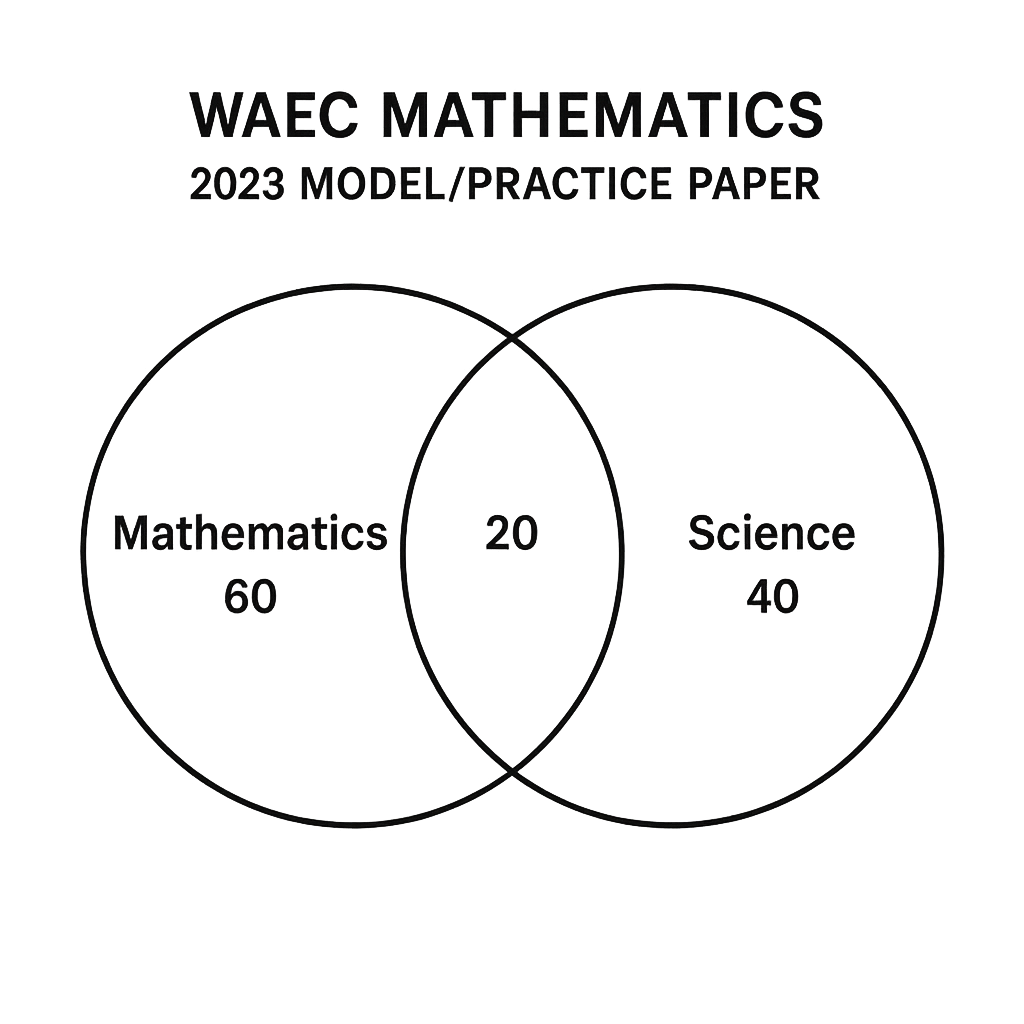
A survey was conducted among students to find out their preferred subjects. The results are represented in a Venn diagram. Given that 60 students prefer Mathematics, 40 prefer Science, and 20 students prefer both subjects, answer the following questions: (a) How many students prefer only Mathematics? (b) How many students prefer only Science? (c) If there are 100 students surveyed, how many students do not prefer either subject? (d) Represent the data in a Venn diagram.
Question Parts
(a)
Calculate the number of students who prefer only Mathematics.
(b)
Calculate the number of students who prefer only Science.
(c)
Determine how many students do not prefer either subject.
(d)
Draw a Venn diagram to represent the data.
Detailed Essay Solution & Marking Scheme Available

Get the step-by-step mathematical proofs, key points required by examiners, and a comprehensive breakdown from our AI Tutor.
Question 5 View Details
A factory produces two types of products, A and B. The production of product A requires 3 hours of labor and 2 kg of raw materials, while product B requires 2 hours of labor and 3 kg of raw materials. The factory has a total of 60 hours of labor and 90 kg of raw materials available per week. The profit from each product A is ₦50 and from each product B is ₦40. (a) Formulate a system of inequalities to represent the constraints of this production problem. (b) Determine the maximum number of products A and B that can be produced without exceeding the available resources. (c) Calculate the maximum profit that can be achieved based on your findings in part (b).
Question Parts
(a)
Formulate a system of inequalities to represent the constraints of this production problem.
(b)
Determine the maximum number of products A and B that can be produced without exceeding the available resources.
(c)
Calculate the maximum profit that can be achieved based on your findings in part (b).
Detailed Essay Solution & Marking Scheme Available

Get the step-by-step mathematical proofs, key points required by examiners, and a comprehensive breakdown from our AI Tutor.
Question 6 View Details
A school is organizing a trip for its students. The total cost of the trip includes a fixed cost of ₦2000 for transportation and an additional ₦50 per student. If the school plans to take 30 students, calculate the total cost of the trip. Then, if the school decides to increase the number of students to 50, determine the new total cost and the difference in cost between the two scenarios.
Question Parts
(a)
Calculate the total cost of the trip for 30 students.
(b)
Determine the new total cost if the number of students increases to 50 and calculate the difference in cost.
Detailed Essay Solution & Marking Scheme Available

Get the step-by-step mathematical proofs, key points required by examiners, and a comprehensive breakdown from our AI Tutor.

Question 7 View Details
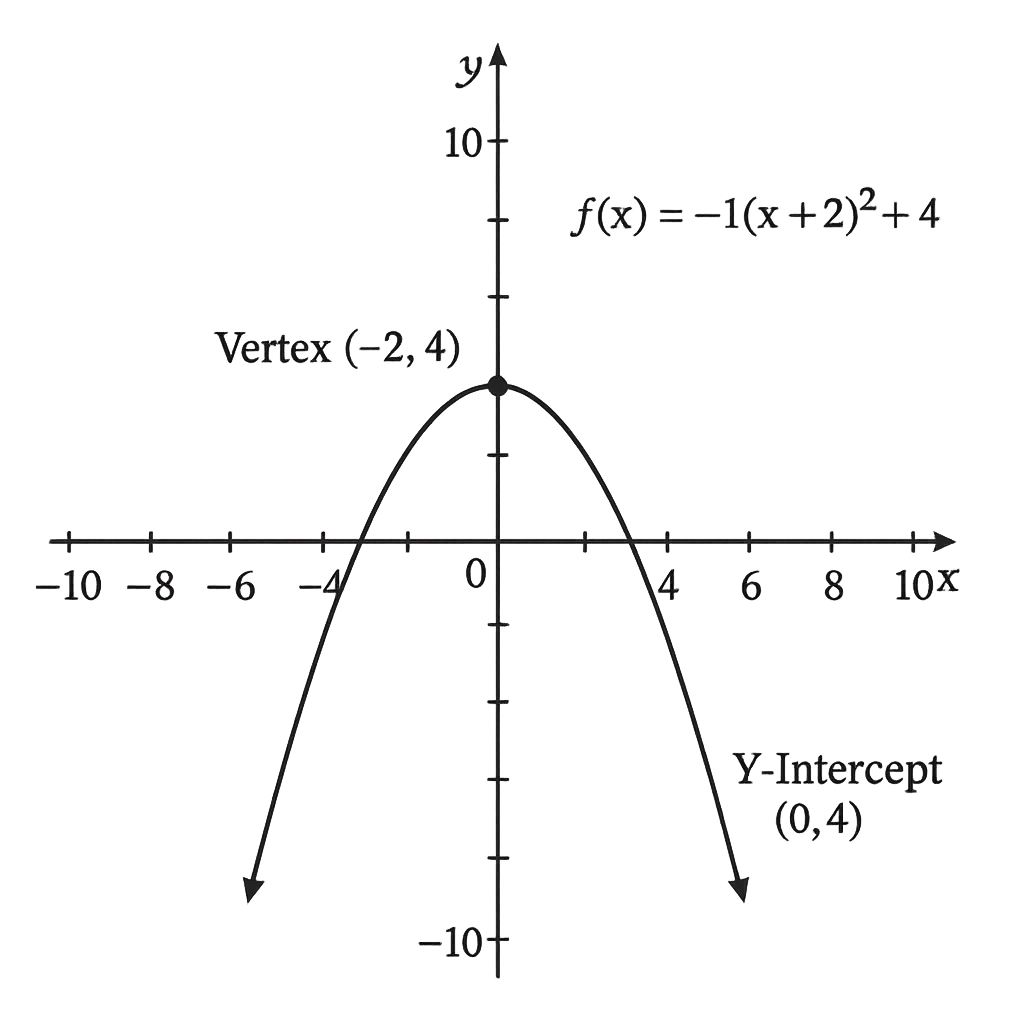
A quadratic function is defined by the equation f(x) = ax² + bx + c, where a, b, and c are constants. Given that the function has a maximum point at x = -2 and passes through the point (0, 4), determine the values of a, b, and c. Also, find the vertex of the quadratic function and sketch the graph of the function.
Question Parts
(a)
Using the information provided, derive the values of a, b, and c.
(b)
Determine the vertex of the quadratic function.
(c)
Sketch the graph of the quadratic function, indicating the vertex and the y-intercept.
Detailed Essay Solution & Marking Scheme Available

Get the step-by-step mathematical proofs, key points required by examiners, and a comprehensive breakdown from our AI Tutor.

Question 8 View Details
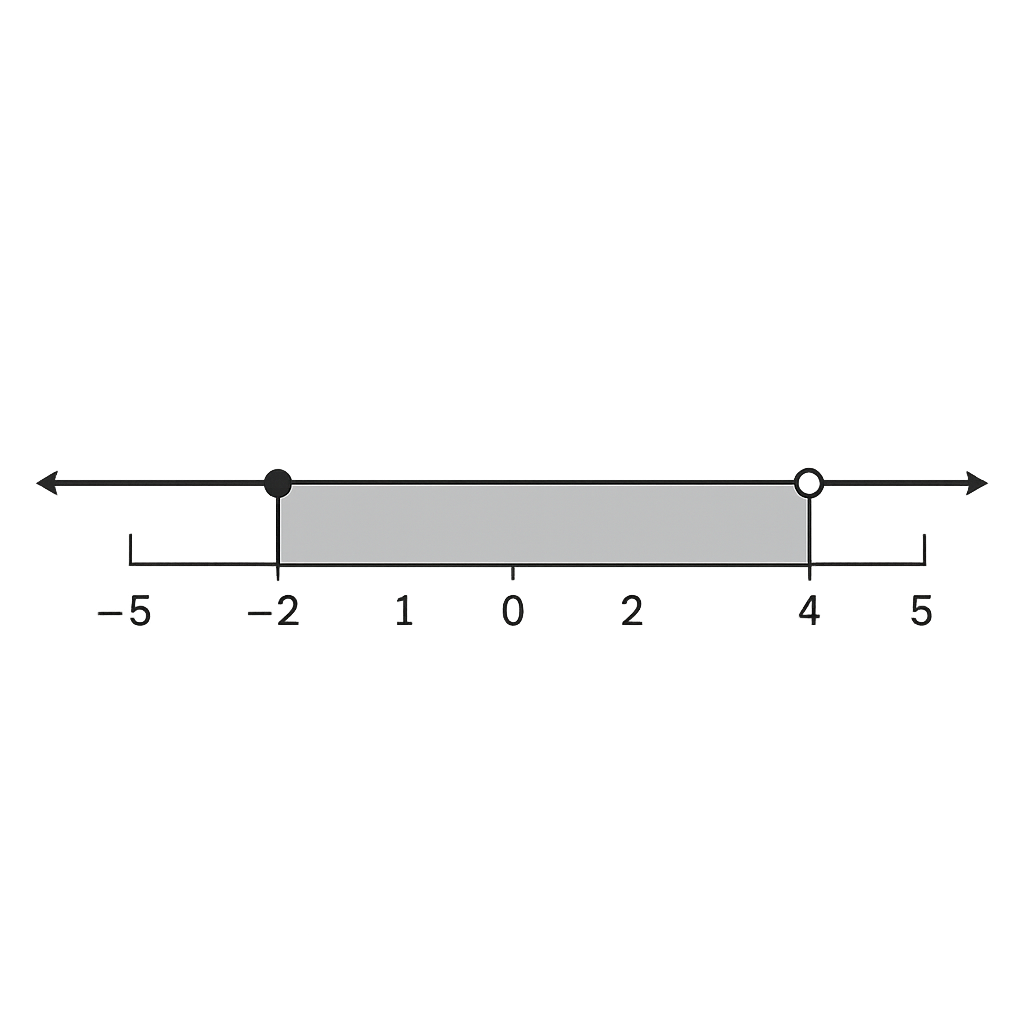
Solve the following inequalities and represent the solution on a number line: (i) 3x - 5 < 7, (ii) 2 - x ≤ 4.
Question Parts
(a)
Solve the inequality 3x - 5 < 7.
(b)
Solve the inequality 2 - x ≤ 4.
(c)
Represent the solutions of both inequalities on a number line.
Detailed Essay Solution & Marking Scheme Available

Get the step-by-step mathematical proofs, key points required by examiners, and a comprehensive breakdown from our AI Tutor.

Question 9 View Details
Consider the arithmetic series defined by the first term a = 5 and a common difference d = 3. The series continues until the nth term, which is less than or equal to 50. Calculate the following:
Question Parts
(a)
Determine the value of n, the number of terms in the series.
(b)
Calculate the sum of the series up to the nth term.
(c)
If the series were to continue with a common difference of 5 instead of 3, determine the new sum of the series up to the same nth term calculated in part (a).
Detailed Essay Solution & Marking Scheme Available

Get the step-by-step mathematical proofs, key points required by examiners, and a comprehensive breakdown from our AI Tutor.

Question 10 View Details
A population of a certain species of fish in a lake is known to vary directly with the area of the lake. If a lake of 200 hectares supports a population of 800 fish, calculate the expected population in a lake of 350 hectares. Additionally, if the population is to be increased by 20% for conservation purposes, determine the new expected population after the increase.
Question Parts
(a)
Determine the constant of variation based on the information given.
(b)
Using the constant from part (a), calculate the expected fish population in a 350-hectare lake.
(c)
Calculate the new expected population after a 20% increase.
Detailed Essay Solution & Marking Scheme Available

Get the step-by-step mathematical proofs, key points required by examiners, and a comprehensive breakdown from our AI Tutor.

Question 11 View Details
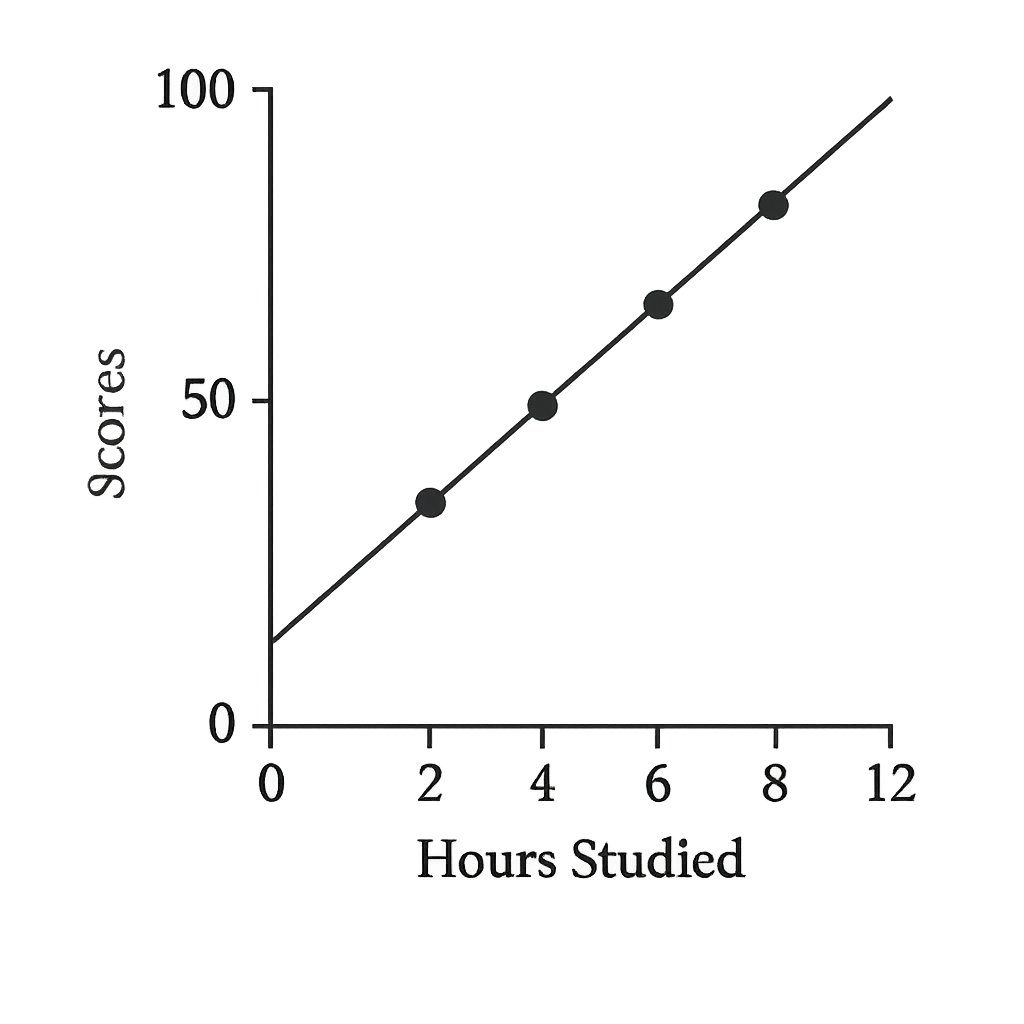
The graph below represents the relationship between the number of hours a student studies and the scores obtained in an examination. Analyze the graph and answer the following questions.
Question Parts
(a)
Identify the coordinates of the point where the student scored 70 marks.
(b)
Determine the slope of the line representing the relationship between hours studied and scores obtained. Explain what this slope indicates about the relationship.
(c)
If the trend continues, predict the score a student would achieve after studying for 10 hours. Show your working.
Detailed Essay Solution & Marking Scheme Available

Get the step-by-step mathematical proofs, key points required by examiners, and a comprehensive breakdown from our AI Tutor.

Question 12 View Details
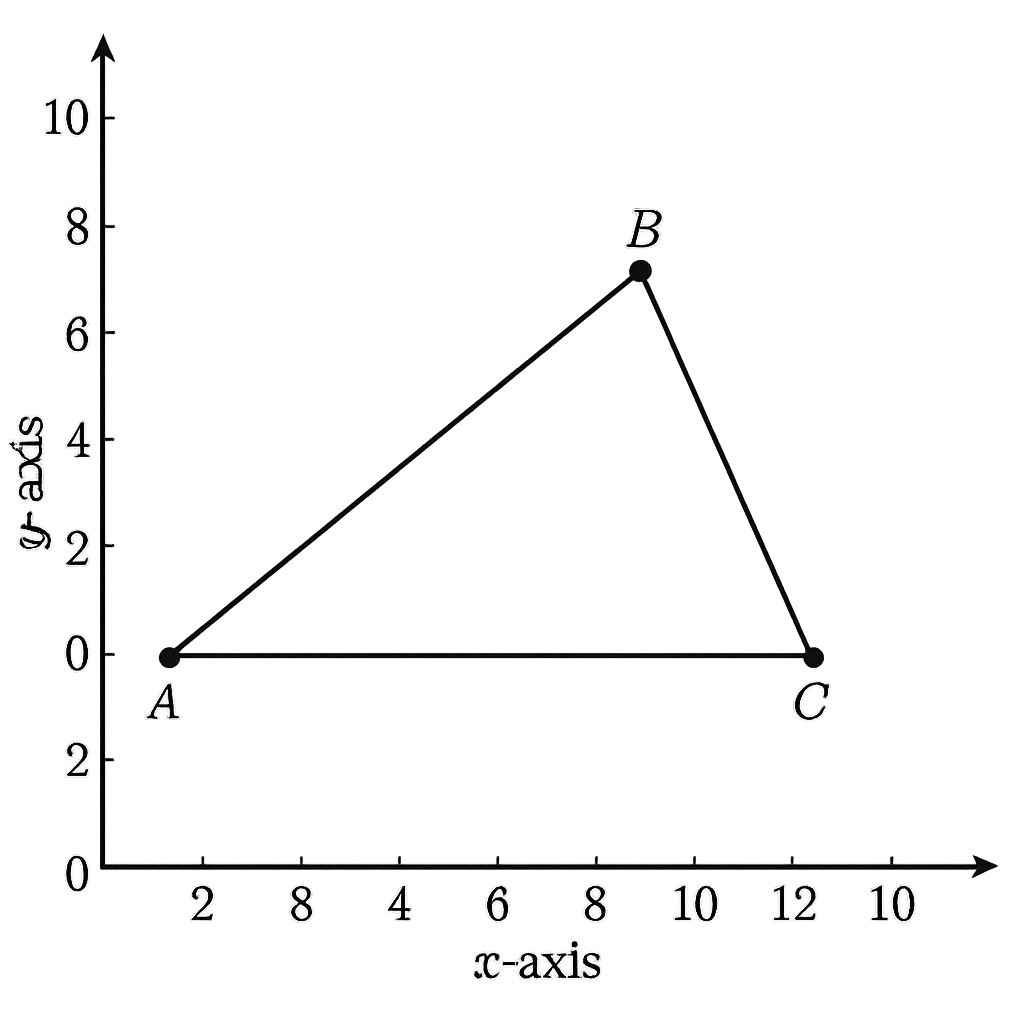
A triangle has vertices A(2, 3), B(5, 7), and C(8, 3). Analyze the triangle and answer the following questions.
Question Parts
(a)
Calculate the lengths of sides AB, BC, and AC.
(b)
Determine the area of triangle ABC using the coordinates of its vertices.
(c)
Find the coordinates of the centroid of triangle ABC.
Detailed Essay Solution & Marking Scheme Available

Get the step-by-step mathematical proofs, key points required by examiners, and a comprehensive breakdown from our AI Tutor.

Question 13 View Details
A rectangular park has a length that is three times its width. The park is to be surrounded by a path of uniform width. If the total area of the park and the path is 6000 square meters, determine the dimensions of the park and the width of the path.
Question Parts
(a)
Let the width of the park be x meters. Express the length of the park in terms of x and write an equation for the total area of the park.
(b)
Solve the equation from part (a) to find the width of the park.
(c)
Given that the path around the park has a width of y meters, write an expression for the total area of the park including the path, and derive an equation to find y.
(d)
Solve the equation from part (c) to find the width of the path.
Detailed Essay Solution & Marking Scheme Available

Get the step-by-step mathematical proofs, key points required by examiners, and a comprehensive breakdown from our AI Tutor.

Master the Exam!

You've seen a preview, but there are thousands more questions plus AI tutor to break down complex solutions.

Unlock Full Access Available for Android & Windows
Help others prepare! Share this practice hub:
Chat with Support