waec model questions vol1 2023 chemistry | Objective

Are you preparing for waec model questions vol1 exams? Reviewing past questions is one of the most effective ways to guarantee a high score. This practice hub features authentic 2023 chemistry (Objective) questions designed to simulate the real exam environment.

Practice these randomly selected questions to test your readiness.

Question 1 View Details
10.0 g of styrene (C₈H₈) is brominated in aqueous solution to give 1‑bromo‑2‑phenylethanol as the major product. The bromohydrin is then dehydrated with concentrated H₂SO₄ to afford trans‑1‑bromo‑1‑phenylethene (C₈H₇Br). If the overall isolated yield of the final alkene is 65 % based on the initial styrene, calculate the mass of trans‑1‑bromo‑1‑phenylethene obtained.
A. 10.2 g
Correct B. 11.4 g
C. 9.5 g
D. 12.6 g

Correct Answer: B

Want to see the full step-by-step solution? Unlock AI Explanation & Analytics
Question 2 View Details
A 25.0 mL sample of 0.200 M potassium permanganate solution is added to excess oxalic acid in acidic medium. The MnO₄⁻ ions are reduced to Mn²⁺. Determine the volume of CO₂ gas produced at STP.
Correct A. 0.560 L
B. 0.500 L
C. 0.630 L
D. 0.450 L

Correct Answer: A

Want to see the full step-by-step solution? Unlock AI Explanation & Analytics
Question 3 View Details
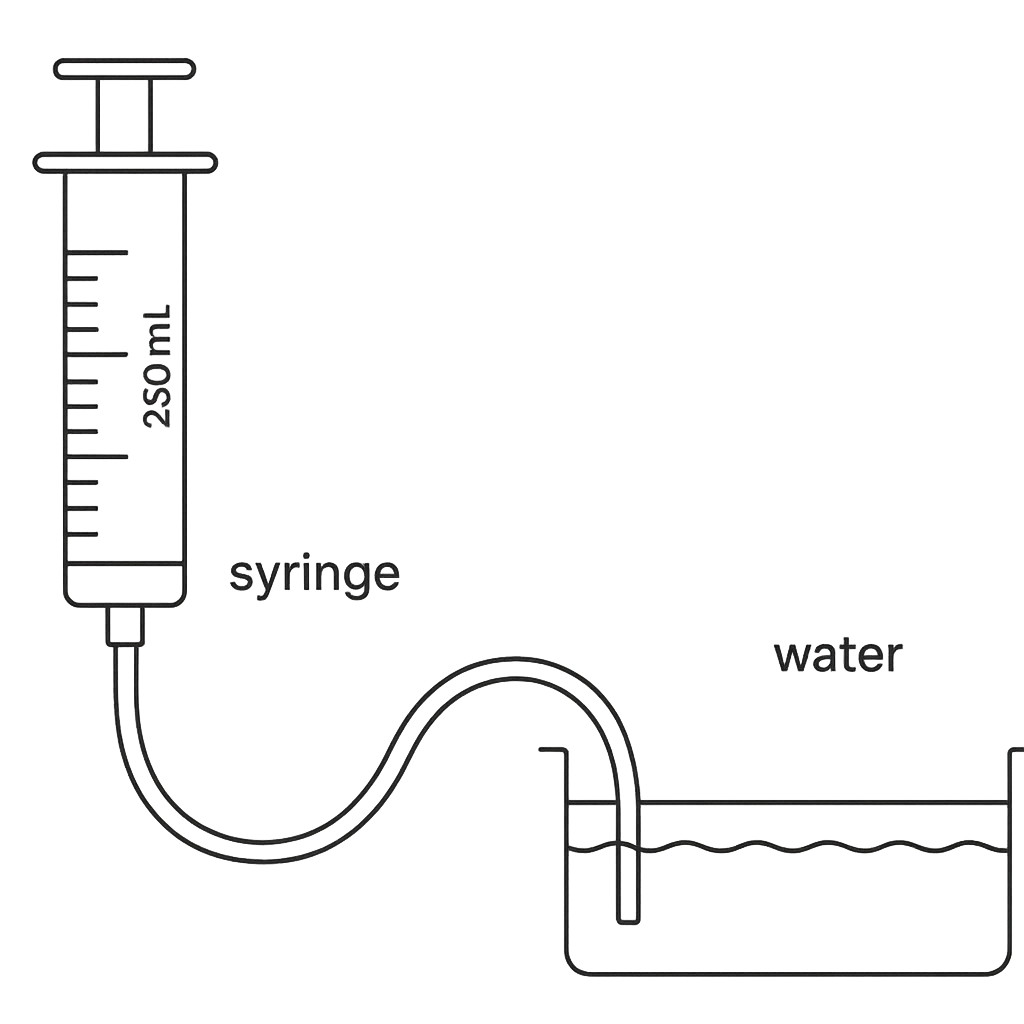
A gas syringe of 250 mL capacity is used to collect hydrogen gas over water at 25 °C. The total pressure inside the syringe is 760 mmHg and the vapour pressure of water at this temperature is 23.8 mmHg. Calculate the amount (in moles) of hydrogen gas collected.
A. 1.0×10⁻³ mol
Correct B. 9.9×10⁻³ mol
C. 8.3×10⁻³ mol
D. 1.2×10⁻² mol

Correct Answer: B

Want to see the full step-by-step solution? Unlock AI Explanation & Analytics
Question 4 View Details
A concentration cell is constructed with two Fe²⁺/Fe electrodes. The left half‑cell contains 0.010 M FeSO₄ and the right half‑cell contains 0.10 M FeSO₄. The temperature is 298 K. Calculate the electromotive force (EMF) of the cell.
A. 0.040 V
Correct B. 0.030 V
C. 0.025 V
D. 0.015 V

Correct Answer: B

Want to see the full step-by-step solution? Unlock AI Explanation & Analytics
Question 5 View Details
A 7.00 g sample of an unknown hydrocarbon is burnt completely in excess O₂. The combustion produces 22.0 g of CO₂ and 9.00 g of H₂O. The hydrocarbon contains only carbon and hydrogen and is known to be an alkane with a molar mass less than 100 g·mol⁻¹. Determine its molecular formula.
A. C₂H₆
B. C₃H₈
Correct C. C₂H₄
D. C₄H₁₀

Correct Answer: C

Want to see the full step-by-step solution? Unlock AI Explanation & Analytics
Question 6 View Details
The solubility product of silver chloride at 25 °C is 1.8 × 10⁻¹⁰. At 35 °C the Ksp increases by 20 %. In a solution that already contains 0.010 M NaCl, calculate the solubility of AgCl (in mol L⁻¹) at 35 °C.
A. 3.00×10⁻⁸ M
B. 1.80×10⁻⁸ M
C. 2.50×10⁻⁸ M
Correct D. 2.16×10⁻⁸ M

Correct Answer: D

Want to see the full step-by-step solution? Unlock AI Explanation & Analytics
Question 7 View Details
A buffer solution is prepared by dissolving 0.20 mol of acetic acid (CH₃COOH) and 0.15 mol of sodium acetate (CH₃COONa) in 1.00 L of water. The acid dissociation constant of acetic acid is Ka = 1.8 × 10⁻⁵. If 0.020 mol of HCl is added to the buffer, what is the new pH of the solution?
A. 4.72
B. 4.32
Correct C. 4.52
D. 5.02

Correct Answer: C

Want to see the full step-by-step solution? Unlock AI Explanation & Analytics
Question 8 View Details
Five‑point‑zero grams of 2‑butanol (C₄H₁₀O, M = 74.12 g mol⁻¹) is oxidised with potassium dichromate in acidic medium according to the balanced equation: 3 C₄H₁₀O + K₂Cr₂O₇ + 8 H₂SO₄ → 3 CH₃COCH₃ + Cr₂(SO₄)₃ + K₂SO₄ + 7 H₂O. If 0.080 mol of K₂Cr₂O₇ is used, calculate the theoretical mass of butan‑2‑one (CH₃COCH₃) that can be obtained.
A. 3.90 g
Correct B. 4.86 g
C. 6.12 g
D. 5.78 g

Correct Answer: B

Want to see the full step-by-step solution? Unlock AI Explanation & Analytics
Question 9 View Details
A 2.00 g sample of tetraphosphorus (P₄) is burnt in a closed vessel containing 2.0 g of oxygen gas. The combustion reaction is P₄ + 5 O₂ → P₄O₁₀. Determine the mass of phosphorus pentoxide (P₄O₁₀) formed.
Correct A. 3.55 g
B. 4.12 g
C. 5.00 g
D. 2.78 g

Correct Answer: A

Want to see the full step-by-step solution? Unlock AI Explanation & Analytics
Question 10 View Details
A galvanic cell is constructed as follows: Zn|Zn²⁺ (0.010 M)||Cu²⁺ (0.10 M)|Cu. The standard electrode potentials are E°(Zn²⁺/Zn) = -0.76 V and E°(Cu²⁺/Cu) = +0.34 V. (a) Calculate the cell EMF at 25 °C using the Nernst equation. (b) If the cell is connected to an external source that forces current in the opposite direction, which metal will be deposited at the cathode?
A. 0.58 V; Cu
B. 0.86 V; Zn
Correct C. 1.13 V; Zn
D. 1.13 V; Cu

Correct Answer: C

Want to see the full step-by-step solution? Unlock AI Explanation & Analytics
Question 11 View Details
A 0.500 g sample of polyethylene (-CH₂-)ₙ is dissolved in 100.0 g of benzene (K_f = 5.12 K·kg·mol⁻¹). The freezing point of pure benzene is 5.53 °C and the solution freezes at 5.48 °C. Assuming ideal behaviour, calculate the average degree of polymerisation (n) of the polyethylene sample. Give the nearest whole number.
Correct A. 37
B. 35
C. 41
D. 38

Correct Answer: A

Want to see the full step-by-step solution? Unlock AI Explanation & Analytics
Question 12 View Details
A 2.00 g mixture of ethanol (C₂H₅OH, M = 46.07 g mol⁻¹) and isopropanol (C₃H₇OH, M = 60.10 g mol⁻¹) reacts with excess metallic sodium. The hydrogen gas liberated is collected over water at STP and occupies 420 mL. Determine the mass percent of ethanol in the original mixture. Give your answer to one decimal place.
A. 50.0
B. 45.3
Correct C. 41.7
D. 38.9

Correct Answer: C

Want to see the full step-by-step solution? Unlock AI Explanation & Analytics
Question 13 View Details
A 2.00 g mixture of benzoic acid (C₇H₆O₂, M = 122.12 g mol⁻¹) and salicylic acid (C₇H₆O₃, M = 138.12 g mol⁻¹) is dissolved in 250 mL of 0.060 M NaOH. After complete neutralisation, the excess NaOH is back‑titrated with 0.060 M HCl, requiring 0.50 mL of the acid to reach the phenolphthalein endpoint. Calculate the mass percent of benzoic acid in the original mixture. Give your answer to one decimal place.
A. 28.3
Correct B. 25.8
C. 22.5
D. 31.0

Correct Answer: B

Want to see the full step-by-step solution? Unlock AI Explanation & Analytics
Question 14 View Details
A 5.00 g sample of an unknown compound containing only carbon, hydrogen and oxygen is combusted completely. The combustion yields 6.66 L of CO₂ and 5.32 L of H₂O measured at STP. Determine the empirical formula of the compound.
A. C5H10O2
B. C4H8O2
C. C6H10O
Correct D. C5H8O

Correct Answer: D

Want to see the full step-by-step solution? Unlock AI Explanation & Analytics
Question 15 View Details
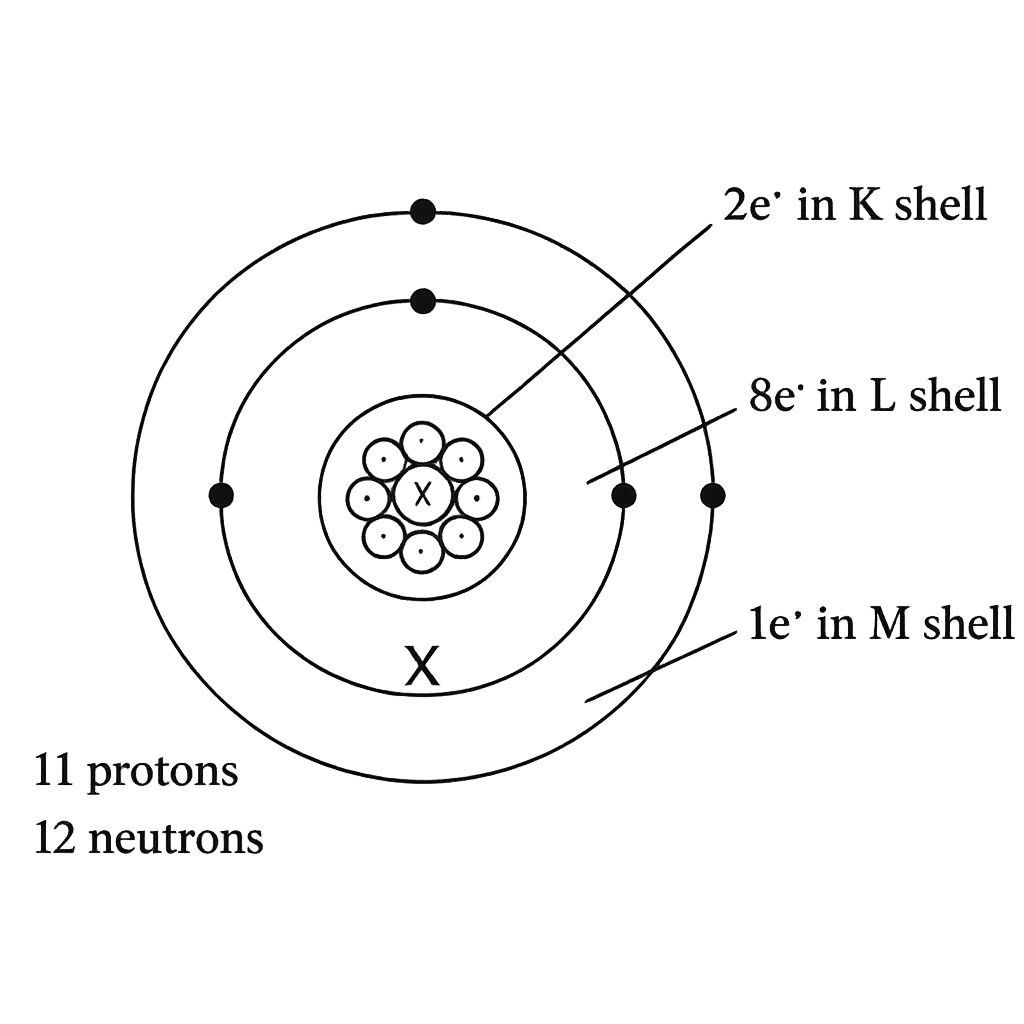
The diagram shows a neutral atom of element X. The nucleus contains 11 protons and 12 neutrons. Electrons are arranged in three shells: the first shell holds 2 electrons, the second shell holds 8 electrons, and the third shell holds 1 electron. Identify element X and write its ground‑state electron configuration.
A. Neon; 1s2 2s2 2p6
Correct B. Sodium; 1s2 2s2 2p6 3s1
C. Sodium; 1s2 2s2 2p6 3p1
D. Magnesium; 1s2 2s2 2p6 3s2

Correct Answer: B

Want to see the full step-by-step solution? Unlock AI Explanation & Analytics
Question 16 View Details
A 2.80 g sample of nitrogen gas (N₂) is passed over excess copper(II) oxide at 800 °C according to the reaction N₂ + 2 CuO → 2 NO + 2 Cu. The NO formed is then oxidised completely by oxygen: 2 NO + O₂ → 2 NO₂. The NO₂ is absorbed in 250.0 mL of water, producing nitric acid (HNO₃) and nitrous acid (HNO₂) in a 3 : 1 molar ratio. Assuming complete absorption and that HNO₃ dissociates completely while HNO₂ dissociates with Ka = 4.5 × 10⁻⁴, calculate the pH of the resulting solution. Give your answer to two decimal places.
A. 0.30
Correct B. 0.22
C. 0.18
D. 0.45

Correct Answer: B

Want to see the full step-by-step solution? Unlock AI Explanation & Analytics
Question 17 View Details
Water boils at 100 °C (373 K) under a pressure of 1.00 atm. Its enthalpy of vaporisation is 40.7 kJ mol⁻¹ and can be assumed constant over the temperature range considered. Estimate the boiling point of water at a pressure of 0.80 atm using the Clausius-Clapeyron equation. Give your answer in °C to one decimal place.
Correct A. 93.8
B. 90.5
C. 95.2
D. 92.1

Correct Answer: A

Want to see the full step-by-step solution? Unlock AI Explanation & Analytics
Question 18 View Details
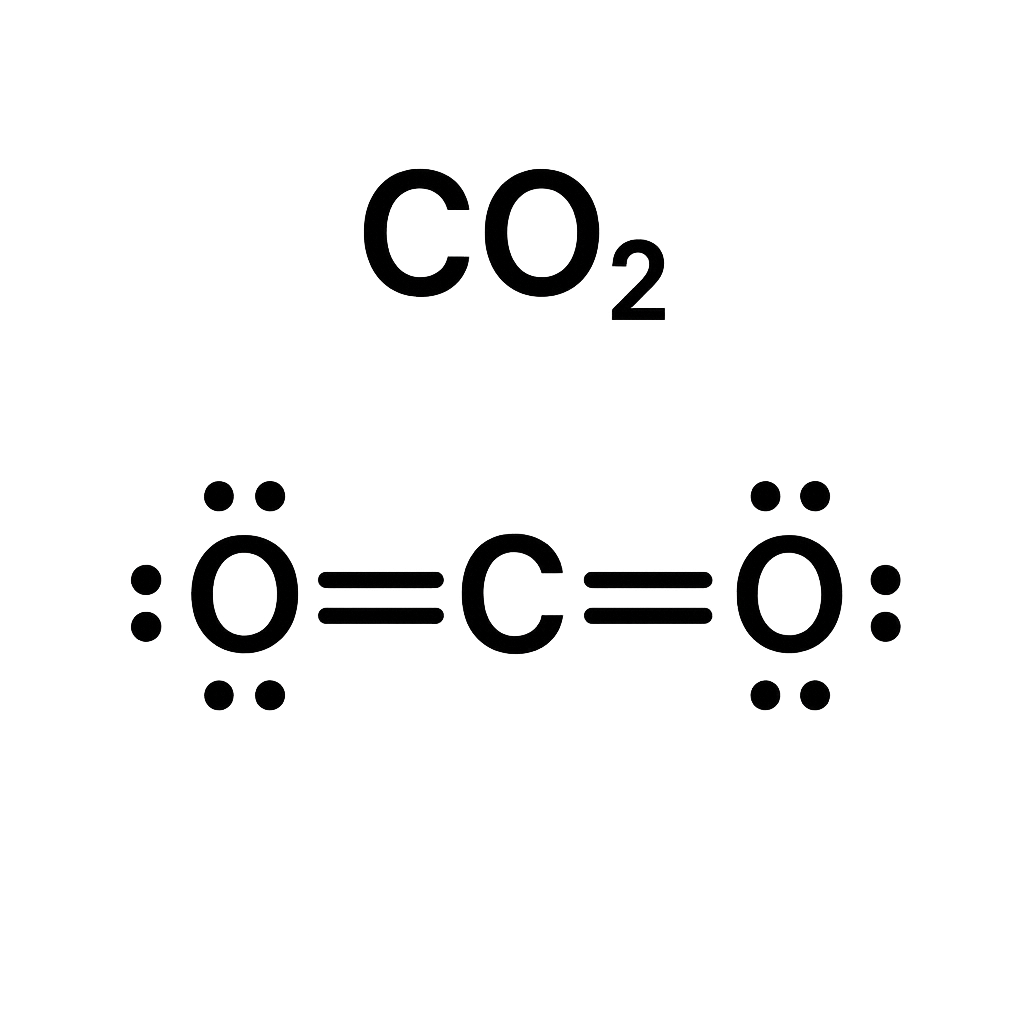
The diagram shows the Lewis structure of a molecule consisting of one carbon atom double‑bonded to two oxygen atoms. Based on this structure, state the hybridisation of the carbon atom and the molecular geometry of the molecule.
A. sp3, tetrahedral
Correct B. sp, linear
C. sp2, trigonal planar
D. sp, bent

Correct Answer: B

Want to see the full step-by-step solution? Unlock AI Explanation & Analytics
Question 19 View Details
An element has atomic number 26, electron configuration [Ar] 3d⁶ 4s², is a transition metal that commonly forms Fe²⁺ and Fe³⁺ ions and is magnetic. Identify the element.
A. Nickel (Ni)
Correct B. Iron (Fe)
C. Cobalt (Co)
D. Copper (Cu)

Correct Answer: B

Want to see the full step-by-step solution? Unlock AI Explanation & Analytics
Question 20 View Details
A polyester is formed by condensation of monomer A (C₂H₄O₂, M = 60 g mol⁻¹) and monomer B (C₃H₆O, M = 58 g mol⁻¹) in a 1:1 molar ratio, losing one molecule of water (M = 18 g mol⁻¹) per repeating unit. A sample of the polymer has a number‑average molecular weight of 1.20 × 10⁵ g mol⁻¹. (i) Determine the average degree of polymerisation (DP). (ii) If each repeating unit releases 0.5 kJ upon combustion, calculate the heat of combustion per gram of polymer. Give DP as a whole number and the heat of combustion in J g⁻¹ to the nearest whole number.
A. DP = 1300; heat of combustion = 6 J g⁻¹
B. DP = 1500; heat of combustion = 10 J g⁻¹
Correct C. DP = 1200; heat of combustion = 5 J g⁻¹
D. DP = 1000; heat of combustion = 4 J g⁻¹

Correct Answer: C

Want to see the full step-by-step solution? Unlock AI Explanation & Analytics
Question 21 View Details
The electronegativity values of sodium (Na) and chlorine (Cl) are 0.93 and 3.16 respectively. Based on the difference in electronegativity, what type of chemical bond is formed between Na and Cl in NaCl?
A. metallic
B. covalent
Correct C. ionic
D. polar covalent

Correct Answer: C

Want to see the full step-by-step solution? Unlock AI Explanation & Analytics
Question 22 View Details
In the thermite reaction Fe₂O₃ + 2Al → Al₂O₃ + 2Fe, 5.00 g of Fe₂O₃ reacts with excess aluminium. Calculate the mass of Al₂O₃ produced. (Molar masses: Fe = 55.85 g·mol⁻¹, Al = 26.98 g·mol⁻¹, O = 16.00 g·mol⁻¹)
A. 5.00 g
B. 4.12 g
C. 2.45 g
Correct D. 3.19 g

Correct Answer: D

Want to see the full step-by-step solution? Unlock AI Explanation & Analytics
Question 23 View Details
The solubility product constant (Ksp) of silver chloride is 1.8×10⁻¹⁰ at 25 °C. Calculate the solubility of AgCl (in g L⁻¹) in a solution that already contains 0.10 M NaCl.
A. 3.2×10⁻⁸ g/L
B. 5.0×10⁻⁷ g/L
C. 1.8×10⁻⁶ g/L
Correct D. 2.6×10⁻⁷ g/L

Correct Answer: D

Want to see the full step-by-step solution? Unlock AI Explanation & Analytics
Question 24 View Details
A 2.00 kg block of ice at -10 °C is heated until it becomes liquid water at 20 °C. Given: specific heat capacity of ice = 2.10 J g⁻¹ °C⁻¹, specific heat capacity of water = 4.18 J g⁻¹ °C⁻¹, latent heat of fusion of ice = 334 J g⁻¹. Determine the total heat energy required (in joules).
A. 7.65×10⁵ J
B. 1.02×10⁶ J
C. 9.12×10⁵ J
Correct D. 8.77×10⁵ J

Correct Answer: D

Want to see the full step-by-step solution? Unlock AI Explanation & Analytics
Question 25 View Details
Benzoic acid (C₆H₅COOH) has Ka = 6.3×10⁻⁵. A 0.250 M solution of benzoic acid is prepared in 200 mL of water. Then 0.020 mol of NaOH is added. Assuming complete neutralisation of the added base, calculate the pH of the resulting buffer solution.
Correct A. 4.02
B. 4.56
C. 4.27
D. 3.78

Correct Answer: A

Want to see the full step-by-step solution? Unlock AI Explanation & Analytics

Master the Exam!

You've seen a preview, but there are thousands more questions plus AI tutor to break down complex solutions.

Unlock Full Access Available for Android & Windows
Help others prepare! Share this practice hub:
Chat with Support