waec model questions vol1 2023 biology | Objective

Prepare for your exams with waec model questions vol1 questions? Reviewing past/model questions is one of the most effective ways to guarantee a high score. This practice hub features authentic 2023 biology (Objective) questions designed to simulate the real exam environment.

Practice these randomly selected questions to test your readiness.

Question 1 View Details
Two plant cells, A and B, are connected by plasmodesmata. Cell A contains 0.30 mol L⁻¹ sucrose, cell B contains 0.10 mol L⁻¹ sucrose. The temperature is 25 °C (298 K). The pressure potential (ψp) of cell A is +0.4 MPa and that of cell B is -0.2 MPa. Using ψ = ψs + ψp and ψs = -i C R T (i = 1, C = 0.0831 L·MPa·K⁻¹·mol⁻¹), determine the direction of net water movement between the cells.
A. From cell A into cell B
B. No net water movement
Correct C. From cell B into cell A
D. Water moves equally in both directions (no net flow)

Correct Answer: C

Want to see the full step-by-step solution? Unlock AI Explanation & Analytics
Question 2 View Details
In a kidney the glomerular filtration rate is 120 mL min⁻¹. The primary filtrate contains Na⁺ at 140 mmol L⁻¹. Reabsorption percentages are: proximal tubule - 99 % of Na⁺ and 85 % of water; loop of Henle - 60 % of the remaining Na⁺ and 15 % of the remaining water; distal tubule - 50 % of the remaining Na⁺ and 40 % of the remaining water; collecting duct - 80 % of the remaining water (no further Na⁺ reabsorption). Assuming no secretion, calculate (a) the volume of urine formed per minute and (b) the amount of Na⁺ excreted per minute.
A. Urine volume ≈ 1.2 mL min⁻¹; Na⁺ excreted ≈ 0.05 mmol min⁻¹
B. Urine volume ≈ 2.5 mL min⁻¹; Na⁺ excreted ≈ 0.12 mmol min⁻¹
C. Urine volume ≈ 0.9 mL min⁻¹; Na⁺ excreted ≈ 0.20 mmol min⁻¹
Correct D. Urine volume ≈ 1.84 mL min⁻¹; Na⁺ excreted ≈ 0.034 mmol min⁻¹

Correct Answer: D

Want to see the full step-by-step solution? Unlock AI Explanation & Analytics
Question 3 View Details
A beetle population has allele frequencies p = 0.6 (A) and q = 0.4 (a). Fitness values are wAA = 1.0, wAa = 0.9, waa = 0.6. Assuming random mating and selection acting only on viability, what is the frequency of allele a (q′) in the next generation?
Correct A. 0.351
B. 0.300
C. 0.360
D. 0.345

Correct Answer: A

Want to see the full step-by-step solution? Unlock AI Explanation & Analytics
Question 4 View Details
Two genes, B (brown eyes, dominant) and C (curly hair, dominant), are linked on the same chromosome with a recombination fraction of 10 %. An individual heterozygous in coupling (BC/bc) is crossed with a homozygous recessive (bc/bc). What is the probability that an offspring will be homozygous recessive for both traits (bc/bc)?
A. 0.35
B. 0.55
C. 0.40
Correct D. 0.45

Correct Answer: D

Want to see the full step-by-step solution? Unlock AI Explanation & Analytics
Question 5 View Details
In a 28‑day menstrual cycle the concentrations (mIU mL⁻¹) of FSH and LH are recorded as follows: Days 1‑5: FSH 5, LH 5; Days 6‑10: FSH rises linearly to 12, LH remains 5; Days 11‑13: FSH stays 12, LH rises sharply to 30 on day 13; Days 14‑16: both hormones fall to 5; Days 17‑28: remain at 5. Ovulation occurs about 24-36 h after the LH surge reaches at least 20 mIU mL⁻¹. On which day of the cycle is ovulation most likely to occur?
A. Day 15
B. Day 12
C. Day 13
Correct D. Day 14

Correct Answer: D

Want to see the full step-by-step solution? Unlock AI Explanation & Analytics
Question 6 View Details
Immediately after a meal a person's blood glucose concentration rises to 180 mg/dL. The normal fasting level is 90 mg/dL. The pancreas secretes insulin that increases cellular glucose uptake at a rate of 0.8 mg/dL per minute, while glucagon secretion is suppressed, decreasing hepatic glucose output at 0.2 mg/dL per minute. Assuming the blood volume is 5 L and these rates remain constant, after how many minutes will the blood glucose return to the fasting level?
A. 45
B. 80
Correct C. 90
D. 120

Correct Answer: C

Want to see the full step-by-step solution? Unlock AI Explanation & Analytics
Question 7 View Details
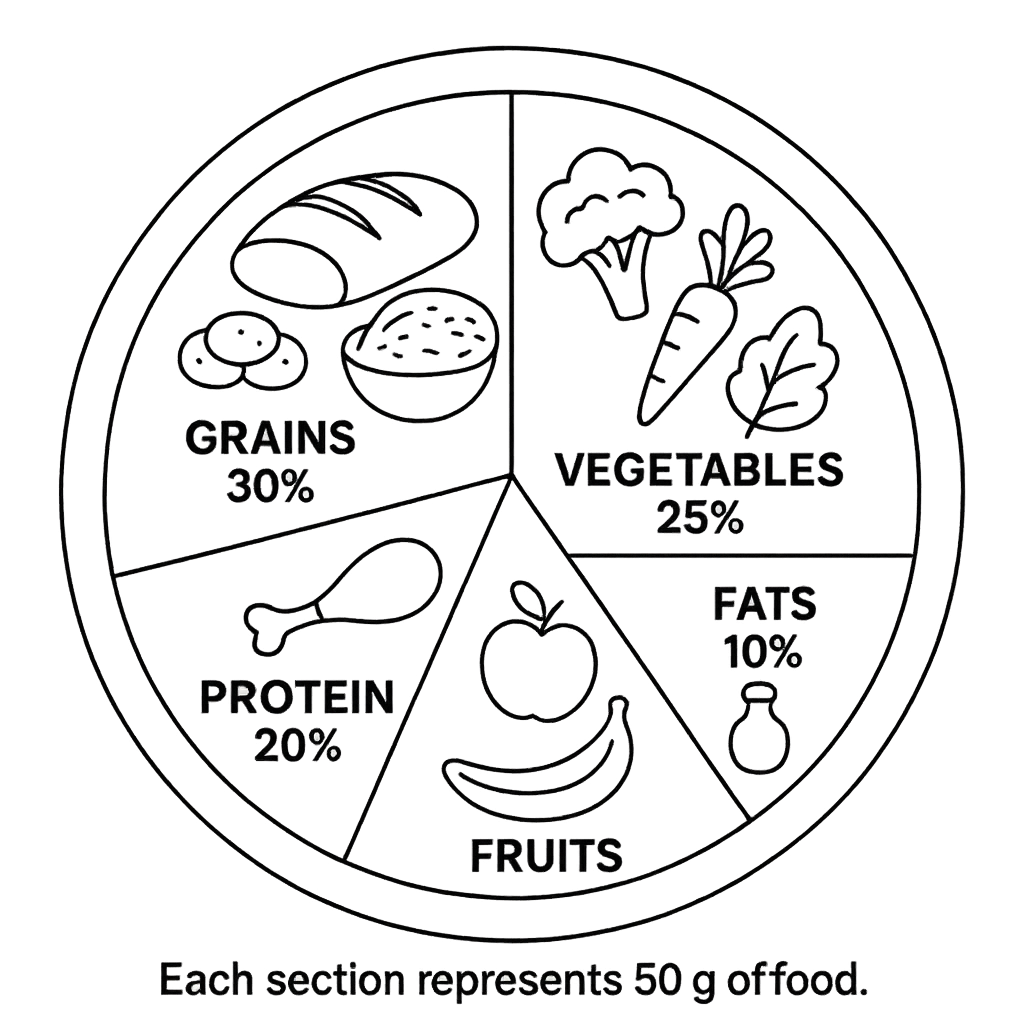
The diagram shows a balanced plate divided into five food‑group sections. Each section represents 50 g of food and is labelled with its percentage of the total plate: Grains 30 %, Vegetables 25 %, Fruits 15 %, Protein 20 %, Fats 10 %. Using the average caloric values (carbohydrate = 4 kcal/g, protein = 4 kcal/g, fat = 9 kcal/g), calculate the percentage of the total calories that comes from the protein section.
A. 20
B. 25
C. 12
Correct D. 16

Correct Answer: D

Want to see the full step-by-step solution? Unlock AI Explanation & Analytics
Question 8 View Details
A newly isolated virus shows these properties: (i) genome is single‑stranded RNA of negative polarity, (ii) virion is enveloped and roughly spherical with surface glycoprotein spikes, (iii) replication occurs in the cytoplasm, (iv) the genome is segmented into six RNA segments. To which virus family does this organism most likely belong?
A. Arenaviridae
B. Bunyaviridae
C. Paramyxoviridae
Correct D. Orthomyxoviridae

Correct Answer: D

Want to see the full step-by-step solution? Unlock AI Explanation & Analytics
Question 9 View Details
A phylogenetic tree of four species is described as follows: from the root, a branch of 5 Myr leads to node X and a branch of 7 Myr leads to node Y. Node X splits into Species A (branch 4 Myr) and Species B (branch 6 Myr). Node Y splits into Species C (branch 3 Myr) and Species D (branch 2 Myr). Which pair of species shows the greatest evolutionary distance and what is that distance (in million years)?
A. Species A and Species C, 22 million years
B. Species A and Species D, 20 million years
C. Species B and Species D, 19 million years
Correct D. Species B and Species C, 21 million years

Correct Answer: D

Want to see the full step-by-step solution? Unlock AI Explanation & Analytics
Question 10 View Details
Which organelle is primarily responsible for the production of ATP through oxidative phosphorylation in eukaryotic cells?
A. Ribosome
B. Nucleus
C. Chloroplast
Correct D. Mitochondrion

Correct Answer: D

Want to see the full step-by-step solution? Unlock AI Explanation & Analytics
Question 11 View Details
A newly discovered insect exhibits the following characteristics: (i) exoskeleton, (ii) three pairs of legs, (iii) wings present, (iv) adult mouthparts are chewing, (v) undergoes complete metamorphosis. Within the class Insecta, the orders that show complete metamorphosis and chewing mouthparts in the adult stage are Coleoptera and Lepidoptera, but only Coleoptera retain chewing mouthparts as adults. Within Coleoptera, families that have forewings hardened into elytra are Carabidae and Coccinellidae. The insect is nocturnal and predatory, a behaviour typical of Carabidae. Identify the class, order and family of the insect.
A. Class Arachnida; Order Coleoptera; Family Carabidae
B. Class Insecta; Order Coleoptera; Family Coccinellidae
C. Class Insecta; Order Lepidoptera; Family Carabidae
Correct D. Class Insecta; Order Coleoptera; Family Carabidae

Correct Answer: D

Want to see the full step-by-step solution? Unlock AI Explanation & Analytics
Question 12 View Details
In a plant, hormone X is synthesised in leaves when temperature falls below 10 °C. X is transported through the phloem to the shoot apical meristem where it suppresses the expression of gene Y. Gene Y normally activates the production of hormone Z, which promotes stem elongation. In a mutant plant the transport of hormone X is blocked, but the enzymatic steps that produce hormone Z remain functional. Under low‑temperature conditions, compare the expected stem elongation of the mutant with that of a wild‑type plant and explain the reasoning.
Correct A. The mutant will exhibit relatively normal (or increased) stem elongation, whereas the wild‑type plant shows reduced elongation under low temperature.
B. Both the mutant and the wild‑type plant show severely reduced stem elongation under low temperature.
C. The mutant shows no stem elongation, whereas the wild‑type plant displays increased elongation under low temperature.
D. The mutant will exhibit reduced stem elongation, while the wild‑type plant maintains normal elongation under low temperature.

Correct Answer: A

Want to see the full step-by-step solution? Unlock AI Explanation & Analytics
Question 13 View Details
A desert rodent employs three independent water‑conserving mechanisms: (i) its urine is concentrated to an osmolality of 3000 mOsm kg⁻¹, whereas a typical mammal excretes urine at 900 mOsm kg⁻¹; urine accounts for 40 % of its total daily water loss. (ii) a nasal counter‑current heat exchanger recovers 60 % of the evaporative water loss from breathing; breathing contributes 30 % of the total water loss after the urine adaptation has taken effect. (iii) the rodent is nocturnal, reducing its exposure temperature by 15 °C compared with a diurnal lifestyle; each 1 °C drop in ambient temperature lowers total water loss by 0.1 mL day⁻¹. If the basal water loss of a comparable diurnal mammal at 30 °C is 5 mL day⁻¹, calculate the rodent's total water loss per day after all three adaptations act, assuming independence of the mechanisms. Give your answer to two decimal places.
Correct A. 1.72 mL day⁻¹
B. 2.30 mL day⁻¹
C. 2.05 mL day⁻¹
D. 1.50 mL day⁻¹

Correct Answer: A

Want to see the full step-by-step solution? Unlock AI Explanation & Analytics
Question 14 View Details
State the correct sequential order of the phases of mitosis in a typical animal cell.
A. Prophase, Anaphase, Metaphase, Telophase
B. Metaphase, Prophase, Anaphase, Telophase
C. Prophase, Metaphase, Telophase, Anaphase
Correct D. Prophase, Metaphase, Anaphase, Telophase

Correct Answer: D

Want to see the full step-by-step solution? Unlock AI Explanation & Analytics
Question 15 View Details
A molecular clock estimates that species A and B diverged 12 million years ago with a standard deviation of 1.5 million years (assume a normal distribution). The oldest known fossils are 10 million years old for species A and 9 million years old for species B. What is the probability that the true divergence time is more recent than 10 million years ago? Express your answer as a decimal rounded to two places.
A. 0.15
B. 0.01
C. 0.19
Correct D. 0.09

Correct Answer: D

Want to see the full step-by-step solution? Unlock AI Explanation & Analytics
Question 16 View Details
Two desert plants differ in their water‑saving adaptations. Plant A (a CAM plant) has a leaf area of 150 cm² and opens its stomata for 4 h each night. Its transpiration rate is 0.5 g H₂O per hour per cm², but CAM metabolism reduces its total water loss by 30 %. Plant B (a C₃ plant) has a leaf area of 120 cm², opens its stomata for 6 h each day, and its transpiration rate is 0.8 g H₂O per hour per cm². Which plant loses less water over a 24‑hour period and by how many grams?
A. Plant A loses less water by 156 g
B. Plant B loses less water by 366 g
Correct C. Plant A loses less water by 366 g
D. Plant A loses less water by 426 g

Correct Answer: C

Want to see the full step-by-step solution? Unlock AI Explanation & Analytics
Question 17 View Details
Under an electron microscope a cell shows numerous tiny, dense particles scattered throughout the cytoplasm, while larger membrane‑bound organelles are scarce. Which cellular structure is most abundant in this cell?
Correct A. ribosome
B. peroxisome
C. mitochondrion
D. lysosome

Correct Answer: A

Want to see the full step-by-step solution? Unlock AI Explanation & Analytics
Question 18 View Details
A bacterial culture starts with 2 × 10⁵ cells ml⁻¹. After 3 h the concentration is 1.6 × 10⁶ cells ml⁻¹. Assuming exponential growth, (a) calculate the generation time in minutes; (b) a bacteriophage then reduces the population by 75 % after 2 h of further growth. If the culture continues to grow with the same generation time for another 2 h, what is the final cell concentration?
A. Generation time = 45 min; final concentration = 5 × 10⁵ cells ml⁻¹
B. Generation time = 75 min; final concentration = 1 × 10⁶ cells ml⁻¹
Correct C. Generation time = 60 min; final concentration = 8 × 10⁵ cells ml⁻¹
D. Generation time = 90 min; final concentration = 2 × 10⁵ cells ml⁻¹

Correct Answer: C

Want to see the full step-by-step solution? Unlock AI Explanation & Analytics
Question 19 View Details
A plant cell section shows large, green, double‑membrane organelles that contain stacks of thylakoid membranes called grana. Which organelle is being described?
Correct A. chloroplast
B. vacuole
C. nucleus
D. mitochondrion

Correct Answer: A

Want to see the full step-by-step solution? Unlock AI Explanation & Analytics
Question 20 View Details
A woman has a regular 28‑day menstrual cycle. Ovulation occurs 14 days after the first day of menstruation. Sperm can survive up to 5 days in the female tract, and an ovum remains viable for 24 h after ovulation. If she has sexual intercourse on day 10 of her cycle, what is the probability (as a percentage) that fertilisation will occur, assuming fertilisation is equally likely on any day when sperm and ovum are simultaneously viable?
A. 70%
B. 30%
C. 50%
Correct D. 40%

Correct Answer: D

Want to see the full step-by-step solution? Unlock AI Explanation & Analytics
Question 21 View Details
After a carbohydrate‑rich meal, a student's blood glucose concentration rises to 8 mmol L⁻¹. The normal fasting level is 5 mmol L⁻¹. Pancreatic β‑cells secrete insulin in proportion to the excess glucose above the normal level, at a rate of 1.5 µU mL⁻¹ for each mmol L⁻¹ excess. The insulin present in the bloodstream lowers the glucose concentration at a rate of 0.3 mmol L⁻¹ per µU mL⁻¹ of insulin per hour. Assuming no other physiological changes, what will be the blood glucose concentration after 2 hours?
A. 5.9 mmol L⁻¹
B. 5.6 mmol L⁻¹
C. 5.0 mmol L⁻¹
Correct D. 5.3 mmol L⁻¹

Correct Answer: D

Want to see the full step-by-step solution? Unlock AI Explanation & Analytics
Question 22 View Details
A mixed forest contains two tree species, A and B. Species A grows at 2 % per year and species B at 3 % per year. Initially, species A accounts for 60 % of the total basal area and species B for 40 %. After 10 years a pest reduces the growth rate of species B to 1 % per year for the remaining period. What percentage of the total basal area will be occupied by species A after 15 years?
A. 55 %
B. 58 %
C. 61 %
Correct D. 59 %

Correct Answer: D

Want to see the full step-by-step solution? Unlock AI Explanation & Analytics
Question 23 View Details
In a lake the annual primary productivity is 1200 kcal m⁻². Zooplankton consume 45 % of this production. Small fish eat 30 % of the zooplankton biomass and assimilate 70 % of the ingested energy. Piscivorous birds feed on the fish and assimilate 80 % of the energy they obtain from the fish. What percentage of the original primary production is finally assimilated by the birds?
Correct A. 7.6 %
B. 6.8 %
C. 8.2 %
D. 5.4 %

Correct Answer: A

Want to see the full step-by-step solution? Unlock AI Explanation & Analytics
Question 24 View Details
A bacterial culture follows logistic growth: dN/dt = rN(1 - N/K). The initial population is N₀ = 1 × 10⁶ cells, the carrying capacity K = 1 × 10⁹ cells and the intrinsic growth rate r = 0.8 h⁻¹. An antibiotic is added at t = 2 h, reducing the growth rate by 30 % (so r becomes 0.56 h⁻¹) for the next 4 h; after that the growth rate returns to its original value. What is the population size at t = 8 h? (Give your answer in scientific notation to two significant figures.)
A. 2.1×10⁸ cells
B. 2.3×10⁸ cells
C. 1.5×10⁸ cells
Correct D. 1.9×10⁸ cells

Correct Answer: D

Want to see the full step-by-step solution? Unlock AI Explanation & Analytics
Question 25 View Details
A xerophytic plant normally has a leaf‑area index (LAI) of 5. During a drought its stomatal conductance per unit LAI falls by 20 % from the normal value of 0.8 mmol m⁻² s⁻¹ kPa⁻¹. The ambient vapor‑pressure deficit (VPD) remains constant at 2 kPa. To avoid excessive water loss the plant must keep its total transpiration rate at or below 10 mmol m⁻² s⁻¹. What is the greatest LAI the plant can retain under these conditions? (Give your answer to two decimal places.)
A. 8.33
B. 6.25
C. 7.69
Correct D. 7.81

Correct Answer: D

Want to see the full step-by-step solution? Unlock AI Explanation & Analytics

Master the Exam!

You've seen a preview, but there are thousands more questions plus AI tutor to break down complex solutions.

Unlock Full Access Available for Android & Windows
Help others prepare! Share this practice hub:
Chat with Support