waec model questions vol1 2023 agricultural_science | Objective

Prepare for your exams with waec model questions vol1 questions? Reviewing past/model questions is one of the most effective ways to guarantee a high score. This practice hub features authentic 2023 agricultural_science (Objective) questions designed to simulate the real exam environment.

Practice these randomly selected questions to test your readiness.

Question 1 View Details
A farmer sells maize at ₦120 per kg. Fixed costs for the season are ₦150,000 and the variable cost is ₦70 per kg. A 5 % sales tax is levied on the gross revenue and the government gives a subsidy of ₦5 per kg for the first 2,000 kg sold. What is the minimum quantity of maize (in kg) the farmer must sell to achieve a net profit of at least ₦30,000 after tax and subsidy?
A. 4000 kg
Correct B. 3864 kg
C. 4200 kg
D. 3500 kg

Correct Answer: B

Want to see the full step-by-step solution? Unlock AI Explanation & Analytics
Question 2 View Details
In a herd of 150 cattle, 45 animals develop fever, anorexia and watery diarrhoea. Within five days, 30 of the affected cattle die. The disease is transmitted by ticks and the causative agent is a protozoan. Identify the disease and calculate (i) the mortality rate among the affected animals and (ii) the overall herd mortality rate, both expressed as percentages.
A. Anaplasmosis; mortality among affected = 55%; overall herd mortality = 15%
Correct B. East Coast fever; mortality among affected = 66.7%; overall herd mortality = 20%
C. Theileriosis; mortality among affected = 70.0%; overall herd mortality = 18%
D. Babesiosis; mortality among affected = 60%; overall herd mortality = 22%

Correct Answer: B

Want to see the full step-by-step solution? Unlock AI Explanation & Analytics
Question 3 View Details
A 5‑ha maize field contains 25,000 plants per hectare. Initially the incidence of leaf blight is 12 %. After a fungicide is applied only to the 60 % of the field (Zone A), the disease incidence in Zone A falls to 3 % while the remaining 40 % (Zone B) stays at 12 %. How many plants in the whole field are saved from infection because of the fungicide?
A. 5,250 plants
B. 8,250 plants
C. 7,500 plants
Correct D. 6,750 plants

Correct Answer: D

Want to see the full step-by-step solution? Unlock AI Explanation & Analytics
Question 4 View Details
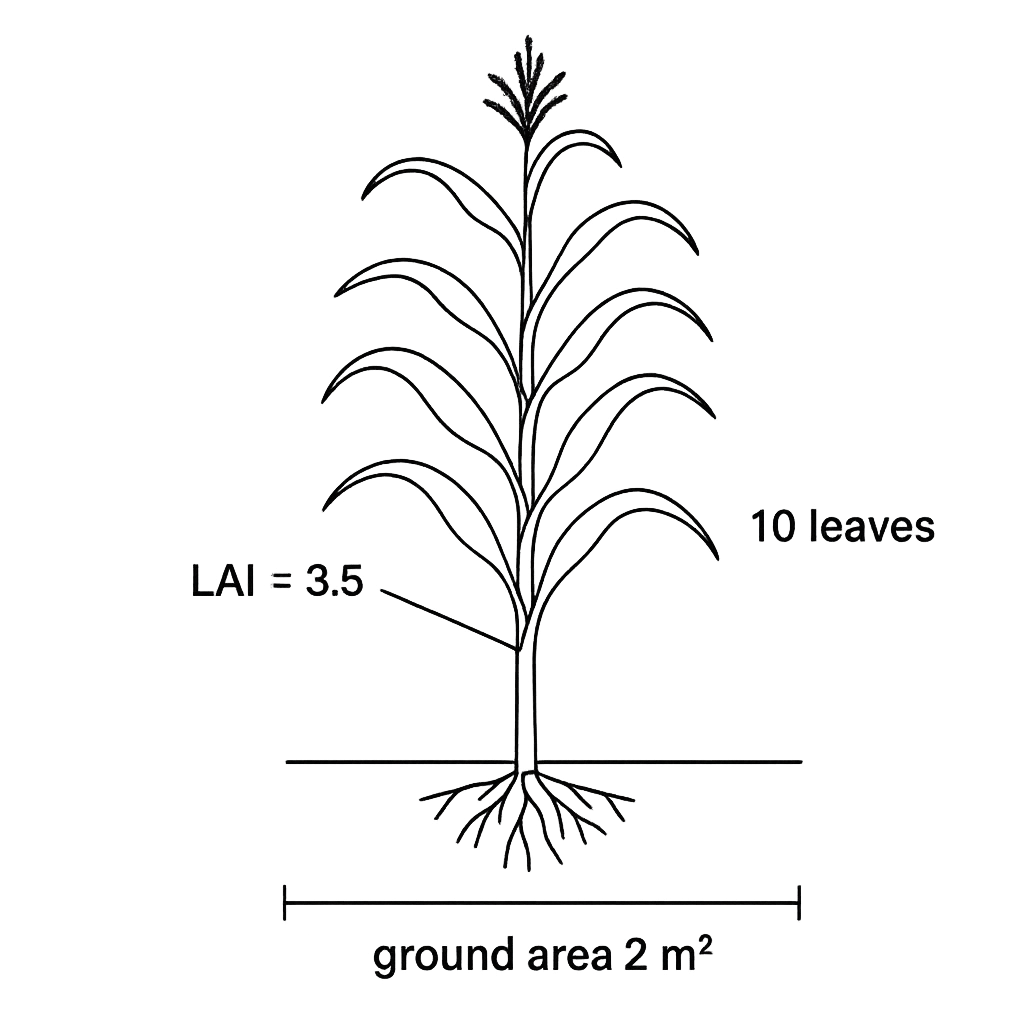
The diagram shows a mature maize plant. The leaf‑area index (LAI) for the plant is 3.5 and the ground area represented by the diagram is 2 m². The plant has 10 leaves of equal size. Using the information from the diagram, calculate the average leaf area of one leaf in square metres.
A. 0.9 m^2 per leaf
Correct B. 0.7 m^2 per leaf
C. 1.0 m^2 per leaf
D. 0.5 m^2 per leaf

Correct Answer: B

Want to see the full step-by-step solution? Unlock AI Explanation & Analytics
Question 5 View Details
A farmer cultivates sorghum and cowpea on a total of 10 ha of land. The expected yields (kg per ha) are 30 kg of sorghum and 20 kg of cowpea. After government policies, the net price of sorghum becomes ₦70 /kg (original ₦80 /kg minus a ₦10 /kg export tax) and the net price of cowpea becomes ₦125 /kg (original ₦120 /kg plus a ₦5 /kg import tariff). Fixed production costs are ₦500 per ha for sorghum and ₦400 per ha for cowpea. Because of market saturation, the profit from each crop decreases with the area planted: - Sorghum profit (in ₦) = 2000 x - 150 x², where x is the area (ha) planted to sorghum. - Cowpea profit (in ₦) = 2500 y - 200 y², where y is the area (ha) planted to cowpea. If x + y = 10, determine the land allocation (ha) to sorghum and to cowpea that maximises total profit. Give the answer to two decimal places.
A. 6 ha sorghum, 4 ha cowpea
B. 4 ha sorghum, 6 ha cowpea
C. 3 ha sorghum, 7 ha cowpea
Correct D. 5 ha sorghum, 5 ha cowpea

Correct Answer: D

Want to see the full step-by-step solution? Unlock AI Explanation & Analytics
Question 6 View Details
A farmer rotates maize with a legume crop that fixes 80 kg of nitrogen per hectare. Only 30% of the fixed nitrogen becomes available to the subsequent maize crop, and 10% of this available nitrogen is lost by leaching before the maize can use it. How many kilograms of nitrogen are contributed to the maize crop?
A. 24
B. 22.4
C. 20.4
Correct D. 21.6

Correct Answer: D

Want to see the full step-by-step solution? Unlock AI Explanation & Analytics
Question 7 View Details
In a cotton field there are 40,000 plants per hectare. Each aphid causes a 0.02% loss of the yield of the plant it attacks. The total cotton yield is 2,000 kg per hectare and the market price is ₦150 per kg. A pesticide application costs ₦12,000 per hectare and reduces the aphid population by 80%. What is the minimum number of aphids per plant at which applying the pesticide becomes economically justified?
A. 300
Correct B. 250
C. 400
D. 200

Correct Answer: B

Want to see the full step-by-step solution? Unlock AI Explanation & Analytics
Question 8 View Details
A soil sample has a cation exchange capacity (CEC) of 20 cmolc kg⁻¹. The exchangeable bases are calcium 8 cmolc kg⁻¹, magnesium 4 cmolc kg⁻¹, potassium 2 cmolc kg⁻¹ and sodium 1 cmolc kg⁻¹. What is the base saturation percentage of the soil?
A. 80
Correct B. 75
C. 65
D. 55

Correct Answer: B

Want to see the full step-by-step solution? Unlock AI Explanation & Analytics
Question 9 View Details
A broiler chicken gains 1.5 kg in 30 days. Its body is 20% protein by weight. The feed contains 20% crude protein with a digestibility of 85%, and only 25% of the digestible protein is retained for growth. How many kilograms of feed are required for the weight gain?
A. 8.20
B. 5.90
C. 6.45
Correct D. 7.06

Correct Answer: D

Want to see the full step-by-step solution? Unlock AI Explanation & Analytics
Question 10 View Details
A small dairy farm has fixed costs of ₦150,000 per month. Variable cost is ₦30 per litre of milk produced. The farm sells milk at ₦45 per litre for the first 8,000 litres each month; any production above 8,000 litres is sold at a reduced price of ₦42 per litre. What is the minimum total milk production (in litres) per month required to achieve a profit of at least ₦20,000?
A. 14167
B. 12500
Correct C. 12167
D. 11334

Correct Answer: C

Want to see the full step-by-step solution? Unlock AI Explanation & Analytics
Question 11 View Details
A farmer has 20 kg of maize seed consisting of two varieties, A and B. Variety A requires a sowing rate of 25 kg/ha and yields 4.5 t/ha, while variety B requires 20 kg/ha and yields 3.8 t/ha. The farmer wants the average yield of the cultivated area to be at least 4.2 t/ha. What is the maximum total area (in hectares) that can be cultivated under these conditions?
A. 0.8
B. 1.0
C. 0.9
Correct D. 0.875

Correct Answer: D

Want to see the full step-by-step solution? Unlock AI Explanation & Analytics
Question 12 View Details
A lake fish population follows the logistic model dP/dt = rP(1‑P/K) with initial population P₀ = 2000 fish, intrinsic growth rate r = 0.5 yr⁻¹ and carrying capacity K = 8000 fish. If a constant number H fish are harvested each year, what is the maximum constant harvest (in fish per year) that can be sustained indefinitely without causing extinction?
A. 1200
Correct B. 1000
C. 1500
D. 800

Correct Answer: B

Want to see the full step-by-step solution? Unlock AI Explanation & Analytics
Question 13 View Details
A tractor pulls a plough that requires a draft force given by F = a + b(M‑M_opt)², where M is the soil moisture (% dry basis). For the soil in question a = 1500 N, b = 200 N/(%²) and the optimum moisture M_opt = 12%. On a day when the moisture is 15% the tractor moves at 5 km/h. Assuming an overall mechanical efficiency of 85%, what is the minimum engine power (in kW) required? Give your answer to one decimal place.
Correct A. 5.4
B. 4.8
C. 6.2
D. 7.0

Correct Answer: A

Want to see the full step-by-step solution? Unlock AI Explanation & Analytics
Question 14 View Details
In a 10‑ha wheat field the incidence of a fungal disease follows I(t) = I₀e^{kt}, where I₀ = 5% at planting (t = 0 days) and k = 0.03 day⁻¹. A fungicide reduces the current incidence instantly by 60% of its value and may be applied at most twice, on days 20 and 40 after planting. After the last application the disease continues to grow according to the same exponential law. Each 1% of final incidence reduces yield by 0.8 tonnes per ha. Assuming harvest occurs on day 60, decide whether to apply the fungicide on each of the two possible days (you may skip any application) so that the total yield loss (in tonnes) is minimised. What is the minimum total yield loss?
A. 40.1
B. 42.5
C. 35.2
Correct D. 38.7

Correct Answer: D

Want to see the full step-by-step solution? Unlock AI Explanation & Analytics
Question 15 View Details
A batch of 500 kg of maize kernels has an initial moisture content of 22% (wet basis). The target moisture for safe storage is 13% (wet basis). Two drying methods are available: sun drying, which reduces moisture at 0.5% per hour but cannot lower moisture below 15%; and a mechanical dryer, which reduces moisture at 1.2% per hour with no lower limit. The farmer may first use sun drying for any integer number of hours and then finish with the mechanical dryer. What is the minimum total drying time (in whole hours) required to reach the target moisture?
A. 9
Correct B. 8
C. 10
D. 7

Correct Answer: B

Want to see the full step-by-step solution? Unlock AI Explanation & Analytics
Question 16 View Details
A farmer uses two implements to cultivate a 12‑hectare field. The disc harrow is 1.5 m wide and the power tiller is 0.9 m wide. Both operate at 4 km h⁻¹ with a field efficiency of 80 %. The disc harrow is employed on two‑thirds of the field area and the power tiller on the remaining one‑third. The farmer works exactly 6 hours each day. What is the minimum number of whole days required to complete the cultivation?
A. 7
Correct B. 6
C. 5
D. 8

Correct Answer: B

Want to see the full step-by-step solution? Unlock AI Explanation & Analytics
Question 17 View Details
A fish pond initially contains 5 000 kg of fish. The fish population follows the logistic growth model with intrinsic growth rate r = 0.3 month⁻¹ and carrying capacity K = 20 000 kg. The manager harvests fish at a constant rate H kg per month. What is the greatest constant harvest rate (in kg per month) that can be sustained indefinitely without the stock eventually collapsing?
A. 2000
Correct B. 1500
C. 1200
D. 1800

Correct Answer: B

Want to see the full step-by-step solution? Unlock AI Explanation & Analytics
Question 18 View Details
A forest stand has a current standing volume of 120 m³ ha⁻¹. The average annual volume growth is 2.5 m³ ha⁻¹. After the first ten years, a mortality loss of 0.2 m³ ha⁻¹ per year begins, reducing the net annual growth to 2.3 m³ ha⁻¹. If the manager wishes to harvest a constant volume H m³ ha⁻¹ each year for the next 20 years, what is the maximum value of H that will ensure the standing volume after 20 years is at least 100 m³ ha⁻¹?
A. 2.8
Correct B. 3.4
C. 4.1
D. 3.0

Correct Answer: B

Want to see the full step-by-step solution? Unlock AI Explanation & Analytics
Question 19 View Details
A farmer plans to grow maize on 5 ha. Fixed costs (land rent, machinery) total ₦300 000. Variable cost per hectare for seed, fertilizer and labour is ₦80 000. The expected market price is ₦100 per kg. What is the minimum average yield per hectare (in tonnes) that must be obtained to achieve a profit of at least ₦200 000?
A. 1.5
B. 2.0
Correct C. 1.8
D. 2.3

Correct Answer: C

Want to see the full step-by-step solution? Unlock AI Explanation & Analytics
Question 20 View Details
A 3‑ha field is to be treated for a pest. The recommended pesticide dosage is 2.5 L of a spray solution per hectare, prepared at a concentration of 0.8 % (v/v) of active ingredient. The active ingredient is sold as a 25 % concentrate. How many litres of the concentrate must be purchased to treat the whole field?
A. 0.30
B. 0.12
C. 0.48
Correct D. 0.24

Correct Answer: D

Want to see the full step-by-step solution? Unlock AI Explanation & Analytics
Question 21 View Details
A farmer keeps 20 breeding does. Each doe produces on average 1.5 kids per year. The mortality rate of kids in the first month is 12%. The farmer wants at least 30 kids to survive to weaning. Assuming all does have the same kidding and mortality rates, how many does must be retained to meet the target?
A. 20
Correct B. 23
C. 30
D. 26

Correct Answer: B

Want to see the full step-by-step solution? Unlock AI Explanation & Analytics
Question 22 View Details
A hand‑operated winch is used to lift a 200 kg sack of grain. The winch drum has a radius of 0.15 m and the handle length is 0.60 m, acting as a lever. The winch incorporates a gear set that gives a mechanical advantage of 3 (output torque is three times the input torque). Assuming no friction losses, what minimum force must the farmer apply at the end of the handle to lift the sack?
A. 190
B. 150
C. 175
Correct D. 163

Correct Answer: D

Want to see the full step-by-step solution? Unlock AI Explanation & Analytics
Question 23 View Details
A farmer intends to cultivate maize on 5 ha. Variable cost is ₦120 000 per ha and fixed cost is ₦250 000. Expected yield is 3.5 t ha⁻¹. The expected market price is ₦45 000 t⁻¹, but there is a 30 % chance the price will fall by 40 % (to ₦27 000 t⁻¹) and a 70 % chance it will stay at the expected price. The farmer can buy crop insurance that costs 3 % of the expected revenue (without insurance) and guarantees a minimum price of ₦35 000 t⁻¹ if the market price falls below that, paying the shortfall per tonne. Should the farmer purchase the insurance? Show the expected profit with and without insurance and state the decision.
Correct A. Yes, the farmer should purchase the insurance
B. No, the farmer should not purchase the insurance
C. No, the farmer should purchase the insurance
D. Yes, the farmer should purchase the insurance only if the price falls

Correct Answer: A

Want to see the full step-by-step solution? Unlock AI Explanation & Analytics
Question 24 View Details
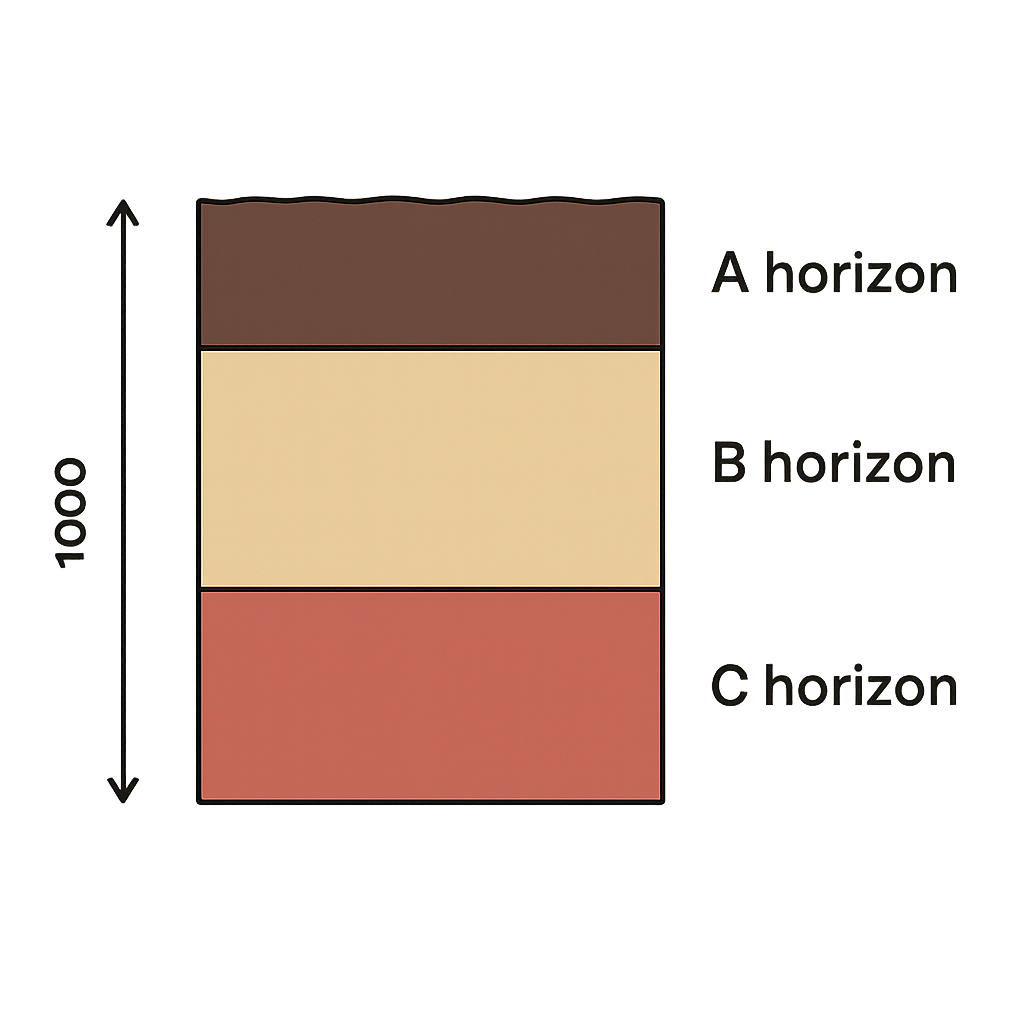
The diagram shows a vertical soil profile consisting of three distinct layers. Identify the layer that indicates the highest organic matter content.
A. the reddish layer (C horizon)
B. the white layer (E horizon)
Correct C. the dark brown layer (A horizon)
D. the light brown layer (B horizon)

Correct Answer: C

Want to see the full step-by-step solution? Unlock AI Explanation & Analytics
Question 25 View Details
A farmer measures the length of a rectangular field with a measuring wheel that over‑reads by 2 % (the wheel shows 2 % more than the true distance). The wheel records 250 m for the length and 150 m for the width. The field is not a perfect rectangle; a right‑angled triangular corner has been cut off, whose area equals ½ × (difference between the corrected length and corrected width)². What is the actual area of the field in square metres?
A. 31143
B. 31253
Correct C. 31243
D. 32243

Correct Answer: C

Want to see the full step-by-step solution? Unlock AI Explanation & Analytics

Master the Exam!

You've seen a preview, but there are thousands more questions plus AI tutor to break down complex solutions.

Unlock Full Access Available for Android & Windows
Help others prepare! Share this practice hub:
Chat with Support