waec model questions vol1 2022 physics | Essay

Prepare for your exams with waec model questions vol1 questions? Reviewing past/model questions is one of the most effective ways to guarantee a high score. This practice hub features authentic 2022 physics (Essay) questions designed to simulate the real exam environment.

Practice these randomly selected questions to test your readiness.
Question 1 View Details
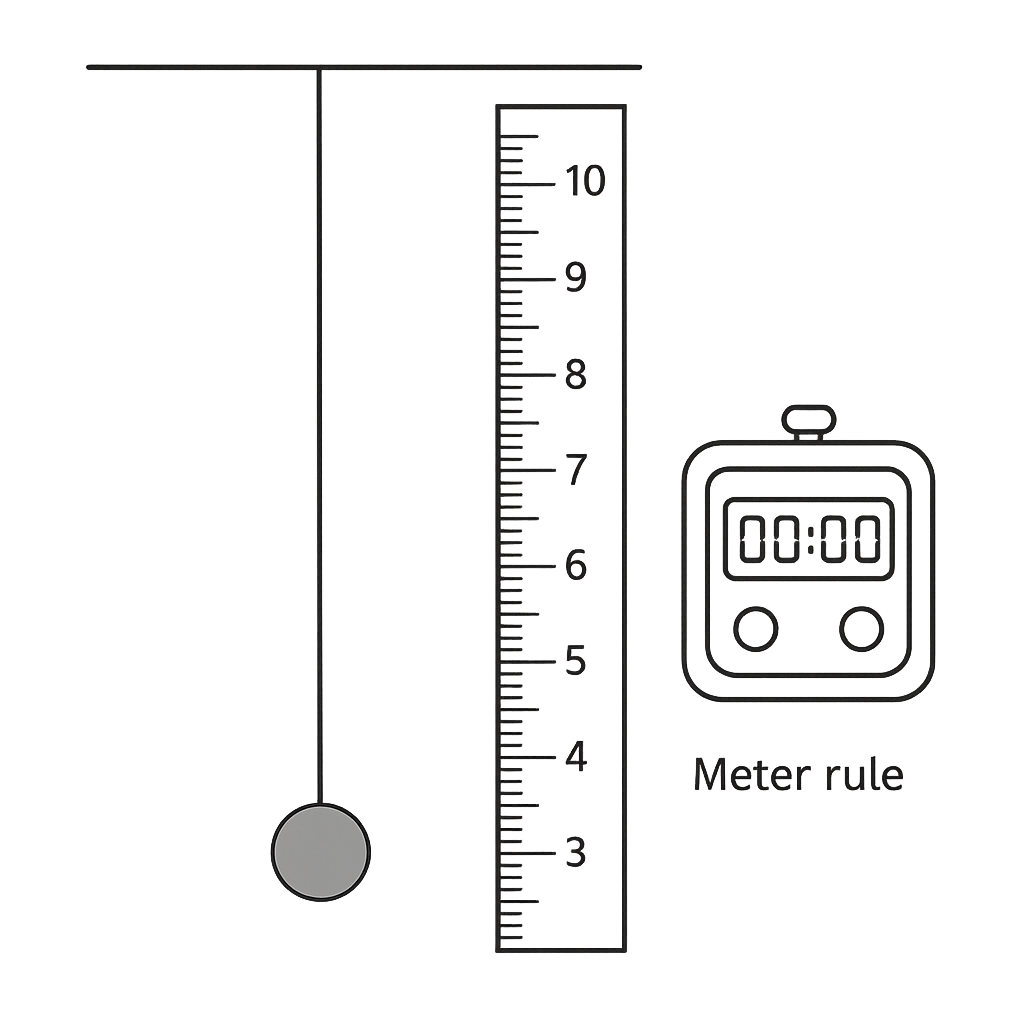
A student is required to determine the acceleration due to gravity (g) using a simple pendulum. The apparatus consists of a thin string attached to a small spherical bob, suspended from a fixed pivot. The length of the pendulum is measured with a metre rule placed vertically beside the string, and the time for 20 complete oscillations is recorded with a digital stopwatch. The diagram shows the pendulum, the metre rule and the stopwatch.
Question Parts
(a)
Explain how the length of the pendulum should be measured so that systematic error is minimised.
(b)
The recorded times for 20 oscillations are 40.2 s, 40.5 s and 40.1 s. Calculate:
(c)
Identify two possible sources of error in this experiment and suggest a method to reduce each error.
Detailed Essay Solution & Marking Scheme Available

Get the step-by-step mathematical proofs, key points required by examiners, and a comprehensive breakdown from our AI Tutor.
Question 2 View Details
A car moves along a straight road. At time t = 0 s the car is at point O and starts from rest. It accelerates uniformly for 5 s, then travels at a constant speed for 10 s, and finally decelerates uniformly to rest in 4 s.
Question Parts
(a)
During the first 5 s the car covers a distance of 100 m. Determine the magnitude of the constant acceleration in this phase.
(b)
Find the speed of the car at the end of the acceleration phase (i.e., at t = 5 s).
(c)
Calculate the total distance travelled by the car during the whole motion.
(d)
Sketch a velocity–time graph for the whole motion, clearly indicating the three phases, and state the area under the graph.
Detailed Essay Solution & Marking Scheme Available

Get the step-by-step mathematical proofs, key points required by examiners, and a comprehensive breakdown from our AI Tutor.
Question 3 View Details
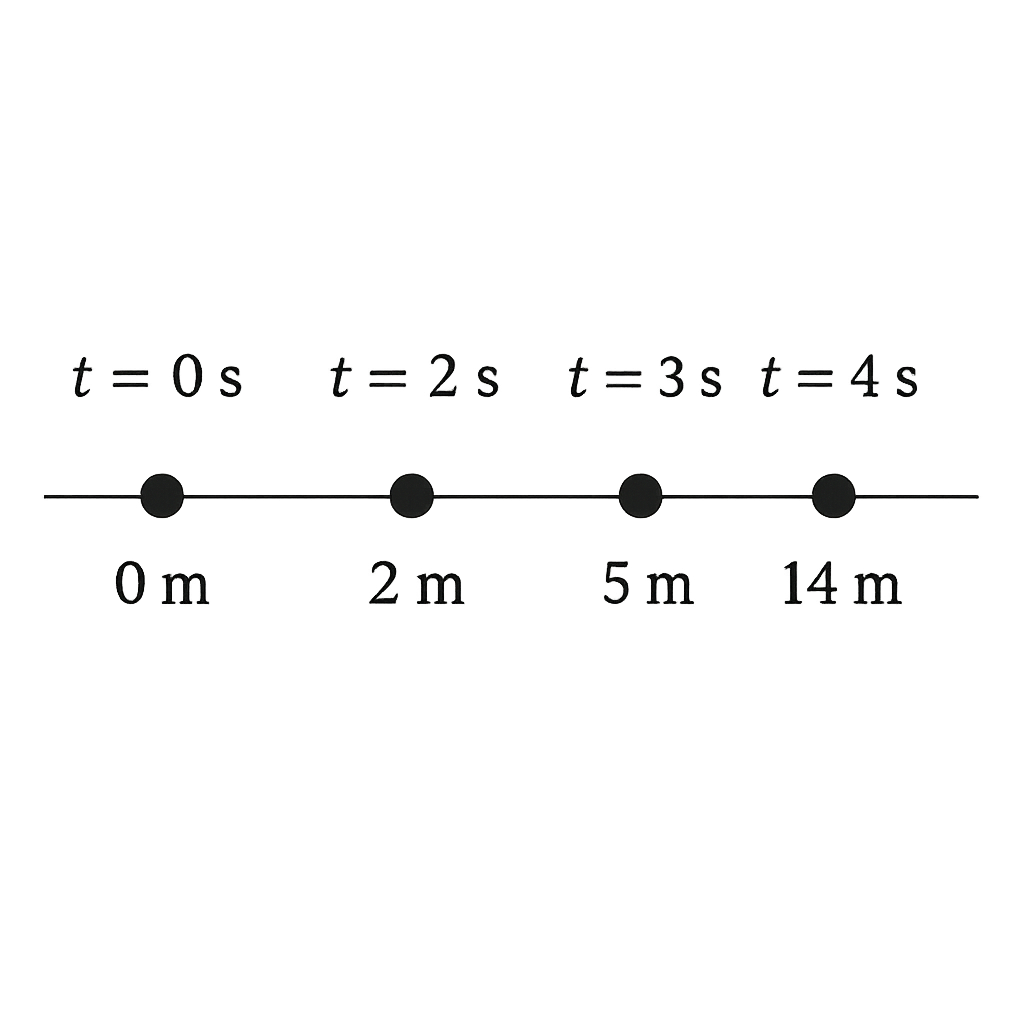
A cyclist travels along a straight road. The motion diagram shown represents the cyclist’s position at successive one‑second intervals. At t = 0 s the cyclist is at the origin (0 m). At each subsequent second the cyclist’s position is as follows: 2 m at t = 1 s, 5 m at t = 2 s, 9 m at t = 3 s and 14 m at t = 4 s.
Question Parts
(a)
Determine the average speed of the cyclist over the 4 s interval.
(b)
Assuming the cyclist started from rest and moved with uniform acceleration, calculate the magnitude of the acceleration.
(c)
If the cyclist continues with the same acceleration, find the speed at t = 6 s.
(d)
Comment on whether the motion diagram is consistent with the assumption of uniform acceleration.
Detailed Essay Solution & Marking Scheme Available

Get the step-by-step mathematical proofs, key points required by examiners, and a comprehensive breakdown from our AI Tutor.
Question 4 View Details
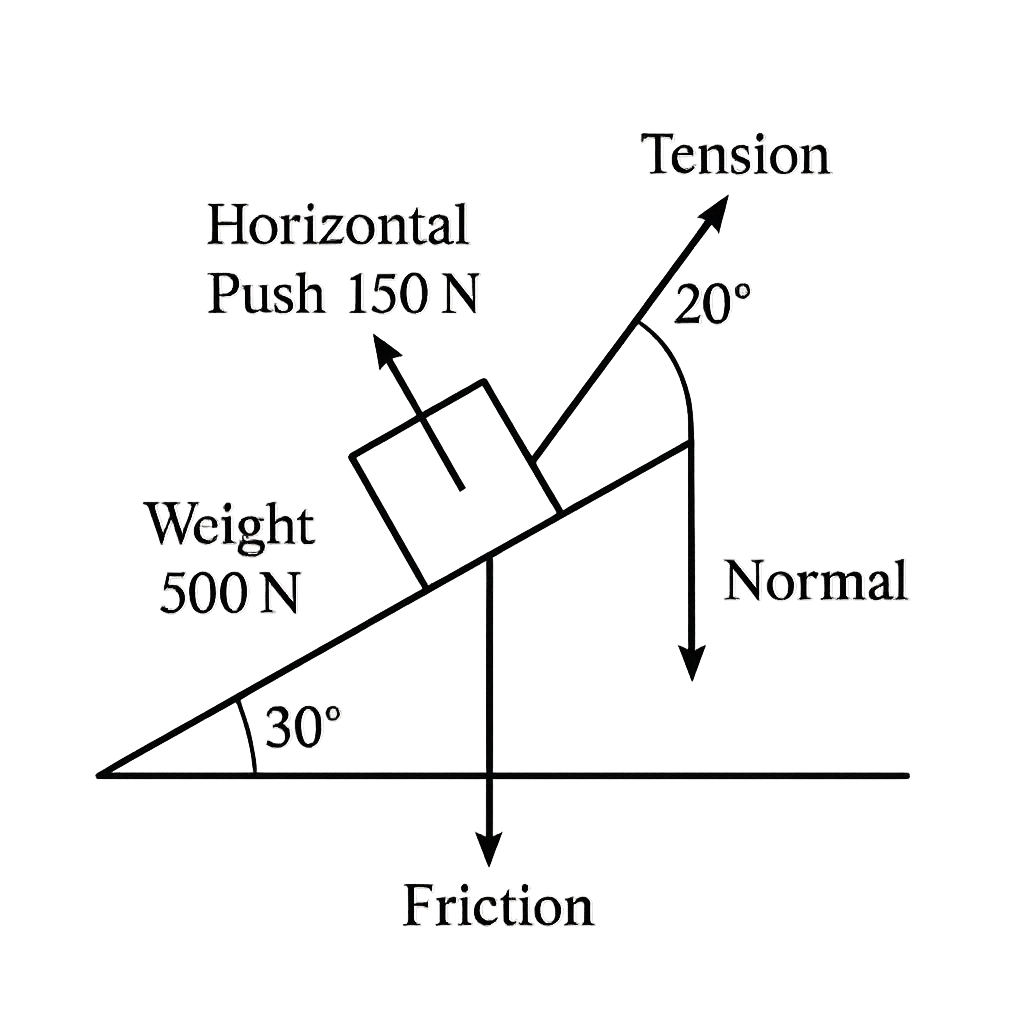
A block rests on a smooth inclined plane that makes an angle of 30° with the horizontal. The block is acted upon by the following forces:
Question Parts
(a)
Given that the coefficient of static friction between the block and the plane is 0.40, calculate the magnitude of the normal reaction exerted by the plane on the block.
(b)
Using the result from part (a) and the given coefficient of friction, determine the magnitude of the tension in the rope required to keep the block at rest.
(c)
Calculate the magnitude of the frictional force acting on the block.
(d)
If the horizontal push is increased from 150 N to 200 N while all other conditions remain the same, state qualitatively whether the block will move up the plane, down the plane, or remain at rest. Justify your answer with a brief calculation.
Detailed Essay Solution & Marking Scheme Available

Get the step-by-step mathematical proofs, key points required by examiners, and a comprehensive breakdown from our AI Tutor.

Question 5 View Details
A 2.0 kg block is released from rest at the top of an inclined plane that is 5.0 m long and makes an angle of 30° with the horizontal. The surface of the plane is rough with a coefficient of kinetic friction \(\mu_k = 0.20\).
Question Parts
(a)
Calculate the work done by the gravitational force on the block as it moves down the plane.
(b)
Determine the magnitude of the kinetic friction force and the work done by friction over the 5.0 m displacement.
(c)
After reaching the bottom, the block is pulled upward along the same incline at a constant speed of 4.0 m s⁻¹ by a motor. Find the power that the motor must supply to maintain this motion.
Detailed Essay Solution & Marking Scheme Available

Get the step-by-step mathematical proofs, key points required by examiners, and a comprehensive breakdown from our AI Tutor.

Question 6 View Details
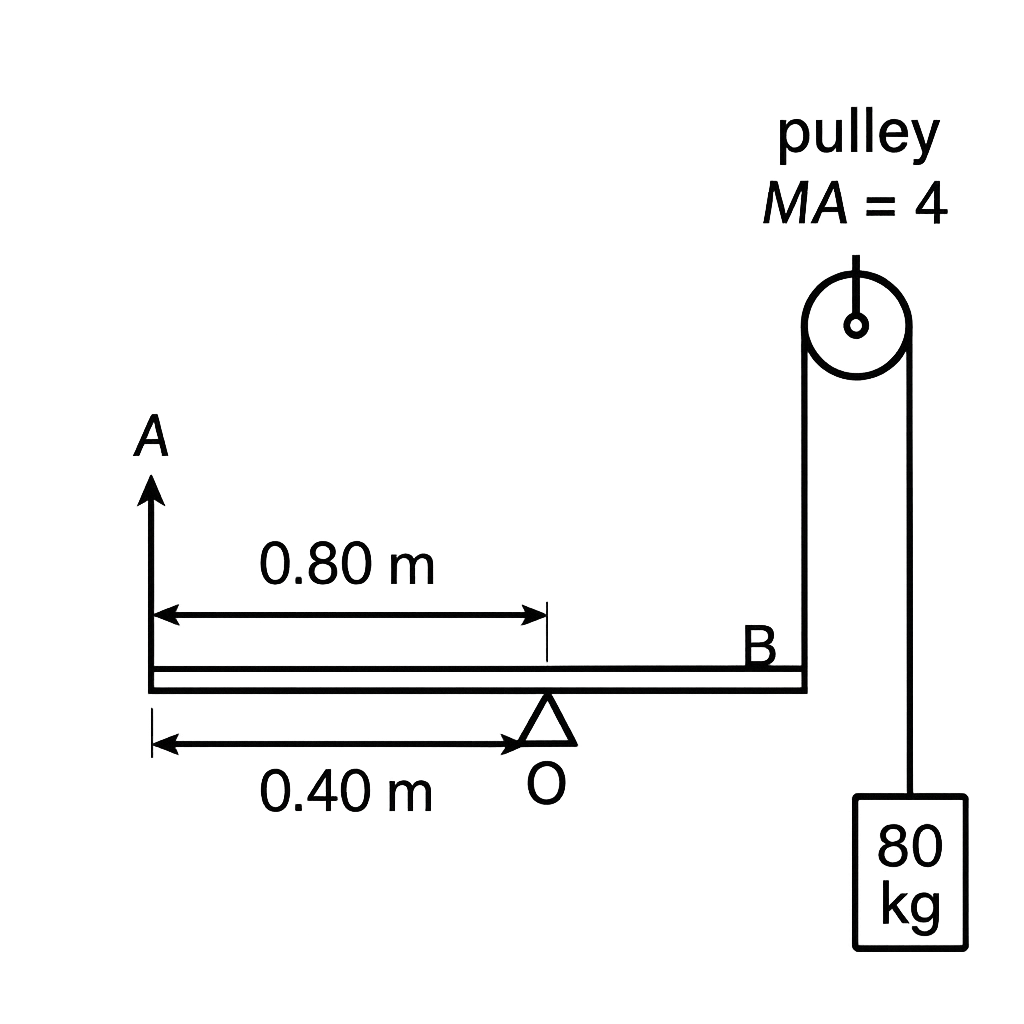
The diagram shows a compound machine that consists of a fixed fulcrum lever AB of total length 1.20 m. The fulcrum O divides the lever so that the effort is applied at point A, 0.80 m from O, and the load is attached at point B, 0.40 m from O. From B a light, frictionless rope passes upward over a fixed pulley attached to the ceiling and then hangs vertically to a load of mass 80 kg. The pulley provides a mechanical advantage of 4 (the tension in the rope is one‑quarter of the effort force). All strings and the lever are assumed massless and the pulley is smooth. Answer the following questions.
Question Parts
(a)
Determine the magnitude of the effort force required to raise the load at constant speed when the effort is applied vertically upward.
(b)
If the effort is now applied at an angle of 30° above the horizontal, find the magnitude of the effort force required to raise the load at constant speed.
(c)
In practice the effort required is measured as 110 N when the effort point moves through a distance of 0.80 m while the load rises 0.10 m. Calculate the efficiency of the compound machine.
(d)
State two practical advantages of using such a compound machine in construction work.
Detailed Essay Solution & Marking Scheme Available

Get the step-by-step mathematical proofs, key points required by examiners, and a comprehensive breakdown from our AI Tutor.

Question 7 View Details
A frictionless piston seals a fixed‑volume cylindrical container that initially holds 0.020 m³ of air at 300 K and atmospheric pressure (101 kPa). The container is then lowered vertically into a large water tank. The piston is exposed to the water pressure at a depth that can be read on a calibrated scale attached to the container. When the water level above the piston reads 3.5 m, the volume of the trapped air is found to be 0.015 m³ (the temperature of the air remains 300 K). Assume the water temperature is uniform and the acceleration due to gravity is 9.8 m s⁻². Answer the following: a) Determine the absolute pressure of the trapped air at the instant the volume is 0.015 m³. b) Using the result of (a), calculate the density of the water in the tank. c) State the physical principle that justifies the relationship used between the water depth and its pressure.
Question Parts
(a)
Determine the absolute pressure of the trapped air at the instant the volume is 0.015 m³.
(b)
Using the result of (a), calculate the density of the water in the tank.
(c)
State the physical principle that justifies the relationship used between the water depth and its pressure.
Detailed Essay Solution & Marking Scheme Available

Get the step-by-step mathematical proofs, key points required by examiners, and a comprehensive breakdown from our AI Tutor.

Question 8 View Details
A solid metal rod 0.50 m long and of mass 2.00 kg is heated uniformly to 150 °C and then placed with one end immersed in a large water bath at 20 °C. The other end of the rod is perfectly insulated. The water bath contains 10.0 kg of water (specific heat capacity 4186 J kg⁻¹ K⁻¹) and its temperature rises to 22 °C after 10 minutes. Assume that no heat is lost to the surroundings and that the heat transferred from the rod to the water is uniform during the 10‑minute interval. Answer the following: a) Determine the specific heat capacity of the metal rod. b) Calculate the average rate of heat transfer from the rod to the water (in joules per second) and express it per metre of rod length. c) If the rod were made of copper (c = 385 J kg⁻¹ K⁻¹) and subjected to the same experimental conditions, what would be its final temperature after 10 minutes, assuming the same amount of heat is transferred to the water as in part (b)?
Question Parts
(a)
Determine the specific heat capacity of the metal rod.
Detailed Essay Solution & Marking Scheme Available

Get the step-by-step mathematical proofs, key points required by examiners, and a comprehensive breakdown from our AI Tutor.

Master the Exam!

You've seen a preview, but there are thousands more questions plus AI tutor to break down complex solutions.

Unlock Full Access Available for Android & Windows
Help others prepare! Share this practice hub:
Chat with Support