waec model questions vol1 2022 chemistry | Objective

Are you preparing for waec model questions vol1 exams? Reviewing past questions is one of the most effective ways to guarantee a high score. This practice hub features authentic 2022 chemistry (Objective) questions designed to simulate the real exam environment.

Practice these randomly selected questions to test your readiness.

Question 1 View Details
A 1.00 L solution contains 0.250 mol of a weak acid HA (Ka = 1.8×10⁻⁵). To prepare a buffer of pH 5.00, how many grams of its sodium salt NaA must be added? (Molar mass of NaA = 82.03 g·mol⁻¹)
A. 45.2 g
B. 28.5 g
C. 52.0 g
Correct D. 36.91 g

Correct Answer: D

Want to see the full step-by-step solution? Unlock AI Explanation & Analytics
Question 2 View Details
5.00 g of magnesium reacts with excess HCl to produce hydrogen gas. The gas is collected over water at 25 °C and a total pressure of 750 mmHg, giving a dry H₂ volume of 1.80 L. What is the percent yield of H₂? (M(Mg)=24.305 g·mol⁻¹, vapor pressure of water at 25 °C = 23.8 mmHg, R=0.082057 L·atm·K⁻¹·mol⁻¹)
A. 41.8 %
Correct B. 34.2 %
C. 55.0 %
D. 27.5 %

Correct Answer: B

Want to see the full step-by-step solution? Unlock AI Explanation & Analytics
Question 3 View Details
A diatomic molecule XY has a total of 11 valence electrons and a measured magnetic moment of 1.73 BM (spin‑only). Determine the bond order of XY.
A. 3.0
B. 2.0
Correct C. 2.5
D. 1.5

Correct Answer: C

Want to see the full step-by-step solution? Unlock AI Explanation & Analytics
Question 4 View Details
Metal A forms a soluble nitrate. Its solid is placed in a solution that contains 0.010 M of metal B³⁺ ions (E°(B³⁺/B) = -0.45 V). The solubility product of A(OH)₃ is 1.0×10⁻³³ and the solution pH is 7.0. A cell is set up with A as the cathode and B as the anode, and a potential of +0.30 V is measured at 25 °C. Assuming unit activities, calculate the standard reduction potential E°(A³⁺/A).
A. +0.00 V
B. -0.05 V
C. +0.15 V
Correct D. +0.05 V

Correct Answer: D

Want to see the full step-by-step solution? Unlock AI Explanation & Analytics
Question 5 View Details
When 12.0 g of calcium carbonate is heated, it decomposes: CaCO₃ → CaO + CO₂. The CO₂ is collected over water at 30 °C and 740 mmHg; the water vapour pressure at this temperature is 31.8 mmHg and the measured dry CO₂ volume is 2.80 L. After cooling, 5.80 g of CaO is recovered. Calculate the percent yield of CaO.
A. 78.5 %
Correct B. 86.3 %
C. 64.0 %
D. 92.1 %

Correct Answer: B

Want to see the full step-by-step solution? Unlock AI Explanation & Analytics
Question 6 View Details
Aluminium metal reacts with copper(II) sulphate pentahydrate according to the equation: 2 Al + 3 CuSO₄·5H₂O → Al₂(SO₄)₃ + 3 Cu + 15 H₂O. If 15.0 g of Al are mixed with 45.0 g of CuSO₄·5H₂O, what mass of copper metal is produced? (Molar masses: Al = 26.98 g·mol⁻¹, CuSO₄·5H₂O = 249.68 g·mol⁻¹, Cu = 63.55 g·mol⁻¹)
A. 11.3 g
B. 52.9 g
C. 12.0 g
Correct D. 11.46 g

Correct Answer: D

Want to see the full step-by-step solution? Unlock AI Explanation & Analytics
Question 7 View Details
A mixture containing 0.050 mol of acetic acid (CH₃COOH) and 0.030 mol of propanoic acid (CH₃CH₂COOH) is refluxed with excess ethanol in the presence of a catalytic amount of H₂SO₄. At 25 °C the equilibrium constant for the esterification of acetic acid to ethyl acetate is K₁ = 4.0, and for propanoic acid to ethyl propionate is K₂ = 1.5 (K = [ester]/[acid] because the activity of ethanol and water are taken as unity). Assuming the two reactions reach equilibrium independently, calculate the total mass of esters formed.
A. 5.09 g
B. 5.4 g
Correct C. 5.36 g
D. 7.47 g

Correct Answer: C

Want to see the full step-by-step solution? Unlock AI Explanation & Analytics
Question 8 View Details
The solubility product of silver chloride at 25 °C is Ksp = 1.8 × 10⁻¹⁰. When 0.010 mol of NaCl is dissolved in 1.0 L of water, the solution is saturated with AgCl. (a) Calculate the solubility of AgCl (in mol L⁻¹) in this solution at 25 °C. (b) At 35 °C the Ksp of AgCl increases to 2.0 × 10⁻¹⁰. Assuming the NaCl concentration remains 0.010 M, determine the new solubility of AgCl at 35 °C.
A. 9.0×10⁻⁹ mol L⁻¹ at 25 °C; 1.0×10⁻⁸ mol L⁻¹ at 35 °C
B. 1.3×10⁻⁵ mol L⁻¹ at 25 °C; 1.4×10⁻⁵ mol L⁻¹ at 35 °C
C. 2.5×10⁻⁸ mol L⁻¹ at 25 °C; 2.8×10⁻⁸ mol L⁻¹ at 35 °C
Correct D. 1.8×10⁻⁸ mol L⁻¹ at 25 °C; 2.0×10⁻⁸ mol L⁻¹ at 35 °C

Correct Answer: D

Want to see the full step-by-step solution? Unlock AI Explanation & Analytics
Question 9 View Details
A 2.00 g sample of an unknown hydrocarbon CₓHᵧ is combusted completely, producing 5.53 g of CO₂ and 2.24 g of H₂O. Assuming the hydrocarbon contains only carbon and hydrogen and that its molar mass is approximately 58 g·mol⁻¹, determine its molecular formula.
A. C₅H₁₀
Correct B. C₄H₈
C. C₃H₆
D. C₄H₁₀

Correct Answer: B

Want to see the full step-by-step solution? Unlock AI Explanation & Analytics
Question 10 View Details
A cyclic ether with molecular formula C₅H₁₀O undergoes acid‑catalysed hydrolysis with excess water to give a diol D. The diol is then oxidised with sodium hypochlorite (NaOCl) under alkaline conditions to afford a dicarboxylic acid E. Identify compound E (provide its common name and molecular formula).
A. Glutaric acid (C₅H₈O₄)
Correct B. Adipic acid (C₆H₁₀O₄)
C. Succinic acid (C₄H₆O₄)
D. Azelaic acid (C₉H₁₆O₄)

Correct Answer: B

Want to see the full step-by-step solution? Unlock AI Explanation & Analytics
Question 11 View Details
A 150 g sample of a substance is initially a solid at 20 °C. Its specific heat capacities are 2.0 J g⁻¹ °C⁻¹ (solid), 1.5 J g⁻¹ °C⁻¹ (liquid) and 1.0 J g⁻¹ °C⁻¹ (vapour). The melting point is 80 °C with a latent heat of fusion of 60 J g⁻¹, and the boiling point is 150 °C with a latent heat of vaporisation of 200 J g⁻¹. If 90 000 J of heat are supplied to the sample, state the final physical state of the substance and its temperature.
A. liquid at 265 °C
B. solid at 265 °C
Correct C. vapour at 265 °C
D. vapour at 150 °C

Correct Answer: C

Want to see the full step-by-step solution? Unlock AI Explanation & Analytics
Question 12 View Details
A 3.0 L sealed container initially contains 0.25 mol of N₂(g) and 0.45 mol of NO₂(g) at 27 °C. The mixture is allowed to react completely according to 2 NO₂(g) → N₂(g) + O₂(g). After the reaction, the total pressure measured at 27 °C is 1.20 atm. Assuming ideal gas behaviour, calculate the partial pressure of O₂ in the final mixture.
A. 0.30 atm
Correct B. 0.39 atm
C. 0.55 atm
D. 0.45 atm

Correct Answer: B

Want to see the full step-by-step solution? Unlock AI Explanation & Analytics
Question 13 View Details
A 5.00 g sample of a pure primary alcohol with molecular formula CₙH₂ₙ₊₂O (molar mass 74 g mol⁻¹) is oxidised with excess acidic K₂Cr₂O₇. The alcohol is first converted to the corresponding aldehyde, which is then distilled and weighed (mass = 3.20 g). The aldehyde is subsequently oxidised further to the carboxylic acid, but this second oxidation is incomplete. Determine (a) the value of n (the number of carbon atoms in the alcohol) and (b) the percentage of the aldehyde that was further oxidised to the acid.
A. n = 5; 28.9 %
B. n = 3; 41.7 %
C. n = 4; 50.0 %
Correct D. n = 4; 34.2 %

Correct Answer: D

Want to see the full step-by-step solution? Unlock AI Explanation & Analytics
Question 14 View Details
A galvanic cell at 25 °C consists of the following half‑cells:\n\nAnode: Zn(s) | Zn²⁺ (0.010 M)\nCathode: Cu²⁺ (0.50 M) | Cu(s)\n\nStandard reduction potentials: E°(Cu²⁺/Cu) = +0.34 V, E°(Zn²⁺/Zn) = -0.76 V.\n\n(a) Calculate the cell potential E_cell under the given conditions.\n(b) Using the calculated E_cell, determine the equilibrium constant K for the overall cell reaction.
A. E_cell = 1.22 V; K ≈ 9.1×10^{40}
Correct B. E_cell = 1.15 V; K ≈ 1.6×10^{37}
C. E_cell = 0.98 V; K ≈ 3.2×10^{30}
D. E_cell = 1.05 V; K ≈ 5.4×10^{33}

Correct Answer: B

Want to see the full step-by-step solution? Unlock AI Explanation & Analytics
Question 15 View Details
A cyclic ether with molecular formula C₅H₁₀O undergoes acid‑catalysed hydrolysis with water to give a straight‑chain diol. The diol obtained is a straight‑chain compound containing two hydroxyl groups on terminal carbon atoms. Identify (a) the structure of the cyclic ether and (b) the IUPAC name of the diol product.
A. oxane; 1,4‑pentanediol
Correct B. tetrahydropyran (oxane); 1,5‑pentanediol
C. tetrahydrofuran (oxolane); 1,4‑butanediol
D. oxolane; 1,5‑pentanediol

Correct Answer: B

Want to see the full step-by-step solution? Unlock AI Explanation & Analytics
Question 16 View Details
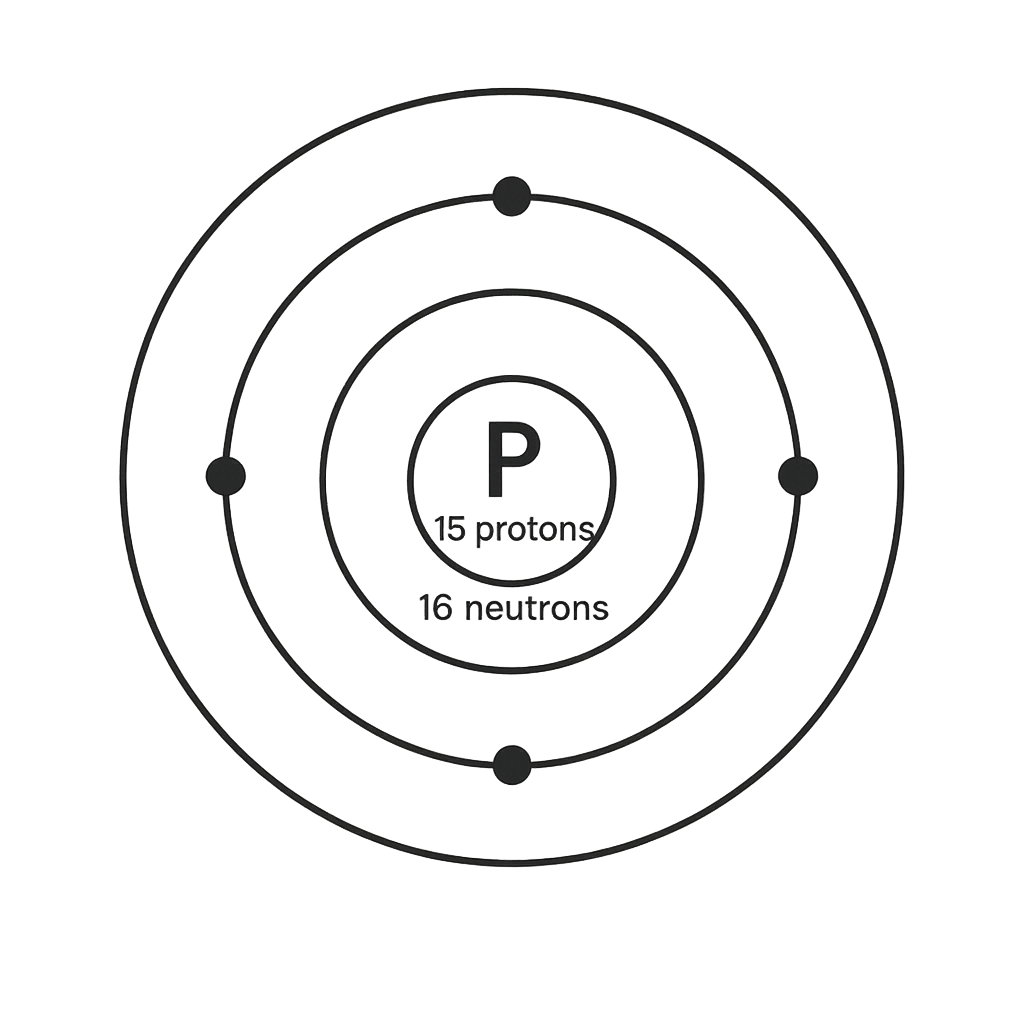
The diagram shows a Bohr model of a neutral phosphorus atom. Using the information in the diagram, state the number of protons, neutrons and electrons present in the atom.
A. 15 protons, 16 neutrons, 16 electrons
Correct B. 15 protons, 16 neutrons, 15 electrons
C. 15 protons, 15 neutrons, 15 electrons
D. 16 protons, 16 neutrons, 15 electrons

Correct Answer: B

Want to see the full step-by-step solution? Unlock AI Explanation & Analytics
Question 17 View Details
An atom of magnesium has a mass number of 24 and an atomic number of 12. How many neutrons are present in this atom?
A. 11
B. 14
Correct C. 12
D. 13

Correct Answer: C

Want to see the full step-by-step solution? Unlock AI Explanation & Analytics
Question 18 View Details
A 10.0 g sample of a mixture of 2‑butanol and 1‑butanol contains 60 % (by mass) 2‑butanol. The mixture is oxidised with excess K₂Cr₂O₇/H₂SO₄. Only 2‑butanol is converted to butan‑2‑one (C₄H₈O) in a 1:1 molar ratio, and the reaction proceeds with 90 % efficiency for this alcohol. Calculate the mass of butan‑2‑one obtained (give your answer to two decimal places).
A. 5.84
B. 5.40
Correct C. 5.26
D. 4.68

Correct Answer: C

Want to see the full step-by-step solution? Unlock AI Explanation & Analytics
Question 19 View Details
In acidic solution potassium permanganate oxidises oxalic acid according to the reaction: KMnO₄ + H₂C₂O₄ → CO₂ + Mn²⁺ + H₂O. If 0.10 mol of KMnO₄ reacts completely with excess oxalic acid, calculate the volume of CO₂ produced at STP (22.4 L per mole).
A. 4.5
B. 22.4
C. 2.2
Correct D. 11.2

Correct Answer: D

Want to see the full step-by-step solution? Unlock AI Explanation & Analytics
Question 20 View Details
Consider the galvanic cell: Zn(s) | Zn²⁺ (0.010 M) || Cu²⁺ (0.10 M) | Cu(s). Standard reduction potentials are E°(Zn²⁺/Zn) = -0.76 V and E°(Cu²⁺/Cu) = +0.34 V. Calculate the cell potential at 25 °C using the Nernst equation and state whether the cell reaction is spontaneous.
Correct A. 1.13 V
B. -0.59 V
C. 0.59 V
D. 1.45 V

Correct Answer: A

Want to see the full step-by-step solution? Unlock AI Explanation & Analytics
Question 21 View Details
What is the atomic number of the element whose chemical symbol is Zn?
Correct A. 30
B. 28
C. 31
D. 34

Correct Answer: A

Want to see the full step-by-step solution? Unlock AI Explanation & Analytics
Question 22 View Details
A 2.00 mol sample of water at 20 °C is heated until it becomes steam at 120 °C. Given: specific heat capacity of liquid water = 4.18 J g⁻¹ K⁻¹, specific heat capacity of steam = 2.01 J g⁻¹ K⁻¹, latent heat of vaporisation of water = 2260 J g⁻¹. Calculate the total heat required for the whole process. Give your answer in kJ (to one decimal place).
Correct A. 94.9 kJ
B. 110.0 kJ
C. 85.3 kJ
D. 102.5 kJ

Correct Answer: A

Want to see the full step-by-step solution? Unlock AI Explanation & Analytics
Question 23 View Details
In acidic solution, potassium dichromate reacts with iron(II) sulfate according to the redox reaction. Write the balanced overall equation and calculate the mass of FeSO₄ required to completely react with 5.00 g of K₂Cr₂O₇, assuming excess FeSO₄ is not present. Give your answer in grams to three significant figures.
A. 18.7 g
B. 14.2 g
C. 12.3 g
Correct D. 15.5 g

Correct Answer: D

Want to see the full step-by-step solution? Unlock AI Explanation & Analytics
Question 24 View Details
A steel pipeline (external diameter 200 mm, wall thickness 10 mm) is to be protected by galvanising with a zinc coating. In the soil the corrosion rate of zinc is 0.025 mm yr⁻¹ for the first 5 years and then increases by 20 % for the remaining period. The corrosion rate of steel, if exposed, would be 0.15 mm yr⁻¹. Determine the minimum thickness of zinc coating required so that the steel does not become exposed for at least 20 years. Give your answer in millimetres, rounded up to two decimal places.
Correct A. 0.58 mm
B. 0.62 mm
C. 0.71 mm
D. 0.45 mm

Correct Answer: A

Want to see the full step-by-step solution? Unlock AI Explanation & Analytics
Question 25 View Details
Which element in period 3 of the periodic table has the highest first ionisation energy?
A. S
B. Cl
Correct C. Ar
D. P

Correct Answer: C

Want to see the full step-by-step solution? Unlock AI Explanation & Analytics

Master the Exam!

You've seen a preview, but there are thousands more questions plus AI tutor to break down complex solutions.

Unlock Full Access Available for Android & Windows
Help others prepare! Share this practice hub:
Chat with Support