waec model questions vol1 2022 biology | Objective

Are you preparing for waec model questions vol1 exams? Reviewing past questions is one of the most effective ways to guarantee a high score. This practice hub features authentic 2022 biology (Objective) questions designed to simulate the real exam environment.

Practice these randomly selected questions to test your readiness.

Question 1 View Details
A culture of *Bacillus subtilis* is inoculated with 10³ cells in a nutrient broth at 30 °C. Under optimal conditions its generation time is 20 min. At 37 °C the generation time increases by 15 % because of heat stress. The culture is incubated for 4 h at 30 °C and then the temperature is shifted to 37 °C for the remaining time. How many cells are present after a total incubation of 8 h?
A. 473000000
B. 71680000000
C. 4194304000
Correct D. 5665000000

Correct Answer: D

Want to see the full step-by-step solution? Unlock AI Explanation & Analytics
Question 2 View Details
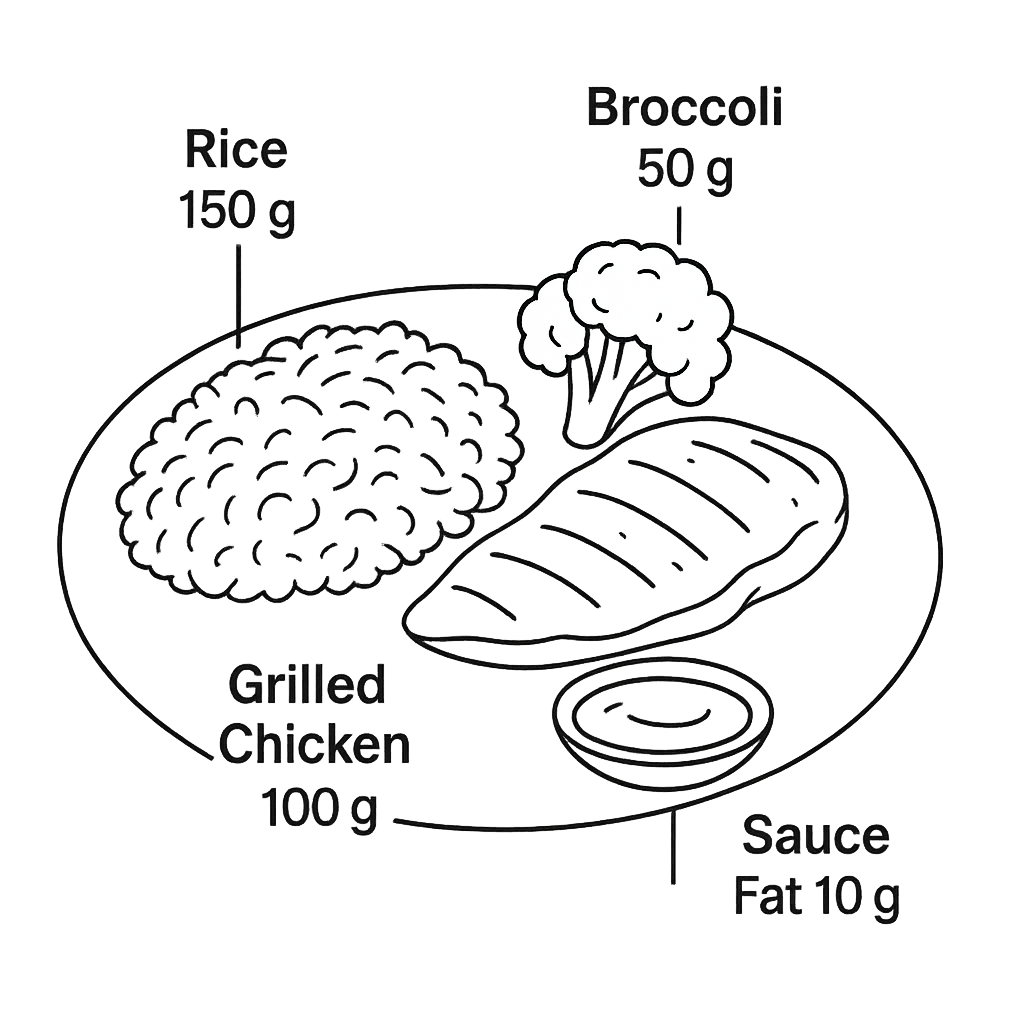
The diagram shows a meal plate containing 150 g of rice, 100 g of grilled chicken, 50 g of broccoli and a sauce that contributes 10 g of fat. Assume the following composition: rice - 80 % carbohydrate, 2 % protein; chicken - 30 % protein, 5 % fat; broccoli - 7 % carbohydrate, 3 % protein; sauce - only fat. Using Atwater factors (carbohydrate = 4 kcal g⁻¹, protein = 4 kcal g⁻¹, fat = 9 kcal g⁻¹), calculate the percentage of the total caloric content of the meal that is supplied by carbohydrates. Round to the nearest whole percent.
A. 58
B. 69
Correct C. 64
D. 68

Correct Answer: C

Want to see the full step-by-step solution? Unlock AI Explanation & Analytics
Question 3 View Details
An adult male's diet provides 2500 kcal per day with 55 % of the calories from carbohydrates, 15 % from protein and the remainder from fat. The diet supplies 30 mg of vitamin C. The RDA for vitamin C for an adult male is 90 mg. Each orange (130 g) contains 70 mg of vitamin C and supplies 150 kcal per 100 g, all of which is carbohydrate. How many grams of orange must be added to meet the vitamin C RDA, and what will be the new percentage of calories derived from carbohydrates after the orange is added? Give the orange mass to the nearest gram and the carbohydrate percentage to the nearest whole percent.
A. 95 g; 55 %
B. 130 g; 60 %
C. 120 g; 62 %
Correct D. 111 g; 58 %

Correct Answer: D

Want to see the full step-by-step solution? Unlock AI Explanation & Analytics
Question 4 View Details
Name the organelle in which oxidative phosphorylation takes place in eukaryotic cells.
A. Chloroplast
Correct B. Mitochondrion
C. Endoplasmic reticulum
D. Nucleus

Correct Answer: B

Want to see the full step-by-step solution? Unlock AI Explanation & Analytics
Question 5 View Details
During strenuous activity a muscle cell performs anaerobic glycolysis followed by lactic‑acid fermentation. In this pathway each glucose yields 2 ATP from glycolysis, and the conversion of pyruvate to lactate re‑oxidises the 2 NADH produced, which would otherwise generate 3 ATP each via oxidative phosphorylation. If aerobic oxidation of one glucose yields 30 ATP, (a) what is the net loss of ATP per glucose when the cell uses anaerobic fermentation instead of aerobic respiration? (b) If the cell consumes 5 × 10⁶ glucose molecules per minute under anaerobic conditions, calculate the total ATP produced per minute and the difference compared with the theoretical aerobic ATP production for the same glucose amount. Express the difference in ATP molecules per minute.
Correct A. 28 ATP per glucose; 1.4×10⁸ ATP per minute
B. 28 ATP per glucose; 1.2×10⁸ ATP per minute
C. 26 ATP per glucose; 1.3×10⁸ ATP per minute
D. 30 ATP per glucose; 1.5×10⁸ ATP per minute

Correct Answer: A

Want to see the full step-by-step solution? Unlock AI Explanation & Analytics
Question 6 View Details
A diploid human somatic cell contains 46 chromosomes. After the S phase of the cell cycle, how many chromatids are present in the cell?
Correct A. 92
B. 48
C. 46
D. 94

Correct Answer: A

Want to see the full step-by-step solution? Unlock AI Explanation & Analytics
Question 7 View Details
A patient's kidney function tests show a glomerular filtration rate (GFR) of 120 mL min⁻¹ and a renal plasma flow (RPF) of 600 mL min⁻¹. Calculate the filtration fraction as a percentage and state whether it lies within the normal adult range (20‑25 %).
A. 20%; above normal range
B. 24%; within normal range
C. 15%; below normal range
Correct D. 20%; within normal range

Correct Answer: D

Want to see the full step-by-step solution? Unlock AI Explanation & Analytics
Question 8 View Details
Each flower of a certain plant species has 5 stamens, and each stamen produces 200 pollen grains. A pollinator visits 12 such flowers and transfers 60 % of the total pollen to compatible stigmas. If each transferred pollen grain fertilises one ovule and each flower contains 8 ovules, how many seeds are formed in total?
A. 72
B. 144
Correct C. 96
D. 120

Correct Answer: C

Want to see the full step-by-step solution? Unlock AI Explanation & Analytics
Question 9 View Details
Two mammals, A and B, live in the same cold environment. Species A has a body surface area of 0.8 m², fur thickness of 2 mm and thermal conductivity of its fur 0.04 W m⁻¹ K⁻¹. Species B has a surface area of 1.2 m², fur thickness of 5 mm and conductivity 0.03 W m⁻¹ K⁻¹. Assuming a constant core‑to‑ambient temperature difference of 20 °C and using the heat‑loss formula $Q = k\,A\,\Delta T / d$, which species loses less heat and by what factor?
A. Species B; about 200 W (≈63 % of species A's loss)
B. Species B; about 100 W (≈31 % of species A's loss)
Correct C. Species B; about 144 W (≈45 % of species A's loss)
D. Species B; about 250 W (≈78 % of species A's loss)

Correct Answer: C

Want to see the full step-by-step solution? Unlock AI Explanation & Analytics
Question 10 View Details
In a community of 10 000 people an infectious disease shows exponential growth, with the number of cases doubling every 5 days. The average infectious period is 7 days. Assuming a simple SIR model where the early‑growth rate $r$ satisfies $r = (R_0-1)/D$, estimate the basic reproduction number $R_0$ and the proportion of the population that must be immunised to achieve herd immunity (threshold = $1-1/R_0$). Express the herd‑immunity proportion as a percentage.
A. 40.9
B. 58.1
C. 45
Correct D. 49.3

Correct Answer: D

Want to see the full step-by-step solution? Unlock AI Explanation & Analytics
Question 11 View Details
A bacterial culture grows exponentially. After 2 h the population is 5.0×10⁶ cells and after 5 h it is 4.0×10⁷ cells. (i) Determine the generation time (in hours). (ii) Using that generation time, calculate the expected number of cells after 10 h. (iii) If a bacteriostatic agent reduces the growth rate by 30%, what will be the population after 10 h under the same initial conditions?
A. 3.2×10⁸ cells
B. 8.0×10⁷ cells
C. 2.0×10⁸ cells
Correct D. 1.6×10⁸ cells

Correct Answer: D

Want to see the full step-by-step solution? Unlock AI Explanation & Analytics
Question 12 View Details
A person's glomerular filtration rate (GFR) is 120 mL min⁻¹. Of the filtrate, 99 % is re‑absorbed in the proximal tubule, 85 % of the remainder is re‑absorbed in the loop of Henle, and 95 % of the remaining fluid is re‑absorbed in the distal tubule. Assuming no other losses, what is the total volume of urine produced in one day (24 h)?
A. 0.96 L
B. 1.5 L
Correct C. 1.28 L
D. 2.0 L

Correct Answer: C

Want to see the full step-by-step solution? Unlock AI Explanation & Analytics
Question 13 View Details
At sea level the atmospheric pressure is 760 mmHg and the water vapour pressure in the alveoli is 47 mmHg. The fraction of inspired O₂ is 0.21. A subject has an arterial PCO₂ of 40 mmHg and a respiratory quotient (RQ) of 0.8. Using the alveolar gas equation, calculate the alveolar partial pressure of O₂ (PAO₂).
A. ≈ 85 mmHg
Correct B. ≈ 100 mmHg
C. ≈ 115 mmHg
D. ≈ 130 mmHg

Correct Answer: B

Want to see the full step-by-step solution? Unlock AI Explanation & Analytics
Question 14 View Details
A diploid human cell (46 chromosomes) has completed DNA replication and therefore contains 46 chromosomes each consisting of two sister chromatids. At the end of anaphase of mitosis, how many individual chromatids are present in the cell?
A. 46
B. 184
C. 94
Correct D. 92

Correct Answer: D

Want to see the full step-by-step solution? Unlock AI Explanation & Analytics
Question 15 View Details
In a closed community of 10 000 people an infectious disease has a basic reproduction number $R_{0}=2.5$. A vaccination programme immunises 60 % of the population with a vaccine that is 90 % effective. Assuming homogeneous mixing, (i) calculate the effective reproduction number $R_{e}$ after vaccination and state whether herd immunity is achieved, and (ii) determine the minimum vaccination coverage (with the same vaccine efficacy) required to achieve herd immunity.
A. Re = 1.30 (no herd immunity); minimum coverage ≈ 55 %
B. Re = 0.75 (herd immunity); minimum coverage ≈ 80 %
C. Re = 0.90 (herd immunity); minimum coverage ≈ 60 %
Correct D. Re = 1.15 (no herd immunity); minimum coverage ≈ 66.7 %

Correct Answer: D

Want to see the full step-by-step solution? Unlock AI Explanation & Analytics
Question 16 View Details
In a grassland ecosystem the following energy transfers occur: - Herbivore group A consumes 40 % of the net primary productivity (NPP) and respire 30 % of the energy it ingests. - Herbivore group B consumes the remaining 60 % of NPP and respire 50 % of the energy it ingests. - Carnivores feed on the post‑respiration energy of the herbivores. They take 25 % of the energy remaining after group A's respiration and 15 % of the energy remaining after group B's respiration. Carnivores respire 55 % of the energy they ingest. - The energy that finally reaches the top‑predator level (i.e., after carnivore respiration) is measured as 2 200 kJ m⁻² yr⁻¹. Assuming all plant material consumed by the herbivores originates from the ecosystem's NPP, calculate the NPP (in kJ m⁻² yr⁻¹).
Correct A. ≈ 42 500 kJ m⁻² yr⁻¹
B. ≈ 35 000 kJ m⁻² yr⁻¹
C. ≈ 48 000 kJ m⁻² yr⁻¹
D. ≈ 55 000 kJ m⁻² yr⁻¹

Correct Answer: A

Want to see the full step-by-step solution? Unlock AI Explanation & Analytics
Question 17 View Details
In a beetle population two alleles, A and a, segregate at a single locus. The fitnesses are w(AA)=1.00, w(Aa)=0.90 and w(aa)=0.80. Mutation from A to a occurs at a rate μ = 2×10⁻⁴ per generation, while reverse mutation is negligible. The initial frequency of allele A is p₀ = 0.60. Assuming selection and mutation act each generation, what is the frequency of allele A after one generation (to three decimal places)?
A. 0.604
B. 0.580
Correct C. 0.626
D. 0.642

Correct Answer: C

Want to see the full step-by-step solution? Unlock AI Explanation & Analytics
Question 18 View Details
A fish species is modelled with three age classes. Survival from age 1 to age 2 is 0.5, and from age 2 to age 3 is 0.7; no individuals survive beyond age 3. Fecundities (offspring per individual per year) are: age 1 = 0, age 2 = 1.2, age 3 = 2.5. Construct the Leslie matrix for this species and determine the long‑term population growth rate (the dominant eigenvalue λ). Give λ to two decimal places.
A. 1.34
Correct B. 1.16
C. 1.05
D. 0.96

Correct Answer: B

Want to see the full step-by-step solution? Unlock AI Explanation & Analytics
Question 19 View Details
A 30‑year‑old female weighs 70 kg and is 165 cm tall. Using the Mifflin‑St Jeor equation, her basal metabolic rate (BMR) is BMR = (10 × weight) + (6.25 × height) - (5 × age) - 161 (kcal day⁻¹). She is moderately active (activity factor 1.55). She wishes to lose 5 kg in 10 weeks, assuming that a loss of 1 kg of fat requires a 7 700 kcal deficit. What daily caloric intake should she adopt (rounded to the nearest kilocalorie)?
A. 1700 kcal/day
Correct B. 1650 kcal/day
C. 1800 kcal/day
D. 1500 kcal/day

Correct Answer: B

Want to see the full step-by-step solution? Unlock AI Explanation & Analytics
Question 20 View Details
Fossil measurements show that the length of a particular bone increased from 10 mm to 15 mm over a period of 2 million years. Express the evolutionary rate in darwins (where 1 darwin = change in the natural logarithm of a trait per million years). Give your answer to two decimal places.
A. 0.15 darwins
B. 0.35 darwins
C. 0.25 darwins
Correct D. 0.20 darwins

Correct Answer: D

Want to see the full step-by-step solution? Unlock AI Explanation & Analytics
Question 21 View Details
The plant family Solanaceae comprises 4 subfamilies. The overall average number of genera per subfamily is 9, and the overall average number of species per genus is 28. Subfamily A contains 6 genera, each with an average of 22 species. Subfamily B contains 12 genera, each with an average of 35 species. The remaining two subfamilies (C and D) have the same number of genera, and within each of them the average number of species per genus is the same unknown value k. Determine the total number of species in the entire Solanaceae family.
A. 1020
B. 960
Correct C. 1008
D. 1080

Correct Answer: C

Want to see the full step-by-step solution? Unlock AI Explanation & Analytics
Question 22 View Details
A student drinks 2 L of a solution that contains 0.5 g of urea. The urea distributes uniformly in the extracellular fluid, whose volume is 20 L. The kidneys filter plasma at a rate of 120 mL·min⁻¹ for 4 h. During filtration, 99% of the filtered water is re‑absorbed, while 85% of the filtered urea is re‑absorbed. Assuming no metabolic loss of urea, how many grams of urea are excreted in the urine?
A. 0.15
B. 0.09
Correct C. 0.108
D. 0.12

Correct Answer: C

Want to see the full step-by-step solution? Unlock AI Explanation & Analytics
Question 23 View Details
A patient's daily calcium intake is 1000 mg. Under normal conditions, 500 mg are deposited in bone each day and 150 mg are re‑absorbed by the kidneys; the remainder is excreted. After administration of a drug that blocks calcitonin, bone deposition falls by 40% while renal calcium re‑absorption rises by 20% of its normal value. What is the net change in the amount of calcium excreted per day (in mg) compared with the normal condition?
Correct A. 170
B. 190
C. 210
D. 150

Correct Answer: A

Want to see the full step-by-step solution? Unlock AI Explanation & Analytics
Question 24 View Details
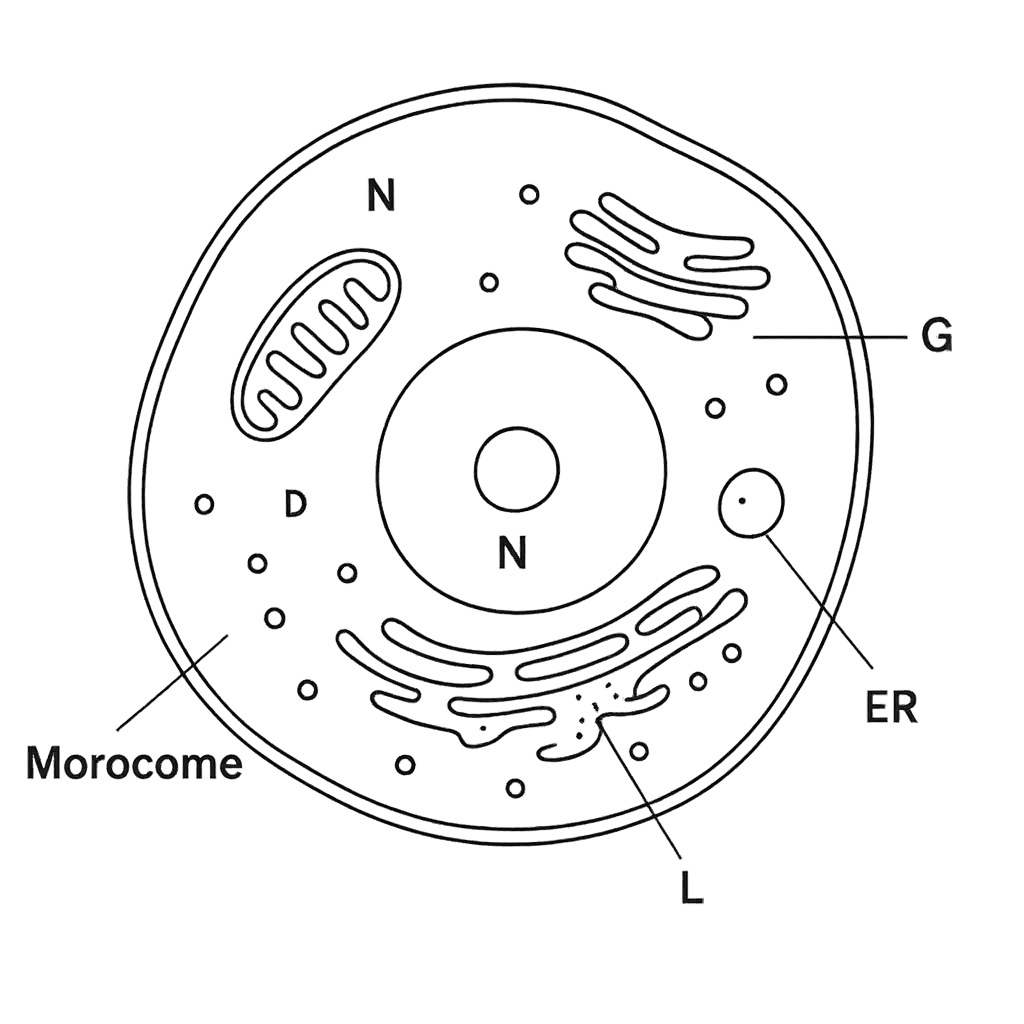
Refer to the labelled diagram of an animal cell. Which organelle is primarily responsible for the synthesis of ATP?
A. chloroplast
Correct B. mitochondrion
C. nucleus
D. ribosome

Correct Answer: B

Want to see the full step-by-step solution? Unlock AI Explanation & Analytics
Question 25 View Details
During a spinal reflex, the sensory neuron fires at a frequency of 120 impulses per second. Each impulse would normally release 5×10⁴ acetylcholine (ACh) molecules at the neuromuscular junction, but presynaptic inhibition reduces the release by 10%. The postsynaptic muscle fibre contains acetylcholinesterase that hydrolyses ACh at a rate of 2×10⁶ molecules per second. Assuming steady‑state conditions, what is the net accumulation of ACh molecules in the synaptic cleft per second?
A. 4000000
B. 4200000
C. 3600000
Correct D. 3400000

Correct Answer: D

Want to see the full step-by-step solution? Unlock AI Explanation & Analytics

Master the Exam!

You've seen a preview, but there are thousands more questions plus AI tutor to break down complex solutions.

Unlock Full Access Available for Android & Windows
Help others prepare! Share this practice hub:
Chat with Support