waec model questions vol1 2022 agricultural_science | Objective

Prepare for your exams with waec model questions vol1 questions? Reviewing past/model questions is one of the most effective ways to guarantee a high score. This practice hub features authentic 2022 agricultural_science (Objective) questions designed to simulate the real exam environment.

Practice these randomly selected questions to test your readiness.
Question 1 View Details
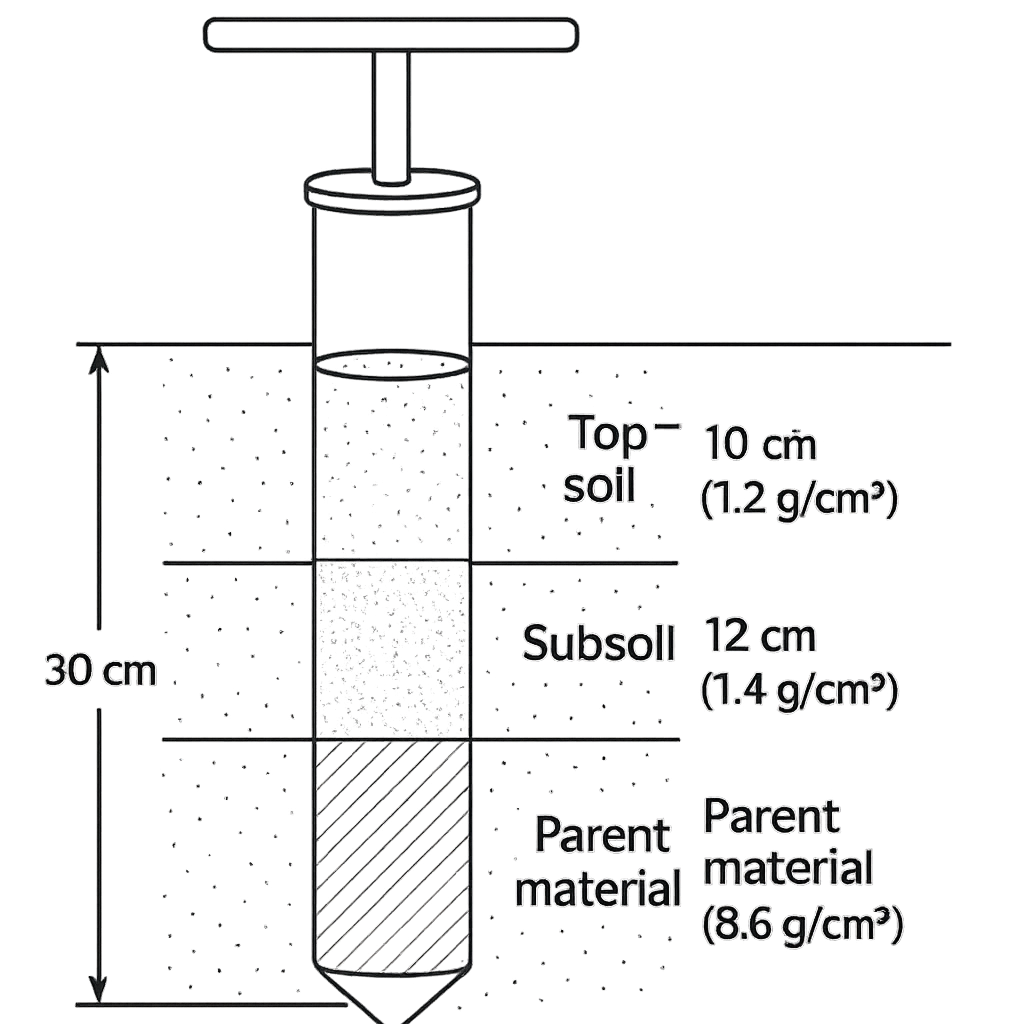
A soil core sampler of length 30 cm is driven vertically into the ground and the extracted core shows three distinct layers: Topsoil (10 cm thick, bulk density 1.2 g/cm³), Subsoil (12 cm thick, bulk density 1.4 g/cm³) and Parent material (8 cm thick, bulk density 1.6 g/cm³). Assuming the cross‑sectional area of the core is 1 cm², calculate the average bulk density of the whole core sample.
A. 1.25 g/cm³
Correct B. 1.39 g/cm³
C. 1.45 g/cm³
D. 1.33 g/cm³

Correct Answer: B

Want to see the full step-by-step solution? Unlock AI Explanation & Analytics
Question 2 View Details
A farmer uses a hand hoe whose handle is 1.2 m long. The hoe blade is 0.2 m from the pivot (the hand). The farmer applies a force at the end of the handle directed 30° upward from the horizontal. What minimum magnitude of force must be applied to lift a rock weighing 30 N?
A. 12 N
B. 8 N
Correct C. 10 N
D. 15 N

Correct Answer: C

Want to see the full step-by-step solution? Unlock AI Explanation & Analytics
Question 3 View Details
A farmer intends to cultivate maize on 5 hectares. Expected yield is 4 tonnes per hectare. Variable cost is ₦150,000 per tonne produced, and fixed cost is ₦200,000 per hectare. The market price is ₦250,000 per tonne, but if total production exceeds 15 tonnes the price falls by 5%. Calculate the farmer's profit or loss.
A. ₦850,000 profit
Correct B. ₦750,000 profit
C. ₦650,000 profit
D. ₦750,000 loss

Correct Answer: B

Want to see the full step-by-step solution? Unlock AI Explanation & Analytics
Question 4 View Details
A pest population on a farm follows $P(t)=P_0e^{kt}$ where $P_0=200$ insects/ha at $t=0$ weeks and $k=0.3$ per week. The economic injury level (EIL) is 800 insects/ha. A pesticide costs ₦50,000 per hectare and reduces the population by 90% instantly. Each insect above the EIL causes a loss of ₦200. The farmer can apply the pesticide only once. In which week should the pesticide be applied to minimise the total cost (pesticide cost plus loss)?
A. Week 4
B. Week 2
Correct C. Week 3
D. Week 5

Correct Answer: C

Want to see the full step-by-step solution? Unlock AI Explanation & Analytics
Question 5 View Details
A farmer wants to sow soybeans on 2 hectares. The recommended seed rate is 80 kg/ha for 100 % germination. A germination test shows the seed batch has 85 % viability. The farmer also intends to sow a legume cover crop that requires 20 kg/ha, and this cover‑crop seed must constitute exactly 10 % of the total seed mixture. How many kilograms of seed (soybean + cover crop) must the farmer purchase for the 2‑hectare field?
A. 420 kg
Correct B. 400 kg
C. 350 kg
D. 380 kg

Correct Answer: B

Want to see the full step-by-step solution? Unlock AI Explanation & Analytics
Question 6 View Details
A farmer cultivates 2 ha of maize. Expected yield without disease is 5 t ha⁻¹. A fungal disease reduces yield by 5 % of the potential yield for every 10 % increase in disease incidence. After scouting, 30 % of the plants show symptoms. A fungicide reduces the observed incidence by 40 % and costs ₦12,000 per ha. The market price of maize is ₦150 per kg. Should the farmer apply the fungicide? State the decision and the net monetary gain or loss compared with not applying the fungicide.
A. Yes, the farmer should apply the fungicide; net gain of ₦45,000
B. No, the farmer should not apply the fungicide; net loss of ₦12,000
C. Yes, the farmer should apply the fungicide; net gain of ₦0
Correct D. Yes, the farmer should apply the fungicide; net gain of ₦66,000

Correct Answer: D

Want to see the full step-by-step solution? Unlock AI Explanation & Analytics
Question 7 View Details
A farmer must plow 5 ha. Two options are available: (i) a manual plough that a person can till 0.2 ha per hour, (ii) a tractor‑mounted plough that tills 0.8 ha per hour and uses fuel costing ₦500 per hour. Four labourers are available, each can work up to 6 h per day, and the tractor can be used for at most 2 h per day. Labour costs ₦200 per labourer per hour. The farmer wants the field ready within 3 days and to minimise total cost (fuel + labour). Determine how many hours the tractor should be used and how many hours the manual labour should work, and give the minimum total cost (in naira).
A. Use the tractor for 6 hours (2 h each day) and manual labour for 0.5 hour; minimum total cost = ₦3 400
Correct B. Use the tractor for 6 hours (2 h each day) and manual labour for 0.25 hour; minimum total cost = ₦3 200
C. Use the tractor for 4 hours (2 h each day) and manual labour for 1 hour; minimum total cost = ₦3 600
D. Use the tractor for 2 hours (1 h each day) and manual labour for 2 hours; minimum total cost = ₦2 800

Correct Answer: B

Want to see the full step-by-step solution? Unlock AI Explanation & Analytics
Question 8 View Details
A lake supports a fish population that follows logistic growth: dP/dt = rP(1‑P/K), where K = 200 000 kg, r = 0.4 yr⁻¹ and P is the biomass in kg. Harvests of 30 000 kg are taken at the beginning of each year for three consecutive years. Assuming the population at the start (year 0) is at carrying capacity, (a) will the biomass remain above 50 000 kg after the third harvest? (b) What is the greatest constant annual harvest H_max (in kg, rounded to the nearest whole number) that can be taken each year indefinitely without ever allowing the post‑harvest biomass to fall below 50 000 kg?
A. No, the biomass falls below 50 000 kg; H_max = 22 000 kg
Correct B. Yes, the biomass stays above 50 000 kg; H_max = 20 000 kg
C. No, the biomass falls below 50 000 kg; H_max = 18 000 kg
D. Yes, the biomass stays above 50 000 kg; H_max = 15 000 kg

Correct Answer: B

Want to see the full step-by-step solution? Unlock AI Explanation & Analytics
Question 9 View Details
A forest plantation of species X has a volume‑growth function V(t) = 0.05t³ - 0.9t² + 12t (m³ ha⁻¹), where t is the age in years (0 ≤ t ≤ 30). The timber price is ₦500 per m³ and the planting‑site‑preparation cost is ₦15 000 per hectare, incurred at the start of each rotation. The discount rate is 10 % per annum. Determine the integer rotation age T (in years) that maximizes the land expectation value (LEV). Give the optimal T, the timber volume at that age, and the LEV rounded to the nearest thousand naira.
A. Optimal rotation age = 20 years; volume = 600 m³ ha⁻¹; LEV ≈ ₦9 500 000
B. Optimal rotation age = 28 years; volume = 850 m³ ha⁻¹; LEV ≈ ₦11 000 000
Correct C. Optimal rotation age = 30 years; volume = 900 m³ ha⁻¹; LEV ≈ ₦11 500 000
D. Optimal rotation age = 25 years; volume = 800 m³ ha⁻¹; LEV ≈ ₦10 200 000

Correct Answer: C

Want to see the full step-by-step solution? Unlock AI Explanation & Analytics
Question 10 View Details
In a field there are 2 000 plants of species A. Each plant supports on average 3 insects of species B, and each insect of species B is preyed upon by 0.5 birds of species C. Estimate the total number of birds of species C present in the field.
A. 1 500
B. 4 500
Correct C. 3 000
D. 2 000

Correct Answer: C

Want to see the full step-by-step solution? Unlock AI Explanation & Analytics
Question 11 View Details
A foot‑and‑mouth disease vaccine is to be administered to a herd of 250 cattle. The recommended dosage is 2 ml per 100 kg body weight. The average weight of each animal is 450 kg. The vaccine is supplied in bottles containing 500 ml each. How many whole bottles are required to vaccinate the entire herd?
Correct A. 5
B. 7
C. 4
D. 6

Correct Answer: A

Want to see the full step-by-step solution? Unlock AI Explanation & Analytics
Question 12 View Details
A rabbit farm intends to raise the average live weight of its 200 rabbits from 1.2 kg to 1.5 kg over 8 weeks. The feed conversion ratio (FCR) is 3.5 kg feed per kg weight gain. Feed is sold in bags of 25 kg. How many whole bags of feed must be purchased for the whole flock during the 8‑week period?
A. 10
B. 11
C. 8
Correct D. 9

Correct Answer: D

Want to see the full step-by-step solution? Unlock AI Explanation & Analytics
Question 13 View Details
A farmer harvests 5,000 kg of fresh cassava roots. To reduce post‑harvest loss, he processes them into gari. The processing steps cause the following sequential losses: peeling - 8 % of the fresh weight; washing - 5 % of the weight after peeling; fermentation - 12 % of the weight after washing. The final gari contains 12 % moisture (i.e., 88 % dry matter). The market price of dry gari is ₦250 per kilogram of dry matter. Assuming no other losses, calculate the gross revenue the farmer can expect from the processed gari (in naira).
A. 845532
B. 912345
Correct C. 845782
D. 800000

Correct Answer: C

Want to see the full step-by-step solution? Unlock AI Explanation & Analytics
Question 14 View Details
Explain how rotating a maize crop with a leguminous crop benefits soil nitrogen levels, mentioning the specific biological process involved.
A. Leguminous crops improve soil nitrogen by increasing the activity of mycorrhizal fungi, which convert atmospheric nitrogen into usable forms for maize.
B. The benefit comes from leguminous crops absorbing nitrogen from the soil and storing it in their leaves, which decompose and add nitrogen after harvest.
C. Leguminous crops increase soil nitrogen by releasing nitrates directly from their roots, which the following maize crop can absorb.
Correct D. Leguminous crops fix atmospheric nitrogen through symbiotic nitrogen fixation with Rhizobium bacteria, enriching the soil nitrogen for the subsequent maize crop.

Correct Answer: D

Want to see the full step-by-step solution? Unlock AI Explanation & Analytics
Question 15 View Details
A farmer plans to invest in a small poultry unit. Fixed costs (building, equipment) total ₦150,000. Variable cost per bird per year (feed, medicine, labour) is ₦12,000. The farmer expects to raise 200 birds each year for 5 years. At the end of 5 years the equipment can be sold for a salvage value of ₦30,000. Assuming a discount rate of 10 % per annum, calculate the minimum average selling price per bird (in naira) that the farmer must achieve each year to obtain a net present value (NPV) of zero for the project.
A. 12800
Correct B. 12174
C. 13500
D. 11500

Correct Answer: B

Want to see the full step-by-step solution? Unlock AI Explanation & Analytics
Question 16 View Details
A county extension office has a total budget of ₦2,500,000 for a three‑year farmer‑training programme. The cost per farmer consists of a one‑time workshop fee of ₦12,500 and a field‑visit fee of ₦2,000 each year. In addition, the programme incurs a fixed overhead of ₦300,000 per year. The programme aims to train at least 150 farmers and to achieve an average yield increase of 80 tonnes per farmer. Is the budget sufficient? If not, what is the greatest number of farmers that can be trained while still guaranteeing at least a 70 tonne increase per farmer?
A. 101
B. 92
C. 84
Correct D. 86

Correct Answer: D

Want to see the full step-by-step solution? Unlock AI Explanation & Analytics
Question 17 View Details
An infestation of fall armyworm in a maize field starts with 150 larvae ha⁻¹. The population grows exponentially at 15 % per day. The economic injury level (EIL) is 500 larvae ha⁻¹. A pesticide applied on any day costs ₦8,000 and instantly reduces the existing larvae by 70 %. After each application the remaining larvae continue to grow at the same 15 % daily rate. The farmer has a total pest‑control budget of ₦24,000. (a) On which latest day must the farmer first apply the pesticide to keep the population from ever exceeding the EIL? (b) Assuming the farmer follows the optimal schedule, can the required number of applications be afforded within the budget? Answer with the day number and "yes" or "no".
A. day 7, no
B. day 9, yes
Correct C. day 8, no
D. day 8, yes

Correct Answer: C

Want to see the full step-by-step solution? Unlock AI Explanation & Analytics
Question 18 View Details
A teak plantation covers 120 ha. Average stand volume (m³ ha⁻¹) at ages 5, 10, 15 and 20 years are 2.5, 7.0, 12.5 and 18.0 respectively. The forest is managed by harvesting equal‑area compartments every 5 years, each compartment being harvested at the same age (the rotation age). Determine the rotation age (a multiple of 5 years) that gives the maximum average annual sustained yield (total volume harvested per year) for the whole plantation.
A. 10
Correct B. 20
C. 25
D. 15

Correct Answer: B

Want to see the full step-by-step solution? Unlock AI Explanation & Analytics
Question 19 View Details
An extension programme introduced a new seed variety to 200 farmers, each cultivating 1 ha. Before the programme the average yield was 1.8 t ha⁻¹. After one season the average yield rose to 2.4 t ha⁻¹ with a standard deviation of 0.5 t. The market price of maize is ₦150,000 per tonne and the total cost of the programme was ₦1,200,000. Compute (a) the average net benefit per farmer, (b) the overall cost‑benefit ratio (total benefit ÷ total cost) rounded to two decimal places, and state whether the programme is economically viable (ratio > 1).
A. 9.00
B. 12.00
Correct C. 15.00
D. 18.00

Correct Answer: C

Want to see the full step-by-step solution? Unlock AI Explanation & Analytics
Question 20 View Details
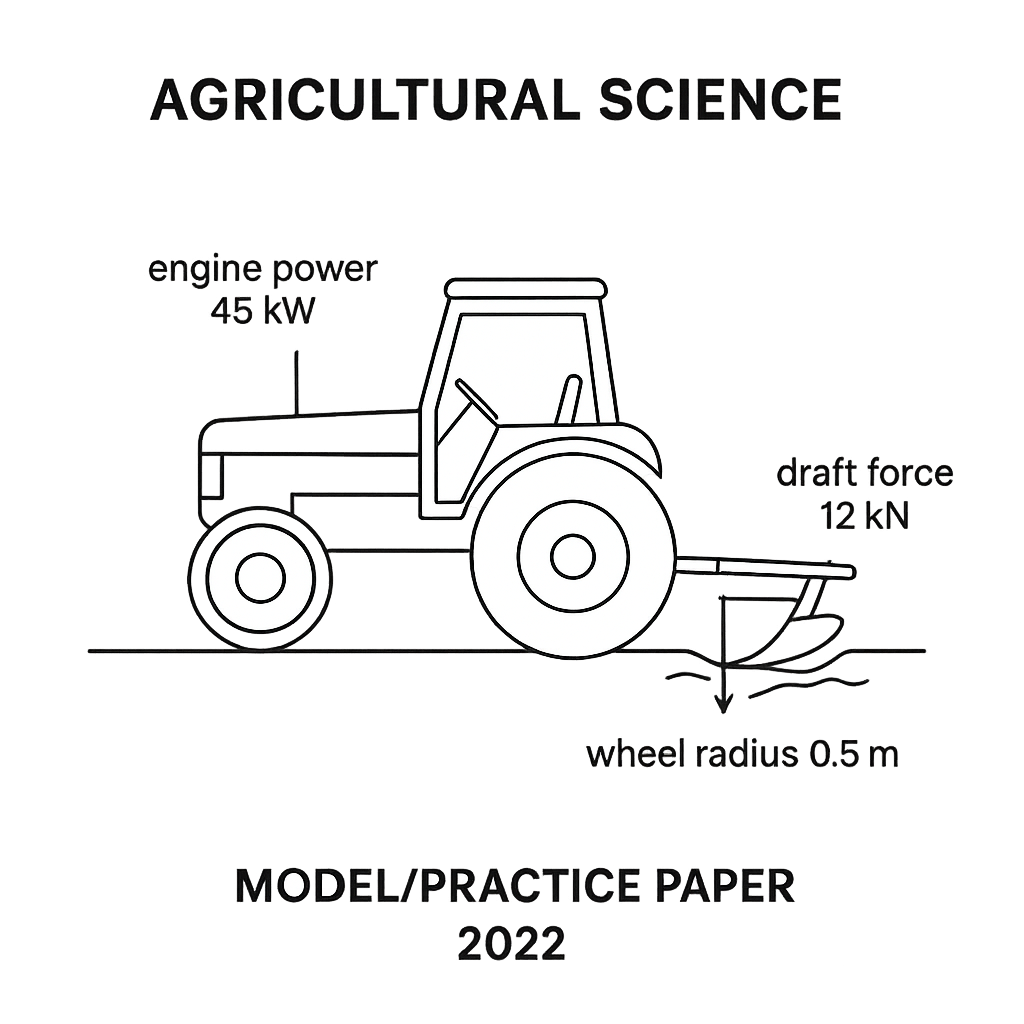
The diagram shows a tractor pulling a single‑bottom plow. The indicated draft force on the drawbar is 12 kN. The tractor wheels have a radius of 0.5 m and the engine power rating is 45 kW. Assuming no mechanical losses, calculate the tractor's forward speed in km h⁻¹.
A. 9.6
Correct B. 13.5
C. 15.0
D. 10.8

Correct Answer: B

Want to see the full step-by-step solution? Unlock AI Explanation & Analytics
Question 21 View Details
In a lake, the fish population follows the logistic growth model dN/dt = rN(1 - N/K). Two constant annual harvests have been recorded: when H = 1,500 fish the population stabilises at N = 8,000 fish; when H = 2,500 fish the population stabilises at N = 6,000 fish. Determine (a) the intrinsic growth rate r (per year) and the carrying capacity K (number of fish); (b) the maximum sustainable yield (MSY) and the equilibrium population at which this yield occurs; (c) the percentage of the carrying capacity represented by this equilibrium population.
A. r ≈ 1.25 per year; K ≈ 8,500 fish; MSY ≈ 2,660 fish per year; equilibrium population at MSY ≈ 4,250 fish; this is 50% of K
B. r ≈ 0.85 per year; K ≈ 10,200 fish; MSY ≈ 2,300 fish per year; equilibrium population at MSY ≈ 5,100 fish; this is 50% of K
Correct C. r ≈ 1.10 per year; K ≈ 9,636 fish; MSY ≈ 2,657 fish per year; equilibrium population at MSY ≈ 4,818 fish; this is 50% of K
D. r ≈ 1.10 per year; K ≈ 9,636 fish; MSY ≈ 3,000 fish per year; equilibrium population at MSY ≈ 5,000 fish; this is 52% of K

Correct Answer: C

Want to see the full step-by-step solution? Unlock AI Explanation & Analytics
Question 22 View Details
Name any two abiotic factors that significantly influence crop growth in a tropical savanna agro‑ecosystem.
A. Nutrient availability and sunlight
B. Soil pH and rainfall
C. Sunlight and wind
Correct D. Soil moisture and temperature

Correct Answer: D

Want to see the full step-by-step solution? Unlock AI Explanation & Analytics
Question 23 View Details
In a cattle herd a contagious disease has a transmission coefficient β = 0.3 per contact per day, each animal makes on average 4 contacts per day, and the average infectious period is 10 days. (a) Calculate the basic reproduction number R₀. (b) What minimum proportion of the herd must be immunised with a perfectly effective vaccine to reduce the effective reproduction number below 1? Express your answer as a percentage.
Correct A. Approximately 91.7% of the herd must be immunised
B. Approximately 78.5% of the herd must be immunised
C. Approximately 84.3% of the herd must be immunised
D. Approximately 97.2% of the herd must be immunised

Correct Answer: A

Want to see the full step-by-step solution? Unlock AI Explanation & Analytics
Question 24 View Details
A tractor of weight 3,000 N must pull a single‑bottom plough 1.2 m wide through a field. The soil resistance is 1,500 N per metre of travel for each metre of plough width. The tractor moves at 5 km/h up a 2% slope. Rolling resistance coefficient of the tractor wheels is 0.02. Assuming a drivetrain efficiency of 85%, calculate the minimum engine power required (in kW).
A. Approximately 2.5 kW
Correct B. Approximately 3.14 kW
C. Approximately 4.2 kW
D. Approximately 5.0 kW

Correct Answer: B

Want to see the full step-by-step solution? Unlock AI Explanation & Analytics
Question 25 View Details
A farmer intends to cultivate 5 ha of maize. Fixed costs (land rent, machinery depreciation) total ₦120,000. Variable cost per hectare (seed, fertilizer, labour) is ₦45,000. Expected yield is 3.5 tonnes per hectare. The farmer desires a profit equal to 20% of the total cost (fixed + variable). What is the minimum selling price per kilogram of maize required to achieve this profit?
A. ₦20.00 per kilogram
B. ₦22.10 per kilogram
Correct C. ₦23.66 per kilogram
D. ₦25.50 per kilogram

Correct Answer: C

Want to see the full step-by-step solution? Unlock AI Explanation & Analytics

Master the Exam!

You've seen a preview, but there are thousands more questions plus AI tutor to break down complex solutions.

Unlock Full Access Available for Android & Windows
Help others prepare! Share this practice hub:
Chat with Support