waec model questions vol1 2022 agricultural_science | Essay

Prepare for your exams with waec model questions vol1 questions? Reviewing past/model questions is one of the most effective ways to guarantee a high score. This practice hub features authentic 2022 agricultural_science (Essay) questions designed to simulate the real exam environment.

Practice these randomly selected questions to test your readiness.

Question 1 View Details
Answer the following questions on Agricultural Ecology.
Question Parts
(a)
Explain the concept of ecological succession that occurs in a cultivated field after it has been left fallow for three years. Include the main stages and the typical changes in plant species composition.
(b)
Discuss two advantages and two disadvantages of monoculture cropping with respect to biodiversity and pest incidence.
(c)
A farmer intends to intercrop maize with cowpea to improve soil fertility and reduce pest damage. Identify three ecological principles that support this practice and briefly explain how each principle contributes to the goal.
Detailed Essay Solution & Marking Scheme Available

Get the step-by-step mathematical proofs, key points required by examiners, and a comprehensive breakdown from our AI Tutor.
Question 2 View Details
A soil infiltration experiment is set up as described in the illustration.
Question Parts
(a)
Describe the step‑by‑step procedure for determining the infiltration rate using the apparatus shown.
(b)
The soil column has a diameter of 10 cm. After 125 seconds, 250 mL of water has been collected in the graduated cylinder. Calculate the infiltration rate in millimetres per hour. Show all working.
(c)
If the recommended infiltration rate for the intended crop is at least 500 mm h⁻¹, state whether the soil is suitable and suggest one management practice to improve infiltration if the rate were lower.
Detailed Essay Solution & Marking Scheme Available

Get the step-by-step mathematical proofs, key points required by examiners, and a comprehensive breakdown from our AI Tutor.

Question 3 View Details
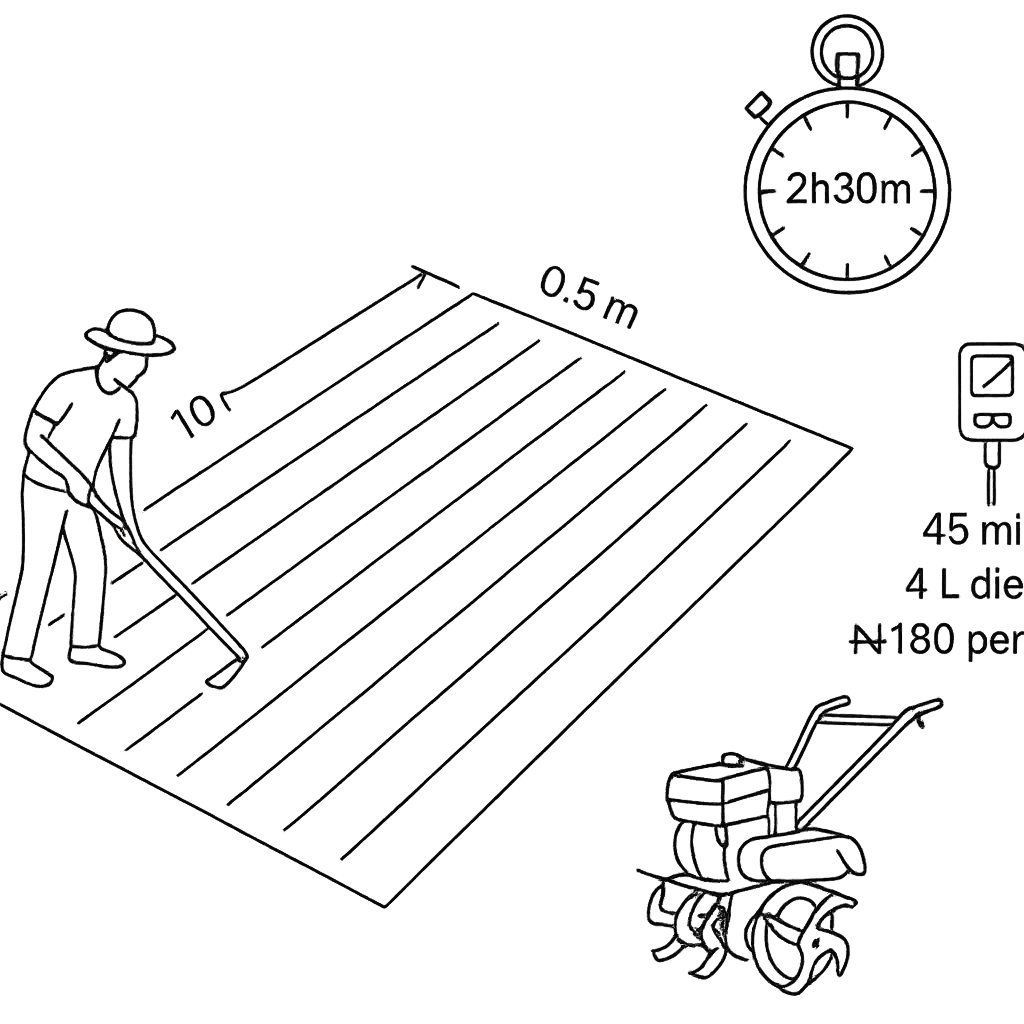
A farmer is using a hand hoe to prepare a rectangular plot of land. The plot measures 10 m in length and 5 m in width. The farmer starts at one corner and works in parallel rows 0.5 m apart, moving the hoe forward 1 m and then returning along the next row. A stopwatch records that the farmer completes the entire plot in 2 hours 30 minutes. The soil moisture meter reads 12 % at the start and 10 % at the end, indicating a slight reduction due to tillage.
Question Parts
(a)
Calculate the total area cultivated per hour by the farmer.
(b)
A motorised tiller can prepare the same plot in 45 minutes but consumes 4 L of diesel at ₦180 per litre. Assuming a manual labour wage of ₦150 per hour, compare the cost of the hand‑hoe method with the fuel cost of the tiller and state which method is more economical.
(c)
Discuss two agronomic advantages of using a motorised tiller over a hand hoe in this context.
(d)
Suggest one management practice that could reduce the observed soil‑moisture loss during tillage.
Detailed Essay Solution & Marking Scheme Available

Get the step-by-step mathematical proofs, key points required by examiners, and a comprehensive breakdown from our AI Tutor.

Question 4 View Details
A smallholder farmer purchases a two‑cylinder diesel tractor for land preparation. The tractor’s rated drawbar pull is 150 kN and it operates at a forward speed of 5 km h⁻¹ when pulling a plough that has a working width of 0.5 m. The tractor’s fuel consumption is 12 L h⁻¹. Diesel costs ₦170 per litre. The farm size to be cultivated is 8 ha. Manual labour for land preparation requires 120 person‑days, each labourer being paid ₦200 per day.
Question Parts
(a)
Calculate the total work (in megajoules) done by the tractor to cultivate the 8 ha, assuming the drawbar pull is applied continuously over the distance travelled.
(b)
Determine the total fuel cost for the tractor to prepare the 8 ha.
Detailed Essay Solution & Marking Scheme Available

Get the step-by-step mathematical proofs, key points required by examiners, and a comprehensive breakdown from our AI Tutor.

Question 5 View Details
A farmer cultivates maize on a 5‑hectare field. The current average yield is 2.5 tonnes per hectare. He intends to increase the yield by 20 % in the next season. To achieve this, he plans to use a locally produced organic manure that contains 1.5 % nitrogen (N) by weight. Maize requires an average of 120 kg of N per hectare for the desired yield. The farmer also intends to adopt a crop‑rotation system with a leguminous crop.
Question Parts
(a)
Calculate the target yield per hectare and the total maize production expected from the 5‑hectare field after the 20 % increase.
(b)
Determine the quantity of organic manure (in kilograms) that must be applied to the whole field to supply the required nitrogen for the target yield.
(c)
Discuss two advantages and two disadvantages of using the organic manure compared with an inorganic nitrogen fertilizer.
(d)
Explain how incorporating a leguminous crop in a rotation sequence can further enhance soil fertility for the subsequent maize crop.
Detailed Essay Solution & Marking Scheme Available

Get the step-by-step mathematical proofs, key points required by examiners, and a comprehensive breakdown from our AI Tutor.

Question 6 View Details
A dairy farmer keeps 20 lactating cows. Each cow currently produces 15 L of milk per day. The farmer wishes to raise the average daily milk yield to 18 L per cow. The cows are fed a basal diet of 8 kg of roughage per day (energy value 1.2 Mcal kg⁻¹). To meet the extra energy requirement, the farmer will supplement the diet with a concentrate that provides 2.5 Mcal kg⁻¹. The price of the concentrate is ₦250 per kg, and the market price of milk is ₦120 per litre.
Question Parts
(a)
Calculate the total amount of milk (in litres) produced by the herd each day under the current production level.
(b)
Assuming that an additional 0.4 Mcal of metabolizable energy is required for each extra litre of milk produced, determine the extra energy (in Mcal) needed per cow to achieve the target yield of 18 L.
(c)
If the roughage intake remains at 8 kg per cow per day, calculate the amount of concentrate (in kg) that must be added to each cow’s diet to supply the extra 1.2 Mcal of energy. Show your working.
(d)
Discuss two non‑nutritional management practices that could help the farmer achieve the higher milk yield, explaining the rationale for each.
Detailed Essay Solution & Marking Scheme Available

Get the step-by-step mathematical proofs, key points required by examiners, and a comprehensive breakdown from our AI Tutor.

Question 7 View Details
A farmer cultivates maize on a 2.5‑hectare field. During the early vegetative stage, the leaves show characteristic whorls of small, pale‑green larvae feeding on the leaf surface, and later, irregular patches of dead tissue appear.
Question Parts
(a)
Identify the pest responsible for the described damage and give its common name.
(b)
Describe the life cycle of the pest, highlighting the stage that causes most damage to the crop.
(c)
Propose an integrated pest management (IPM) programme for this pest, including:
() Two cultural control measures.
() Two chemical control measures, specifying the active ingredient.
() One biological control agent.
(d)
The recommended pesticide formulation contains 200 g of active ingredient per litre. The label advises a dosage of 0.75 L per hectare. Calculate:
() The total volume of pesticide required for the whole field.
() The total amount (in grams) of active ingredient applied.
() If the pesticide costs ₦1 200 per litre, determine the total cost for treating the field.
Detailed Essay Solution & Marking Scheme Available

Get the step-by-step mathematical proofs, key points required by examiners, and a comprehensive breakdown from our AI Tutor.

Question 8 View Details
During a survey of a tomato farm, a total of 200 plants were examined for two foliar diseases: leaf spot disease (Disease X) and wilt disease (Disease Y). The observations were as follows: 30 plants showed only leaf spot symptoms, 15 plants showed only wilt symptoms, and 5 plants exhibited symptoms of both diseases.
Question Parts
(a)
Calculate the disease incidence (percentage of plants affected) for Disease X and Disease Y separately.
(b)
Determine the overall disease prevalence (percentage of plants showing at least one of the two diseases).
Detailed Essay Solution & Marking Scheme Available

Get the step-by-step mathematical proofs, key points required by examiners, and a comprehensive breakdown from our AI Tutor.

Master the Exam!

You've seen a preview, but there are thousands more questions plus AI tutor to break down complex solutions.

Unlock Full Access Available for Android & Windows
Help others prepare! Share this practice hub:
Chat with Support