waec model questions vol1 2021 mathematics | Essay

Are you preparing for waec model questions vol1 exams? Reviewing past questions is one of the most effective ways to guarantee a high score. This practice hub features authentic 2021 mathematics (Essay) questions designed to simulate the real exam environment.

Practice these randomly selected questions to test your readiness.

Question 1
A school organized a mathematics competition where students were required to solve various problems in different categories. The categories included Number and Numeration as well as Fractions, Decimals, and Percentages. Each category had a different scoring system. In the Number and Numeration category, each correct answer earned 5 points, while in the Fractions, Decimals, and Percentages category, each correct answer earned 3 points. If a student answered 12 questions correctly in the Number and Numeration category and 15 questions correctly in the Fractions, Decimals, and Percentages category, calculate the total score for the student. Additionally, if the student had answered 4 questions incorrectly in the Number and Numeration category, what would be the percentage of correct answers in that category? Finally, if the student aims to achieve a total score of at least 100 points in the competition, how many additional questions must they answer correctly in the Fractions, Decimals, and Percentages category?
Question Parts
(a)
Calculate the total score for the student based on the correct answers provided.
(b)
Determine the percentage of correct answers in the Number and Numeration category.
(c)
Calculate how many additional questions must be answered correctly in the Fractions, Decimals, and Percentages category to achieve a total score of at least 100 points.
Detailed Essay Solution & Marking Scheme Available

Get the step-by-step mathematical proofs, key points required by examiners, and a comprehensive breakdown from our AI Tutor.
Question 2
A bakery sells two types of bread: white bread and whole grain bread. The price of a loaf of white bread is ₦150, while the price of a loaf of whole grain bread is ₦200. If a customer buys a total of 20 loaves of bread for ₦3,500, determine how many loaves of each type were purchased. Additionally, if the customer had budgeted ₦4,000 for the purchase, what percentage of their budget did they spend?
Question Parts
(a)
Set up a system of equations to represent the situation and solve for the number of loaves of white bread and whole grain bread purchased.
(b)
Calculate the percentage of the budget spent by the customer.
Detailed Essay Solution & Marking Scheme Available

Get the step-by-step mathematical proofs, key points required by examiners, and a comprehensive breakdown from our AI Tutor.
Question 3
A garden is in the shape of a rectangular plot measuring 30 meters in length and 20 meters in width. The owner wants to plant flowers in a rectangular section of the garden that occupies 40% of the total area. Additionally, a pathway of uniform width is to be constructed around the flower section, taking up 15% of the total area of the garden. Calculate the dimensions of the flower section and the width of the pathway.
Question Parts
(a)
Calculate the total area of the garden.
(b)
Determine the area of the flower section.
(c)
Let the width of the pathway be x meters. Write an equation representing the area of the flower section plus the area of the pathway, which equals the total area of the garden. Solve for x.
(d)
Using the quadratic formula, find the value of x and interpret its meaning in the context of the problem.
Detailed Essay Solution & Marking Scheme Available

Get the step-by-step mathematical proofs, key points required by examiners, and a comprehensive breakdown from our AI Tutor.
Question 4
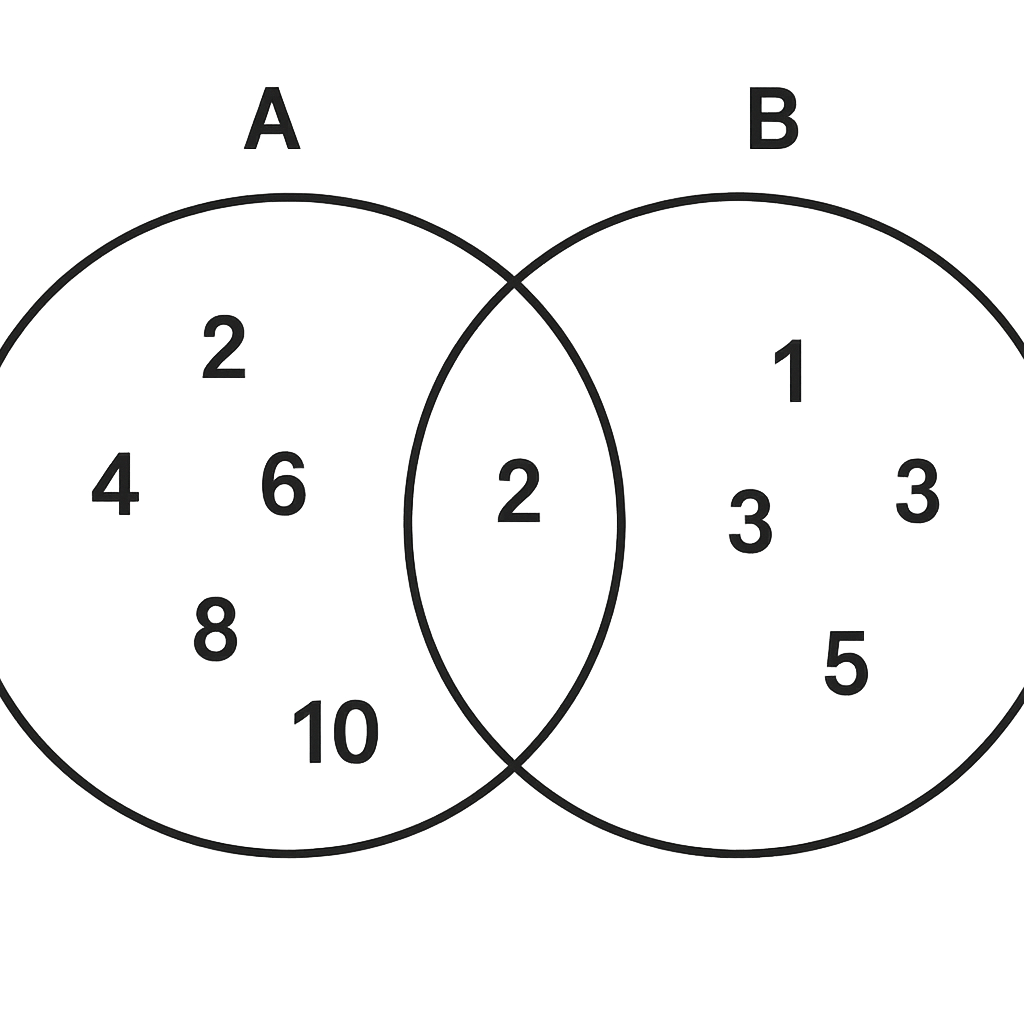
Consider two sets A and B where A = {2, 4, 6, 8, 10} and B = {1, 2, 3, 4, 5}. Using a Venn diagram, illustrate the following: the union of the two sets, the intersection, and the elements unique to each set. Calculate the cardinality of each of these sets.
Question Parts
(a)
Draw a Venn diagram to represent sets A and B.
(b)
List the elements in the union of sets A and B.
(c)
Determine the intersection of sets A and B and state its cardinality.
(d)
Identify the elements unique to each set and calculate their cardinalities.
Detailed Essay Solution & Marking Scheme Available

Get the step-by-step mathematical proofs, key points required by examiners, and a comprehensive breakdown from our AI Tutor.

Question 5
A local school is organizing a sports event. The school has decided to allocate funds for various activities. The total budget for the event is ₦150,000. The activities include a football tournament, a basketball competition, and a cultural display. The football tournament is allocated 40% of the budget, the basketball competition 30%, and the cultural display the remaining amount. (a) Calculate the amount allocated to each activity. (b) If the school decides to increase the total budget by 20% due to additional sponsorship, determine the new allocation for each activity based on the increased budget. (c) If the cultural display requires an additional ₦10,000 for decorations, what percentage of the new total budget will be allocated to the cultural display after this increase?
Question Parts
(a)
Calculate the amount allocated to each activity.
(b)
Determine the new allocation for each activity based on the increased budget.
(c)
What percentage of the new total budget will be allocated to the cultural display after the additional ₦10,000 for decorations?
Detailed Essay Solution & Marking Scheme Available

Get the step-by-step mathematical proofs, key points required by examiners, and a comprehensive breakdown from our AI Tutor.

Question 6
A train travels from City A to City B, a distance of 240 km. The train travels at a speed of 60 km/h for the first part of the journey and then at a speed of 80 km/h for the remaining distance. (a) If the total time taken for the journey is 4 hours, calculate the distance covered at each speed. (b) If the train had traveled the entire distance at a speed of 70 km/h, how long would the journey have taken? (c) Calculate the difference in time taken between the actual journey and the hypothetical journey at 70 km/h.
Question Parts
(a)
Calculate the distance covered at each speed.
(b)
How long would the journey have taken at a speed of 70 km/h?
(c)
Calculate the difference in time taken between the actual journey and the hypothetical journey.
Detailed Essay Solution & Marking Scheme Available

Get the step-by-step mathematical proofs, key points required by examiners, and a comprehensive breakdown from our AI Tutor.

Question 7
A farmer has a rectangular field that measures 120 meters in length and 80 meters in width. The farmer decides to plant two types of crops in the field: maize and cassava. The area allocated for maize is to be twice the area allocated for cassava. (a) Calculate the total area of the field. (b) Let the area allocated for cassava be represented by x. Write an expression for the area allocated for maize in terms of x. (c) Using the expression from part (b), formulate an equation to represent the total area of the field in terms of x. (d) Solve the equation from part (c) to find the area allocated for each type of crop. (e) If the farmer sells the maize at ₦150 per square meter and the cassava at ₦100 per square meter, calculate the total revenue the farmer would earn from selling both crops if all the crops are harvested.
Question Parts
(a)
Calculate the total area of the field.
(b)
Let the area allocated for cassava be represented by x. Write an expression for the area allocated for maize in terms of x.
(c)
Using the expression from part (b), formulate an equation to represent the total area of the field in terms of x.
(d)
Solve the equation from part (c) to find the area allocated for each type of crop.
(e)
If the farmer sells the maize at ₦150 per square meter and the cassava at ₦100 per square meter, calculate the total revenue the farmer would earn from selling both crops if all the crops are harvested.
Detailed Essay Solution & Marking Scheme Available

Get the step-by-step mathematical proofs, key points required by examiners, and a comprehensive breakdown from our AI Tutor.

Question 8
Solve the following inequalities: (a) 3x - 5 < 7 (b) 4 - 2x ≤ 10 (c) x + 3 > 2x - 1. For each inequality, represent the solution on a number line and describe the solution set.
Question Parts
(a)
Solve the inequality 3x - 5 < 7.
(b)
Solve the inequality 4 - 2x ≤ 10.
(c)
Solve the inequality x + 3 > 2x - 1.
(d)
For each inequality, represent the solution on a number line and describe the solution set.
Detailed Essay Solution & Marking Scheme Available

Get the step-by-step mathematical proofs, key points required by examiners, and a comprehensive breakdown from our AI Tutor.

Question 9
A sequence is defined such that the first term is 3 and each subsequent term increases by a constant difference of 5. (a) Write down the first five terms of the sequence. (b) If the nth term of the sequence is represented by T_n, derive an expression for T_n in terms of n. (c) Calculate the 20th term of the sequence. (d) If the sequence is extended, determine the sum of the first 50 terms of the sequence.
Question Parts
(a)
Write down the first five terms of the sequence.
(b)
If the nth term of the sequence is represented by T_n, derive an expression for T_n in terms of n.
(c)
Calculate the 20th term of the sequence.
(d)
If the sequence is extended, determine the sum of the first 50 terms of the sequence.
Detailed Essay Solution & Marking Scheme Available

Get the step-by-step mathematical proofs, key points required by examiners, and a comprehensive breakdown from our AI Tutor.

Question 10
A car's speed varies directly with the time it travels. If a car travels at a speed of 60 km/h for 2 hours, it covers a certain distance. (a) Calculate the distance covered by the car in that time. (b) If the car were to travel at a speed of 90 km/h, how long would it take to cover the same distance? (c) If the car's speed were to decrease to 45 km/h, find the time it would take to cover the same distance. (d) Discuss how the relationship between speed, time, and distance can be represented mathematically.
Question Parts
(a)
Calculate the distance covered by the car in that time.
(b)
If the car were to travel at a speed of 90 km/h, how long would it take to cover the same distance?
(c)
If the car's speed were to decrease to 45 km/h, find the time it would take to cover the same distance.
(d)
Discuss how the relationship between speed, time, and distance can be represented mathematically.
Detailed Essay Solution & Marking Scheme Available

Get the step-by-step mathematical proofs, key points required by examiners, and a comprehensive breakdown from our AI Tutor.

Question 11
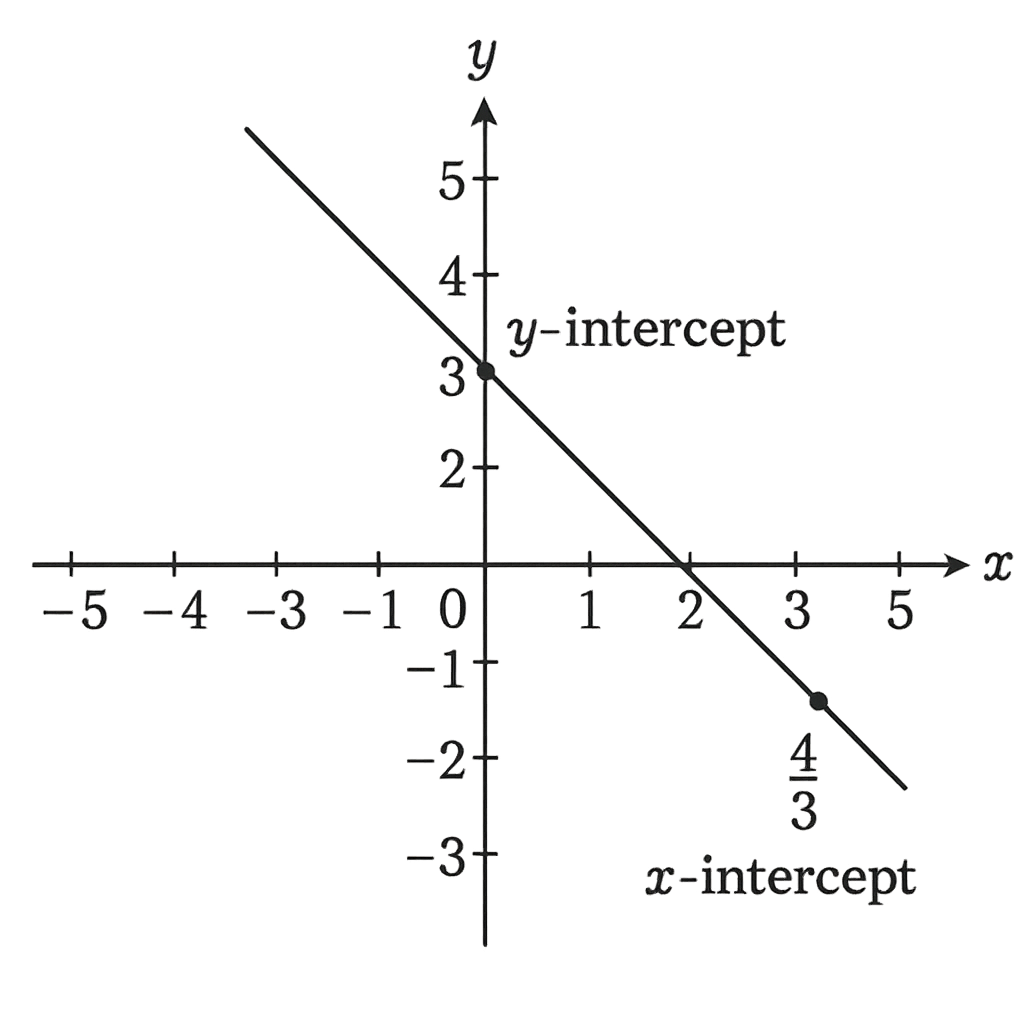
The graph of a linear equation intersects the y-axis at (0, 4) and has a slope of -3. Using this information, determine the equation of the line in slope-intercept form. Then, identify the x-intercept of the line and represent it graphically. Finally, calculate the area of the triangle formed by the x-axis, the y-axis, and the line.
Question Parts
(a)
Determine the equation of the line in slope-intercept form.
(b)
Identify the x-intercept of the line.
(c)
Graph the equation on a coordinate plane and indicate the intercepts.
(d)
Calculate the area of the triangle formed by the x-axis, y-axis, and the line.
Detailed Essay Solution & Marking Scheme Available

Get the step-by-step mathematical proofs, key points required by examiners, and a comprehensive breakdown from our AI Tutor.

Question 12
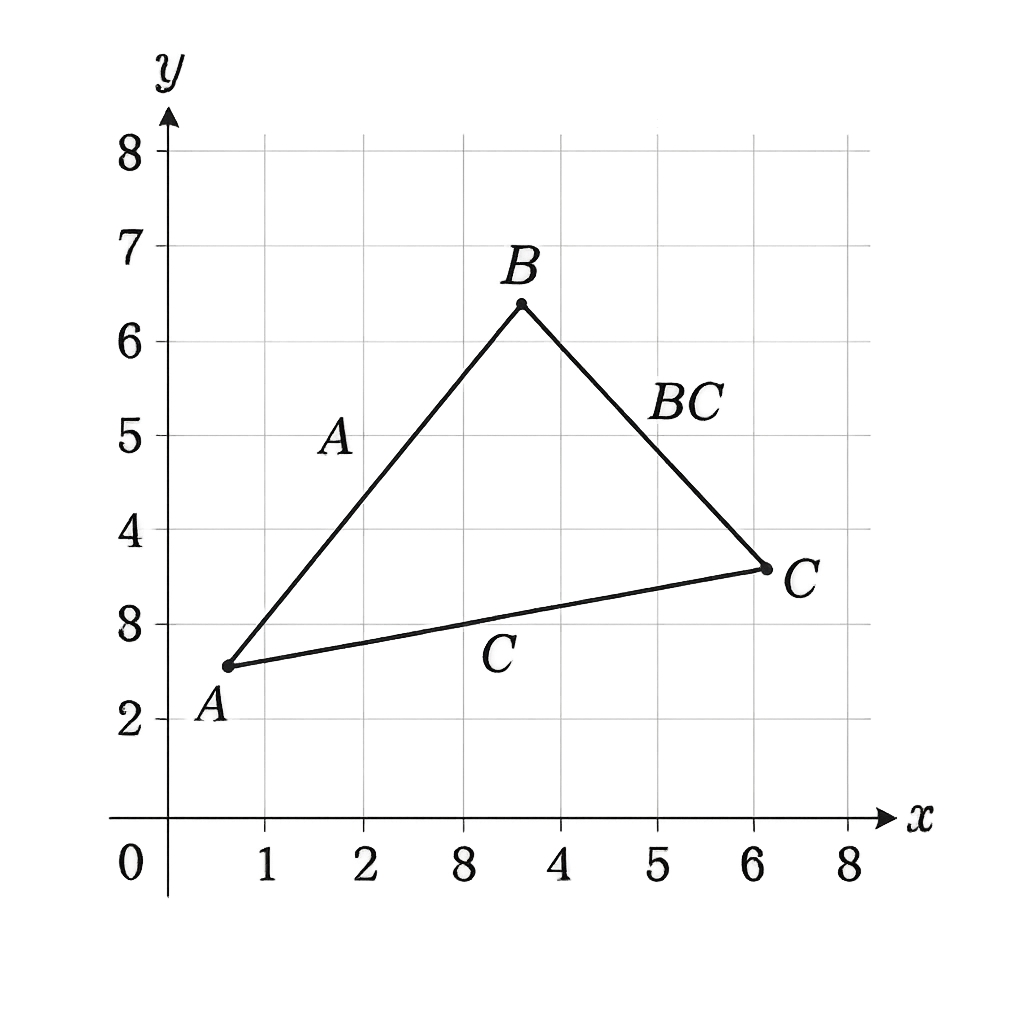
In a coordinate plane, the points A(2, 3), B(4, 7), and C(6, 5) are given. First, determine the lengths of the sides of triangle ABC. Next, calculate the area of triangle ABC using the determinant method. Finally, determine whether triangle ABC is a right triangle by checking the Pythagorean theorem.
Question Parts
(a)
Calculate the lengths of sides AB, BC, and AC.
(b)
Calculate the area of triangle ABC using the determinant method.
(c)
Determine whether triangle ABC is a right triangle using the Pythagorean theorem.
Detailed Essay Solution & Marking Scheme Available

Get the step-by-step mathematical proofs, key points required by examiners, and a comprehensive breakdown from our AI Tutor.

Question 13
The diagram shows triangle ABC, where angle A measures 40 degrees and angle B measures 70 degrees. The length of side AB is 12 cm. Point D is located on side BC such that the ratio of BD to DC is 2:1. Calculate the following:
Question Parts
(a)
Determine the length of side AC.
(b)
Calculate the length of segment BD.
(c)
Determine the area of triangle ABC.
Detailed Essay Solution & Marking Scheme Available

Get the step-by-step mathematical proofs, key points required by examiners, and a comprehensive breakdown from our AI Tutor.

Master the Exam!

You've seen a preview, but there are thousands more questions plus AI tutor to break down complex solutions.

Unlock Full Access Available for Android & Windows
Help others prepare! Share this practice hub:
Chat with Support