waec model questions vol1 2021 geography | Objective

Prepare for your exams with waec model questions vol1 questions? Reviewing past/model questions is one of the most effective ways to guarantee a high score. This practice hub features authentic 2021 geography (Objective) questions designed to simulate the real exam environment.

Practice these randomly selected questions to test your readiness.

Question 1 View Details
A farmer plans to grow maize on a hectare of land. The base yield is 2.5 tonnes/ha when 100 kg of nitrogen fertilizer per hectare, 800 mm of rainfall and a planting density of 40 000 plants/ha are used. Yield responses are as follows: each additional 10 kg N (up to a maximum of 150 kg N) adds 0.2 t/ha; each extra 100 mm of rainfall above 800 mm adds 0.1 t/ha (proportionally for other amounts); for every 5 000 plants/ha above the optimal density the yield falls by 0.15 t/ha (no penalty for lower densities). The forecasted rainfall for the season is 950 mm and the farmer can apply at most 150 kg N/ha. Planting density must be an integer multiple of 5 000 plants/ha between 30 000 and 55 000 plants/ha. The selling price of maize is ₦200 000 per tonne. Pest‑control costs ₦15 000 per ha regardless of other inputs and seed costs ₦0.5 per plant. What planting density (plants per hectare) will give the maximum profit and what is that profit (in Naira) per hectare?
A. 35 000 plants/ha; ₦650 000
B. 30 000 plants/ha; ₦750 000
C. 40 000 plants/ha; ₦600 000
Correct D. 30 000 plants/ha; ₦700 000

Correct Answer: D

Want to see the full step-by-step solution? Unlock AI Explanation & Analytics
Question 2 View Details
A settlement currently has a population of 120 000 people and occupies 3 200 hectares. The natural increase rate is 1.5 % per year and net migration adds 500 persons each year. Each person requires 0.025 hectares of residential land. Assuming the rates remain constant, after how many whole years will the settlement need to expand beyond its present area?
A. 6
B. 3
C. 5
Correct D. 4

Correct Answer: D

Want to see the full step-by-step solution? Unlock AI Explanation & Analytics
Question 3 View Details
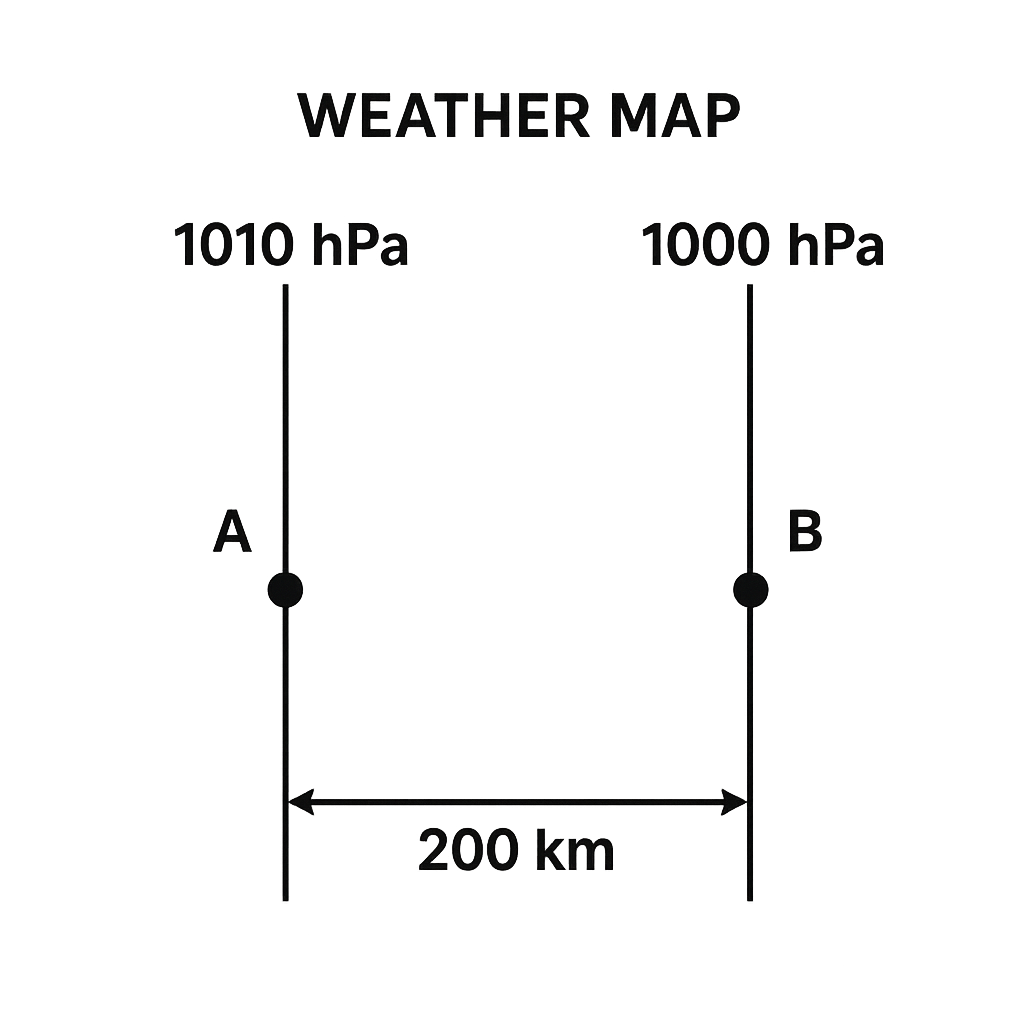
The diagram shows two weather stations, A (west) and B (east). Isobars indicate a pressure of 1010 hPa passing through station A and 1000 hPa passing through station B, the stations being 200 km apart. Using the geostrophic wind approximation V = (1/ρf)·(ΔP/Δd), where air density ρ = 1.2 kg m⁻³ and the Coriolis parameter f = 1×10⁻⁴ s⁻¹, estimate the wind speed at station B. Give your answer in metres per second, rounded to one decimal place.
A. 52.0
B. 45.9
Correct C. 41.7
D. 38.2

Correct Answer: C

Want to see the full step-by-step solution? Unlock AI Explanation & Analytics
Question 4 View Details
An industry uses the production function Q = 10 L^{0.5} K^{0.5}, where Q is output (units), L is labour (units) and K is capital (units). Labour costs ₦200 per unit, capital costs ₦500 per unit, and fixed costs are ₦50 000. The product sells for ₦1 200 per unit. Variable costs (labour + capital) cannot exceed ₦120 000 and both L and K must be integer multiples of 10. Determine the combination of labour and capital that maximizes profit and state the maximum profit (in Naira).
Correct A. Labour = 300 units, Capital = 120 units; Maximum profit = 2 106 880 Naira
B. Labour = 300 units, Capital = 100 units; Maximum profit = 2 000 000 Naira
C. Labour = 280 units, Capital = 130 units; Maximum profit = 2 045 600 Naira
D. Labour = 320 units, Capital = 110 units; Maximum profit = 2 098 400 Naira

Correct Answer: A

Want to see the full step-by-step solution? Unlock AI Explanation & Analytics
Question 5 View Details
Two alternative routes connect City A to City B. Route X: total distance 180 km. The first 100 km can be travelled at 60 km/h, the remaining 80 km at 80 km/h. A toll booth on this route adds a fixed delay of 5 minutes. Route Y: total distance 200 km. The speed limit is 70 km/h throughout, except for a construction zone between km 50 and km 120 where the speed limit drops to 40 km/h. No tolls are present. Which route provides the shorter travel time and what is that minimum travel time expressed in hours and minutes?
A. Route X; 2 hours 30 minutes
B. Route Y; 3 hours 0 minutes
C. Route Y; 2 hours 50 minutes
Correct D. Route X; 2 hours 45 minutes

Correct Answer: D

Want to see the full step-by-step solution? Unlock AI Explanation & Analytics
Question 6 View Details
The population of Town X was 2.5 million at the start of 2010. For the first five years (2010‑2014) it grew at an annual rate of 2.5 %. From 2015 to 2017 the town experienced a net out‑migration of 10 000 persons each year, while the natural growth continued at the same 2.5 % rate. In 2018 a new policy reduced the natural growth rate to 1.5 % and migration ceased. Assuming the rates remain constant thereafter, what was the estimated population at the end of 2020 (rounded to the nearest person)?
A. 3116387
B. 3120000
C. 3096387
Correct D. 3106387

Correct Answer: D

Want to see the full step-by-step solution? Unlock AI Explanation & Analytics
Question 7 View Details
A region covering 12 000 km² is divided into three vegetation zones: forest, savanna and grassland. Forest occupies 30 % of the total area. The area of savanna is twice the area of grassland. If the combined area of forest and savanna is 9 600 km², what is the area (in km²) of the grassland zone?
A. 4500
B. 3600
Correct C. 3000
D. 2400

Correct Answer: C

Want to see the full step-by-step solution? Unlock AI Explanation & Analytics
Question 8 View Details
A sedimentary rock consists of 40 % quartz (density 2.65 g cm⁻³), 35 % calcite (density 2.71 g cm⁻³) and the remainder clay minerals (density 2.58 g cm⁻³). What is the average density of the rock, expressed to three decimal places (g cm⁻³)?
Correct A. 2.654
B. 2.664
C. 2.600
D. 2.645

Correct Answer: A

Want to see the full step-by-step solution? Unlock AI Explanation & Analytics
Question 9 View Details
Lagos lies at 6° 27' N latitude and Abuja at 9° 2' N latitude. Assuming 1° of latitude corresponds to 111 km, calculate the approximate north‑south distance between the two cities (in kilometres, rounded to the nearest kilometre).
A. 284
Correct B. 287
C. 291
D. 300

Correct Answer: B

Want to see the full step-by-step solution? Unlock AI Explanation & Analytics
Question 10 View Details
A map has a scale of 1 cm : 5 km. The distance between Town A and Town B on the map measures 7.2 cm. What is the actual distance between the towns in kilometres?
Correct A. 36
B. 35
C. 38
D. 40

Correct Answer: A

Want to see the full step-by-step solution? Unlock AI Explanation & Analytics
Question 11 View Details
The map of the district is drawn at a scale of 1 cm : 5 km. On the map the straight‑line distance between Town A and Town B is 3 cm, but the road shown follows a detour that is 4 cm long. What is the shortest possible real distance (in km) between the two towns?
A. 25 km
Correct B. 15 km
C. 20 km
D. 12 km

Correct Answer: B

Want to see the full step-by-step solution? Unlock AI Explanation & Analytics
Question 12 View Details
A farmer can increase the yield of maize by applying fertilizer as shown in the table below. The price of maize is ₦5 per kg and fertilizer costs ₦20 per kg. | Fertilizer (kg) | Yield (kg) | |----------------|------------| | 0 | 2000 | | 50 | 2600 | | 100 | 3400 | | 150 | 4300 | | 200 | 5200 | Assuming the yield varies linearly between the listed points, what is the minimum whole kilogram of fertilizer that must be applied to achieve a profit of at least ₦16,000?
A. 120 kg
Correct B. 113 kg
C. 110 kg
D. 115 kg

Correct Answer: B

Want to see the full step-by-step solution? Unlock AI Explanation & Analytics
Question 13 View Details
A textile factory employs 200 workers and produces 5,000 units of fabric per month. When 50 additional workers are hired, output rises to 5,800 units. (a) Calculate the average product of labour (units per worker) before and after the increase. (b) Assuming the marginal product of the additional workers remains constant, estimate how many extra workers are needed to raise output by another 2,000 units.
A. Average product before: 25 units/worker; after: 22.0 units/worker; additional workers needed: 100
Correct B. Average product before: 25 units/worker; after: 23.2 units/worker; additional workers needed: 125
C. Average product before: 20 units/worker; after: 24.5 units/worker; additional workers needed: 150
D. Average product before: 26 units/worker; after: 23.2 units/worker; additional workers needed: 130

Correct Answer: B

Want to see the full step-by-step solution? Unlock AI Explanation & Analytics
Question 14 View Details
A rock sample weighing 250 g has the following mineral composition by weight: quartz 40 %, feldspar 30 %, mica 20 %, other minerals 10 %. Typical granite contains 20-60 % quartz, 10-65 % feldspar and at most 20 % mica. Determine whether the sample can be classified as granite, and state the weight of quartz present in the sample.
A. Yes; 110 g
Correct B. Yes; 100 g
C. No; 100 g
D. No; 90 g

Correct Answer: B

Want to see the full step-by-step solution? Unlock AI Explanation & Analytics
Question 15 View Details
A catchment area of 5 km² is composed of 30 % residential land (runoff coefficient 0.55) and 70 % agricultural land (runoff coefficient 0.30). During a storm the rainfall intensity is 20 mm/h lasting 1 hour. Using the rational method, calculate the peak discharge in cubic metres per second (m³/s), rounding to one decimal place.
A. 9.6 m³/s
Correct B. 10.4 m³/s
C. 8.3 m³/s
D. 12.0 m³/s

Correct Answer: B

Want to see the full step-by-step solution? Unlock AI Explanation & Analytics
Question 16 View Details
A catchment receives 250 mm of rainfall in a month. Evaporation loss equals 30% of the rainfall, and after evaporation, 20% of the remaining water infiltrates into the ground. What is the net runoff depth (in mm) from the catchment for that month?
A. 175 mm
B. 215 mm
C. 105 mm
Correct D. 140 mm

Correct Answer: D

Want to see the full step-by-step solution? Unlock AI Explanation & Analytics
Question 17 View Details
A bus travels a total distance of 360 km from City A to City B. It covers the first 120 km at 60 km/h. Because of road works, the next 150 km is travelled at a speed reduced by 20% of the previous speed. After completing these two sections, the bus stops for 15 minutes and then covers the remaining distance at a constant speed. The whole journey takes exactly 6 hours. What was the average speed (in km/h) for the final segment?
Correct A. 144 km/h
B. 150 km/h
C. 120 km/h
D. 96 km/h

Correct Answer: A

Want to see the full step-by-step solution? Unlock AI Explanation & Analytics
Question 18 View Details
A river has eroded a canyon to a depth of 250 m over 5 million years. During the first 2 million years the average erosion rate was 30% higher than during the later period. Assuming a constant rate within each period, what was the average erosion rate (in mm per year) during the later period?
A. 0.035 mm per year
Correct B. 0.045 mm per year
C. 0.040 mm per year
D. 0.055 mm per year

Correct Answer: B

Want to see the full step-by-step solution? Unlock AI Explanation & Analytics
Question 19 View Details
Region X covers 12,500 km² and has a current population of 3.6 million. Its annual population growth rate is 2.4% compounded yearly. Adjacent Region Y covers 9,800 km², has a current population of 2.94 million and grows at 1.8% per year. In how many whole years will the population density of Region X become greater than the projected population density of Region Y? Give the smallest integer number of years after which this occurs.
A. 10 years
B. 5 years
Correct C. 7 years
D. 8 years

Correct Answer: C

Want to see the full step-by-step solution? Unlock AI Explanation & Analytics
Question 20 View Details
A soil sample contains 45% sand, 35% silt and 20% clay by weight. Field capacity (FC) can be estimated by FC = 0.2 × clay % + 0.1 × silt % (in % water content by weight) and wilting point (WP) by WP = 0.1 × clay % + 0.05 × silt % (in %). Assuming that 1% water content by weight corresponds to 10 mm of water per 1 m depth, determine the available water capacity (AWC) in millimetres for a 1.0 m thick soil layer with a bulk density of 1.4 g cm⁻³.
A. 45.0 mm
B. 30.0 mm
Correct C. 37.5 mm
D. 52.5 mm

Correct Answer: C

Want to see the full step-by-step solution? Unlock AI Explanation & Analytics
Question 21 View Details
In a region, a river flows over a resistant sandstone forming a waterfall. Downstream, the river enters a softer shale and erodes vertically at an average rate of 0.5 mm per year. The waterfall formed 10 000 years ago. Assuming the erosion rate has remained constant, what is the approximate depth of the gorge that has developed downstream of the waterfall?
Correct A. 5
B. 10
C. 2
D. 0.5

Correct Answer: A

Want to see the full step-by-step solution? Unlock AI Explanation & Analytics
Question 22 View Details
A catchment area of 250 km² contains a main river 30 km long and three tributaries measuring 12 km, 8 km and 5 km respectively. Calculate the drainage density of the basin (in km km⁻²) and state whether the basin is likely to have high or low infiltration capacity, given that a drainage density greater than 2 km km⁻² indicates low infiltration.
Correct A. 0.22 km km⁻², high infiltration capacity
B. 0.22 km km⁻², low infiltration capacity
C. 0.15 km km⁻², high infiltration capacity
D. 0.35 km km⁻², low infiltration capacity

Correct Answer: A

Want to see the full step-by-step solution? Unlock AI Explanation & Analytics
Question 23 View Details
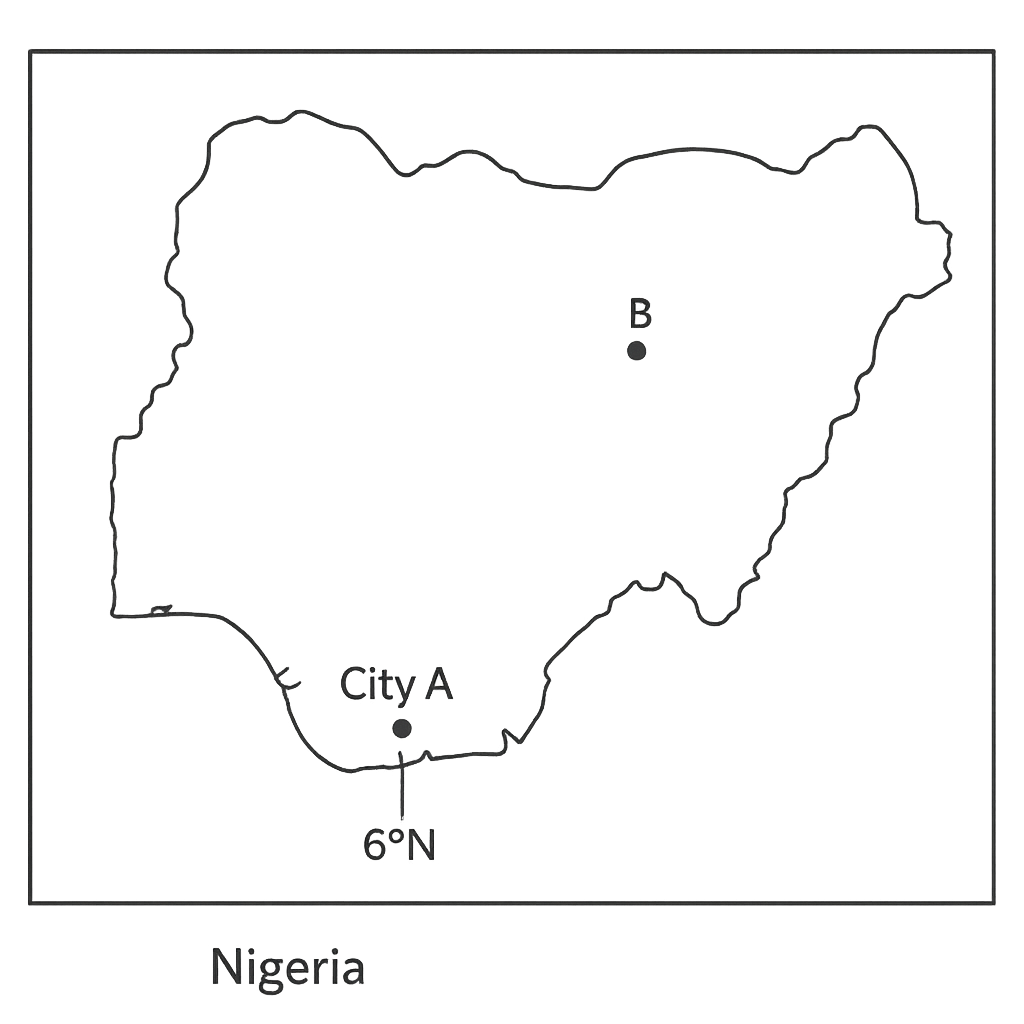
The map shows City A at latitude 6° N, longitude 7° E and City B at latitude 9° N, longitude 7° E. Using the approximation that 1° of latitude equals 111 km, estimate the straight‑line north‑south distance between the two cities.
A. 222
Correct B. 333
C. 444
D. 111

Correct Answer: B

Want to see the full step-by-step solution? Unlock AI Explanation & Analytics
Question 24 View Details
The monthly discharge (in m³ s⁻¹) of River X for a year is: Jan 20, Feb 22, Mar 30, Apr 45, May 70, Jun 90, Jul 100, Aug 95, Sep 80, Oct 55, Nov 35, Dec 25. Identify the month with the highest discharge and explain what this pattern reveals about the dominant source of runoff in the basin.
A. August; nival regime
Correct B. July; pluvial regime
C. July; nival regime
D. June; pluvial regime

Correct Answer: B

Want to see the full step-by-step solution? Unlock AI Explanation & Analytics
Question 25 View Details
A farmer intends to cultivate maize on 5 ha. Expected yield is 4 t ha⁻¹. Maize removes 0.5 % of its grain weight as nitrogen. Soil analysis shows the top 15 cm of soil (bulk density 1.3 g cm⁻³) contains 15 kg N ha⁻¹ of plant‑available nitrogen. Urea fertilizer (46 % N) is applied with an efficiency of 80 %. How many kilograms of urea should be applied to meet the crop's nitrogen requirement?
A. 80
B. 73
C. 54
Correct D. 68

Correct Answer: D

Want to see the full step-by-step solution? Unlock AI Explanation & Analytics

Master the Exam!

You've seen a preview, but there are thousands more questions plus AI tutor to break down complex solutions.

Unlock Full Access Available for Android & Windows
Help others prepare! Share this practice hub:
Chat with Support