waec model questions vol1 2021 chemistry | Objective

Are you preparing for waec model questions vol1 exams? Reviewing past questions is one of the most effective ways to guarantee a high score. This practice hub features authentic 2021 chemistry (Objective) questions designed to simulate the real exam environment.

Practice these randomly selected questions to test your readiness.

Question 1 View Details
A 0.250 g sample of the salt AB₂ (molar mass 150 g·mol⁻¹) is added to 250.0 mL of water at 25 °C. The solution becomes saturated and some solid remains. The solubility product of AB₂ at this temperature is Kₛₚ = 1.6×10⁻⁹. Calculate the concentration of B⁻ ions in the saturated solution (in mol·L⁻¹).
Correct A. 1.48×10⁻³ mol·L⁻¹
B. 1.48×10⁻⁴ mol·L⁻¹
C. 2.96×10⁻³ mol·L⁻¹
D. 7.40×10⁻⁴ mol·L⁻¹

Correct Answer: A

Want to see the full step-by-step solution? Unlock AI Explanation & Analytics
Question 2 View Details
A 8.00 g sample of an unknown compound containing only C, H, O and N is combusted completely in excess O₂. The combustion yields 13.2 g of CO₂ and 5.4 g of H₂O. It is known that the original sample contained 20 % (by mass) nitrogen. Determine the empirical formula of the organic portion (i.e., the part containing only C, H and O).
A. C10H20O5
B. C12H24O5
C. C11H20O5
Correct D. C11H22O5

Correct Answer: D

Want to see the full step-by-step solution? Unlock AI Explanation & Analytics
Question 3 View Details
A 0.500 g piece of an unknown metal Z is reacted with excess dilute H₂SO₄. The reaction produces H₂ gas, and the volume of H₂ collected at STP is 112 mL. The resulting acidic solution is then used to reduce Cu²⁺ ions from a CuSO₄ solution, depositing 0.150 g of copper metal. Assuming the metal forms a sulfate of the type ZSO₄ (i.e., oxidation state +n) and that the reactions proceed with 100 % efficiency, determine the equivalent weight of metal Z.
A. 85 g·eq⁻¹
Correct B. 100 g·eq⁻¹
C. 130 g·eq⁻¹
D. 115 g·eq⁻¹

Correct Answer: B

Want to see the full step-by-step solution? Unlock AI Explanation & Analytics
Question 4 View Details
A galvanic cell is set up at 25 °C with the half‑cells: Zn(s) | Zn²⁺ (0.010 M) || Cu²⁺ (0.10 M) | Cu(s). Standard reduction potentials are E°(Zn²⁺/Zn) = -0.76 V and E°(Cu²⁺/Cu) = +0.34 V. (a) Calculate the cell potential under the given conditions. (b) If this cell is used to drive the electrolysis of water and an overpotential of 0.20 V is required for oxygen evolution, what additional external voltage must be applied to the cell to achieve water splitting?
Correct A. 0.30 V
B. 0.45 V
C. 0.35 V
D. 0.25 V

Correct Answer: A

Want to see the full step-by-step solution? Unlock AI Explanation & Analytics
Question 5 View Details
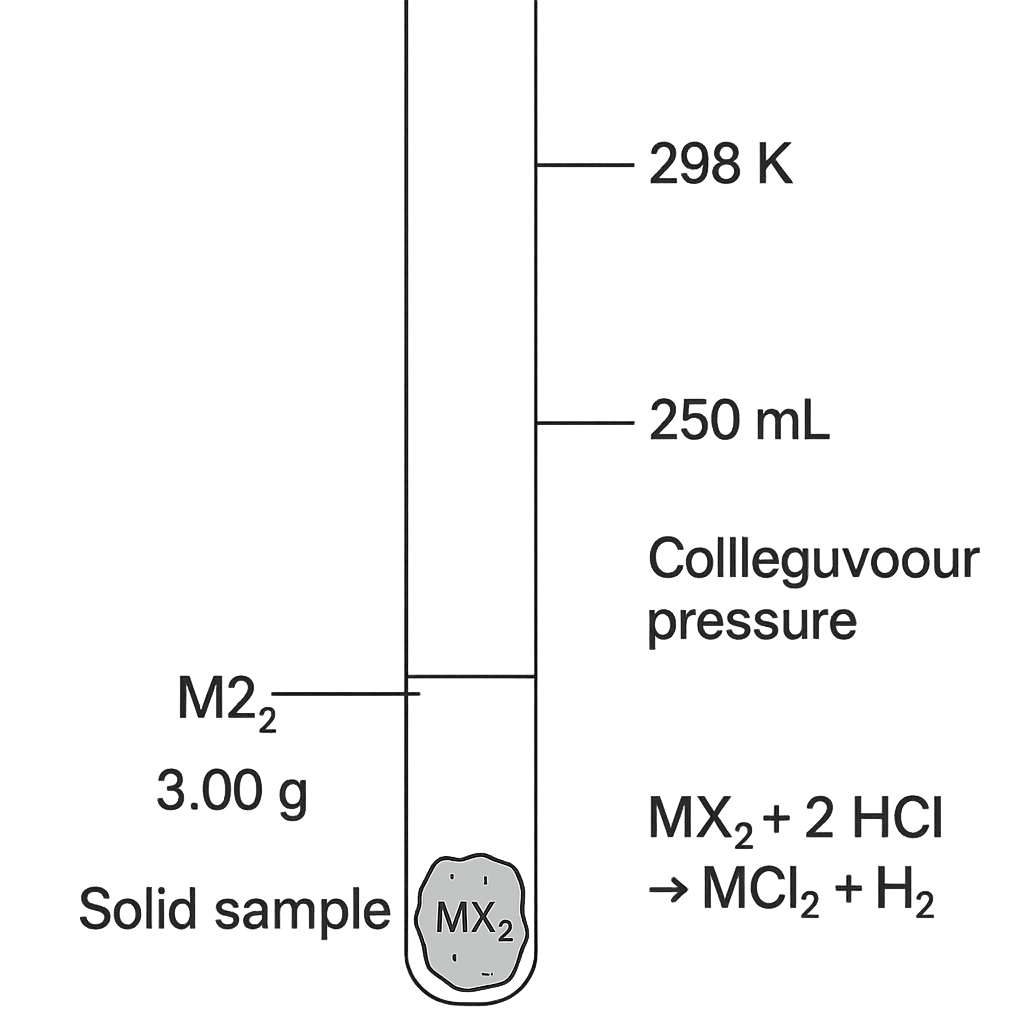
The diagram shows a sealed eudiometer tube containing 50.0 mL of water at 25 °C. A solid sample of MX₂ (unknown metal M, mass 3.00 g) reacts with excess HCl gas inside the tube, producing a gas that displaces the water. The volume of gas collected at the top of the tube is 250.0 mL at the same temperature and pressure. The water‑vapour pressure at 25 °C is 23.8 mm Hg. Using the information from the diagram, determine the atomic mass of metal M (in g·mol⁻¹).
A. 150 g·mol⁻¹
Correct B. 223 g·mol⁻¹
C. 180 g·mol⁻¹
D. 300 g·mol⁻¹

Correct Answer: B

Want to see the full step-by-step solution? Unlock AI Explanation & Analytics
Question 6 View Details
A 2.00 L aqueous solution contains 0.30 mol of sodium acetate (CH₃COONa) and 0.10 mol of acetic acid (CH₃COOH). The acid dissociation constant of acetic acid is Ka = 1.8×10⁻⁵. If 0.040 mol of HCl is added to the solution (volume change is negligible), calculate the pH of the resulting solution.
A. 4.85
B. 5.50
Correct C. 5.01
D. 5.23

Correct Answer: C

Want to see the full step-by-step solution? Unlock AI Explanation & Analytics
Question 7 View Details
Cyclohexanol (C₆H₁₂O) is oxidised with Na₂Cr₂O₇/H₂SO₄ to give a ketone. The ketone is then treated with PCl₅. Write the molecular formula of the final product and name the type of reaction that occurs in each step.
A. C6H12Cl2, oxidation then substitution
B. C6H10Cl2, substitution then oxidation
Correct C. C6H10Cl2, oxidation then substitution
D. C6H10Cl2, oxidation then elimination

Correct Answer: C

Want to see the full step-by-step solution? Unlock AI Explanation & Analytics
Question 8 View Details
A 0.050 mol sample of oxalic acid (H₂C₂O₄, diprotic, Ka₁ = 5.6×10⁻², Ka₂ = 6.4×10⁻⁵) is dissolved in 250.0 mL of water. How many millilitres of 0.200 M NaOH are required to adjust the solution to pH = 3.00? (Assume the second dissociation is negligible at this pH.)
A. 2.46×10^1 mL
B. 3.50×10^2 mL
Correct C. 2.46×10^2 mL
D. 1.23×10^2 mL

Correct Answer: C

Want to see the full step-by-step solution? Unlock AI Explanation & Analytics
Question 9 View Details
An industrial effluent containing phenol at a concentration of 30 mg L⁻¹ is discharged into a river. Phenol degrades in the river by first‑order biodegradation with a rate constant k = 0.15 day⁻¹. The permissible phenol concentration in the river is 2 mg L⁻¹. (a) Assuming no dilution, how many days will it take for the phenol concentration to fall to the permissible level? (b) If the river flow is 5.0×10⁵ L day⁻¹ and the effluent flow is 2.0×10⁴ L day⁻¹, what is the minimum dilution factor (river flow : effluent flow) required so that the phenol concentration after mixing is immediately at or below the permissible level (ignore degradation during mixing)?
Correct A. a) 18.1 days, b) 14
B. a) 20.5 days, b) 16
C. a) 15.3 days, b) 12
D. a) 18.1 days, b) 10

Correct Answer: A

Want to see the full step-by-step solution? Unlock AI Explanation & Analytics
Question 10 View Details
A 0.845 g sample of an unknown compound containing only C, H and O is combusted completely, producing 2.34 g of CO₂ and 0.945 g of H₂O. Determine the empirical formula of the compound and the mass of oxygen present in the original sample.
Correct A. C8H16O, 0.101 g
B. C7H14O, 0.112 g
C. C9H18O, 0.089 g
D. C8H14O2, 0.095 g

Correct Answer: A

Want to see the full step-by-step solution? Unlock AI Explanation & Analytics
Question 11 View Details
A 2.00 g sample of an unknown straight‑chain alkane is burnt completely in excess oxygen. The combustion yields 6.12 g of carbon dioxide and 3.00 g of water. (a) Determine the empirical formula of the alkane. (b) Given that the molar mass of the alkane is 72 g·mol⁻¹, deduce its molecular formula and write its IUPAC name.
A. Empirical formula C₄H₁₀; molecular formula C₈H₁₈; IUPAC name octane
B. Empirical formula C₅H₁₀; molecular formula C₁₀H₂₀; IUPAC name decane
Correct C. Empirical formula C₅H₁₂; molecular formula C₅H₁₂; IUPAC name pentane
D. Empirical formula C₆H₁₄; molecular formula C₆H₁₄; IUPAC name hexane

Correct Answer: C

Want to see the full step-by-step solution? Unlock AI Explanation & Analytics
Question 12 View Details
State the type of chemical bond formed between magnesium and chlorine and give the formula of the compound produced.
A. Metallic bond; MgCl₂
B. Ionic bond; MgCl₃
C. Covalent bond; MgCl₂
Correct D. Ionic bond; MgCl₂

Correct Answer: D

Want to see the full step-by-step solution? Unlock AI Explanation & Analytics
Question 13 View Details
When 5.00 g of aluminium is reacted with excess hydrochloric acid, 4.50 L of hydrogen gas is collected at 25 °C and 1.00 atm. Calculate the percent yield of hydrogen gas. (R = 0.0821 L·atm·mol⁻¹·K⁻¹)
A. 78.9 %
Correct B. 66.2 %
C. 62.5 %
D. 55.0 %

Correct Answer: B

Want to see the full step-by-step solution? Unlock AI Explanation & Analytics
Question 14 View Details
A 1.00 g sample of an unknown metal reacts with an aqueous solution of Cu²⁺ ions, precipitating 1.32 g of copper metal. (Assume the reaction: M(s) + Cu²⁺(aq) → M²⁺(aq) + Cu(s)). Determine the equivalent weight of the metal and identify the metal, given that it belongs to the first transition series and has an atomic number less than 30.
A. Equivalent weight ≈ 22.5 g·equiv⁻¹; metal is vanadium (V)
B. Equivalent weight ≈ 26.0 g·equiv⁻¹; metal is chromium (Cr)
Correct C. Equivalent weight ≈ 24.0 g·equiv⁻¹; metal is titanium (Ti)
D. Equivalent weight ≈ 20.0 g·equiv⁻¹; metal is scandium (Sc)

Correct Answer: C

Want to see the full step-by-step solution? Unlock AI Explanation & Analytics
Question 15 View Details
A buffer solution is prepared by dissolving 0.20 mol of acetic acid (CH₃COOH, Ka = 1.8×10⁻⁵) and 0.15 mol of sodium acetate (CH₃COONa) in 1.00 L of water. (a) Calculate the pH of the buffer. (b) If 0.05 mol of HCl is added to the solution, what is the new pH? (Assume the volume change is negligible.)
A. Initial pH = 4.58; after adding 0.05 mol HCl, pH = 4.30
B. Initial pH = 4.50; after adding 0.05 mol HCl, pH = 4.20
C. Initial pH = 4.74; after adding 0.05 mol HCl, pH = 4.55
Correct D. Initial pH = 4.62; after adding 0.05 mol HCl, pH = 4.34

Correct Answer: D

Want to see the full step-by-step solution? Unlock AI Explanation & Analytics
Question 16 View Details
Chlorine has an atomic number of 17. Using the Aufbau principle, determine how many electrons are present in the second energy level (n = 2) of a neutral chlorine atom.
Correct A. 8
B. 17
C. 2
D. 7

Correct Answer: A

Want to see the full step-by-step solution? Unlock AI Explanation & Analytics
Question 17 View Details
Sodium belongs to group 1 of the periodic table. How many valence electrons does a neutral sodium atom possess?
A. 2
B. 11
Correct C. 1
D. 0

Correct Answer: C

Want to see the full step-by-step solution? Unlock AI Explanation & Analytics
Question 18 View Details
A 2.00 L container at 27 °C contains a mixture of oxygen and nitrogen gases at a total pressure of 1.00 atm. The partial pressure of oxygen is twice that of nitrogen. Calculate the mass of oxygen present in the container. (Molar mass of O₂ = 32.0 g mol⁻¹, R = 0.082057 L·atm·K⁻¹·mol⁻¹)
Correct A. 1.73 g
B. 1.20 g
C. 2.05 g
D. 0.86 g

Correct Answer: A

Want to see the full step-by-step solution? Unlock AI Explanation & Analytics
Question 19 View Details
When 1.00 mol of an unknown alkane CₙH₂ₙ₊₂ is completely combusted, 2210 kJ of heat is released. The heat of combustion of ethane (C₂H₆) is 1560 kJ mol⁻¹. Assuming the heat released per -CH₂- group is the same for all alkanes, determine the molecular formula of the unknown alkane.
A. C5H12
B. C4H10
C. C2H6
Correct D. C3H8

Correct Answer: D

Want to see the full step-by-step solution? Unlock AI Explanation & Analytics
Question 20 View Details
A solution is prepared by dissolving 5.00 g of methanol (CH₃OH, M = 32.04 g mol⁻¹) in 100.0 g of water. The observed boiling point of the solution is 100.5 °C. Assuming the boiling‑point elevation follows \(\Delta T_b = i\,K_b\,m\) with \(K_b\) for water = 0.512 °C·kg mol⁻¹ and that methanol does not ionise (i = 1), (a) calculate the expected boiling‑point elevation and state whether the observation is consistent; (b) if not, determine the apparent molal boiling‑point constant \(K_{b,\text{app}}\) that would give the observed elevation.
Correct A. a) Expected ΔTb = 0.799 °C (predicted boiling point 100.799 °C) - observation not consistent. b) Kb,app = 0.320 °C·kg·mol⁻¹
B. a) Expected ΔTb = 0.799 °C (predicted boiling point 100.799 °C) - observation consistent. b) Kb,app = 0.512 °C·kg·mol⁻¹
C. a) Expected ΔTb = 0.256 °C (predicted boiling point 100.256 °C) - observation not consistent. b) Kb,app = 0.128 °C·kg·mol⁻¹
D. a) Expected ΔTb = 1.024 °C (predicted boiling point 101.024 °C) - observation not consistent. b) Kb,app = 0.256 °C·kg·mol⁻¹

Correct Answer: A

Want to see the full step-by-step solution? Unlock AI Explanation & Analytics
Question 21 View Details
A 200.0 mL solution contains Fe²⁺ and Cr²⁺ ions. It is titrated with 0.0200 M KMnO₄ in acidic medium. Exactly 25.0 mL of the KMnO₄ solution is added, which first oxidises all Fe²⁺ and then partially oxidises Cr²⁺. The excess KMnO₄ remaining after the reaction is back‑titrated with 0.0100 M Fe²⁺ solution, requiring 10.0 mL. If the original concentration of Cr²⁺ was 0.0050 M, calculate the original concentration of Fe²⁺ in the mixture.
A. 5.0×10⁻³ M
Correct B. 7.0×10⁻³ M
C. 7.0×10⁻² M
D. 9.0×10⁻³ M

Correct Answer: B

Want to see the full step-by-step solution? Unlock AI Explanation & Analytics
Question 22 View Details
A saturated solution of AgCl at 25 °C has a solubility of 1.3×10⁻⁵ M. When NaCl is added to give a final chloride concentration of 0.010 M, the solubility of AgCl decreases. (a) Calculate the new solubility of Ag⁺ under these conditions. (b) The solubility product of AgCl at 35 °C is twice that at 25 °C. Assuming the Ksp doubles for every 10 °C increase, estimate the temperature (to the nearest degree Celsius) at which the solution containing 0.010 M Cl⁻ would become unsaturated (i.e., [Ag⁺] < 1.0×10⁻⁶ M).
A. a) 2.6×10⁻⁸ M; b) ≈ 78 °C
B. a) 3.4×10⁻⁸ M; b) ≈ 70 °C
Correct C. a) 1.69×10⁻⁸ M; b) ≈ 84 °C
D. a) 1.0×10⁻⁸ M; b) ≈ 90 °C

Correct Answer: C

Want to see the full step-by-step solution? Unlock AI Explanation & Analytics
Question 23 View Details
A gaseous oxide of phosphorus is collected over water at 298 K and a total pressure of 760 mmHg. The volume of gas collected is 0.155 L and its mass is 0.500 g. The gas is found to contain 40.0 % phosphorus by mass. Determine the empirical and molecular formulas of the oxide.
A. Empirical formula PO₂; molecular formula PO₂
Correct B. Empirical formula PO₃; molecular formula PO₃
C. Empirical formula P₄O₁₀; molecular formula P₄O₁₀
D. Empirical formula P₂O₅; molecular formula P₂O₅

Correct Answer: B

Want to see the full step-by-step solution? Unlock AI Explanation & Analytics
Question 24 View Details
Equal masses of ethanol (C₂H₅OH) and 1‑propanol (C₃H₇OH) are each reacted separately with excess sodium metal in dry ether. The hydrogen gas liberated is collected over water at 25 °C and 1 atm total pressure. The volume of H₂ obtained from the ethanol reaction is 0.560 L, while that from the 1‑propanol reaction is 0.420 L. Determine the common mass of alcohol used in each experiment (to two significant figures).
A. 2.5 g
Correct B. 2.0 g
C. 1.5 g
D. 3.0 g

Correct Answer: B

Want to see the full step-by-step solution? Unlock AI Explanation & Analytics
Question 25 View Details
A 5.00 g sample of a mixture containing CaCO₃ and Na₂CO₃ is heated so that both carbonates decompose: CaCO₃ → CaO + CO₂ and Na₂CO₃ → Na₂O + CO₂. The total volume of CO₂ collected over water at 25 °C and 760 mmHg is 1.68 L. Assuming the overall decomposition yield is 85 % (the same for both carbonates), calculate the mass of CaO obtained (to three significant figures).
A. 0.300 g
Correct B. 0.267 g
C. 0.215 g
D. 0.350 g

Correct Answer: B

Want to see the full step-by-step solution? Unlock AI Explanation & Analytics

Master the Exam!

You've seen a preview, but there are thousands more questions plus AI tutor to break down complex solutions.

Unlock Full Access Available for Android & Windows
Help others prepare! Share this practice hub:
Chat with Support