waec model questions vol1 2021 chemistry | Essay

Prepare for your exams with waec model questions vol1 questions? Reviewing past/model questions is one of the most effective ways to guarantee a high score. This practice hub features authentic 2021 chemistry (Essay) questions designed to simulate the real exam environment.

Practice these randomly selected questions to test your readiness.
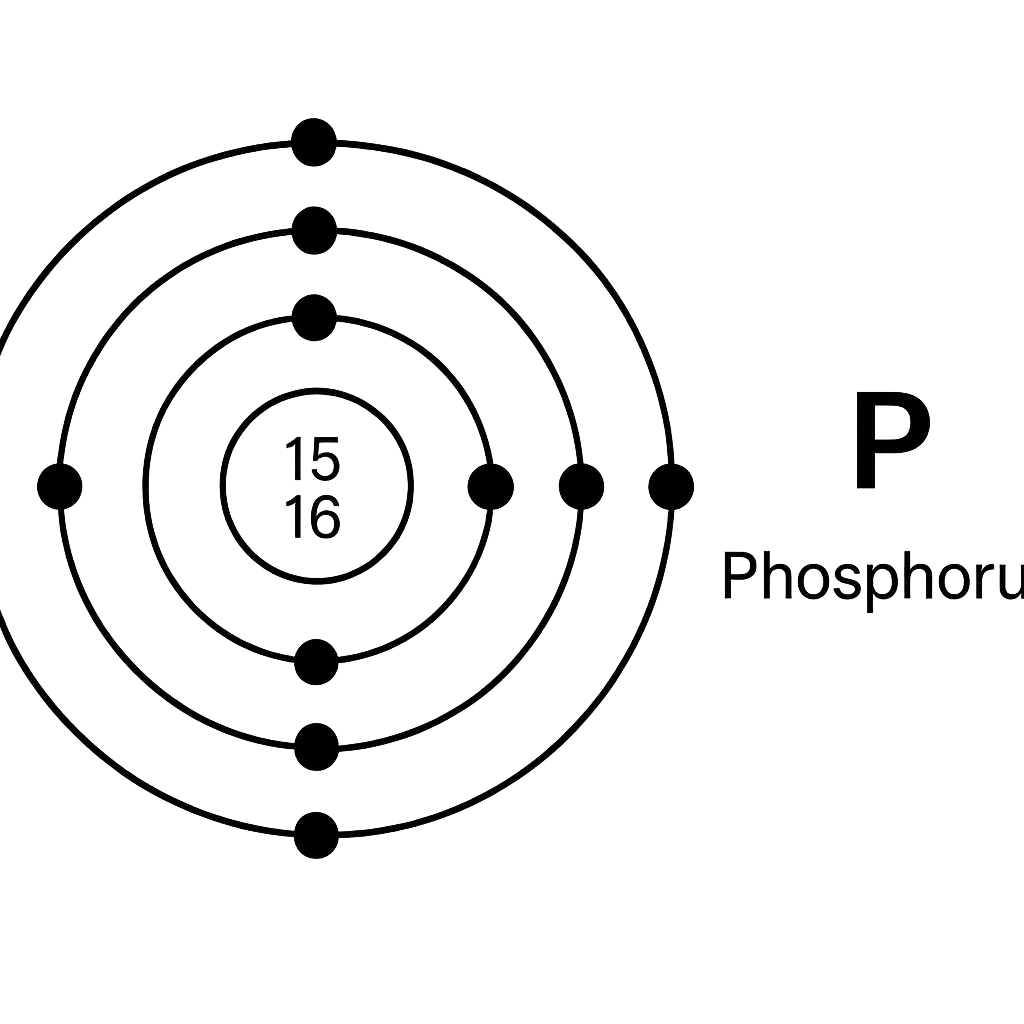
Question 1 View Details
The diagram shows a simplified Bohr model of an unknown element. The nucleus contains 15 protons and 16 neutrons. The electron shells are labelled K, L and M. The K‑shell holds 2 electrons, the L‑shell holds 8 electrons and the M‑shell holds 5 electrons.
Question Parts
(a)
Write the chemical symbol and the name of the element shown in the diagram.
(b)
State the mass number of the element.
(c)
Confirm the number of neutrons present in the atom and explain how you obtained it.
(d)
Write the ground‑state electron configuration of the element using the Aufbau principle.
(e)
The element commonly exhibits oxidation states –3, +3 and +5. Explain, using its valence‑electron arrangement, why these oxidation states are possible.
Detailed Essay Solution & Marking Scheme Available

Get the step-by-step mathematical proofs, key points required by examiners, and a comprehensive breakdown from our AI Tutor.
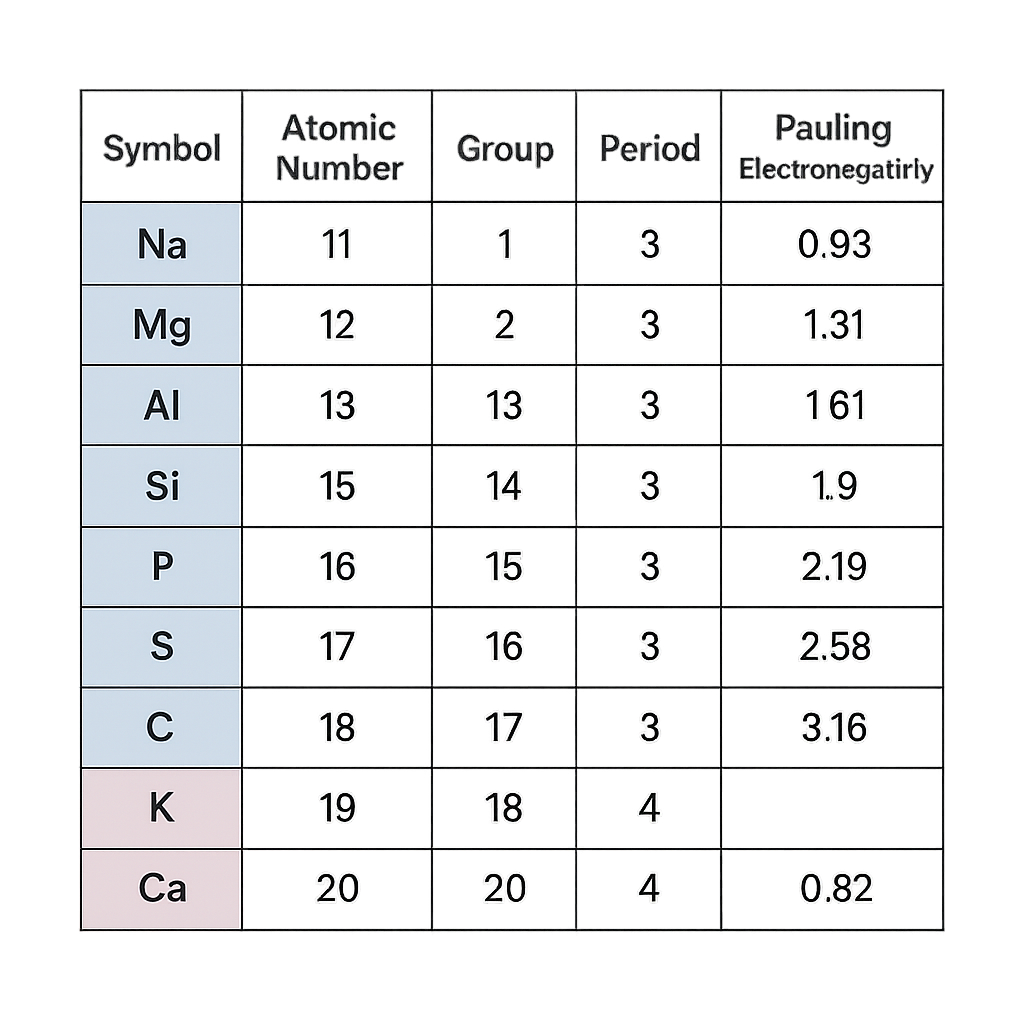
Question 2 View Details
The diagram shows a portion of the periodic table containing the elements with atomic numbers 11 to 20, together with their group numbers, periods and Pauling electronegativity values.
Question Parts
(a)
Identify the element whose electron configuration is [Ar] 4s². State its group number and the oxidation state(s) it most commonly exhibits in its compounds.
(b)
Using the periodic trends illustrated in the diagram, explain why the atomic radius of potassium (K) is larger than that of calcium (Ca).
(c)
Predict the type of bond formed between aluminium (Al) and chlorine (Cl) and justify your answer with the electronegativity values given in the diagram.
Detailed Essay Solution & Marking Scheme Available

Get the step-by-step mathematical proofs, key points required by examiners, and a comprehensive breakdown from our AI Tutor.
Question 3 View Details
Sodium chloride (NaCl) is a typical ionic compound, while carbon dioxide (CO₂) is a covalent molecular compound. Using the concepts of chemical bonding, answer the following.
Question Parts
(a)
Describe the nature of ionic bonding and covalent bonding, highlighting the role of electron transfer and sharing.
(b)
Explain why NaCl has a high melting point and is soluble in water, whereas CO₂ has a low sublimation point and is poorly soluble in water.
(c)
Predict the type of electrical conductivity exhibited by molten NaCl and gaseous CO₂ and justify your answer.
Detailed Essay Solution & Marking Scheme Available

Get the step-by-step mathematical proofs, key points required by examiners, and a comprehensive breakdown from our AI Tutor.

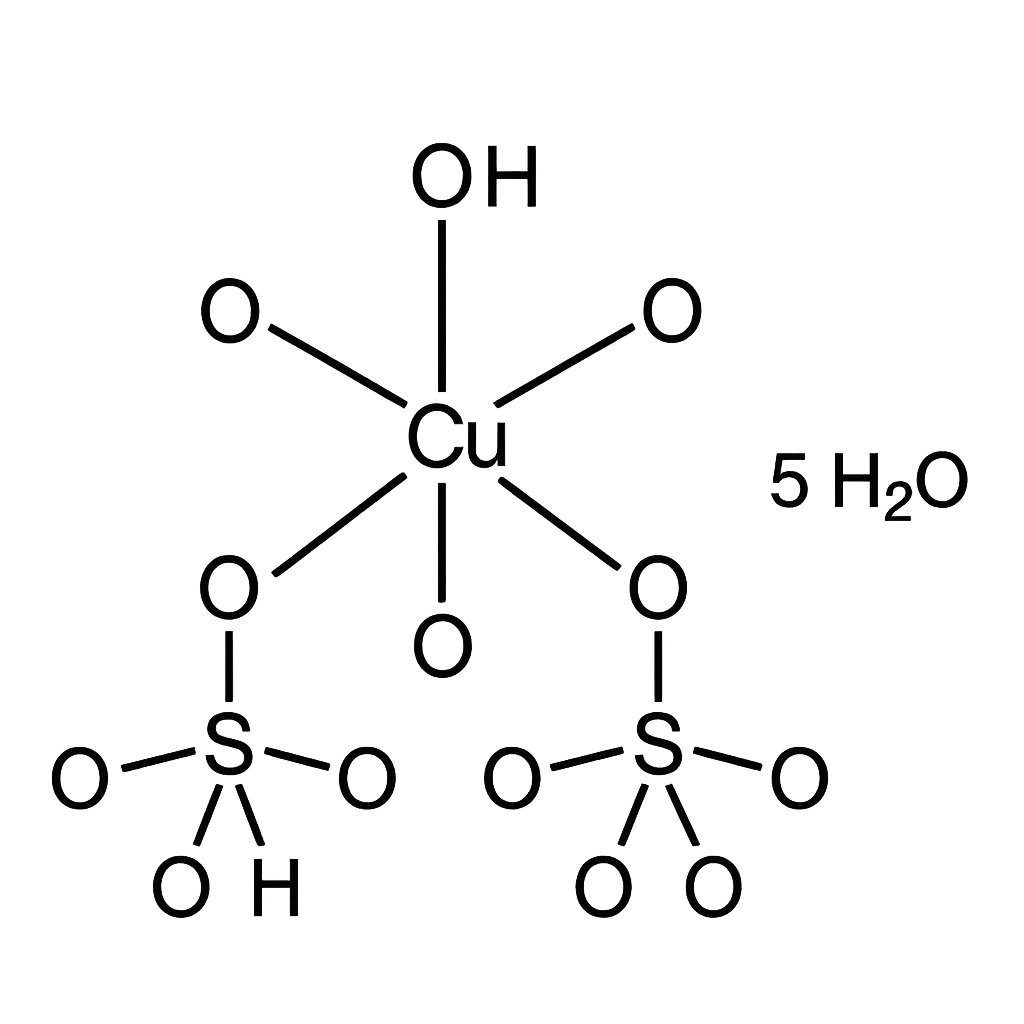
Question 4 View Details
The diagram shows the crystal structure of copper(II) sulfate pentahydrate, CuSO₄·5H₂O. In the structure each Cu²⁺ ion is octahedrally coordinated to four water molecules and two oxygen atoms belonging to two different sulfate ions. The sulfate ion is depicted as a tetrahedron with the S atom at the centre bonded to four O atoms.
Question Parts
(a)
Write the correct molecular formula of the compound shown in the diagram.
(b)
A 12.5 g sample of the compound is heated strongly to expel the water of crystallisation, leaving anhydrous CuSO₄. (i) Calculate the number of moles of water removed. (ii) Calculate the mass of the anhydrous CuSO₄ obtained.
(c)
The anhydrous CuSO₄ is further heated and decomposes according to: CuSO₄ → CuO + SO₃. (i) Calculate the number of moles of CuO produced. (ii) Calculate the mass of CuO obtained.
(d)
The CuO obtained is dissolved in excess aqueous H₂SO₄ to give a solution containing Cu²⁺ ions. (i) Write the net ionic equation for the dissolution. (ii) State the total number of moles of Cu²⁺ ions present in the final solution.
Detailed Essay Solution & Marking Scheme Available

Get the step-by-step mathematical proofs, key points required by examiners, and a comprehensive breakdown from our AI Tutor.

Question 5 View Details
A laboratory experiment involves the reaction 2 Al(s) + 3 CuSO₄(aq) → Al₂(SO₄)₃(aq) + 3 Cu(s) A student weighs 15.0 g of aluminium metal and 30.0 g of copper(II) sulphate pentahydrate (CuSO₄·5H₂O). The molar masses are: Al = 26.98 g mol⁻¹, CuSO₄·5H₂O = 249.7 g mol⁻¹, Al₂(SO₄)₃ = 342.2 g mol⁻¹, Cu = 63.55 g mol⁻¹. After the reaction is complete, the student isolates and weighs 24.5 g of copper metal. Answer the following questions:
Question Parts
(a)
Identify the limiting reagent and calculate the theoretical mass of copper that could be produced.
(b)
Calculate the percent yield of copper obtained in the experiment.
(c)
The copper(II) sulphate used was impure; it contained 5 % by mass of an inert solid that does not react. Discuss qualitatively how this impurity would affect the percent yield calculated in part (b).
Detailed Essay Solution & Marking Scheme Available

Get the step-by-step mathematical proofs, key points required by examiners, and a comprehensive breakdown from our AI Tutor.

Question 6 View Details
Water undergoes several phase changes under standard atmospheric pressure (1 atm). The following data are given: • Specific heat capacity of ice, c₁ = 2.09 J g⁻¹ K⁻¹ (for –10 °C to 0 °C) • Specific heat capacity of liquid water, c₂ = 4.18 J g⁻¹ K⁻¹ (for 0 °C to 100 °C) • Specific heat capacity of steam, c₃ = 2.01 J g⁻¹ K⁻¹ (for 100 °C to 120 °C) • Enthalpy of fusion of water, ΔH_fus = 334 J g⁻¹ • Enthalpy of vaporisation of water, ΔH_vap = 2260 J g⁻¹ A sample of 150.0 g of ice at –10 °C is heated until it becomes steam at 120 °C. Answer the following questions:
Question Parts
(a)
Calculate the total amount of heat energy (in kJ) required to convert the 150.0 g of ice at –10 °C to steam at 120 °C. Show all steps.
(b)
If the pressure were increased to 2 atm, explain qualitatively how the boiling point of water would change and why this would affect the total heat calculated in part (a).
(c)
A student mistakenly uses the specific heat capacity of liquid water (c₂) for the entire temperature range (–10 °C to 120 °C) and ignores the latent heats. Estimate the percentage error in the total heat calculated compared with the correct value from part (a).
Detailed Essay Solution & Marking Scheme Available

Get the step-by-step mathematical proofs, key points required by examiners, and a comprehensive breakdown from our AI Tutor.

Question 7 View Details
A 0.250 mol sample of sodium carbonate (Na2CO3) is dissolved in 500.0 mL of water. The solution is then titrated with 0.1000 M hydrochloric acid (HCl) until the pH reaches 8.0. The carbonate ion undergoes successive neutralisation reactions with H+ ions.
Question Parts
(a)
Write the net ionic equation for each step of the neutralisation of carbonate ion by HCl.
(b)
Calculate the volume (in mL) of 0.1000 M HCl required to reach a pH of 8.0. Use Ka2 of carbonic acid = 4.8 × 10⁻¹¹.
(c)
Explain why the pH at the first equivalence point of this titration is greater than 7.
Detailed Essay Solution & Marking Scheme Available

Get the step-by-step mathematical proofs, key points required by examiners, and a comprehensive breakdown from our AI Tutor.

Question 8 View Details
A saturated solution of lead(II) chloride (PbCl₂) at 25 °C is prepared. The solubility product constant at this temperature is Ksp = 1.6 × 10⁻⁵. In addition, lead(II) forms the complex ion [PbCl₄]²⁻ with a formation constant Kf = 1.0 × 10⁵.
Question Parts
(a)
Calculate the molar solubility of PbCl₂ in pure water at 25 °C.
(b)
If 0.10 mol of NaCl is added to 1.00 L of the saturated solution, determine the new molar solubility of PbCl₂ (ignore complex formation).
(c)
Taking the complex formation of [PbCl₄]²⁻ into account, calculate the total molar solubility of lead(II) in the 0.10 M NaCl solution.
Detailed Essay Solution & Marking Scheme Available

Get the step-by-step mathematical proofs, key points required by examiners, and a comprehensive breakdown from our AI Tutor.

Master the Exam!

You've seen a preview, but there are thousands more questions plus AI tutor to break down complex solutions.

Unlock Full Access Available for Android & Windows
Help others prepare! Share this practice hub:
Chat with Support