waec model questions vol1 2021 biology | Objective

Are you preparing for waec model questions vol1 exams? Reviewing past questions is one of the most effective ways to guarantee a high score. This practice hub features authentic 2021 biology (Objective) questions designed to simulate the real exam environment.

Practice these randomly selected questions to test your readiness.

Question 1 View Details
In a typical 28‑day menstrual cycle, the length of the follicular phase (in days) varies linearly with the peak estrogen concentration (in pg/mL). When the estrogen peak is 200 pg/mL the follicular phase lasts 12 days, and when the peak is 150 pg/mL it lasts 14 days. A woman's estrogen peak is measured at 180 pg/mL. On which day of the cycle does ovulation occur?
A. 12
B. 15
Correct C. 13
D. 14

Correct Answer: C

Want to see the full step-by-step solution? Unlock AI Explanation & Analytics
Question 2 View Details
In a beetle population two alleles, A and a, determine colour. After one generation of selection the observed genotype frequencies are AA = 0.36, Aa = 0.48 and aa = 0.16. Selection acted only on the AA genotype, reducing its fitness to 0.5, while the other genotypes have fitness 1. What was the frequency of allele A before selection?
Correct A. 0.73
B. 0.68
C. 0.80
D. 0.60

Correct Answer: A

Want to see the full step-by-step solution? Unlock AI Explanation & Analytics
Question 3 View Details
A population of island birds shows an observed heterozygosity (gene diversity) of H = 0.02 at a neutral locus. The neutral mutation rate per generation is μ = 1×10⁻⁵. Assuming the neutral theory equilibrium relationship \(H = \frac{4N_e\mu}{1+4N_e\mu}\), estimate the effective population size Nₑ (rounded to the nearest whole number).
A. 2000
B. 500
C. 520
Correct D. 510

Correct Answer: D

Want to see the full step-by-step solution? Unlock AI Explanation & Analytics
Question 4 View Details
In a lake ecosystem the total biomass of phytoplankton (primary producers) is 8 000 kg. Energy transfer between successive trophic levels is 10 % efficient. A fish species (secondary consumer) feeds exclusively on zooplankton (primary consumer) which in turn feeds on the phytoplankton. The fish population currently has a total biomass of 120 kg. (a) What is the minimum biomass that must be present in the zooplankton level to sustain this fish biomass under steady‑state conditions? (b) What percentage of the original phytoplankton biomass is ultimately incorporated into the fish biomass?
A. 1200 kg; 2.5%
B. 800 kg; 2%
Correct C. 1200 kg; 1.5%
D. 1500 kg; 1%

Correct Answer: C

Want to see the full step-by-step solution? Unlock AI Explanation & Analytics
Question 5 View Details
In a plant species flower colour is controlled by a single X‑linked gene with two alleles: R (red, dominant) and r (white, recessive). Females are XX and males are XY. A red‑flowered male (genotype X^R Y) is crossed with a red‑flowered female who is a carrier (heterozygous, genotype X^R X^r). What is the expected phenotypic ratio of red to white flowers among the progeny?
A. 4:1
Correct B. 3:1
C. 1:1
D. 2:1

Correct Answer: B

Want to see the full step-by-step solution? Unlock AI Explanation & Analytics
Question 6 View Details
A vertebrate animal exhibits the following characteristics: it is warm‑blooded, covered with fur, females possess mammary glands that secrete milk, it has sharp, shearing carnassial teeth, and its hind limbs are adapted for retractable claws. Using standard vertebrate classification, determine the class, order, and family of this animal.
A. Class Mammalia, Order Primates, Family Felidae
B. Class Reptilia, Order Carnivora, Family Felidae
C. Class Mammalia, Order Carnivora, Family Canidae
Correct D. Class Mammalia, Order Carnivora, Family Felidae

Correct Answer: D

Want to see the full step-by-step solution? Unlock AI Explanation & Analytics
Question 7 View Details
Two desert rodent species employ different adaptations to survive prolonged water scarcity. Species A possesses (i) kidneys that produce urine with an osmolarity of 3000 mOsm kg⁻¹, (ii) nocturnal activity, and (iii) large, thin ears that radiate heat. Species B lives in deep burrows, obtains water solely from metabolic oxidation of food, and has a thick, reflective fur coat. Which of the listed adaptations contributes most directly to water conservation, and why?
A. Nocturnal activity in Species A; it reduces water loss by limiting exposure to daytime heat.
Correct B. The production of highly concentrated urine (kidney adaptation) in Species A; it directly minimizes water loss through excretion.
C. Thick, reflective fur coat in Species B; it reflects solar radiation, lowering water loss through sweating.
D. Large, thin ears in Species A; they radiate heat, decreasing the need for evaporative cooling.

Correct Answer: B

Want to see the full step-by-step solution? Unlock AI Explanation & Analytics
Question 8 View Details
A wound swab from a patient yields the following laboratory results: Gram stain shows Gram‑negative bacilli; the organism grows on MacConkey agar producing colourless colonies; it is oxidase positive, reduces nitrate to nitrite, produces H₂S, is urease negative, ferments glucose with gas production, does not produce indole, is motile, is susceptible to ciprofloxacin but resistant to ampicillin. Identify the most probable bacterial species.
Correct A. Salmonella typhi (Salmonella species)
B. Proteus mirabilis (Proteus species)
C. Escherichia coli (E. coli species)
D. Shigella dysenteriae (Shigella species)

Correct Answer: A

Want to see the full step-by-step solution? Unlock AI Explanation & Analytics
Question 9 View Details
During a sudden rise in ambient temperature, the human body initiates a negative‑feedback response to maintain core temperature around 37 °C. Identify the primary sensor, the integrative centre, and the main effector(s) involved in this thermoregulatory response.
A. Sensor - peripheral (muscle) thermoreceptors; Integrator - thalamus; Effectors - increased metabolic heat production and vasoconstriction
Correct B. Sensor - peripheral (skin) thermoreceptors; Integrator - hypothalamic preoptic area; Effectors - sweat glands and cutaneous vasodilation
C. Sensor - hypothalamic thermoreceptors; Integrator - spinal cord; Effectors - panting and brown adipose tissue activation
D. Sensor - central (brain) thermoreceptors; Integrator - medullary respiratory center; Effectors - shivering and peripheral vasoconstriction

Correct Answer: B

Want to see the full step-by-step solution? Unlock AI Explanation & Analytics
Question 10 View Details
Measles has a basic reproduction number \(R_{0}=15\). To achieve herd immunity, the proportion of the population that must be immune is given by \(1-\frac{1}{R_{0}}\). If the measles vaccine is 95 % effective, calculate the minimum vaccination coverage required to interrupt transmission in the community.
Correct A. Approximately 98 % vaccination coverage
B. Approximately 90 % vaccination coverage
C. Approximately 85 % vaccination coverage
D. Approximately 95 % vaccination coverage

Correct Answer: A

Want to see the full step-by-step solution? Unlock AI Explanation & Analytics
Question 11 View Details
In a closed community a contagious disease has a basic reproduction number (R₀) of 3.5. A vaccine available for this disease is 80 % effective. What minimum proportion of the total population must be vaccinated to achieve herd immunity?
Correct A. 89%
B. 71%
C. 80%
D. 95%

Correct Answer: A

Want to see the full step-by-step solution? Unlock AI Explanation & Analytics
Question 12 View Details
A terrestrial ecosystem receives a primary productivity of 2000 kcal m⁻² yr⁻¹. Energy transfer efficiencies are 10 % from producers to primary consumers, 8 % from primary to secondary consumers, and 5 % from secondary to tertiary consumers. A pollutant reduces the secondary‑to‑tertiary efficiency by 40 % of its original value. What is the net energy available to tertiary consumers per square metre per year after the reduction?
A. 0.64 kcal m⁻² yr⁻¹
B. 0.8 kcal m⁻² yr⁻¹
Correct C. 0.48 kcal m⁻² yr⁻¹
D. 0.4 kcal m⁻² yr⁻¹

Correct Answer: C

Want to see the full step-by-step solution? Unlock AI Explanation & Analytics
Question 13 View Details
A culture of *Escherichia coli* starts with 5 × 10⁴ cells. During the exponential phase the population doubles every 20 min. After exactly 2 h an antibiotic is added that reduces the growth rate by 30 % (i.e., the doubling time increases by 30 %). Assuming the reduced rate continues, how many cells will be present after a total of 5 h from the start of the culture? Give your answer in scientific notation to two significant figures.
A. 2.6×10⁸ cells
Correct B. 3.9×10⁸ cells
C. 1.2×10⁹ cells
D. 5.1×10⁸ cells

Correct Answer: B

Want to see the full step-by-step solution? Unlock AI Explanation & Analytics
Question 14 View Details
Human somatic cells contain 46 chromosomes. How many chromosomes are present in a human gamete (sperm or ovum)?
A. 46
Correct B. 23
C. 24
D. 22

Correct Answer: B

Want to see the full step-by-step solution? Unlock AI Explanation & Analytics
Question 15 View Details
A fish population in a lake follows the logistic growth model \(\frac{dN}{dt}=rN\left(1-\frac{N}{K}\right)\). The intrinsic growth rate is \(r=0.5\) yr⁻¹ and the carrying capacity is \(K=10\,000\) fish. A constant harvest of \(H\) fish per year is applied. Determine the maximum sustainable harvest rate (the maximum value of \(H\) that still allows a positive equilibrium) and give the equilibrium population size at this harvest.
A. Maximum sustainable harvest = 1500 fish per year; equilibrium population = 6000 fish
Correct B. Maximum sustainable harvest = 1250 fish per year; equilibrium population = 5000 fish
C. Maximum sustainable harvest = 1300 fish per year; equilibrium population = 4500 fish
D. Maximum sustainable harvest = 1000 fish per year; equilibrium population = 4000 fish

Correct Answer: B

Want to see the full step-by-step solution? Unlock AI Explanation & Analytics
Question 16 View Details
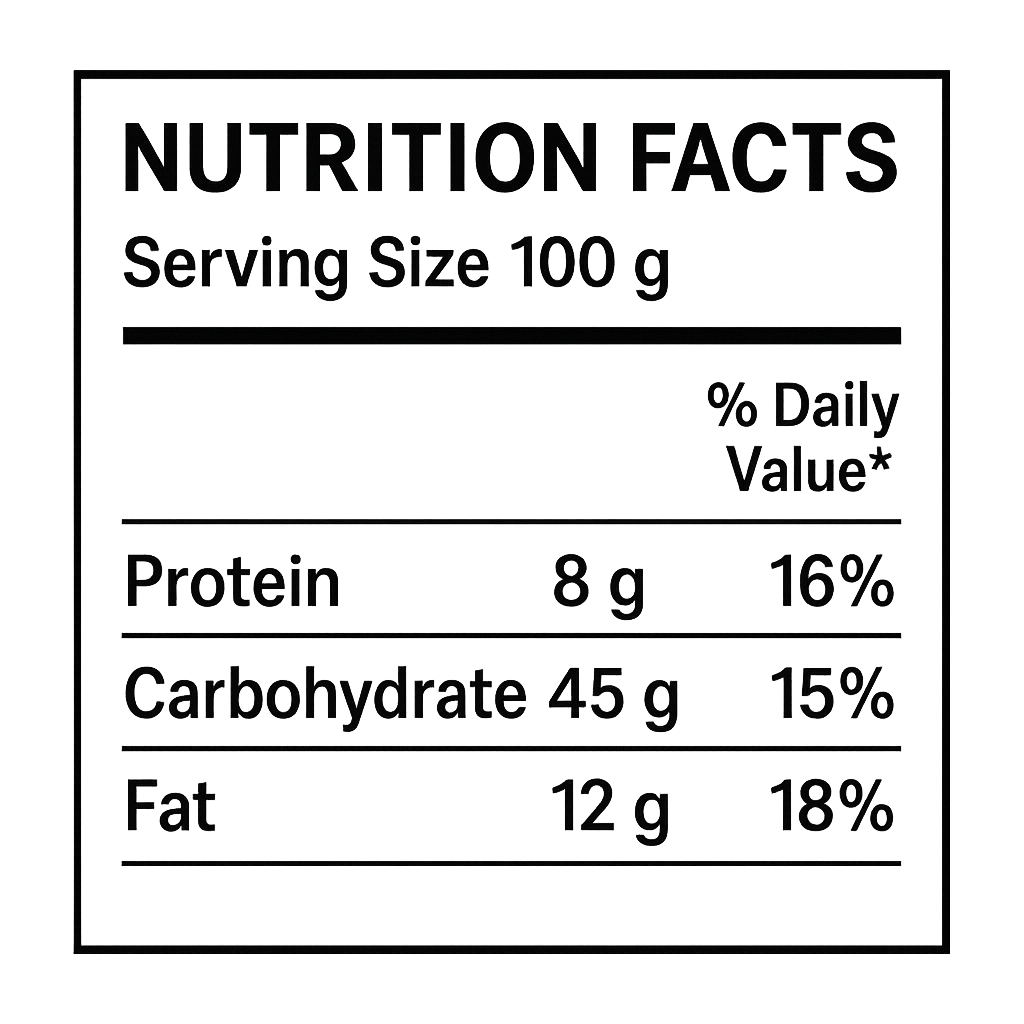
The diagram shows the nutrition label of a snack. The label states that per 100 g the snack contains 8 g protein, 45 g carbohydrate and 12 g fat. If a person consumes 250 g of the snack, how many kilocalories will be taken in? (Use 4 kcal per gram of protein or carbohydrate and 9 kcal per gram of fat.)
Correct A. 800 kilocalories
B. 820 kilocalories
C. 900 kilocalories
D. 750 kilocalories

Correct Answer: A

Want to see the full step-by-step solution? Unlock AI Explanation & Analytics
Question 17 View Details
Which cellular organelle is primarily responsible for the synthesis of proteins that are destined for secretion outside the cell?
A. Golgi apparatus
Correct B. Rough endoplasmic reticulum
C. Mitochondrion
D. Smooth endoplasmic reticulum

Correct Answer: B

Want to see the full step-by-step solution? Unlock AI Explanation & Analytics
Question 18 View Details
A diet provides 2 500 kcal per day with the following macronutrient distribution: 55 % carbohydrate, 15 % protein and 30 % fat. The individual wishes to increase the protein contribution to 20 % of total calories while keeping the total caloric intake at 2 500 kcal. Assuming the reductions in carbohydrate and fat calories occur proportionally to their original contributions, how many additional grams of protein must be consumed each day?
A. 25 grams
B. 34.5 grams
Correct C. 31.25 grams
D. 28.0 grams

Correct Answer: C

Want to see the full step-by-step solution? Unlock AI Explanation & Analytics
Question 19 View Details
The normal plasma osmolarity of a healthy adult is about 300 mOsm/L. A patient receives an intravenous infusion of 250 mL of 5 % dextrose (D5W), which contains no solutes and therefore acts as free water. If the patient's plasma volume before the infusion is 3 L and no solutes are lost or added during the infusion, what will be the new plasma osmolarity after the infusion? Express your answer to the nearest whole mOsm/L.
A. 285 mOsm/L
B. 250 mOsm/L
Correct C. 277 mOsm/L
D. 300 mOsm/L

Correct Answer: C

Want to see the full step-by-step solution? Unlock AI Explanation & Analytics
Question 20 View Details
According to Fick's law, the rate of diffusion (J) of a gas across a membrane is given by J = (D × A × ΔP) / T, where D is the diffusion coefficient, A the surface area, ΔP the partial‑pressure difference and T the membrane thickness. Initially, the alveolar membrane has A = 70 cm², T = 0.20 cm, ΔP = 100 mmHg and D = 0.003 cm²·mmHg·s⁻¹. During vigorous exercise the alveolar surface area increases by 20 % and the membrane thickness decreases by 10 %. What is the percentage increase in the diffusion rate of oxygen under these new conditions? Give your answer to one decimal place.
A. 40.0 %
B. 30.0 %
Correct C. 33.3 %
D. 36.0 %

Correct Answer: C

Want to see the full step-by-step solution? Unlock AI Explanation & Analytics
Question 21 View Details
A contagious disease has a basic reproduction number (R0) of 4.5. A vaccine available for this disease is 80% effective in preventing infection. What minimum proportion of the total population must be vaccinated (expressed as a percentage) to achieve herd immunity?
A. 90%
B. 80%
C. 95%
Correct D. 98%

Correct Answer: D

Want to see the full step-by-step solution? Unlock AI Explanation & Analytics
Question 22 View Details
Substance X is freely filtered by the glomeruli and is neither secreted nor reabsorbed. Its plasma concentration is 0.15 mg mL⁻¹, its urine concentration is 0.45 mg mL⁻¹ and the urine flow rate is 1.2 mL min⁻¹. Calculate the renal clearance of X (in mL min⁻¹) and state what percentage of the normal adult glomerular filtration rate (≈125 mL min⁻¹) this clearance represents.
Correct A. 3.6 mL/min (≈2.9 % of normal GFR)
B. 1.8 mL/min (≈1.4 % of normal GFR)
C. 5.0 mL/min (≈4.0 % of normal GFR)
D. 2.4 mL/min (≈1.9 % of normal GFR)

Correct Answer: A

Want to see the full step-by-step solution? Unlock AI Explanation & Analytics
Question 23 View Details
In a bacterial culture the cell number increased from 2.0 × 10⁶ to 1.6 × 10⁸ in 4 hours. Assuming exponential growth:
Correct A. Generation time ≈ 38 min; cell number after 10 h ≈ 1.1 × 10¹¹
B. Generation time ≈ 50 min; cell number after 10 h ≈ 8.0 × 10¹⁰
C. Generation time ≈ 30 min; cell number after 10 h ≈ 2.2 × 10¹¹
D. Generation time ≈ 45 min; cell number after 10 h ≈ 5.0 × 10¹⁰

Correct Answer: A

Want to see the full step-by-step solution? Unlock AI Explanation & Analytics
Question 24 View Details
In the normal menstrual cycle a pre‑ovulatory surge of luteinising hormone (LH) reaches about 25 IU and a minimum of 10 IU is required to trigger ovulation. A woman has a pituitary disorder that reduces the amplitude of LH surges by 40 % while follicle‑stimulating hormone (FSH) secretion remains unchanged. Will ovulation still occur in this woman?
A. Yes; the reduced surge (≈12 IU) still exceeds the 10 IU minimum, so ovulation can occur.
B. No; the reduced surge (≈15 IU) is close to the minimum and likely insufficient for ovulation.
Correct C. Yes; the reduced surge (≈15 IU) still exceeds the 10 IU minimum, so ovulation can occur.
D. No; the reduced surge (≈15 IU) falls below the 10 IU threshold, preventing ovulation.

Correct Answer: C

Want to see the full step-by-step solution? Unlock AI Explanation & Analytics
Question 25 View Details
An unknown bacterium shows the following characteristics: (i) Gram‑positive, (ii) large rod‑shaped cells, (iii) forms central endospores, (iv) catalase positive, (v) obligate aerobe, (vi) non‑motile, (vii) can reduce nitrate to nitrite. Identify the organism (common name).
Correct A. Bacillus anthracis
B. Clostridium tetani
C. Clostridium perfringens
D. Bacillus cereus

Correct Answer: A

Want to see the full step-by-step solution? Unlock AI Explanation & Analytics

Master the Exam!

You've seen a preview, but there are thousands more questions plus AI tutor to break down complex solutions.

Unlock Full Access Available for Android & Windows
Help others prepare! Share this practice hub:
Chat with Support