waec model questions vol1 2021 agricultural_science | Objective

Prepare for your exams with waec model questions vol1 questions? Reviewing past/model questions is one of the most effective ways to guarantee a high score. This practice hub features authentic 2021 agricultural_science (Objective) questions designed to simulate the real exam environment.

Practice these randomly selected questions to test your readiness.

Question 1 View Details
A farmer intends to grow maize on a hectare. The expected grain yield (in tonnes per hectare) as a function of plant density D (plants per m²) is Y = 0.8 [1 - e^{‑0.05D}]. Each plant requires 0.2 kg of nitrogen. Nitrogen fertilizer costs ₦20,000 per 100 kg. The farmer has a fertilizer budget of ₦150,000 per hectare. What is the maximum attainable grain yield (in kilograms per hectare) under this budget?
Correct A. approximately 15 kg per hectare
B. approximately 18 kg per hectare
C. approximately 12 kg per hectare
D. approximately 22 kg per hectare

Correct Answer: A

Want to see the full step-by-step solution? Unlock AI Explanation & Analytics
Question 2 View Details
A dairy herd of 20 cows each produces an average of 22 L of milk per day. The herd consumes a total of 12 000 kg of dry‑matter feed per day. By adding a feed additive, the milk‑output per kilogram of feed can be increased by a factor of 1.15 without changing the total feed intake. What is the new average milk yield per cow per day (in litres) after supplementation?
A. approximately 24.0 litres per cow per day
Correct B. approximately 25.3 litres per cow per day
C. approximately 28.0 litres per cow per day
D. approximately 26.5 litres per cow per day

Correct Answer: B

Want to see the full step-by-step solution? Unlock AI Explanation & Analytics
Question 3 View Details
The soil pH of a field is 5.2. To raise the pH to 6.5, 2.5 tonnes of agricultural lime are required for each 0.5‑unit increase in pH. How many tonnes of lime are needed per hectare to reach the target pH?
A. 5.0 tonnes per hectare
B. 7.5 tonnes per hectare
Correct C. 6.5 tonnes per hectare
D. 8.0 tonnes per hectare

Correct Answer: C

Want to see the full step-by-step solution? Unlock AI Explanation & Analytics
Question 4 View Details
Cassava chips have an initial moisture content of 55 % (wet basis) and must be dried to 12 % (wet basis). In a drying chamber operating at 45 °C with an airflow of 2 m s⁻¹, the equilibrium moisture content is 10 % (wet basis) and the drying follows the first‑order model dM/dt = -k(M - M_e) with k = 0.5 h⁻¹. Determine the minimum drying time required (in hours, to two decimal places).
A. 5.78 hours
B. 8.45 hours
Correct C. 6.23 hours
D. 7.10 hours

Correct Answer: C

Want to see the full step-by-step solution? Unlock AI Explanation & Analytics
Question 5 View Details
A farmer's total cost function for maize production is TC(Q) = 0.02Q³ - 0.3Q² + 15Q + 200, where Q is output in tonnes. The market price per tonne is given by the linear demand function P = 120 - 0.5Q (Naira per tonne). What output level Q (in tonnes, to one decimal place) maximizes profit, and what is the maximum profit (in Naira, to the nearest naira)?
A. Output ≈ 38.6 tonnes; Maximum profit ≈ ₦2,800
B. Output ≈ 41.2 tonnes; Maximum profit ≈ ₦2,720
C. Output ≈ 35.0 tonnes; Maximum profit ≈ ₦2,150
Correct D. Output ≈ 38.6 tonnes; Maximum profit ≈ ₦2,405

Correct Answer: D

Want to see the full step-by-step solution? Unlock AI Explanation & Analytics
Question 6 View Details
Pest A causes a yield loss of 0.8% for every 10 insects per square metre, while pest B causes a loss of 1.2% for every 5 insects per square metre. If a farmer wants the total yield loss to stay below 5%, what is the maximum number of insects per square metre that can be tolerated, assuming the two pests occur together and their effects are additive?
A. 58 insects per square metre
Correct B. 62 insects per square metre
C. 66 insects per square metre
D. 70 insects per square metre

Correct Answer: B

Want to see the full step-by-step solution? Unlock AI Explanation & Analytics
Question 7 View Details
A field initially has 2% of its plants infected with a fungal disease. Without any control, the incidence rises by 15% each day (i.e., the percentage is multiplied by 1.15 daily). After the fourth day a fungicide is applied, reducing the daily increase to 5% for the remaining period. What is the disease incidence after a total of 7 days?
A. 4.20%
B. 4.50%
C. 3.85%
Correct D. 4.05%

Correct Answer: D

Want to see the full step-by-step solution? Unlock AI Explanation & Analytics
Question 8 View Details
A farmer wants to mix two pesticides, A and B, for a field. The recommended doses are 2 L ha⁻¹ for A and 1.5 L ha⁻¹ for B. Because of a synergistic effect, the total volume can be reduced by 20 % while keeping the same efficacy, but the mixture must retain the volume ratio A : B = 4 : 3. What volume of each pesticide should be applied per hectare?
Correct A. 1.6 L/ha of A and 1.2 L/ha of B
B. 1.8 L/ha of A and 1.35 L/ha of B
C. 1.2 L/ha of A and 1.6 L/ha of B
D. 2.0 L/ha of A and 1.5 L/ha of B

Correct Answer: A

Want to see the full step-by-step solution? Unlock AI Explanation & Analytics
Question 9 View Details
A maize farmer's total cost function (in Naira) is TC = 0.05Q² + 20Q + 5 000, where Q is the quantity produced in tonnes. The market price per tonne follows the linear demand equation P = 1 500 - 0.2Q. The government imposes a per‑tonne tax of 100 Naira. Determine the output level (in tonnes) that maximizes the farmer's profit after tax and calculate the maximum profit.
A. Output = 1380 tonnes; Maximum profit = ₦1,423,300
B. Output = 2760 tonnes; Maximum profit = ₦1,800,000
Correct C. Output = 2760 tonnes; Maximum profit = ₦1,899,400
D. Output = 2960 tonnes; Maximum profit = ₦2,185,400

Correct Answer: C

Want to see the full step-by-step solution? Unlock AI Explanation & Analytics
Question 10 View Details
A combine harvester can harvest 2.5 ha h⁻¹ at a base fuel consumption of 8 L h⁻¹. For each hectare actually harvested per hour, an additional 1.6 L of fuel is used. Because of turning, a 10 % overlap of the field must be accounted for. How many litres of fuel are required to harvest a 15‑ha field?
Correct A. 77.3 litres (approximately)
B. 71.4 litres (approximately)
C. 68.2 litres (approximately)
D. 84.0 litres (approximately)

Correct Answer: A

Want to see the full step-by-step solution? Unlock AI Explanation & Analytics
Question 11 View Details
Explain why soil pH is a critical factor influencing nutrient availability to crops.
A. Because pH determines the temperature of the soil, and most crops grow best when the pH is between 6.0‑7.0, while extreme pH values cause heat stress.
Correct B. Because pH controls the chemical form and solubility of nutrients; most nutrients are optimally available in the pH range 6.0‑7.0, while too low or too high pH reduces availability or causes toxicity.
C. Because pH changes the color of the soil, making it easier to see nutrient deficiencies; the optimal pH range is 6.0‑7.0, and outside this range the soil appears dull.
D. Because pH influences the soil's moisture content; nutrients are most available when the pH is 6.0‑7.0, and low or high pH dries out the soil.

Correct Answer: B

Want to see the full step-by-step solution? Unlock AI Explanation & Analytics
Question 12 View Details
A combine harvester has a header width of 6.5 m and operates at a forward speed of 5 km h⁻¹. Its field efficiency is 78 %. (i) Calculate the theoretical field capacity in hectares per hour. (ii) Determine the effective field capacity.
A. Theoretical field capacity = 3.70 ha h⁻¹; Effective field capacity ≈ 2.89 ha h⁻¹.
Correct B. Theoretical field capacity = 3.25 ha h⁻¹; Effective field capacity ≈ 2.54 ha h⁻¹.
C. Theoretical field capacity = 2.80 ha h⁻¹; Effective field capacity ≈ 2.18 ha h⁻¹.
D. Theoretical field capacity = 3.10 ha h⁻¹; Effective field capacity ≈ 2.42 ha h⁻¹.

Correct Answer: B

Want to see the full step-by-step solution? Unlock AI Explanation & Analytics
Question 13 View Details
A farmer intends to cultivate maize on 2.5 ha. The expected yield is 4.2 t ha⁻¹ and the anticipated market price is ₦120 kg⁻¹. Variable costs amount to ₦45 000 per hectare, while fixed costs are ₦30 000. (i) Compute the expected gross profit. (ii) What is the break‑even price per kilogram of maize?
A. Gross profit = ₦1 200 000; Break‑even price ≈ ₦14.20 per kg.
B. Gross profit = ₦1 050 000; Break‑even price ≈ ₦12.00 per kg.
Correct C. Gross profit = ₦1 117 500; Break‑even price ≈ ₦13.57 per kg.
D. Gross profit = ₦950 000; Break‑even price ≈ ₦11.50 per kg.

Correct Answer: C

Want to see the full step-by-step solution? Unlock AI Explanation & Analytics
Question 14 View Details
A forest of 150 ha is to be managed for timber. The stand volume per hectare at different ages is given: Age (years) - Volume (m³ ha⁻¹) 10 - 80 15 - 150 20 - 210 25 - 260 30 - 300 The manager wants to adopt a rotation age that maximizes the mean annual increment (MAI). (i) Determine the rotation age that gives the highest MAI. (ii) Calculate the total timber (in m³) that will be harvested each rotation at that age. (iii) If the average volume of a mature tree at that age is 0.75 m³, estimate the number of trees that must be present per hectare at the start of rotation to achieve the projected volume.
A. Optimal rotation age = 25 years; Total timber per rotation = 39 000 m³; Trees required per hectare = 320.
Correct B. Optimal rotation age = 20 years; Total timber per rotation = 31 500 m³; Trees required per hectare = 280.
C. Optimal rotation age = 30 years; Total timber per rotation = 45 000 m³; Trees required per hectare = 350.
D. Optimal rotation age = 15 years; Total timber per rotation = 22 500 m³; Trees required per hectare = 200.

Correct Answer: B

Want to see the full step-by-step solution? Unlock AI Explanation & Analytics
Question 15 View Details
State the primary effect of applying agricultural lime to an acidic soil.
A. It lowers the soil pH, increasing acidity and decreasing nutrient availability.
B. It adds calcium carbonate, which directly supplies nitrogen to the soil.
C. It neutralizes soil microbes, leading to reduced organic matter decomposition.
Correct D. It raises the soil pH, reducing acidity and improving nutrient availability.

Correct Answer: D

Want to see the full step-by-step solution? Unlock AI Explanation & Analytics
Question 16 View Details
A tractor of mass 2,500 kg pulls a plough weighing 500 kg up a uniform slope of 5°. The rolling‑resistance coefficient for the combined vehicle is 0.03. The tractor moves at a constant speed of 4 km/h. Assuming no other losses, what is the minimum engine power in kilowatts required to maintain this speed? (Take g = 9.8 m/s² and 1 kW = 1000 W.)
A. 2.95 kW
B. 5.10 kW
C. 4.50 kW
Correct D. 3.83 kW

Correct Answer: D

Want to see the full step-by-step solution? Unlock AI Explanation & Analytics
Question 17 View Details
A maize field yields 5 t ha⁻¹. Each fall armyworm larva destroys 0.02 kg of grain per plant. The market price of maize is ₦150 per kg and the cost of applying an insecticide is ₦12,000 per hectare. Determine the economic injury level (EIL), i.e., the number of larvae per hectare at which the cost of control equals the loss avoided.
Correct A. 4000 larvae per hectare
B. 6000 larvae per hectare
C. 2500 larvae per hectare
D. 5000 larvae per hectare

Correct Answer: A

Want to see the full step-by-step solution? Unlock AI Explanation & Analytics
Question 18 View Details
A contagious viral disease of cattle has a basic reproduction number (R₀) of 4. To achieve herd immunity the proportion p of the herd that must be immune satisfies p > 1 - 1/R₀. If a vaccine is 85 % effective, what is the minimum number of cattle that must be vaccinated in a herd of 200 to obtain herd immunity?
A. 170 cattle
Correct B. 177 cattle
C. 180 cattle
D. 165 cattle

Correct Answer: B

Want to see the full step-by-step solution? Unlock AI Explanation & Analytics
Question 19 View Details
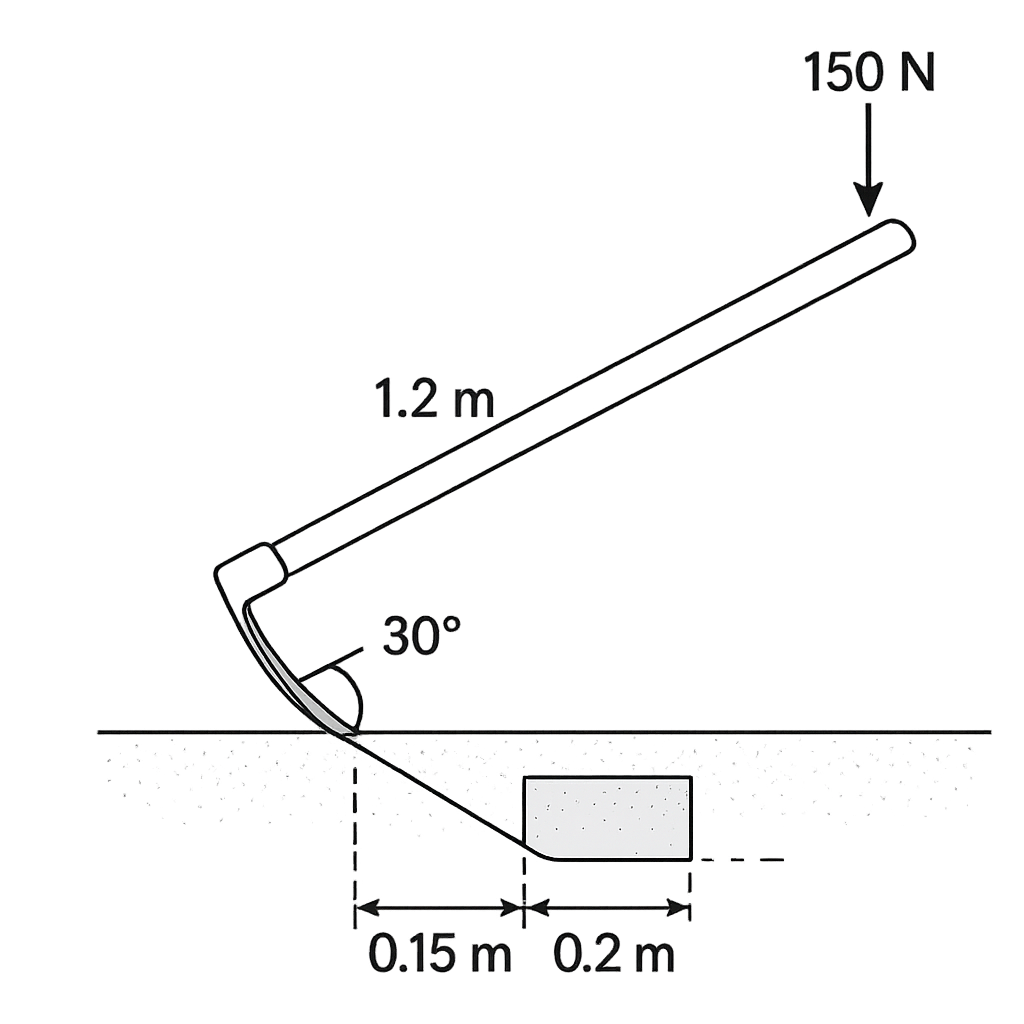
The diagram shows a hand hoe held at a 30° angle to the horizontal. The farmer applies a 150 N force at the handle end (1.2 m long). The hoe cuts a soil slice 0.15 m deep and 0.20 m wide. Assuming the force acts parallel to the handle and the soil slice is lifted vertically by its depth, calculate the work done by the farmer in joules.
A. 55 J
Correct B. 45 J
C. 40 J
D. 50 J

Correct Answer: B

Want to see the full step-by-step solution? Unlock AI Explanation & Analytics
Question 20 View Details
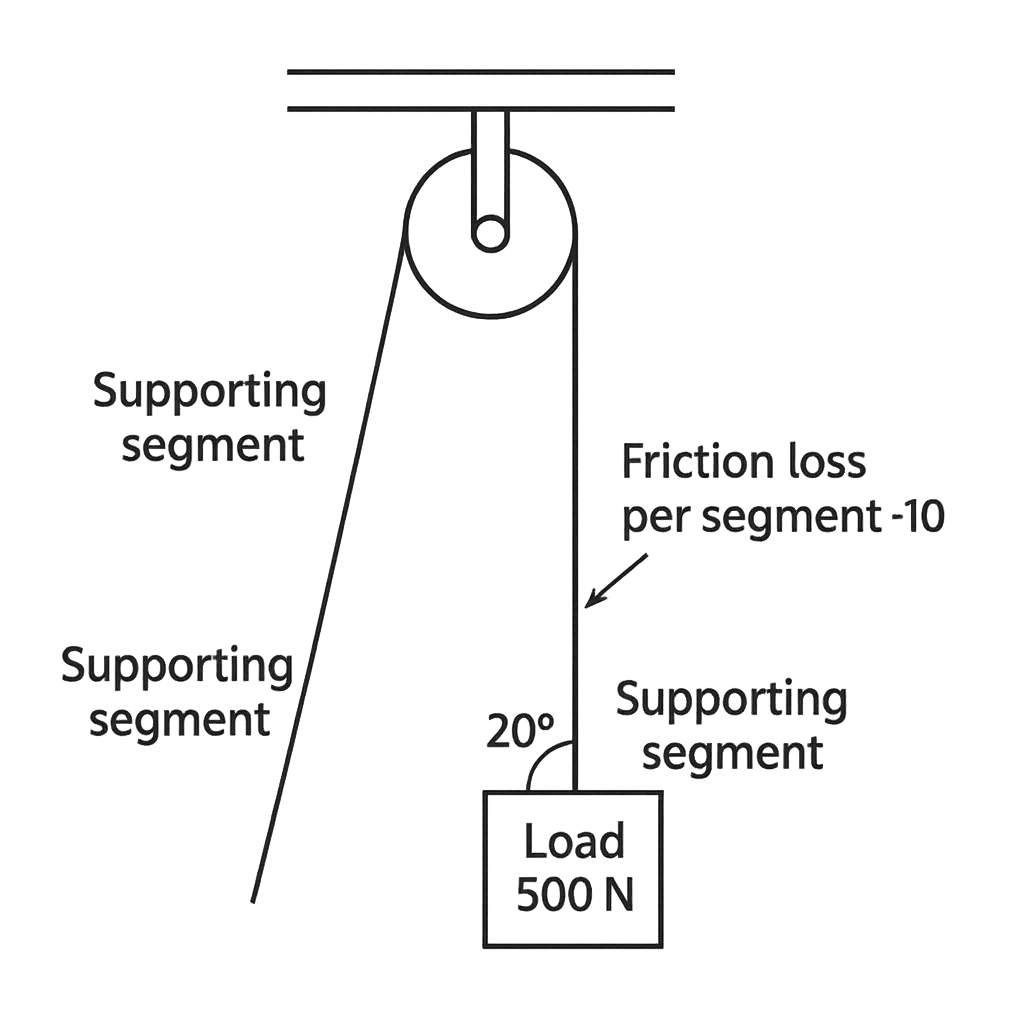
The diagram depicts a fixed pulley system used to lift a 500 N load. Three supporting rope segments share the load. Each segment loses 10 % of the tension because of friction (coefficient 0.1). The farmer pulls the rope at a 20° angle above the horizontal. Determine the minimum effort force (in newtons) the farmer must apply to lift the load, accounting for the tension loss in each supporting segment.
Correct A. 185 N
B. 170 N
C. 225 N
D. 210 N

Correct Answer: A

Want to see the full step-by-step solution? Unlock AI Explanation & Analytics
Question 21 View Details
A 120‑hectare forest is to be planted with two species. Species A is spaced 3 m × 3 m and yields 0.8 m³ of timber per tree. Species B is spaced 4 m × 4 m and yields 1.2 m³ per tree. The manager wants the plantation to contain exactly 80 000 trees and to produce at least 70 000 m³ of timber. Determine, to the nearest tenth of a hectare, how many hectares should be allocated to species A and to species B.
A. Approximately 52.7 ha for species A and 31.8 ha for species B
B. Approximately 56.0 ha for species A and 26.0 ha for species B
Correct C. Approximately 58.5 ha for species A and 24 ha for species B
D. Approximately 60.2 ha for species A and 22.3 ha for species B

Correct Answer: C

Want to see the full step-by-step solution? Unlock AI Explanation & Analytics
Question 22 View Details
A 500‑hectare forest is managed on a 30‑year rotation. The average annual increment (AAI) of timber volume is 2.5 m³ ha⁻¹ yr⁻¹ for the first 20 years and then declines linearly to 1.0 m³ ha⁻¹ yr⁻¹ by the end of year 30. Assuming the initial standing volume is zero and that the same constant volume is harvested each year, what is the maximum sustainable annual harvest (in cubic metres) that will leave the standing stock at zero at the end of the rotation?
A. 950.0 m³ per year
B. 1,050.0 m³ per year
C. 1,200.0 m³ per year
Correct D. 1,112.5 m³ per year

Correct Answer: D

Want to see the full step-by-step solution? Unlock AI Explanation & Analytics
Question 23 View Details
A farmer keeps 50 goats, each weighing 25 kg. He wishes to raise the average weight to 30 kg in 90 days. The feed mixture he will use provides 2.5 MJ of metabolizable energy (ME) and 18 % crude protein (CP) per kilogram. Goats require 2.8 MJ ME and 0.12 kg CP for each kilogram of weight gain. How many kilograms of the feed mixture should each goat receive per day (rounded to three decimal places)?
Correct A. 0.062 kg per goat per day
B. 0.058 kg per goat per day
C. 0.045 kg per goat per day
D. 0.070 kg per goat per day

Correct Answer: A

Want to see the full step-by-step solution? Unlock AI Explanation & Analytics
Question 24 View Details
In a herd of 120 cattle, 2 animals were already infected with a disease at the start of week 1. New cases recorded were: week 1 - 5 cases, week 2 - 8 cases, week 3 - 4 cases, week 4 - 5 cases. The vaccine was introduced at the beginning of week 3 and is expected to reduce the weekly incidence by 40 % compared with the pre‑vaccine average. Calculate the percentage reduction in incidence actually achieved during weeks 3 and 4.
Correct A. Approximately 31 % reduction
B. Approximately 25 % reduction
C. Approximately 40 % reduction
D. Approximately 18 % reduction

Correct Answer: A

Want to see the full step-by-step solution? Unlock AI Explanation & Analytics
Question 25 View Details
A batch of 500 kg of cassava roots has an initial moisture content of 60 % (wet basis). In a solar dryer the moisture removal rate follows the law dM/dt = -k(M - EMC), where M is the moisture content (fraction), EMC is the equilibrium moisture content of 12 % (wet basis), and k = 0.05 h⁻¹. How many hours are required to reduce the moisture content to 15 % (wet basis)? Give your answer to one decimal place.
A. 50.0 hours
B. 62.1 hours
Correct C. 55.5 hours
D. 48.7 hours

Correct Answer: C

Want to see the full step-by-step solution? Unlock AI Explanation & Analytics

Master the Exam!

You've seen a preview, but there are thousands more questions plus AI tutor to break down complex solutions.

Unlock Full Access Available for Android & Windows
Help others prepare! Share this practice hub:
Chat with Support