waec model questions vol1 2020 geography | Objective

Prepare for your exams with waec model questions vol1 questions? Reviewing past/model questions is one of the most effective ways to guarantee a high score. This practice hub features authentic 2020 geography (Objective) questions designed to simulate the real exam environment.

Practice these randomly selected questions to test your readiness.

Question 1 View Details
A region receives an average annual rainfall of 1,200 mm. The mean sea‑level temperature is 22 °C. The area lies at an altitude of 800 m and the environmental lapse rate is 0.6 °C per 100 m. Using the following vegetation‑zone criteria, identify the dominant vegetation type: - Tropical rainforest: rainfall ≥ 2,000 mm and temperature ≥ 24 °C - Savanna: rainfall 500-1,500 mm and temperature 20-30 °C - Montane forest: rainfall 1,000-2,500 mm and temperature 10-20 °C
Correct A. Montane forest
B. Tropical rainforest
C. Savanna
D. Temperate grassland

Correct Answer: A

Want to see the full step-by-step solution? Unlock AI Explanation & Analytics
Question 2 View Details
Town A has a population of 30,000. Three possible sites for a new market are being considered: - Site B: distance from A = 10 km, population = 5,000, land area = 1.5 km² - Site C: distance from A = 15 km, population = 8,000, land area = 2.2 km² - Site D: distance from A = 20 km, population = 6,000, land area = 2.0 km² Using the gravity model I = (P_A × P_site) / d², where I is interaction potential, determine which site should be selected if a viable site must have a land area of at least 2 km².
A. Site A
Correct B. Site C
C. Site D
D. Site B

Correct Answer: B

Want to see the full step-by-step solution? Unlock AI Explanation & Analytics
Question 3 View Details
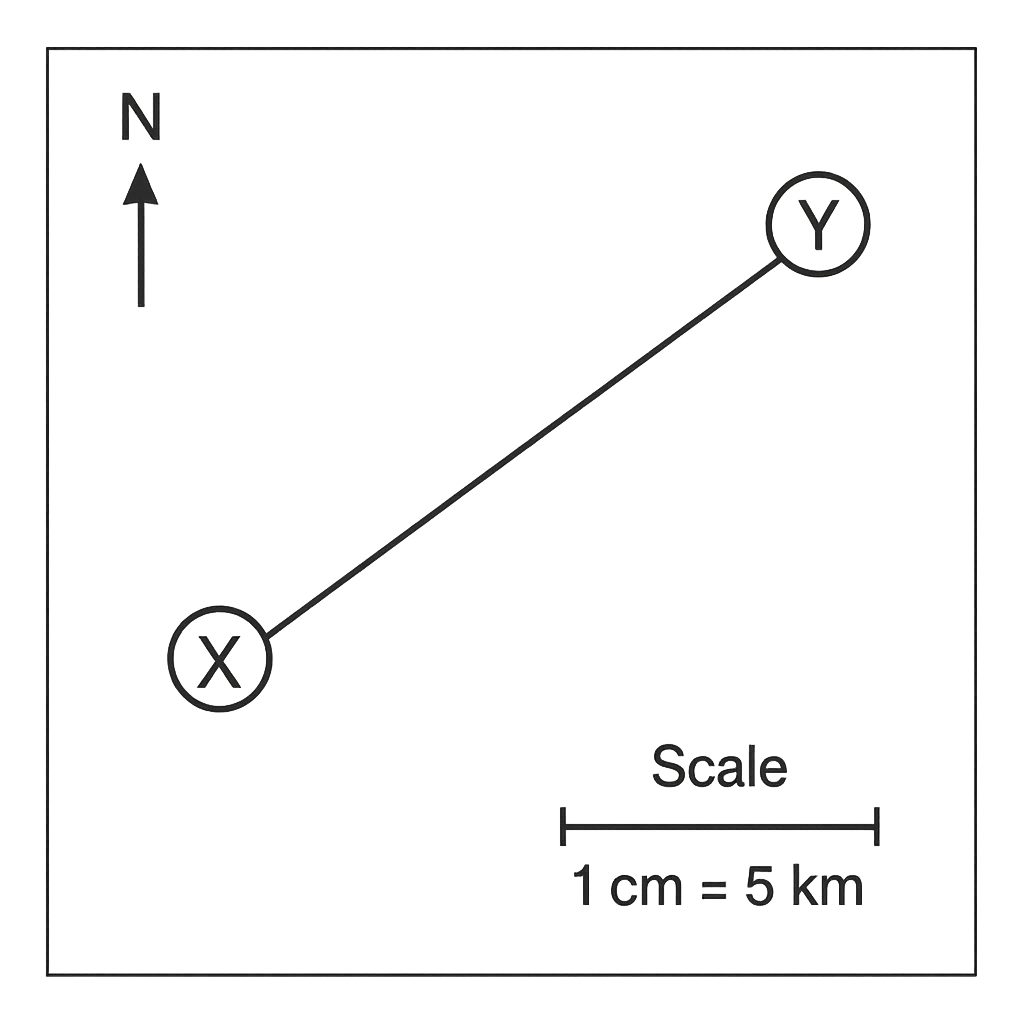
A map has a scale of 1 cm : 5 km. The distance between Town X and Town Y on the map measures 7.2 cm. What is the actual distance between the two towns?
Correct A. 36 km
B. 7.2 km
C. 40 km
D. 35 km

Correct Answer: A

Want to see the full step-by-step solution? Unlock AI Explanation & Analytics
Question 4 View Details
Three cities - X, Y and Z - are to be linked to a new transport hub. The distances and terrain composition of the existing road segments are: - X-Y: 80 km (60 % flat, 40 % hilly) - Y-Z: 120 km (70 % flat, 30 % swamp) - X-Z: 150 km (50 % flat, 30 % hilly, 20 % swamp) Construction costs per kilometre are: flat = ₦5,000, hilly = ₦8,000, swamp = ₦12,000. If the hub is placed at city X, Y or Z, the hub must be connected by road to the other two cities using the existing segments. Determine which city should be chosen as the hub to minimise total road‑construction cost, and state that minimum cost.
A. City X, ₦1,591,000
B. City Z, ₦1,947,000
C. City Y, ₦1,350,000
Correct D. City Y, ₦1,348,000

Correct Answer: D

Want to see the full step-by-step solution? Unlock AI Explanation & Analytics
Question 5 View Details
A region has a total population of 250,000. The age‑group distribution is: 0-14 years = 35 %, 15-64 years = 55 %, 65 + years = 10 %. Each year the total population grows by 2 % (the increase is proportionally distributed among the three age groups) and an additional 5,000 people of working age (15-64) migrate into the region. After five years, what is the total dependency ratio (young + old ÷ working‑age × 100) rounded to the nearest whole percent? State whether the ratio meets a target of ≤ 70 %.
Correct A. 70%, target met
B. 70%, target not met
C. 68%, target met
D. 73%, target met

Correct Answer: A

Want to see the full step-by-step solution? Unlock AI Explanation & Analytics
Question 6 View Details
A textile mill produces cloth and yarn. Fixed costs are ₦500,000 per month. Variable cost per unit of cloth is ₦150 and per unit of yarn is ₦100. Selling price per unit of cloth is ₦250 and per unit of yarn is ₦180. In a particular month the total revenue was ₦2,050,000 and the profit was ₦340,000. How many units of cloth were produced that month?
Correct A. 6400
B. 7200
C. 5600
D. 8000

Correct Answer: A

Want to see the full step-by-step solution? Unlock AI Explanation & Analytics
Question 7 View Details
The maximum temperatures (in °C) recorded over a 7‑day period were 30, 32, 31, 33, 34, 35 and 36 respectively, while the corresponding minimum temperatures were 20, 21, 19, 22, 23, 24 and 25. Find the average temperature for the week in Fahrenheit, rounded to the nearest whole number. (Use \(F = \frac{9}{5}C + 32\)).
A. 90
Correct B. 82
C. 85
D. 78

Correct Answer: B

Want to see the full step-by-step solution? Unlock AI Explanation & Analytics
Question 8 View Details
A rock sample consists of 55 % quartz (density 2.65 g/cm³), 30 % feldspar (density 2.55 g/cm³) and the remaining mineral is mica. If the density of mica is 2.80 g/cm³, calculate the average density of the rock sample (in g/cm³) to four decimal places.
A. 2.6325
B. 2.6525
C. 2.6400
Correct D. 2.6425

Correct Answer: D

Want to see the full step-by-step solution? Unlock AI Explanation & Analytics
Question 9 View Details
A river falls from an elevation of 250 m at point A to 70 m at point B, which lies 12 km downstream along the river course. Determine the average gradient of the river expressed as a percentage (rise/run × 100) and state whether the gradient is gentle (<0.5 %), moderate (0.5 %-2 %) or steep (>2 %).
Correct A. 1.5% (moderate)
B. 2.1% (moderate)
C. 0.9% (gentle)
D. 1.5% (steep)

Correct Answer: A

Want to see the full step-by-step solution? Unlock AI Explanation & Analytics
Question 10 View Details
The population of a town was 48,000 in 2010. Between 2010 and 2020 the town grew at an average annual rate of 2.5 % compounded yearly. What was the population in 2020? Round to the nearest whole number.
A. 61435
Correct B. 61444
C. 61800
D. 60000

Correct Answer: B

Want to see the full step-by-step solution? Unlock AI Explanation & Analytics
Question 11 View Details
The average annual rainfall of a region is 1200 mm. The rainy season lasts four months and the monthly rainfall amounts are in the ratio 3:4:5:6. The remaining eight months constitute the dry season and each dry‑season month receives the same amount of rain. If the average rainfall of the rainy‑season months is twice the average rainfall of a dry‑season month, what is the rainfall (in mm) in the month that receives the greatest amount of rain?
A. 210
B. 180
Correct C. 200
D. 240

Correct Answer: C

Want to see the full step-by-step solution? Unlock AI Explanation & Analytics
Question 12 View Details
A delivery truck must travel a 100 km route that consists of two consecutive sections. The first section is 30 km long and climbs a 5% gradient; because of safety regulations the truck cannot exceed 40 km/h on this uphill section. The second section is a level road of 70 km. Fuel consumption on level ground is given by the relation F(v) = 0.2 + 0.005 v² litres per kilometre, where v is the speed in km/h. On a 5% gradient an additional 0.1 L/km is consumed. The driver wishes to minimise the total fuel used while ensuring that the average speed for the whole journey is at least 60 km/h. What speed (in km/h, to the nearest whole number) should the driver maintain on the level section?
A. 73
B. 80
Correct C. 77
D. 70

Correct Answer: C

Want to see the full step-by-step solution? Unlock AI Explanation & Analytics
Question 13 View Details
A farmer's field has a uniform soil profile 0.90 m deep. The bulk density of the soil is 1.4 g cm⁻³. The volumetric field capacity is 28 % and the wilting point is 12 %. The crop to be grown requires a total of 200 mm of water during the growing season. Assuming the soil is initially at field capacity, determine (a) the depth of irrigation water (in mm) that must be applied to meet the crop's water requirement, given that only 70 % of the applied water is effectively stored in the root zone, and (b) the percentage of the total water requirement that must be supplied by irrigation.
A. 90 mm of irrigation water; 45 %
Correct B. 80 mm of irrigation water; 40 %
C. 100 mm of irrigation water; 50 %
D. 70 mm of irrigation water; 35 %

Correct Answer: B

Want to see the full step-by-step solution? Unlock AI Explanation & Analytics
Question 14 View Details
Town A is located at 5°30′ N, 7°30′ E and Town B at 6°15′ N, 8°45′ E. Using the haversine formula and taking the Earth's radius as 6371 km, calculate the great‑circle distance between the two towns. Give your answer in kilometres, rounded to the nearest kilometre.
Correct A. 161 km
B. 170 km
C. 180 km
D. 150 km

Correct Answer: A

Want to see the full step-by-step solution? Unlock AI Explanation & Analytics
Question 15 View Details
A farmland requires tile drainage to keep the water table at least 0.8 m below the soil surface. The soil hydraulic conductivity is 10 mm h⁻¹, the recharge (excess rainfall) rate is 5 mm h⁻¹, the impermeable layer lies at a depth of 2.0 m, and the tile drains are installed at a depth of 0.6 m. Using the simplified Hooghoudt equation \( S = \sqrt{\dfrac{8 K D_e}{q}} \) where \(S\) is the drain spacing (m), \(K\) is hydraulic conductivity (m h⁻¹), \(q\) is the recharge rate (m h⁻¹) and \(D_e\) is the equivalent depth approximated by \( D_e = \dfrac{D - d}{2} \), determine the maximum allowable spacing between drains. Give your answer in metres, rounded to one decimal place.
A. 2.4 m
Correct B. 3.3 m
C. 4.7 m
D. 5.7 m

Correct Answer: B

Want to see the full step-by-step solution? Unlock AI Explanation & Analytics
Question 16 View Details
A river has two consecutive segments. The upstream segment is 20 km long with a gradient of 0.4 %, while the downstream segment is 30 km long with a gradient of 0.08 %. The river's discharge is uniform along its course. The critical gradient below which a river tends to develop meanders is 0.1 %. Identify which segment is more likely to develop meanders and state the dominant landform expected in the upstream segment.
Correct A. The downstream segment will develop meanders; the upstream segment will have a straight, confined channel (a youthful V‑shaped valley).
B. Both segments will develop meanders; the upstream segment will have a braided channel (a wide floodplain).
C. The upstream segment will develop meanders; the downstream segment will have a straight, confined channel (a youthful V‑shaped valley).
D. The downstream segment will develop meanders; the upstream segment will have a meandering channel (a mature floodplain).

Correct Answer: A

Want to see the full step-by-step solution? Unlock AI Explanation & Analytics
Question 17 View Details
On a map a road runs north for 2 cm and then east for 1.5 cm. The map scale is 1 cm = 2 km. What is the straight‑line distance, in kilometres, between the road's starting point and its end point?
A. 7 km
Correct B. 5 km
C. 6 km
D. 4 km

Correct Answer: B

Want to see the full step-by-step solution? Unlock AI Explanation & Analytics
Question 18 View Details
A map of a lake is drawn at a scale of 1 : 50 000. On the map the lake measures 3 cm in length and 2 cm in width. Calculate the real area of the lake in square kilometres.
A. 3 km²
Correct B. 1.5 km²
C. 2.25 km²
D. 0.75 km²

Correct Answer: B

Want to see the full step-by-step solution? Unlock AI Explanation & Analytics
Question 19 View Details
A coastal town is exposed to two independent flood hazards each year: (i) a storm surge that exceeds 2 m with probability 0.02, and (ii) a river overflow that exceeds 1 m with probability 0.03. A flood occurs if either hazard exceeds its threshold. The expected economic loss when a flood occurs is ₦20 million. The town can implement one of the following mitigation measures within its ₦8 million budget: * Sea wall costing ₦5 million that reduces the probability of storm surge by 70 %. * Up‑stream dam costing ₦8 million that reduces the probability of river overflow by 60 %. Which mitigation option should be chosen to achieve the greatest reduction in expected annual flood loss? Show all calculations.
A. Build the sea wall; it lowers the expected annual loss to about ₦0.68 million, a larger reduction than the dam.
B. Build the upstream dam; it lowers the expected annual loss to about ₦0.70 million, a larger reduction than the sea wall.
C. Build the sea wall; it lowers the expected annual loss to about ₦0.55 million, a larger reduction than the dam.
Correct D. Build the upstream dam; it lowers the expected annual loss to about ₦0.635 million, a larger reduction than the sea wall.

Correct Answer: D

Want to see the full step-by-step solution? Unlock AI Explanation & Analytics
Question 20 View Details
A soil profile consists of three horizons: * A horizon: thickness 15 cm, organic matter 25 % (by weight). Organic matter holds water at 30 % of its weight. * B horizon: thickness 35 cm, clay 35 % (by weight). Clay holds water at 25 % of its weight. * C horizon: thickness 25 cm, sand 20 % (by weight). Sand holds water at 10 % of its weight. The field‑capacity requirement for arable crops is > 5 % water by weight, for forestry > 3 %, and for grazing > 2 %. Determine the overall field capacity of the profile (as a percentage by weight) and state the most suitable land‑use.
A. Overall field capacity ≈ 5.10 %; the profile is most suitable for forestry.
B. Overall field capacity ≈ 4.80 %; the profile is most suitable for grazing.
C. Overall field capacity ≈ 7.30 %; the profile is most suitable for arable agriculture.
Correct D. Overall field capacity ≈ 6.25 %; the profile is most suitable for arable agriculture.

Correct Answer: D

Want to see the full step-by-step solution? Unlock AI Explanation & Analytics
Question 21 View Details
A textile firm is evaluating two possible sites A and B for a new factory. The firm uses four location factors with the following weights: proximity to raw material 30%, availability of labour 25%, transport cost 20%, and government incentives 25%. The scores (out of 100) for each factor are: Site A - raw material 80, labour 70, transport cost 60, incentives 90; Site B - raw material 70, labour 85, transport cost 75, incentives 65. The firm will select a site only if its Overall Suitability Index (OSI) is at least 70. Compute the OSI for each site and state which site, if any, will be selected.
Correct A. Site A (OSI = 76)
B. Site A (OSI = 68)
C. Site B (OSI = 65)
D. Site B (OSI = 74)

Correct Answer: A

Want to see the full step-by-step solution? Unlock AI Explanation & Analytics
Question 22 View Details
A small catchment of 2 km² has land use distribution: 40% residential (runoff coefficient C = 0.70), 35% agricultural (C = 0.30) and 25% forest (C = 0.15). The design storm has a 30‑minute rainfall intensity of 80 mm/h. Using the Rational method Q = 0.278 C i A (where A is in hectares, i in mm/h and Q in m³/s), calculate the peak discharge from the catchment.
A. 1750 m³/s
Correct B. 1880 m³/s
C. 1520 m³/s
D. 2100 m³/s

Correct Answer: B

Want to see the full step-by-step solution? Unlock AI Explanation & Analytics
Question 23 View Details
The population of a town was 150,000 in 2015. The natural increase rate (births minus deaths) is 2.4 % per year. Net migration is -0.3 % per year for the first three years (2015‑2018) and +0.5 % per year thereafter (2018‑2020). Assuming the rates apply at the end of each year, calculate the population at the end of 2020.
A. 166350
B. 170368
C. 168800
Correct D. 169044

Correct Answer: D

Want to see the full step-by-step solution? Unlock AI Explanation & Analytics
Question 24 View Details
A schematic map shows Town X and Town Y separated by a straight line that measures 7.2 cm on the map. The map scale is 1 cm : 5 km. Determine the actual distance between the two towns in kilometres.
A. 3.6 km
B. 72 km
C. 1.44 km
Correct D. 36 km

Correct Answer: D

Want to see the full step-by-step solution? Unlock AI Explanation & Analytics
Question 25 View Details
The city of Lagos is located at 6° 27' N latitude and 3° 24' E longitude. State whether Lagos lies in the Northern or Southern Hemisphere and in the Eastern or Western Hemisphere.
Correct A. Northern Hemisphere, Eastern Hemisphere
B. Southern Hemisphere, Eastern Hemisphere
C. Northern Hemisphere, Western Hemisphere
D. Southern Hemisphere, Western Hemisphere

Correct Answer: A

Want to see the full step-by-step solution? Unlock AI Explanation & Analytics

Master the Exam!

You've seen a preview, but there are thousands more questions plus AI tutor to break down complex solutions.

Unlock Full Access Available for Android & Windows
Help others prepare! Share this practice hub:
Chat with Support