waec model questions vol1 2020 chemistry | Objective

Are you preparing for waec model questions vol1 exams? Reviewing past questions is one of the most effective ways to guarantee a high score. This practice hub features authentic 2020 chemistry (Objective) questions designed to simulate the real exam environment.

Practice these randomly selected questions to test your readiness.

Question 1 View Details
A 5.60 g sample of a non‑metal oxide with formula X₂O₃ is heated in a closed vessel, releasing O₂ gas. The O₂ collected occupies 2.00 L at 298 K and 0.950 atm. Determine the atomic mass of the non‑metal X (in g mol⁻¹).
A. 28.5
B. 35.0
Correct C. 30.0
D. 32.1

Correct Answer: C

Want to see the full step-by-step solution? Unlock AI Explanation & Analytics
Question 2 View Details
A 1.00 L aqueous solution contains 0.20 mol of a weak acid HA and 0.30 mol of its conjugate base A⁻ (from NaA). The measured pH of the solution is 4.75. Calculate the acid dissociation constant Ka of HA.
A. 1.5×10⁻⁴
Correct B. 2.7×10⁻⁵
C. 5.0×10⁻⁶
D. 3.2×10⁻⁵

Correct Answer: B

Want to see the full step-by-step solution? Unlock AI Explanation & Analytics
Question 3 View Details
A 2.00 L gas mixture at 298 K and 1.00 atm contains only pentane (C₅H₁₂) and 1‑pentene (C₅H₁₀). The mixture is passed over a nickel catalyst where the alkene is hydrogenated to the corresponding alkane using excess H₂. After the reaction the pressure drops to 0.85 atm (temperature unchanged). Assuming ideal behaviour, determine the mole fraction of 1‑pentene in the original mixture.
A. 0.10
B. 0.25
Correct C. 0.15
D. 0.20

Correct Answer: C

Want to see the full step-by-step solution? Unlock AI Explanation & Analytics
Question 4 View Details
Consider a galvanic cell: Zn(s) | Zn²⁺ (0.010 M) || Cu²⁺ (0.10 M) | Cu(s). Standard electrode potentials are E°(Zn²⁺/Zn) = -0.76 V and E°(Cu²⁺/Cu) = +0.34 V. (a) Calculate the cell potential at 25 °C using the Nernst equation. (b) If the cell delivers a constant current of 0.250 A for 2.00 h, how many grams of copper are deposited on the cathode?
A. Ecell = 1.05 V; mass Cu = 0.520 g
B. Ecell = 0.96 V; mass Cu = 0.450 g
Correct C. Ecell = 1.13 V; mass Cu = 0.593 g
D. Ecell = 1.20 V; mass Cu = 0.650 g

Correct Answer: C

Want to see the full step-by-step solution? Unlock AI Explanation & Analytics
Question 5 View Details
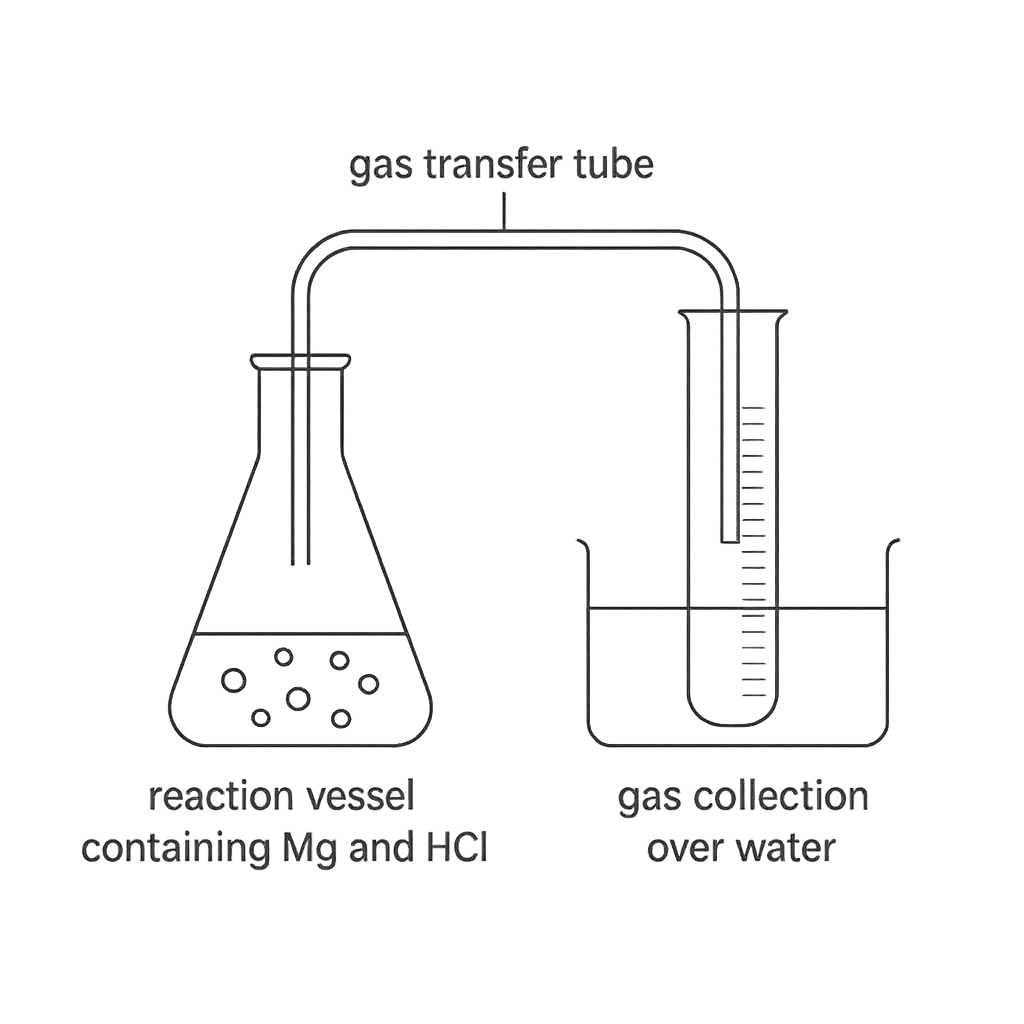
In the apparatus shown, solid magnesium reacts with excess hydrochloric acid to produce hydrogen gas collected over water. The volume of gas collected is 125.0 mL at 298 K. Atmospheric pressure is 760 mmHg and the water‑vapour pressure at this temperature is 23.8 mmHg. The mass of the dry magnesium used is 0.150 g. Calculate the percent yield of hydrogen gas based on the theoretical amount expected from the reaction Mg + 2 HCl → MgCl₂ + H₂.
A. 85.6
B. 92.3
C. 70.5
Correct D. 80.2

Correct Answer: D

Want to see the full step-by-step solution? Unlock AI Explanation & Analytics
Question 6 View Details
A 2.0 mol sample of water at 25 °C is heated with 5.0 kJ of energy. The specific heat capacity of liquid water is 4.18 J g⁻¹ K⁻¹, the molar mass of water is 18 g mol⁻¹ and the latent heat of vaporisation is 2260 J g⁻¹. Determine the final state of the water (liquid, mixture of liquid and vapour, or vapour) and its final temperature (to the nearest °C).
A. Mixture of liquid and vapour at approximately 100 °C
Correct B. Liquid water at approximately 58 °C
C. Vapour at approximately 120 °C
D. Liquid water at approximately 45 °C

Correct Answer: B

Want to see the full step-by-step solution? Unlock AI Explanation & Analytics
Question 7 View Details
Which element in period 3 of the periodic table has the highest first ionisation energy?
A. Magnesium (Mg)
Correct B. Nitrogen (N)
C. Oxygen (O)
D. Silicon (Si)

Correct Answer: B

Want to see the full step-by-step solution? Unlock AI Explanation & Analytics
Question 8 View Details
The solubility product of silver chloride is Ksp = 1.8×10⁻¹⁰ at 25 °C. Calculate the molar solubility of AgCl in a 0.10 M NaCl solution.
A. 1.8×10⁻⁸ M
Correct B. 1.8×10⁻⁹ M
C. 1.8×10⁻¹⁰ M
D. 5.6×10⁻⁹ M

Correct Answer: B

Want to see the full step-by-step solution? Unlock AI Explanation & Analytics
Question 9 View Details
What type of chemical bond is primarily responsible for the attraction between Na⁺ and Cl⁻ ions in sodium chloride?
A. Covalent bond
Correct B. Ionic bond
C. Hydrogen bond
D. Metallic bond

Correct Answer: B

Want to see the full step-by-step solution? Unlock AI Explanation & Analytics
Question 10 View Details
Acetic acid (CH₃COOH) has a Ka of 1.8×10⁻⁵ at 25 °C.\n(a) Calculate the pH of a 0.050 M solution of acetic acid.\n(b) To 250 mL of this solution, 0.010 mol of NaOH is added. Assuming the volume change is negligible, calculate the pH of the resulting solution.
Correct A. (a) pH ≈ 3.02; (b) pH ≈ 5.36
B. (a) pH ≈ 2.87; (b) pH ≈ 5.12
C. (a) pH ≈ 3.25; (b) pH ≈ 5.80
D. (a) pH ≈ 3.00; (b) pH ≈ 4.90

Correct Answer: A

Want to see the full step-by-step solution? Unlock AI Explanation & Analytics
Question 11 View Details
Potassium dichromate reacts with excess sulfuric acid and iron(II) sulfate according to the acidic redox reaction. If 10.0 g of K₂Cr₂O₇ is completely reduced, calculate the volume (in mL) of 0.500 M Fe²⁺ solution required for the reaction. Assume the reaction proceeds as: Cr₂O₇²⁻ + 6 Fe²⁺ + 14 H⁺ → 2 Cr³⁺ + 6 Fe³⁺ + 7 H₂O.
A. 350 mL
Correct B. 408 mL
C. 525 mL
D. 460 mL

Correct Answer: B

Want to see the full step-by-step solution? Unlock AI Explanation & Analytics
Question 12 View Details
A galvanic cell is constructed with the electrodes Zn|Zn²⁺ (0.010 M) and Cu|Cu²⁺ (0.10 M) at 25 °C. Standard potentials are E°(Zn²⁺/Zn)=‑0.76 V and E°(Cu²⁺/Cu)=+0.34 V. Determine the cell potential under these conditions and state whether the cell will operate spontaneously as written.
A. 0.58 V (spontaneous)
B. 1.13 V (non-spontaneous)
Correct C. 1.13 V (spontaneous)
D. 0.85 V (spontaneous)

Correct Answer: C

Want to see the full step-by-step solution? Unlock AI Explanation & Analytics
Question 13 View Details
Cyclohexanol (C₆H₁₂O) is first oxidised with PCC to cyclohexanone, then further oxidised with KMnO₄ in acidic medium to give adipic acid (C₆H₁₀O₄). Starting with 5.00 g of cyclohexanol and assuming an overall isolated yield of 80 % for the two‑step sequence, calculate the mass of adipic acid obtained.
A. 5.12 g
B. 4.96 g
Correct C. 5.84 g
D. 6.48 g

Correct Answer: C

Want to see the full step-by-step solution? Unlock AI Explanation & Analytics
Question 14 View Details
A buffer is prepared by dissolving 0.250 mol of acetic acid (CH₃COOH, Ka = 1.8 × 10⁻⁵) and 0.150 mol of sodium acetate (CH₃COONa) in 1.00 L of water. Calculate the pH of the buffer after adding 0.050 mol of HCl, assuming the volume change is negligible.
A. 4.10
B. 4.55
Correct C. 4.27
D. 3.85

Correct Answer: C

Want to see the full step-by-step solution? Unlock AI Explanation & Analytics
Question 15 View Details
When 2.00 g of calcium carbonate reacts with excess HCl according to CaCO₃ + 2 HCl → CaCl₂ + CO₂ + H₂O, what volume of CO₂ (at STP) is theoretically produced? If the actual volume collected is 0.35 L, calculate the percent yield of the reaction.
A. 81.2 %
B. 71.5 %
C. 64.3 %
Correct D. 78.1 %

Correct Answer: D

Want to see the full step-by-step solution? Unlock AI Explanation & Analytics
Question 16 View Details
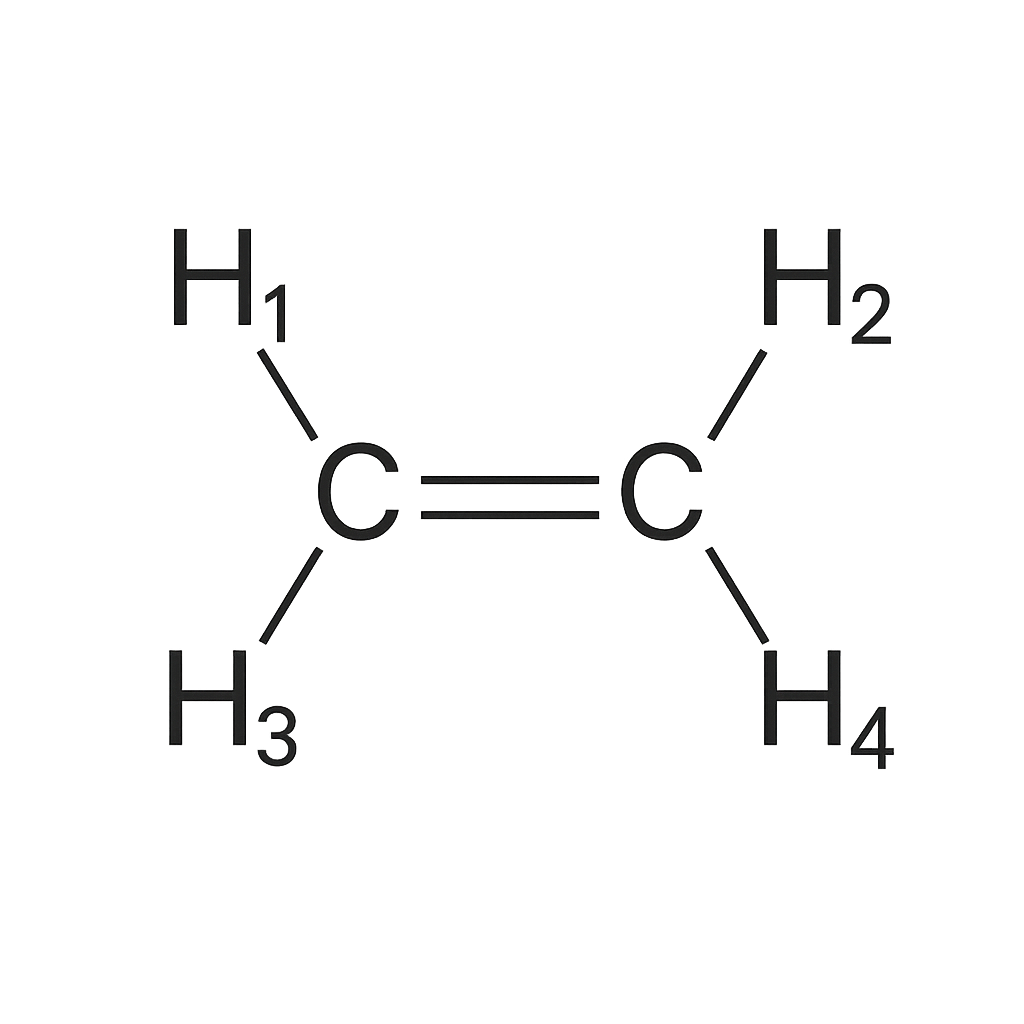
The diagram shows the structural formula of ethene (C₂H₄). Determine the hybridisation of each carbon atom in the molecule.
A. sp³
B. sp^2
Correct C. sp²
D. sp

Correct Answer: C

Want to see the full step-by-step solution? Unlock AI Explanation & Analytics
Question 17 View Details
The reaction 2 Al + 3 Cl₂ → 2 AlCl₃ is carried out using 5.0 g of aluminium and 8.0 g of chlorine gas. After the reaction, 9.0 g of aluminium chloride is obtained. Calculate the percentage yield of the reaction.
A. 78.5
B. 85.0
Correct C. 89.7
D. 92.3

Correct Answer: C

Want to see the full step-by-step solution? Unlock AI Explanation & Analytics
Question 18 View Details
A 0.500 g sample of an unknown monohydric alcohol is combusted completely, producing 1.19 g of CO₂ and 0.61 g of H₂O. The boiling point of the alcohol is 118 °C. (a) Determine the molecular formula of the alcohol. (b) Identify the IUPAC name of the alcohol.
A. pentan-1-ol
Correct B. butan-1-ol
C. propan-1-ol
D. butan-2-ol

Correct Answer: B

Want to see the full step-by-step solution? Unlock AI Explanation & Analytics
Question 19 View Details
Compound X is 1‑chloro‑2‑methylbenzene. When X is nitrated with a mixture of concentrated HNO₃ and H₂SO₄, only one mononitro product is formed. Indicate the position of the nitro group in the product and give the IUPAC name of the product.
A. 4-nitro-1-chloro-2-methylbenzene
B. 3-nitro-2-chloro-1-methylbenzene
Correct C. 3-nitro-1-chloro-2-methylbenzene
D. 3-nitro-1-chloro-3-methylbenzene

Correct Answer: C

Want to see the full step-by-step solution? Unlock AI Explanation & Analytics
Question 20 View Details
A 2.00 L rigid container holds 0.500 mol of a gas at 300 K. The gas has van der Waals constants a = 1.36 L²·atm·mol⁻² and b = 0.0391 L·mol⁻¹. (a) Calculate the pressure exerted by the gas using the van der Waals equation. (b) Compare this pressure with the ideal‑gas pressure and state which is higher.
A. 6.15
B. 5.90
C. 6.40
Correct D. 6.13

Correct Answer: D

Want to see the full step-by-step solution? Unlock AI Explanation & Analytics
Question 21 View Details
A 12.0 g sample of pure malonic acid (HOOC‑CH2‑COOH, molar mass 118.09 g·mol⁻¹) is esterified with excess ethanol in the presence of concentrated H₂SO₄ according to: HOOC‑CH₂‑COOH + 2 C₂H₅OH → CH₃CH₂OOC‑CH₂‑COOCH₂CH₃ + 2 H₂O. If the reaction gives 78% isolated yield of diethyl malonate, calculate (a) the mass of diethyl malonate obtained and (b) the percent by mass of water formed relative to the original malonic acid sample.
A. a) 14.6 g of diethyl malonate; b) 26.3 % water by mass
Correct B. a) 13.8 g of diethyl malonate; b) 23.8 % water by mass
C. a) 11.9 g of diethyl malonate; b) 19.7 % water by mass
D. a) 12.5 g of diethyl malonate; b) 21.5 % water by mass

Correct Answer: B

Want to see the full step-by-step solution? Unlock AI Explanation & Analytics
Question 22 View Details
A galvanic cell is constructed as Zn(s) | Zn²⁺ (0.010 M) || Cu²⁺ (0.10 M) | Cu(s) at 25 °C. Standard electrode potentials are E°(Cu²⁺/Cu)=+0.34 V and E°(Zn²⁺/Zn)=-0.76 V. (a) Calculate the cell EMF under the given concentrations. (b) If 0.500 C of charge passes through the cell, how many milligrams of copper are deposited on the copper electrode?
Correct A. a) 1.13 V; b) 0.165 mg of copper
B. a) 1.20 V; b) 0.180 mg of copper
C. a) 1.05 V; b) 0.210 mg of copper
D. a) 0.95 V; b) 0.120 mg of copper

Correct Answer: A

Want to see the full step-by-step solution? Unlock AI Explanation & Analytics
Question 23 View Details
A 5.00 g sample of calcium carbonate is heated strongly, producing calcium oxide and carbon dioxide. The CO₂ is collected over water at 25 °C and a total pressure of 750 mmHg. The vapor pressure of water at this temperature is 23.8 mmHg. The volume of dry CO₂ collected is 1.20 L. If the mass of CaO actually recovered after the experiment is 2.10 g, calculate the percent yield of CaO.
A. 90 % (percent yield of CaO)
B. 85 % (percent yield of CaO)
Correct C. 80 % (percent yield of CaO)
D. 75 % (percent yield of CaO)

Correct Answer: C

Want to see the full step-by-step solution? Unlock AI Explanation & Analytics
Question 24 View Details
A 5.00 g sample of a commercial alcohol mixture contains 60.0 % (w/w) 2‑butanol and the remainder tert‑butanol. The mixture is dehydrated with concentrated H₂SO₄, giving the corresponding alkenes (1‑butene from 2‑butanol and isobutene from tert‑butanol). Assuming complete conversion of each alcohol present, calculate the overall percentage yield of the dehydration reaction if the combined mass of alkenes obtained is 6.50 g.
Correct A. 86 % (overall dehydration yield)
B. 92 % (overall dehydration yield)
C. 78 % (overall dehydration yield)
D. 80 % (overall dehydration yield)

Correct Answer: A

Want to see the full step-by-step solution? Unlock AI Explanation & Analytics
Question 25 View Details
A wastewater stream contains 150 mg L⁻¹ phenol. It undergoes aerobic biological treatment that follows first‑order kinetics with a rate constant k = 0.12 day⁻¹ at 25 °C. After 5 days, the effluent is further treated by an advanced oxidation process that reduces the remaining phenol concentration by 80 % in a single batch. Determine (a) the phenol concentration (mg L⁻¹) after both treatment steps and (b) the overall removal efficiency percentage. State whether the final concentration meets a discharge limit of 20 mg L⁻¹.
A. a) 18.0 mg L⁻¹; b) 88 % removal; meets the 20 mg L⁻¹ limit
Correct B. a) 16.5 mg L⁻¹; b) 89 % removal; meets the 20 mg L⁻¹ limit
C. a) 14.2 mg L⁻¹; b) 90 % removal; exceeds the 20 mg L⁻¹ limit
D. a) 20.5 mg L⁻¹; b) 86 % removal; does not meet the 20 mg L⁻¹ limit

Correct Answer: B

Want to see the full step-by-step solution? Unlock AI Explanation & Analytics

Master the Exam!

You've seen a preview, but there are thousands more questions plus AI tutor to break down complex solutions.

Unlock Full Access Available for Android & Windows
Help others prepare! Share this practice hub:
Chat with Support