waec model questions vol1 2020 biology | Objective

Are you preparing for waec model questions vol1 exams? Reviewing past questions is one of the most effective ways to guarantee a high score. This practice hub features authentic 2020 biology (Objective) questions designed to simulate the real exam environment.

Practice these randomly selected questions to test your readiness.

Question 1 View Details
In a plant, the water potential (Ψ) values are: soil Ψ = -0.15 MPa, root xylem Ψ = -0.30 MPa, leaf cell Ψ = -1.20 MPa, and atmospheric Ψ = -1.80 MPa. The hydraulic conductance of the root segment is 0.8 mmol m⁻² s⁻¹ MPa⁻¹ and that of the leaf stomatal pathway is 0.5 mmol m⁻² s⁻¹ MPa⁻¹. Assuming the root and leaf pathways are in series, calculate the net water flux (J, in mmol m⁻² s⁻¹) from soil to leaf.
A. 0.24 mmol m⁻² s⁻¹
B. 0.28 mmol m⁻² s⁻¹
C. 0.40 mmol m⁻² s⁻¹
Correct D. 0.32 mmol m⁻² s⁻¹

Correct Answer: D

Want to see the full step-by-step solution? Unlock AI Explanation & Analytics
Question 2 View Details
A mammalian kidney receives a renal plasma flow of 600 mL min⁻¹. The filtration fraction is 0.20. Plasma glucose concentration is 5 mmol L⁻¹, and 99 % of the filtered glucose is reabsorbed. What amount of glucose is excreted in the urine per minute (mmol min⁻¹)?
Correct A. 0.006 mmol min⁻¹
B. 0.05 mmol min⁻¹
C. 0.0006 mmol min⁻¹
D. 0.6 mmol min⁻¹

Correct Answer: A

Want to see the full step-by-step solution? Unlock AI Explanation & Analytics
Question 3 View Details
Two rodent species differ in kidney concentrating ability. Species D (desert) can produce urine with an osmolarity up to 3000 mOsm kg⁻¹, whereas species R (rainforest) reaches only 900 mOsm kg⁻¹. Both generate metabolic waste equivalent to 0.5 Osm per day. Assuming they excrete only this waste in urine, calculate (a) the minimum urine volume each must produce per day (in mL), and (b) the percentage reduction in urine volume of the desert species relative to the rainforest species.
A. Desert ≈150 mL; Rainforest ≈500 mL; reduction ≈70 %
B. Desert ≈180 mL; Rainforest ≈540 mL; reduction ≈67 %
C. Desert ≈200 mL; Rainforest ≈600 mL; reduction ≈67 %
Correct D. Desert ≈167 mL; Rainforest ≈556 mL; reduction ≈70 %

Correct Answer: D

Want to see the full step-by-step solution? Unlock AI Explanation & Analytics
Question 4 View Details
A small mammal has a basal metabolic rate that generates 5 kJ of heat per hour. Heat is lost by convection at a rate of 0.8 kJ h⁻¹ °C⁻¹ multiplied by the temperature difference between body (38 °C) and ambient (10 °C), and by evaporative cooling at 0.5 kJ per gram of water evaporated. The animal can evaporate up to 2 g of water per hour. Determine whether the animal can maintain its body temperature under these conditions, and if not, calculate the heat deficit per hour (kJ).
A. No; deficit ≈25 kJ h⁻¹
Correct B. No; deficit ≈18 kJ h⁻¹
C. Yes; deficit ≈0 kJ h⁻¹
D. No; deficit ≈10 kJ h⁻¹

Correct Answer: B

Want to see the full step-by-step solution? Unlock AI Explanation & Analytics
Question 5 View Details
The photosynthetic rate of a shade‑tolerant leaf is described by P = a I (1 - e^{-kL}) - r L, where I is incident light intensity (µmol photons m⁻² s⁻¹), L is leaf thickness (mm), a = 0.02 µmol CO₂ µmol⁻¹ photons, k = 0.5 mm⁻¹, and r = 0.1 µmol CO₂ m⁻² s⁻¹ mm⁻¹. For I = 200 µmol photons m⁻² s⁻¹, find the leaf thickness L (mm) that maximizes P, and give the corresponding maximum photosynthetic rate (µmol CO₂ m⁻² s⁻¹).
A. L ≈4 mm; P_max ≈2.5 µmol CO₂ m⁻² s⁻¹
B. L ≈7 mm; P_max ≈3.0 µmol CO₂ m⁻² s⁻¹
C. L ≈5 mm; P_max ≈2.8 µmol CO₂ m⁻² s⁻¹
Correct D. L ≈6 mm; P_max ≈3.2 µmol CO₂ m⁻² s⁻¹

Correct Answer: D

Want to see the full step-by-step solution? Unlock AI Explanation & Analytics
Question 6 View Details
Species A and B are endemic to an island. They share 12 homologous traits that are considered primitive. Each species possesses 4 derived (novel) traits that are not found in the other. A mainland species C shares 10 traits with species A and 8 traits with species B. Of the 10 traits shared with A, 6 are primitive and 4 are derived; of the 8 traits shared with B, 6 are primitive and 2 are derived. Based on these data, which island species is more closely related to the mainland species C? State the species (A or B).
A. Species C
B. Species A and B
C. Species B
Correct D. Species A

Correct Answer: D

Want to see the full step-by-step solution? Unlock AI Explanation & Analytics
Question 7 View Details
In peas, the genes for seed shape (R = round, r = wrinkled) and seed colour (Y = yellow, y = green) are linked on the same chromosome with a recombination frequency of 10 %. A plant heterozygous for both traits has the cis arrangement RY / ry and is crossed with a plant homozygous recessive rryy. What percentage of the progeny are expected to be round and yellow (genotype RrYy)?
A. 55
B. 50
Correct C. 45
D. 40

Correct Answer: C

Want to see the full step-by-step solution? Unlock AI Explanation & Analytics
Question 8 View Details
The estrous cycle of a rabbit lasts 8 days and is divided as follows: proestrus = 1 day, estrus = 1 day, metestrus = 2 days, diestrus = 4 days. Rabbits are induced ovulators, and ovulation occurs within 12 hours after mating. If a female rabbit mates on day 3 of her cycle, on which day (counting from the first day of the cycle) will implantation of the fertilised egg occur, given that implantation takes place 6 days after fertilisation?
A. Day 8
B. Day 7
C. Day 10
Correct D. Day 9

Correct Answer: D

Want to see the full step-by-step solution? Unlock AI Explanation & Analytics
Question 9 View Details
A subject has a plasma glucose concentration of 12 mmol L⁻¹. The renal threshold for glucose is 10 mmol L⁻¹ and the tubular maximum (Tm) for glucose reabsorption is 375 mg min⁻¹. Assuming a glomerular filtration rate of 125 mL min⁻¹, calculate the amount of glucose (in grams) excreted in the urine per day.
Correct A. 64.8
B. 54.3
C. 70.2
D. 80.0

Correct Answer: A

Want to see the full step-by-step solution? Unlock AI Explanation & Analytics
Question 10 View Details
At rest a person has an alveolar ventilation of 4 L min⁻¹ and an arterial PCO₂ of 40 mmHg. During moderate exercise the alveolar ventilation rises to 12 L min⁻¹ while the metabolic production of CO₂ doubles. Using the alveolar ventilation equation (PaCO₂ ∝ VCO₂ / VA), estimate the new arterial PCO₂ (in mmHg) during exercise.
A. 33
B. 24
C. 30
Correct D. 27

Correct Answer: D

Want to see the full step-by-step solution? Unlock AI Explanation & Analytics
Question 11 View Details
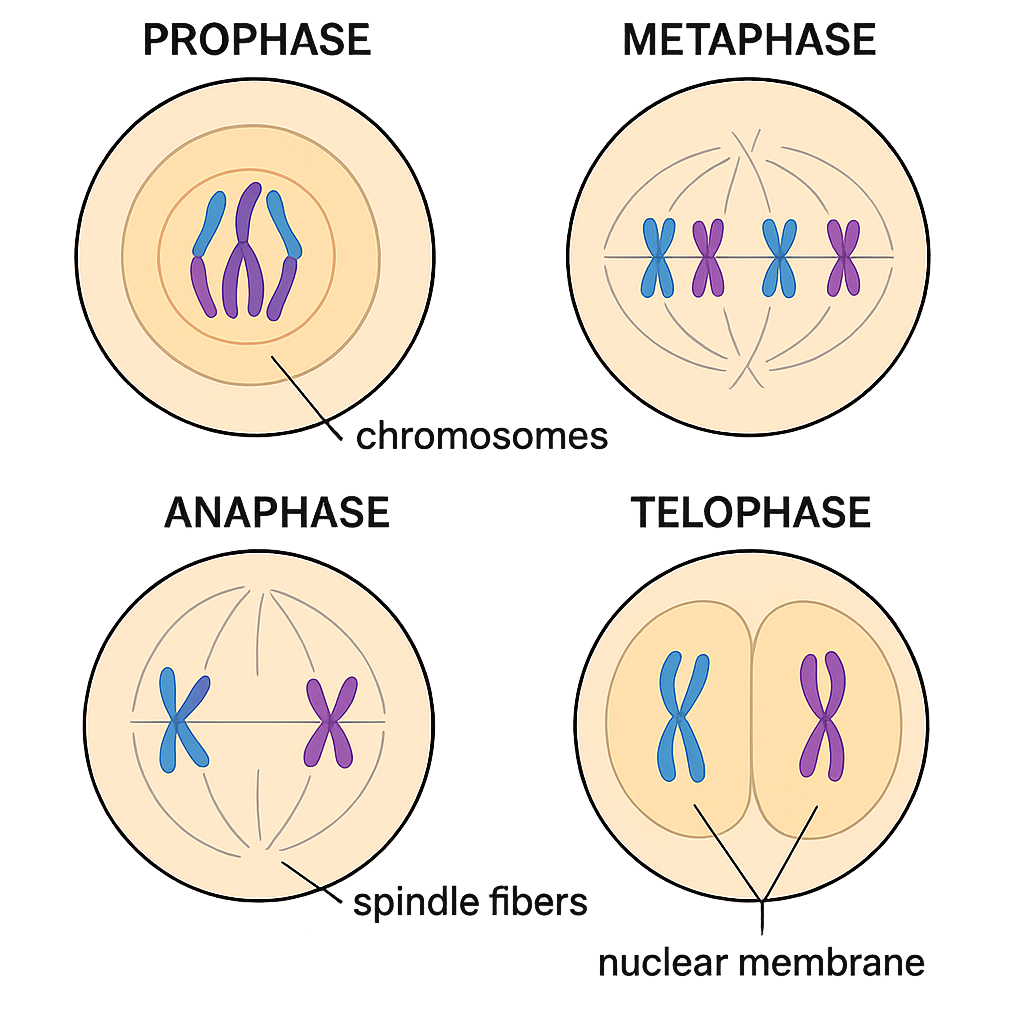
The diagram shows the stages of mitosis in a eukaryotic cell. Which stage is characterised by the chromosomes aligning at the cell's equatorial plate?
Correct A. Metaphase
B. Telophase
C. Prophase
D. Anaphase

Correct Answer: A

Want to see the full step-by-step solution? Unlock AI Explanation & Analytics
Question 12 View Details
A person's glomerular filtration rate (GFR) is 125 mL min⁻¹. Of the filtrate, 98 % of water and 85 % of urea are re‑absorbed. The plasma urea concentration is 6 mmol L⁻¹. How many millimoles of urea are excreted in the urine per day?
A. 180
B. 200
C. 150
Correct D. 162

Correct Answer: D

Want to see the full step-by-step solution? Unlock AI Explanation & Analytics
Question 13 View Details
During a fight‑or‑flight response, adrenaline raises the heart rate by 20 % above a resting rate of 70 beats min⁻¹. Parasympathetic activity simultaneously reduces this increase by 30 % of the adrenaline effect. What is the final heart rate (in beats per minute) after both influences act?
A. 81
Correct B. 80
C. 84
D. 78

Correct Answer: B

Want to see the full step-by-step solution? Unlock AI Explanation & Analytics
Question 14 View Details
In a stretch reflex, the sensory neuron conducts impulses 0.5 m to the spinal cord at 80 m s⁻¹, the synaptic delay is 0.5 ms, and the motor neuron conducts 0.4 m to the muscle at 60 m s⁻¹. Calculate the total time from muscle stretch to contraction in milliseconds (to one decimal place).
A. 15.0
B. 12.9
Correct C. 13.4
D. 14.2

Correct Answer: C

Want to see the full step-by-step solution? Unlock AI Explanation & Analytics
Question 15 View Details
A bacterial culture is inoculated with 5 × 10⁶ cells. It undergoes a 2‑hour lag phase (no growth), followed by exponential growth for 6 hours with a generation time of 30 minutes. The culture then enters a stationary phase for 4 hours (no change in cell number) and finally a decline phase lasting 3 hours during which the viable cell count falls by 10 % each hour. What is the number of viable cells present at the end of the 15‑hour period? Express your answer in scientific notation to two significant figures.
Correct A. 1.5×10^10
B. 1.2×10^10
C. 1.5×10^9
D. 2.0×10^10

Correct Answer: A

Want to see the full step-by-step solution? Unlock AI Explanation & Analytics
Question 16 View Details
A plant is heterozygous for two linked genes A/a and B/b. The recombination frequency between the genes is 10%. It is crossed with a plant that is homozygous recessive (aa bb). What is the probability that an offspring will display both dominant phenotypes (A and B)?
A. 0.40
Correct B. 0.45
C. 0.35
D. 0.55

Correct Answer: B

Want to see the full step-by-step solution? Unlock AI Explanation & Analytics
Question 17 View Details
Which organelle is primarily responsible for the synthesis of ATP in eukaryotic cells?
A. Chloroplast
Correct B. Mitochondrion
C. Golgi apparatus
D. Nucleus

Correct Answer: B

Want to see the full step-by-step solution? Unlock AI Explanation & Analytics
Question 18 View Details
In a community of 10,000 people, an outbreak of disease X starts with 5 cases on day 0. By day 6, the number of cases rises to 80. Assuming the disease spreads in discrete generations with a generation time of 3 days and each infected individual infects R₀ new individuals per generation, estimate the basic reproduction number R₀.
A. 3
Correct B. 4
C. 6
D. 5

Correct Answer: B

Want to see the full step-by-step solution? Unlock AI Explanation & Analytics
Question 19 View Details
During a 5‑minute run, a student's oxygen consumption is measured at 2.5 L·min⁻¹ and the respiratory quotient (RQ) is 0.85. Assuming that an RQ of 1.0 indicates pure carbohydrate oxidation and an RQ of 0.70 indicates pure fat oxidation, calculate the percentage contribution of carbohydrate and fat to the energy supplied during the run.
A. 60% carbohydrate, 40% fat
B. 70% carbohydrate, 30% fat
Correct C. 50% carbohydrate, 50% fat
D. 40% carbohydrate, 60% fat

Correct Answer: C

Want to see the full step-by-step solution? Unlock AI Explanation & Analytics
Question 20 View Details
A newly discovered flowering plant exhibits the following characteristics: (i) parallel leaf venation, (ii) flower parts in multiples of three, (iii) scattered vascular bundles in the stem, and (iv) a hollow stem. Using the hierarchical classification criteria for angiosperms, determine the family to which this plant most likely belongs.
Correct A. Poaceae
B. Juncaceae
C. Bromeliaceae
D. Cyperaceae

Correct Answer: A

Want to see the full step-by-step solution? Unlock AI Explanation & Analytics
Question 21 View Details
A woman has a menstrual cycle that varies between 26 and 30 days. The luteal phase is constant at 14 days. Sperm can survive in the female reproductive tract for up to 5 days. Determine the range of days in the cycle on which she should have sexual intercourse to have the highest chance of conception.
A. Days 9 to 18 of the cycle
B. Days 8 to 17 of the cycle
C. Days 5 to 14 of the cycle
Correct D. Days 7 to 16 of the cycle

Correct Answer: D

Want to see the full step-by-step solution? Unlock AI Explanation & Analytics
Question 22 View Details
During which phase of mitosis are the sister chromatids pulled apart to opposite poles of the cell?
A. Prophase
B. Metaphase
C. Telophase
Correct D. Anaphase

Correct Answer: D

Want to see the full step-by-step solution? Unlock AI Explanation & Analytics
Question 23 View Details
A bacterial culture starts with 1.0×10³ cells. The generation time is 20 minutes for the first 2 hours, after which nutrients become limiting and the generation time doubles to 40 minutes. Assuming bacteria only divide after completing a full generation time, how many cells will be present after a total of 5 hours?
A. 512,000
Correct B. 1,024,000
C. 2,048,000
D. 128,000

Correct Answer: B

Want to see the full step-by-step solution? Unlock AI Explanation & Analytics
Question 24 View Details
Two terrestrial ecosystems, A and B, have different net primary productivity (NPP). Ecosystem A has an NPP of 2000 g C m⁻² yr⁻¹, while ecosystem B has an NPP of 1500 g C m⁻² yr⁻¹. Energy (or biomass) transfer efficiency between successive trophic levels is 10 %. Herbivores consume 70 % of the available plant biomass, and carnivores consume 25 % of the herbivore biomass. Calculate the amount of carnivore biomass (in g C m⁻² yr⁻¹) that can be supported in each ecosystem and state which ecosystem supports the larger carnivore biomass.
A. Ecosystem A: 14 g C m⁻² yr⁻¹; Ecosystem B: 10.5 g C m⁻² yr⁻¹; Ecosystem A supports the larger carnivore biomass
B. Ecosystem A: 3.5 g C m⁻² yr⁻¹; Ecosystem B: 2.6 g C m⁻² yr⁻¹; Ecosystem B supports the larger carnivore biomass
Correct C. Ecosystem A: 3.5 g C m⁻² yr⁻¹; Ecosystem B: 2.6 g C m⁻² yr⁻¹; Ecosystem A supports the larger carnivore biomass
D. Ecosystem A: 7.0 g C m⁻² yr⁻¹; Ecosystem B: 5.3 g C m⁻² yr⁻¹; Ecosystem A supports the larger carnivore biomass

Correct Answer: C

Want to see the full step-by-step solution? Unlock AI Explanation & Analytics
Question 25 View Details
After a meal, a person's blood glucose rises to 180 mg/dL. Insulin secretion increases proportionally to the excess glucose above the normal fasting level of 100 mg/dL at a rate of 0.3 µU mL⁻¹ per mg/dL, while glucagon secretion decreases proportionally at a rate of 0.1 µU mL⁻¹ per mg/dL. Baseline (fasting) insulin is 6 µU mL⁻¹ and baseline glucagon is 12 µU mL⁻¹. What is the ratio of the post‑prandial insulin concentration to the glucagon concentration (insulin : glucagon)?
A. 6.0
B. 8.0
C. 5.0
Correct D. 7.5

Correct Answer: D

Want to see the full step-by-step solution? Unlock AI Explanation & Analytics

Master the Exam!

You've seen a preview, but there are thousands more questions plus AI tutor to break down complex solutions.

Unlock Full Access Available for Android & Windows
Help others prepare! Share this practice hub:
Chat with Support