waec model questions vol1 2020 agricultural_science | Objective

Prepare for your exams with waec model questions vol1 questions? Reviewing past/model questions is one of the most effective ways to guarantee a high score. This practice hub features authentic 2020 agricultural_science (Objective) questions designed to simulate the real exam environment.

Practice these randomly selected questions to test your readiness.

Question 1 View Details
A farmer intends to raise 50 goats from a live weight of 12 kg to 25 kg in 90 days. The breed has a feed conversion ratio (FCR) of 5 kg feed per kg weight gain. The daily protein requirement of each goat is 150 g. The farmer will feed a mixture of two forages: a legume forage containing 20 % protein and a grass forage containing 10 % protein. Assuming the total amount of feed offered each day is determined solely by the FCR, what is the minimum percentage of the legume forage that must be present in the daily mixed ration to satisfy the goats' protein requirement?
A. 70 %
Correct B. 62.5 %
C. 50 %
D. 55 %

Correct Answer: B

Want to see the full step-by-step solution? Unlock AI Explanation & Analytics
Question 2 View Details
A farmer uses a class‑2 lever to lift a sack of grain weighing 250 kg. The load arm (distance from the fulcrum to the sack) is 0.20 m and the effort arm (distance from the fulcrum to the farmer's hands) is 0.80 m. The farmer can apply a maximum effort of 500 N. (a) Can the lever lift the sack with the given arm lengths? (b) If not, what is the minimum effort‑arm length required to lift the sack while keeping the load‑arm length unchanged?
A. No; a minimum effort‑arm length of 0.85 m is required
B. Yes; the current effort‑arm length of 0.80 m is sufficient
C. No; a minimum effort‑arm length of 1.10 m is required
Correct D. No; a minimum effort‑arm length of 0.98 m is required

Correct Answer: D

Want to see the full step-by-step solution? Unlock AI Explanation & Analytics
Question 3 View Details
A farmer wants to dry 500 kg of fresh cassava chips that have an initial moisture content of 45 % (wet basis) to a final moisture content of 12 % (wet basis). The chips are dried in a solar dryer in which air is heated from 25 °C to 45 °C. Air flows through the dryer at 0.5 m³ s⁻¹. The density of air at 45 °C is 1.1 kg m⁻³ and its specific heat is 1.005 kJ kg⁻¹ K⁻¹. The latent heat of vaporisation of water at 45 °C is 2 400 kJ kg⁻¹. Assuming all the sensible heat supplied to the air is used solely for water evaporation, estimate the minimum drying time in hours (round to one decimal place).
Correct A. 11.3 hours
B. 13.5 hours
C. 7.2 hours
D. 9.8 hours

Correct Answer: A

Want to see the full step-by-step solution? Unlock AI Explanation & Analytics
Question 4 View Details
A farmer's tomato crop shows circular leaf spots surrounded by yellow halos, and the fruits later develop concentric rings of necrosis. Laboratory examination reveals the pathogen produces conidia in chains and a sexual stage that forms ascospores. Identify the disease, name the causal organism group, and outline an integrated management strategy that includes cultural, chemical, and biological control measures.
A. Bacterial speck; causal organism group: Bacterial (Pseudomonas syringae pv. tomato); integrated management: sanitation, copper sprays, biological control with Pseudomonas fluorescens
Correct B. Early blight; causal organism group: Ascomycete fungi (Alternaria solani); integrated management: crop rotation, resistant varieties, good spacing and sanitation; copper‑based or systemic fungicide applications; biological control with Bacillus subtilis or Trichoderma harzianum
C. Septoria leaf spot; causal organism group: Ascomycete fungi (Septoria lycopersici); integrated management: crop rotation, use of fungicide chlorothalonil, seed treatment with beneficial bacteria
D. Late blight; causal organism group: Oomycete (Phytophthora infestans); integrated management: use resistant varieties, apply metalaxyl fungicide, remove infected plants, apply compost teas

Correct Answer: B

Want to see the full step-by-step solution? Unlock AI Explanation & Analytics
Question 5 View Details
A vegetable farmer is considering installing a drip‑irrigation system on a 2 ha farm. The system costs ₦1,200,000 upfront and has a 10‑year life with no salvage value. It reduces water use by 30 % and raises annual crop yield by 25 %. Currently, the farm generates ₦3,600,000 of revenue per year and incurs ₦1,800,000 of variable costs (excluding water). Water consumption is 12 000 m³ per year, and water is charged at ₦150 per 1 000 L. The discount rate is 12 % per annum. Calculate the net present value (NPV) of the investment. Should the farmer adopt the drip system? (Give the NPV in ₦, rounded to the nearest thousand.)
A. ₦4 950 000
Correct B. ₦6 936 000
C. ₦7 800 000
D. ₦5 200 000

Correct Answer: B

Want to see the full step-by-step solution? Unlock AI Explanation & Analytics
Question 6 View Details
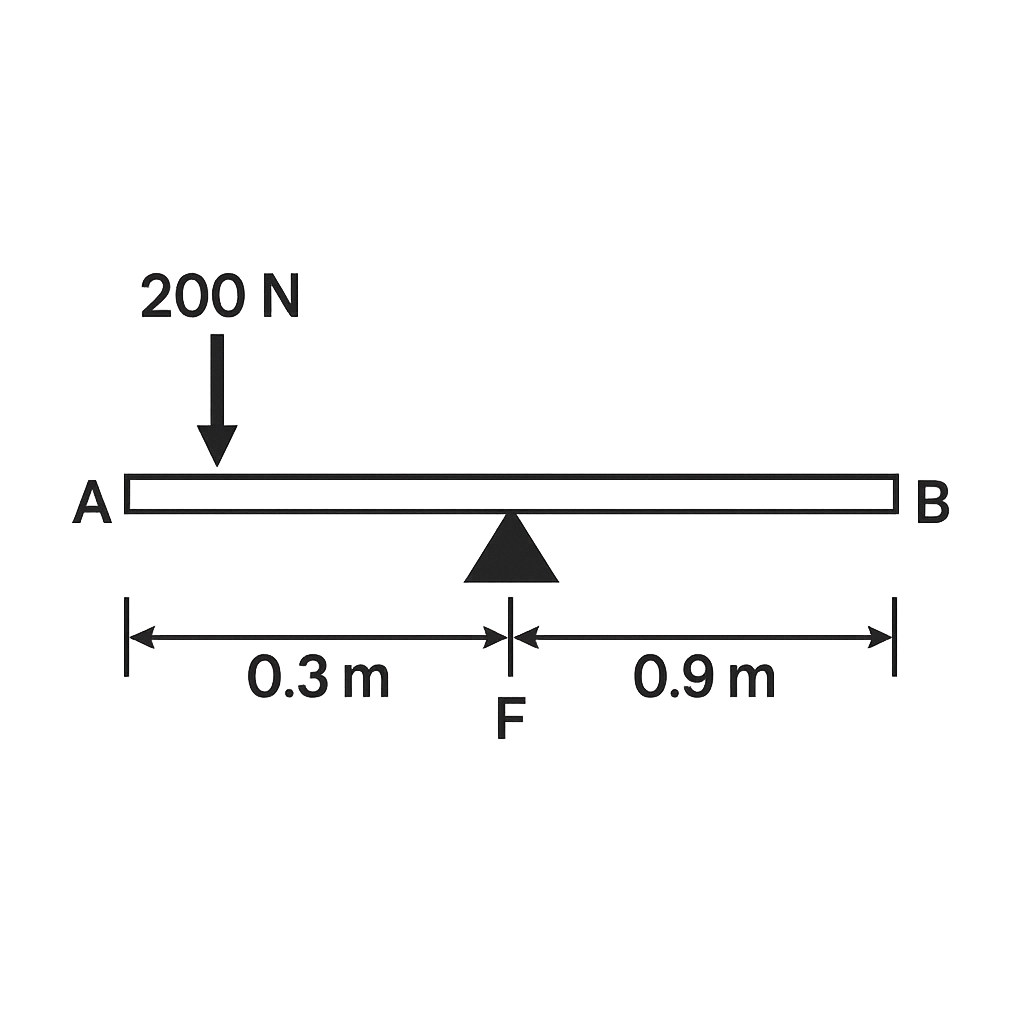
In the diagram, a simple lever AB is used to lift a load. The fulcrum F is located 0.30 m from point A (the effort side) and 0.90 m from point B (the load side). An effort of 200 N is applied vertically downward at A. Assuming the lever is in equilibrium, what is the maximum weight of the load that can be lifted at B (in newtons, to one decimal place)?
A. 100.0
B. 600.0
Correct C. 66.7
D. 66.0

Correct Answer: C

Want to see the full step-by-step solution? Unlock AI Explanation & Analytics
Question 7 View Details
A farmer intends to sow maize on a flat field at a row spacing of 75 cm and a plant spacing within rows of 25 cm. Each maize seed weighs 0.25 g. Calculate the quantity of seed required per hectare (in kilograms, to one decimal place).
A. 12.5
B. 15.0
C. 10.0
Correct D. 13.3

Correct Answer: D

Want to see the full step-by-step solution? Unlock AI Explanation & Analytics
Question 8 View Details
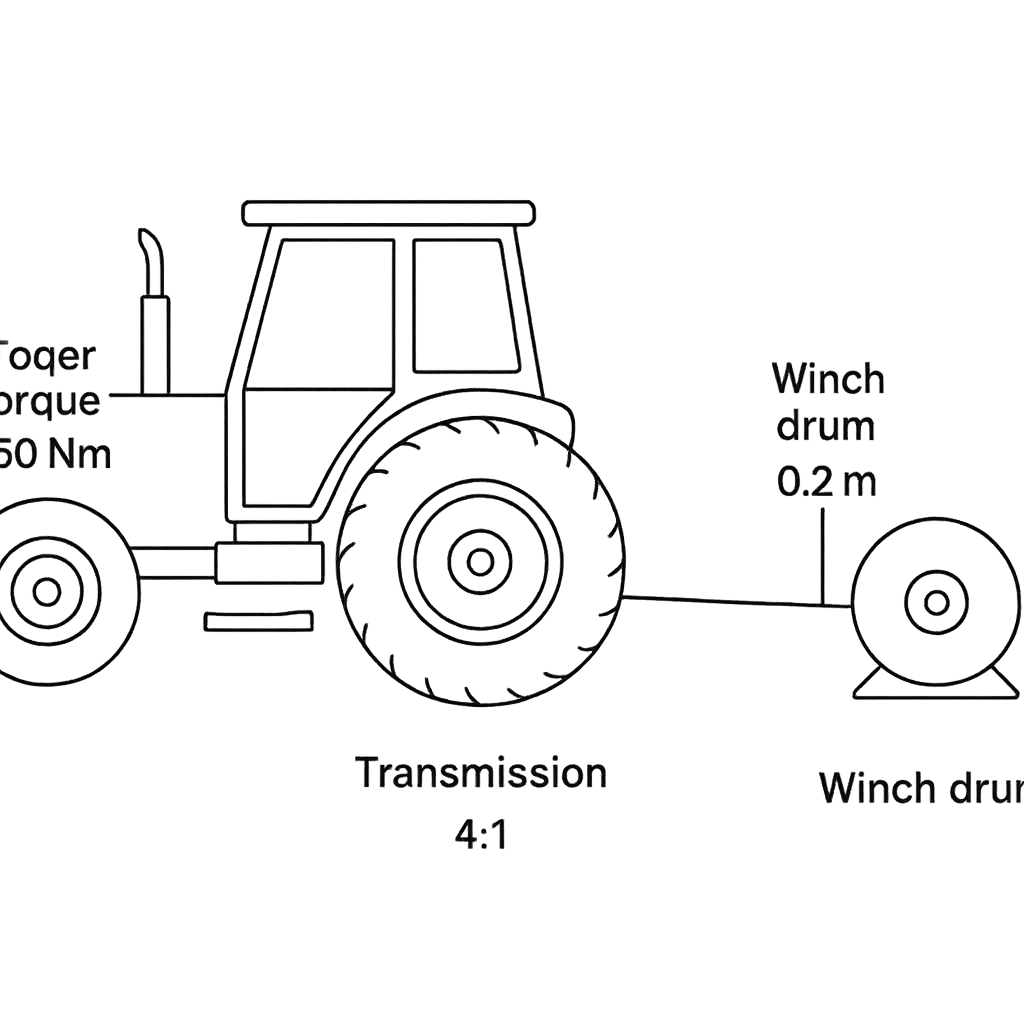
The diagram shows a tractor whose engine delivers a torque of 250 Nm to the transmission. The transmission has a gear ratio of 4 : 1 (engine to PTO) and the PTO drives a winch drum of radius 0.20 m. The overall mechanical efficiency of the system is 90 %. Assuming the winch lifts a load vertically, determine the maximum mass (in kilograms, to the nearest kilogram) that can be lifted.
A. 380
B. 400
C. 520
Correct D. 459

Correct Answer: D

Want to see the full step-by-step solution? Unlock AI Explanation & Analytics
Question 9 View Details
A tilapia farmer plans to raise 5 000 fingerlings, each initially weighing 5 g, to a market weight of 500 g over a 6‑month period. The expected feed conversion ratio (FCR) is 1.5 kg feed per kg of weight gain. Anticipating a 10 % mortality and a 5 % feed loss due to spillage, calculate the total amount of feed (in kilograms, to the nearest kilogram) that must be purchased.
Correct A. 3517
B. 3800
C. 3320
D. 3175

Correct Answer: A

Want to see the full step-by-step solution? Unlock AI Explanation & Analytics
Question 10 View Details
In a 2‑hectare vegetable field containing 12 000 plants, 8 % are initially infected with a fungal disease. The farmer applies two sprays of fungicide. The first spray reduces the current number of infected plants by 60 %, and the second spray, applied later, reduces the remaining infected plants by 50 %. How many plants remain infected after both sprays?
A. 240
B. 384
Correct C. 192
D. 288

Correct Answer: C

Want to see the full step-by-step solution? Unlock AI Explanation & Analytics
Question 11 View Details
A farmer intends to raise 50 goats. Each goat requires 0.8 kg of dry matter (DM) per day. The goats need a daily protein intake equal to 12 % of their DM consumption for optimal growth. The farmer will purchase a commercial feed that contains 40 % protein on a dry‑matter basis and has a moisture content of 10 % (i.e., 90 % DM). What is the minimum amount of this wet feed (in kilograms, to one decimal place) the farmer must buy each day to satisfy the protein requirement of all goats?
A. 12.5
B. 15.0
C. 14.2
Correct D. 13.3

Correct Answer: D

Want to see the full step-by-step solution? Unlock AI Explanation & Analytics
Question 12 View Details
A farmer wishes to sow maize on a rectangular field that is 2.4 ha in size, where the length of the field is twice its width. The recommended planting spacing is 75 cm between rows and 25 cm between plants within a row. If the seed germination rate is 85 %, how many seeds must the farmer purchase (rounded to the nearest whole seed) to obtain a full stand?
A. 149000
B. 152300
Correct C. 150467
D. 155800

Correct Answer: C

Want to see the full step-by-step solution? Unlock AI Explanation & Analytics
Question 13 View Details
A farmer produces 10 tonnes of fresh cassava per year. The market price is ₦150 per kg. The farmer has three marketing options:\n1) Sell directly to a processor at a contract price of ₦140 per kg; the processor pays a 5 % bonus on the total contract value if the farmer sells more than 9 tonnes.\n2) Sell at the open market, incurring a transport cost of ₦5 per kg and a marketing commission of 3 % of the gross sales.\n3) Process the cassava into garri. The conversion factor is 0.6 (i.e., 1 tonne fresh cassava yields 0.6 tonne garri). Garri sells for ₦300 per kg, but processing costs ₦40 per kg of garri produced.\nWhich option gives the highest net revenue and what is that net revenue (in ₦)?
A. Processing to garri; ₦1500000
B. Sell directly to processor; ₦1470000
C. Open market sale; ₦1405000
Correct D. Processing to garri; ₦1560000

Correct Answer: D

Want to see the full step-by-step solution? Unlock AI Explanation & Analytics
Question 14 View Details
In a rabbit breeding program, a doe with genotype Aa (A = dominant allele for larger litter size, a = recessive) is mated with a buck that is also heterozygous (Aa). Assuming independent segregation, what is the probability (as a percentage to one decimal place) that a litter of four kits will contain at least two kits showing the dominant phenotype?
Correct A. 94.9
B. 92.2
C. 87.5
D. 96.8

Correct Answer: A

Want to see the full step-by-step solution? Unlock AI Explanation & Analytics
Question 15 View Details
A farmer harvests 5 tonnes of tomatoes whose initial moisture content is 95 % (wet basis). The farmer wants to dry the tomatoes to a final moisture content of 85 % for storage. The drying process removes water at a constant rate of 2 % of the initial wet weight each day. However, each day of drying also causes a 0.5 % loss of the remaining dry matter due to enzymatic degradation. Determine the minimum whole number of days required to reach the target moisture content, and state the final weight of the dried tomatoes (in kilograms, to one decimal place) after accounting for both water loss and dry‑matter loss.
A. 38 days; 1342.0 kg
B. 35 days; 1365.2 kg
Correct C. 36 days; 1358.8 kg
D. 34 days; 1380.5 kg

Correct Answer: C

Want to see the full step-by-step solution? Unlock AI Explanation & Analytics
Question 16 View Details
A pig farm reports a sudden outbreak characterized by high fever (≈40.5°C), reddening of the skin, loss of appetite and a mortality rate of over 70% among piglets within 3-5 days after the introduction of a new feed. The disease spreads rapidly to all age groups, laboratory tests detect a virus and the disease is known to be transmitted through contaminated feed and fomites. Which disease is most likely responsible for this outbreak?
A. Swine Influenza
Correct B. Classical Swine Fever
C. Porcine Reproductive and Respiratory Syndrome
D. African Swine Fever

Correct Answer: B

Want to see the full step-by-step solution? Unlock AI Explanation & Analytics
Question 17 View Details
A farmer has 2 hectares of land for maize cultivation. The traditional planting arrangement uses 75 cm between plants within a row and 75 cm between rows. A newly released seed variety recommends a reduced intra‑row spacing of 60 cm while keeping the inter‑row spacing at 75 cm. How many additional plants can the farmer plant per hectare by adopting the new spacing?
A. 6000
B. 3333
Correct C. 4444
D. 5000

Correct Answer: C

Want to see the full step-by-step solution? Unlock AI Explanation & Analytics
Question 18 View Details
A wheat fungal disease caused by *Puccinia graminis* proceeds through three stages: spore germination (2 days at 20 °C), hyphal growth (3 days at 20 °C) and sporulation (4 days at 20 °C). The rate of each stage doubles for every 5 °C rise above 20 °C. If the daily temperature for the next week is a constant 25 °C, on which day after the initial infection will the first new spores be released?
A. 6
B. 4
Correct C. 5
D. 8

Correct Answer: C

Want to see the full step-by-step solution? Unlock AI Explanation & Analytics
Question 19 View Details
Identify one biotic factor that directly influences crop growth in a typical farm ecosystem.
Correct A. soil microorganisms
B. irrigation water
C. sunlight
D. soil pH

Correct Answer: A

Want to see the full step-by-step solution? Unlock AI Explanation & Analytics
Question 20 View Details
A fish population in a lake follows the logistic growth model N(t+1) = N(t) + r N(t) (1 - N(t)/K), where the intrinsic growth rate r = 0.5 year⁻¹ and the carrying capacity K = 200,000 fish. Determine the maximum sustainable yield (MSY) in number of fish per year and the corresponding stock size at which this yield is obtained.
Correct A. 25,000 fish per year; 100,000 fish
B. 100,000 fish per year; 200,000 fish
C. 50,000 fish per year; 50,000 fish
D. 12,500 fish per year; 66,667 fish

Correct Answer: A

Want to see the full step-by-step solution? Unlock AI Explanation & Analytics
Question 21 View Details
A farmer mixes two soils in a 2:1 volume ratio. Soil A contains 30% sand, 50% silt and 20% clay. Soil B contains 60% sand, 20% silt and 20% clay. What is the percentage of sand in the resulting mixture?
A. 50
B. 35
C. 45
Correct D. 40

Correct Answer: D

Want to see the full step-by-step solution? Unlock AI Explanation & Analytics
Question 22 View Details
A crop pest causes damage during its larval stage (12 days) and adult stage (8 days). The pest's life cycle repeats every 20 days, so a new damaging generation starts every 20 days. The first damaging larvae appear on day 5 after planting. An insecticide kills both larvae and adults and remains effective for 14 days after each application. For a 60‑day cropping period, what is the minimum number of insecticide applications required to protect the crop throughout?
Correct A. 4
B. 5
C. 6
D. 3

Correct Answer: A

Want to see the full step-by-step solution? Unlock AI Explanation & Analytics
Question 23 View Details
A farmer applies 120 kg of nitrogen fertilizer to a field. Of the applied nitrogen, 30 % is lost by volatilisation and 20 % is lost by leaching. How many kilograms of nitrogen are taken up by the crop?
A. 48
B. 84
Correct C. 60
D. 96

Correct Answer: C

Want to see the full step-by-step solution? Unlock AI Explanation & Analytics
Question 24 View Details
A farmer grows maize. Fixed costs (land rent, equipment) are ₦150,000 per season. Variable cost is ₦120 per kilogram of maize produced. The market price is ₦200 per kilogram, but a 5 % discount on total sales is given if the quantity sold exceeds 2,000 kg. What is the minimum production quantity (in kilograms) at which the farmer breaks even, taking the discount into account?
A. 2100
Correct B. 1875
C. 2000
D. 1500

Correct Answer: B

Want to see the full step-by-step solution? Unlock AI Explanation & Analytics
Question 25 View Details
An extension officer plans a three‑year programme to promote an improved cassava variety. Year 1: training workshops costing ₦500,000, reaching 20 farmers; each trained farmer adopts the variety with probability 0.6. Year 2: demonstration plots costing ₦300,000; each plot involves 5 farmers, and each participant adopts with probability 0.8. Year 3: a radio campaign costing ₦200,000, reaching 10,000 listeners; each listener adopts with probability 0.02. Assuming no farmer or listener participates in more than one activity, what is the minimum number of demonstration plots required in Year 2 so that the expected total number of adopters over the three years is at least 500?
A. 70
B. 80
Correct C. 72
D. 73

Correct Answer: C

Want to see the full step-by-step solution? Unlock AI Explanation & Analytics

Master the Exam!

You've seen a preview, but there are thousands more questions plus AI tutor to break down complex solutions.

Unlock Full Access Available for Android & Windows
Help others prepare! Share this practice hub:
Chat with Support