waec model questions vol1 2020 agricultural_science | Essay

Prepare for your exams with waec model questions vol1 questions? Reviewing past/model questions is one of the most effective ways to guarantee a high score. This practice hub features authentic 2020 agricultural_science (Essay) questions designed to simulate the real exam environment.

Practice these randomly selected questions to test your readiness.

Question 1 View Details
Biodiversity is a vital component of sustainable agricultural ecosystems. Discuss its importance and explain how each of the following farming practices influences biodiversity:
Question Parts
(a)
Explain why maintaining a high level of biodiversity is beneficial to crop production and ecosystem stability.
(b)
Discuss the effect of continuous use of chemical pesticides on biodiversity in the field.
(c)
Explain how intercropping can enhance biodiversity compared with monoculture.
Detailed Essay Solution & Marking Scheme Available

Get the step-by-step mathematical proofs, key points required by examiners, and a comprehensive breakdown from our AI Tutor.
Question 2 View Details
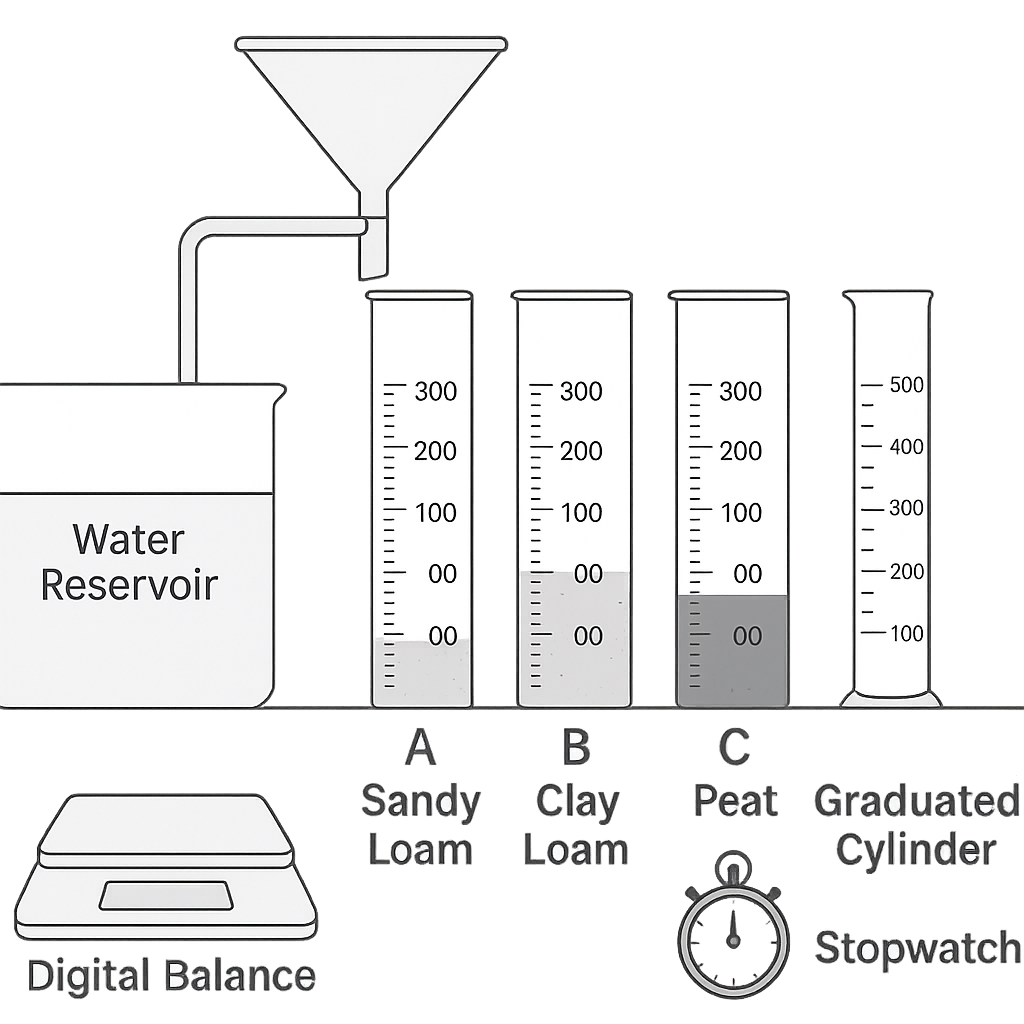
A soil scientist is investigating the water‑holding capacity of three soil types – sandy loam, clay loam and peat – using the laboratory apparatus shown.
Question Parts
(a)
Describe the step‑by‑step procedure for determining the water‑holding capacity of each soil sample with the given apparatus.
(b)
After the procedure, the water retained in the columns are 80 ml (sandy loam), 150 ml (clay loam) and 300 ml (peat). If the dry weight of each soil sample is 200 g, calculate the percentage water‑holding capacity for each soil type.
(c)
Interpret the calculated water‑holding capacities in terms of the suitability of each soil for crop production in a semi‑arid region.
Detailed Essay Solution & Marking Scheme Available

Get the step-by-step mathematical proofs, key points required by examiners, and a comprehensive breakdown from our AI Tutor.
Question 3 View Details
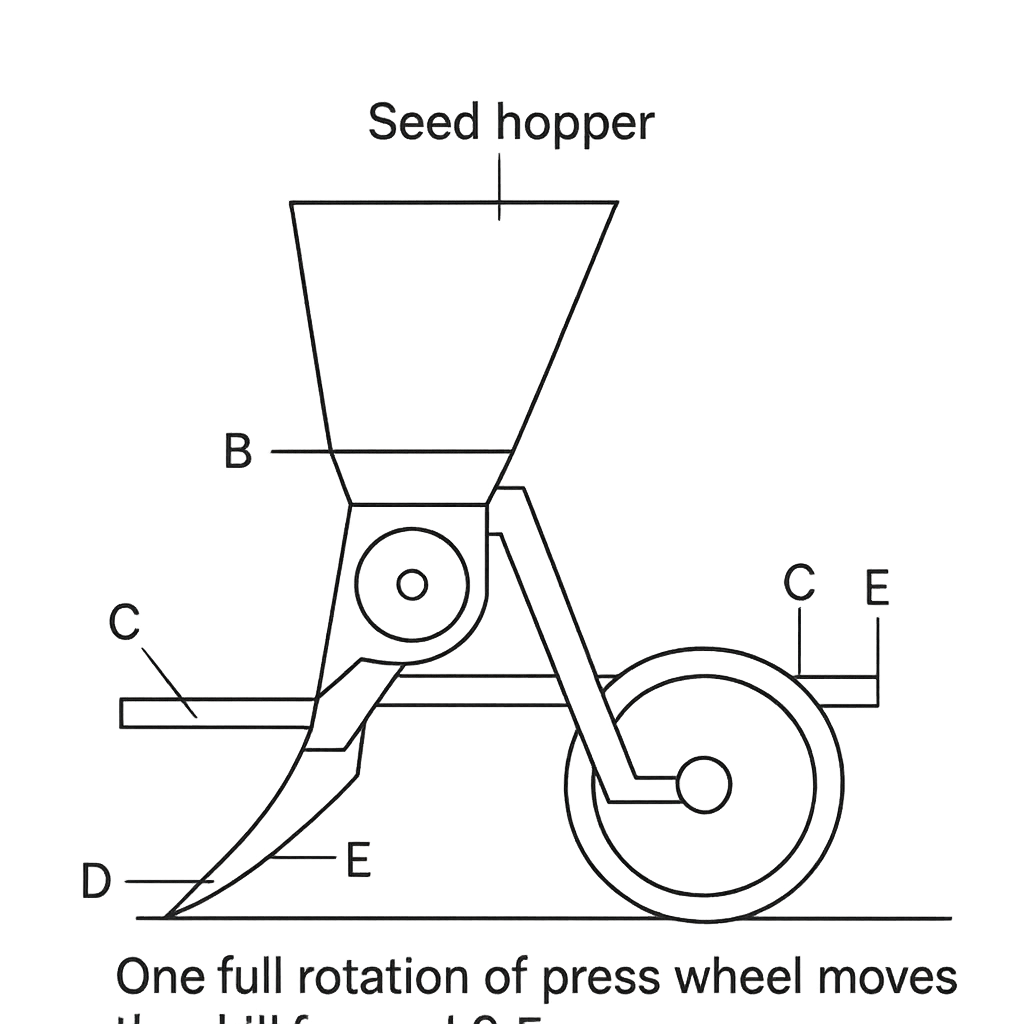
The illustration shows a simple manual seed drill used on a small farm. The parts are labelled as follows: A – seed hopper, B – metering disc, C – furrow opener, D – press wheel, and E – supporting frame.
Question Parts
(a)
Identify each labelled part (A–E) and state its primary function in the operation of the seed drill.
(b)
Explain how seed spacing is controlled in this drill and calculate the number of seeds that will be placed per metre of row if the metering disc has 12 equally spaced holes and the press wheel moves the drill forward 0.5 m for each complete revolution.
(c)
Discuss two advantages and two limitations of using a manual seed drill compared with broadcasting seeds by hand.
Detailed Essay Solution & Marking Scheme Available

Get the step-by-step mathematical proofs, key points required by examiners, and a comprehensive breakdown from our AI Tutor.

Question 4 View Details
A smallholder farmer is evaluating the purchase of a two‑wheel tractor for field operations. The tractor has a rated power of 25 hp, weighs 800 kg and consumes diesel at a rate of 5 L h⁻¹ when operating at full load. Diesel costs ₦250 per litre. The farmer intends to use the tractor for two tasks: - Ploughing: requires 15 hp and a draft force of 2000 N, for 4 h per day. - Hauling harvested crops: requires 20 hp and a draft force of 2500 N, for 2 h per day. The farm operates 150 days per year. The tractor can be bought for ₦1,200,000 and financed at a simple interest rate of 12 % per annum. The farmer estimates that the tractor will save ₦150,000 per year in labour costs compared with manual operations.
Question Parts
(a)
Determine whether the 25 hp tractor can safely operate both the plough and the harvester simultaneously. Justify your answer with appropriate calculations.
(b)
Estimate the annual fuel cost for operating the tractor as described (ploughing 4 h day⁻¹ and hauling 2 h day⁻¹ for 150 days).
(c)
If the tractor is financed at 12 % simple interest per annum, calculate the total amount payable after one year.
Detailed Essay Solution & Marking Scheme Available

Get the step-by-step mathematical proofs, key points required by examiners, and a comprehensive breakdown from our AI Tutor.

Question 5 View Details
A farmer intends to cultivate maize on a 2‑hectare field. Soil analysis shows pH 5.5, organic matter 1.2 %, available N 30 kg ha⁻¹, P 12 kg ha⁻¹ and K 40 kg ha⁻¹. The recommended fertilizer rates for optimum yield are 120 kg N, 60 kg P₂O₅ and 80 kg K₂O per hectare. To raise the soil pH to 6.5, the farmer will apply agricultural lime, which requires 2.5 tonnes per hectare for each unit increase in pH. The farmer plans to use a mixed NPK 15‑15‑15 fertilizer together with urea (46 % N) and single superphosphate (20 % P₂O₅). Prices are: lime ₦5 000 per tonne, mixed NPK ₦25 000 per tonne, urea ₦35 000 per tonne, superphosphate ₦30 000 per tonne.
Question Parts
(a)
Calculate the total amount of lime (in tonnes) required to raise the soil pH of the whole 2‑ha field to 6.5.
(b)
Using the mixed NPK 15‑15‑15 fertilizer together with urea and single superphosphate, determine the quantities (in tonnes per hectare) of each fertilizer that must be applied so that the total N, P₂O₅ and K₂O supplied exactly meet the recommended rates of 120 kg N, 60 kg P₂O₅ and 80 kg K₂O per hectare.
(c)
Compute the total cost (in ₦) of the inputs required for one hectare based on the quantities found in part (b) and the lime requirement from part (a).
Detailed Essay Solution & Marking Scheme Available

Get the step-by-step mathematical proofs, key points required by examiners, and a comprehensive breakdown from our AI Tutor.

Question 6 View Details
A smallholder keeps 12 lactating cows, each producing on average 15 L of milk per day. Milk composition is 3.5 % fat and 3.0 % protein. The farmer wishes to increase total milk yield by 10 % by supplementing the existing diet with a new concentrate feed that contains 12 % CP, 10 % fat and 2.5 Mcal ME per kilogram. The current ration per cow consists of 8 kg of roughage (dry matter 85 %, CP 8 %, ME 2.0 Mcal kg⁻¹) and 2 kg of a conventional concentrate (dry matter 90 %, CP 20 %, ME 2.8 Mcal kg⁻¹). The price of the new concentrate is ₦15 000 per tonne.
Question Parts
(a)
Determine the current daily intake of crude protein (CP) and metabolizable energy (ME) per cow (in kg of CP and Mcal of ME).
Detailed Essay Solution & Marking Scheme Available

Get the step-by-step mathematical proofs, key points required by examiners, and a comprehensive breakdown from our AI Tutor.

Question 7 View Details
A small‑holder farmer in the savanna zone of Nigeria cultivates maize on a 2‑hectare field. During the early rainy season he observes that the whorls of many plants are stunted and some plants have a dead‑heart symptom, while a few whorls contain small, creamy‑white larvae that chew the interior of the stem. The farmer seeks advice on how to manage the problem.
Question Parts
(a)
Identify the pest responsible for the symptoms described and give its scientific name.
(b)
Outline the complete life cycle of this pest, indicating which stage causes the most damage to the crop.
(c)
Discuss at least three control methods (one cultural, one biological and one chemical) and evaluate their suitability for small‑holder farmers.
(d)
Propose an Integrated Pest Management (IPM) strategy for this pest, describing how monitoring would be carried out and how the different control measures would be combined.
Detailed Essay Solution & Marking Scheme Available

Get the step-by-step mathematical proofs, key points required by examiners, and a comprehensive breakdown from our AI Tutor.

Question 8 View Details
A farmer growing tomatoes in the humid zone of southern Nigeria notices that the lower leaves of several plants turn yellow, brown lesions appear on the lower stems and the plants wilt early in the season. Affected plants also show a water‑soaked spot on the fruit that later becomes a large, sunken rot. The farmer wants to know the cause of the disease and how to manage it effectively.
Question Parts
(a)
Identify the disease and name the causal organism, giving its classification (e.g., fungus, bacterium, virus).
(b)
Explain the disease cycle and describe the environmental conditions that favour its spread.
(c)
Evaluate two cultural and two chemical control methods, highlighting the advantages and disadvantages of each for a small‑scale farmer.
Detailed Essay Solution & Marking Scheme Available

Get the step-by-step mathematical proofs, key points required by examiners, and a comprehensive breakdown from our AI Tutor.

Master the Exam!

You've seen a preview, but there are thousands more questions plus AI tutor to break down complex solutions.

Unlock Full Access Available for Android & Windows
Help others prepare! Share this practice hub:
Chat with Support