waec model questions vol1 2019 physics | Objective

Are you preparing for waec model questions vol1 exams? Reviewing past questions is one of the most effective ways to guarantee a high score. This practice hub features authentic 2019 physics (Objective) questions designed to simulate the real exam environment.

Practice these randomly selected questions to test your readiness.
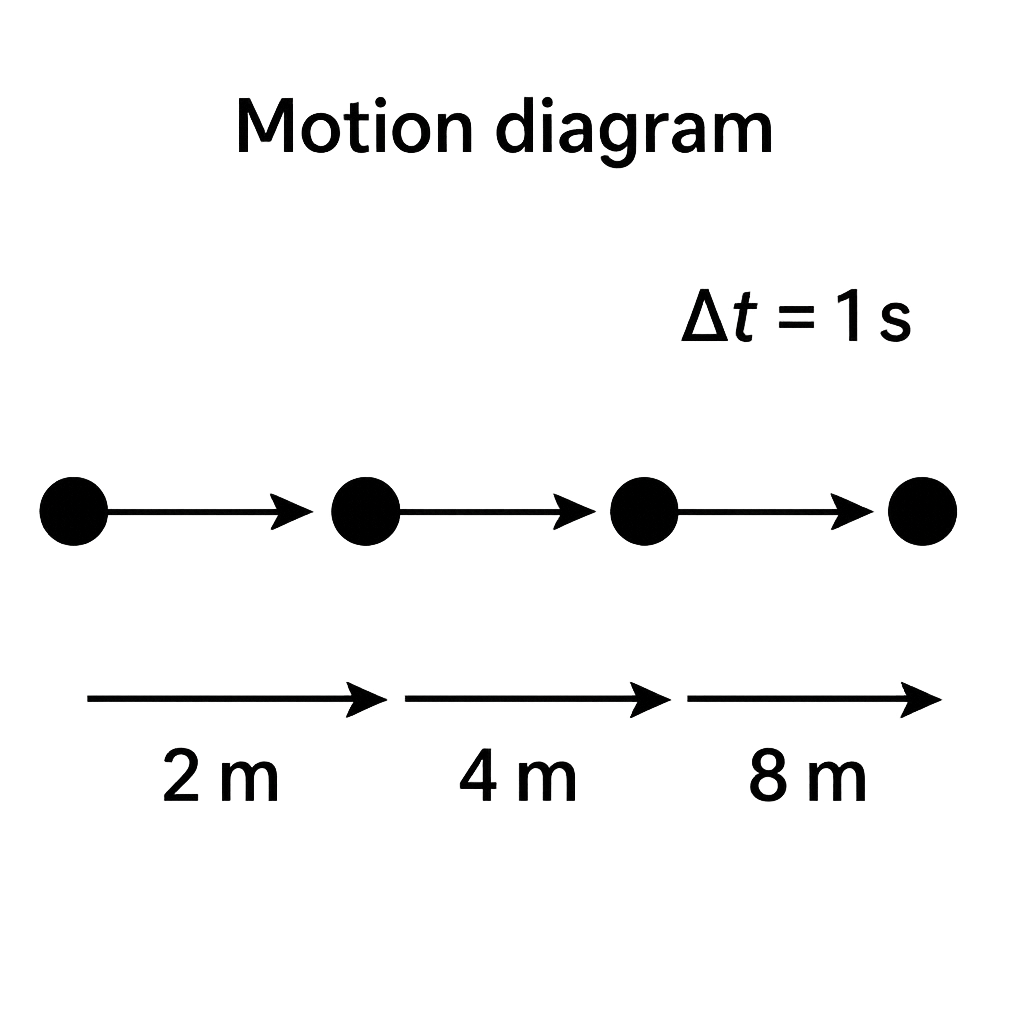
Question 1 View Details
A motion diagram shows a particle at equal time intervals of 1 s. The distances between successive positions are 2 m, 4 m and 8 m. What is the speed of the particle during the third interval?
A. 16 m/s
B. 4 m/s
Correct C. 8 m/s
D. 12 m/s

Correct Answer: C

Want to see the full step-by-step solution? Unlock AI Explanation & Analytics
Question 2 View Details
A string of length 0.50 m and linear mass density 0.010 kg m⁻¹ is fixed at both ends. When the string is under an unknown tension T it vibrates in its second harmonic with a frequency of 200 Hz. The tension is then increased by 25 % and the string vibrates in its fundamental with a frequency of 112 Hz (to the nearest whole number). Determine the original tension T in newtons.
A. 125 N
B. 80 N
Correct C. 100 N
D. 150 N

Correct Answer: C

Want to see the full step-by-step solution? Unlock AI Explanation & Analytics
Question 3 View Details
A police siren emits a sound of frequency 800 Hz. The siren is mounted on a car moving directly towards a stationary observer. The observer also hears a stationary source that emits a sound of frequency 840 Hz. The observer perceives a beat frequency of 40 Hz. Assuming the speed of sound in air is 340 m s⁻¹, determine the speed of the car (in metres per second, to the nearest whole number).
A. 28 m/s
B. 40 m/s
C. 35 m/s
Correct D. 31 m/s

Correct Answer: D

Want to see the full step-by-step solution? Unlock AI Explanation & Analytics
Question 4 View Details
200 g of water at 80 °C is mixed with 300 g of water at 20 °C in an insulated container. A metal rod of mass 150 g and specific heat capacity 0.45 J g⁻¹ °C⁻¹, initially at 150 °C, is then immersed in the mixture. Assuming no heat loss to the surroundings, calculate the final equilibrium temperature of the system (in °C, to one decimal place).
Correct A. 47.3 °C
B. 42.8 °C
C. 45.1 °C
D. 50.2 °C

Correct Answer: A

Want to see the full step-by-step solution? Unlock AI Explanation & Analytics
Question 5 View Details
A rigid container of volume 2.00 L initially contains 0.500 mol of an ideal gas at 27 °C. The gas is heated to 127 °C, after which an additional 0.200 mol of the same gas is introduced at the final temperature. Using $R = 0.0821\,\text{L·atm·mol}^{-1}\text{K}^{-1}$ and $1\,\text{atm}=101.3\,\text{kPa}$, determine the final pressure in the container (in kPa, rounded to the nearest whole number).
Correct A. 1164 kPa
B. 873 kPa
C. 831 kPa
D. 1150 kPa

Correct Answer: A

Want to see the full step-by-step solution? Unlock AI Explanation & Analytics
Question 6 View Details
A particle moves 30 m east and then 40 m north. What is the magnitude of its resultant displacement?
Correct A. 50
B. 70
C. 10
D. 25

Correct Answer: A

Want to see the full step-by-step solution? Unlock AI Explanation & Analytics
Question 7 View Details
A 5.0 kg block is lifted by a system consisting of a fixed pulley and a movable pulley (ideal, massless and frictionless). The system works with an overall efficiency of 80 %. What minimum pulling force must be applied to raise the block at constant speed?
A. 35.0
B. 40.0
Correct C. 30.6
D. 25.0

Correct Answer: C

Want to see the full step-by-step solution? Unlock AI Explanation & Analytics
Question 8 View Details
A liquid of volume 125.0 cm³ is poured into a cylindrical container whose radius is 5.0 cm. By how many centimetres does the liquid level rise?
A. 2.00
B. 1.75
C. 1.25
Correct D. 1.59

Correct Answer: D

Want to see the full step-by-step solution? Unlock AI Explanation & Analytics
Question 9 View Details
A source emits sound of frequency 500 Hz and moves towards a stationary observer at 30 m s⁻¹. Simultaneously the observer moves towards the source at 20 m s⁻¹. If the speed of sound in air is 340 m s⁻¹, what frequency does the observer hear? Give your answer to the nearest hertz.
A. 600
Correct B. 581
C. 540
D. 560

Correct Answer: B

Want to see the full step-by-step solution? Unlock AI Explanation & Analytics
Question 10 View Details
A string 0.50 m long is fixed at both ends. It is under a tension of 80 N and has a linear mass density of 0.010 kg m⁻¹. What is the frequency of the third harmonic of the standing wave on the string? Give your answer in hertz, rounded to the nearest whole number.
A. 357
Correct B. 268
C. 179
D. 537

Correct Answer: B

Want to see the full step-by-step solution? Unlock AI Explanation & Analytics
Question 11 View Details
A 150 g block of an unknown metal is heated to 100 °C and then quickly placed into 200 g of water at 20 °C. The final equilibrium temperature of the system is 30 °C. Given that the specific heat capacity of water is 4.18 J g⁻¹ °C⁻¹, determine the specific heat capacity of the metal in J g⁻¹ °C⁻¹.
A. 0.65
Correct B. 0.80
C. 1.20
D. 0.40

Correct Answer: B

Want to see the full step-by-step solution? Unlock AI Explanation & Analytics
Question 12 View Details
A rectangular coil of 20 turns has dimensions 0.10 m by 0.20 m. It is pulled with a constant speed of 0.5 m s⁻¹ into a uniform magnetic field of 0.30 T that is perpendicular to the plane of the coil. When exactly half of the coil's area is inside the field, what magnitude of the external force must be applied to keep the coil moving at constant speed? (The coil's resistance is 2 Ω.)
Correct A. 0.36
B. 0.72
C. 0.45
D. 0.18

Correct Answer: A

Want to see the full step-by-step solution? Unlock AI Explanation & Analytics
Question 13 View Details
Two tuning forks of frequencies 256 Hz and 260 Hz are placed 100 m apart along a straight line. An observer walks from the lower‑frequency fork toward the higher‑frequency fork at a speed of 10 m s⁻¹. If the speed of sound is 340 m s⁻¹, what beat frequency does the observer hear when he is exactly midway between the forks?
Correct A. 19
B. 21
C. 23
D. 15

Correct Answer: A

Want to see the full step-by-step solution? Unlock AI Explanation & Analytics
Question 14 View Details
An electron in a hydrogen atom is initially in the n = 3 level. It absorbs a photon and jumps to the n = 5 level. It is then ionized by absorbing another photon of wavelength λ. (Take R = 1.097 × 10⁷ m⁻¹, h = 6.626 × 10⁻³⁴ J s, c = 3.00 × 10⁸ m s⁻¹, and 1 eV = 1.602 × 10⁻¹⁹ J.) After ionization, the free electron is accelerated through a potential difference of 150 V. Determine (i) the wavelength λ of the ionizing photon (in nm) and (ii) the de Broglie wavelength of the accelerated electron (in pm).
A. 2.28×10^3 nm, 120 pm
Correct B. 2.28×10^3 nm, 100 pm
C. 2.15×10^3 nm, 110 pm
D. 2.40×10^3 nm, 90 pm

Correct Answer: B

Want to see the full step-by-step solution? Unlock AI Explanation & Analytics
Question 15 View Details
A length measured as 0.00345 m is to be expressed (i) in millimetres, (ii) in micrometres, and (iii) in scientific notation with three significant figures. State the three values.
A. 3.5 mm, 3500 µm, 3.5×10^-3 m
B. 3.45 mm, 3450 µm, 3.45×10^3 m
Correct C. 3.45 mm, 3450 µm, 3.45×10^-3 m
D. 0.345 mm, 345 µm, 3.45×10^-4 m

Correct Answer: C

Want to see the full step-by-step solution? Unlock AI Explanation & Analytics
Question 16 View Details
A converging lens is used to form a sharp image of a candle on a screen. The distance between the candle and the screen is 120 cm. When the lens is placed at one position, a sharp image is obtained. If the lens is moved 20 cm towards the screen, a sharp image is again obtained on the same screen. What is the focal length of the lens (in cm, to one decimal place)?
Correct A. 29.2 cm
B. 24.5 cm
C. 20.0 cm
D. 33.1 cm

Correct Answer: A

Want to see the full step-by-step solution? Unlock AI Explanation & Analytics
Question 17 View Details
A battery of emf E volts and internal resistance r ohms is connected to a 6 Ω external resistor. The terminal voltage measured across the external resistor is 12 V. When a second identical 6 Ω resistor is connected in parallel with the first, the terminal voltage rises to 15 V. Determine the emf of the battery (in volts, to one decimal place) and its internal resistance (in ohms, to two decimal places).
A. E = 20.5 V, r = 1.85 Ω
Correct B. E = 19.0 V, r = 2.32 Ω
C. E = 18.0 V, r = 3.10 Ω
D. E = 22.0 V, r = 2.00 Ω

Correct Answer: B

Want to see the full step-by-step solution? Unlock AI Explanation & Analytics
Question 18 View Details
A 5.0 kg block slides down a rough inclined plane that is 8.0 m long and makes an angle of 30° with the horizontal. The block starts from rest at the top and reaches the bottom with a speed of 4.0 m s⁻¹. Assuming the only non‑conservative force is kinetic friction, determine the coefficient of kinetic friction (μ_k) between the block and the plane (give your answer to two decimal places).
Correct A. 0.46
B. 0.62
C. 0.36
D. 0.56

Correct Answer: A

Want to see the full step-by-step solution? Unlock AI Explanation & Analytics
Question 19 View Details
Two point charges are placed on the y‑axis: a charge +Q at the origin and a charge -2Q at the point (0, a). Determine the magnitude and direction of the resultant electric field at point P (a, 0). Express the magnitude in terms of k, Q and a, and give the direction as the angle measured counter‑clockwise from the positive x‑axis.
A. Magnitude = (kQ\/a^2)·√(2+√2); Direction = 45° above the +x‑axis (tanθ = 1)
B. Magnitude = (kQ\/a^2)·√(3‑√2); Direction = 60° above the +x‑axis (tanθ = √3)
C. Magnitude = (kQ\/a^2)·√(2‑√3); Direction = 75° above the +x‑axis (tanθ = 2+√3)
Correct D. Magnitude = (kQ/a^2)·√(2‑√2); Direction = 67.5° above the +x‑axis (tanθ = 1+√2)

Correct Answer: D

Want to see the full step-by-step solution? Unlock AI Explanation & Analytics
Question 20 View Details
A car travels 60 km due north and then 80 km due east. What is the magnitude of its resultant displacement?
Correct A. 100 km
B. 20 km
C. 120 km
D. 140 km

Correct Answer: A

Want to see the full step-by-step solution? Unlock AI Explanation & Analytics
Question 21 View Details
A rock sample contains two uranium isotopes: \(^{238}\text{U}\) with a half‑life of \(4.5\times10^{9}\) years and \(^{235}\text{U}\) with a half‑life of \(7.04\times10^{8}\) years. Let the initial numbers of atoms be \(N_{0,238}\) and \(N_{0,235}\) respectively. After exactly \(1.0\times10^{9}\) years the measured activity of \(^{238}\text{U}\) is twice that of \(^{235}\text{U}\). Determine the original ratio \(N_{0,238}:N_{0,235}\). Give your answer as a decimal to two significant figures.
Correct A. 5.57
B. 6.8
C. 3.9
D. 4.3

Correct Answer: A

Want to see the full step-by-step solution? Unlock AI Explanation & Analytics
Question 22 View Details
A 2.0 kg metal block at \(150^{\circ}\text{C}\) is placed into an insulated container holding 3.0 kg of water at \(20^{\circ}\text{C}\). After thermal equilibrium is reached the temperature of the system is \(30^{\circ}\text{C}\) and 0.5 kg of the water has frozen. The specific heat capacity of water is \(4.186\times10^{3}\ \text{J·kg}^{-1}\text{K}^{-1}\) and the latent heat of fusion of water is \(3.34\times10^{5}\ \text{J·kg}^{-1}\). Determine the specific heat capacity of the metal (in \(\text{J·kg}^{-1}\text{K}^{-1}\)).
A. 9.5e2
Correct B. 1.22e3
C. 1.45e3
D. 8.0e2

Correct Answer: B

Want to see the full step-by-step solution? Unlock AI Explanation & Analytics
Question 23 View Details
A rectangular coil of \(N=200\) turns and area \(A=0.01\ \text{m}^{2}\) rotates about an axis perpendicular to a uniform magnetic field of magnitude \(B=0.5\ \text{T}\). The coil starts from rest with its plane parallel to the field (\(\theta=0\)). A constant torque of \(\tau=0.02\ \text{N·m}\) is applied, and the coil has a moment of inertia \(I=0.01\ \text{kg·m}^{2}\). Find the magnitude of the induced emf at \(t=4\ \text{s}\). (Give your answer in volts to two decimal places.)
A. 2.78
B. 2.10
Correct C. 2.31
D. 2.55

Correct Answer: C

Want to see the full step-by-step solution? Unlock AI Explanation & Analytics
Question 24 View Details
A source emits sound of frequency \(f=500\ \text{Hz}\) and moves directly toward a stationary observer with a speed of \(30\ \text{m·s}^{-1}\). The speed of sound in still air is \(340\ \text{m·s}^{-1}\). Meanwhile a wind blows from the source toward the observer at \(10\ \text{m·s}^{-1}\). What frequency does the observer hear? (Round to the nearest hertz.)
A. 548
B. 530
Correct C. 547
D. 560

Correct Answer: C

Want to see the full step-by-step solution? Unlock AI Explanation & Analytics
Question 25 View Details
Block A (mass \(4\ \text{kg}\)) rests on a rough horizontal table with a coefficient of kinetic friction \(\mu_k = 0.20\). Block B (mass \(6\ \text{kg}\)) lies on a smooth incline of \(30^{\circ}\) that meets the table at a smooth pulley. The two blocks are connected by a light inextensible string over the pulley. A horizontal force \(F\) is applied to block A to the right. Determine the minimum magnitude of \(F\) required to start moving the system (i.e., to overcome friction on block A). Give your answer in newtons to one decimal place.
Correct A. 37.2
B. 31.5
C. 28.9
D. 42.0

Correct Answer: A

Want to see the full step-by-step solution? Unlock AI Explanation & Analytics

Master the Exam!

You've seen a preview, but there are thousands more questions plus AI tutor to break down complex solutions.

Unlock Full Access Available for Android & Windows
Help others prepare! Share this practice hub:
Chat with Support