waec model questions vol1 2019 chemistry | Essay

Prepare for your exams with waec model questions vol1 questions? Reviewing past/model questions is one of the most effective ways to guarantee a high score. This practice hub features authentic 2019 chemistry (Essay) questions designed to simulate the real exam environment.

Practice these randomly selected questions to test your readiness.
Question 1 View Details
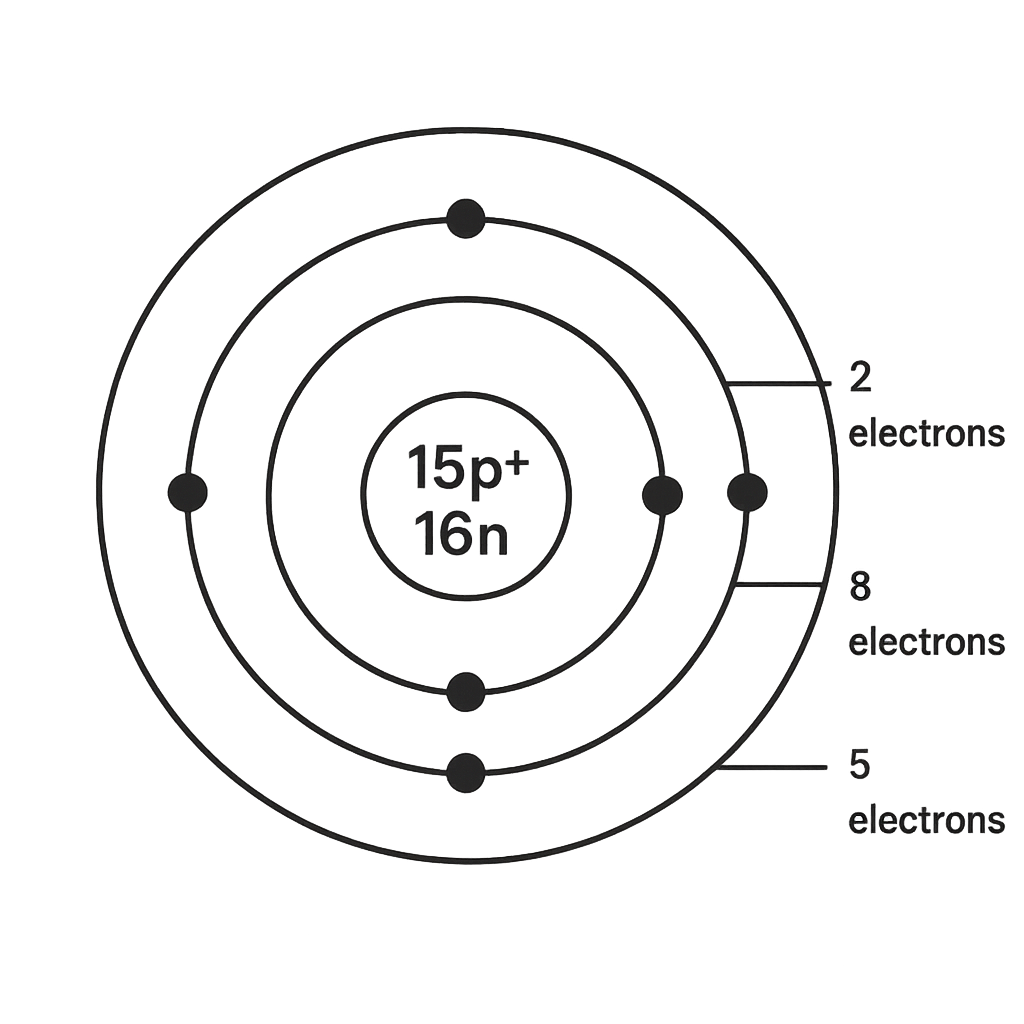
The diagram shows a simplified Bohr model of an unknown element X. The nucleus contains 15 protons and 16 neutrons. The electron shells are drawn with 2 electrons in the first shell, 8 electrons in the second shell and 5 electrons in the outermost shell.
Question Parts
(a)
Identify the element and write its chemical symbol together with its atomic number.
(b)
Write the ground‑state electron configuration of the element using the long‑form notation (e.g., 1s² 2s² 2p⁶ …).
(c)
The element forms a binary ionic compound with oxygen having the formula X₂O₃. (i) Determine the oxidation state of X in this compound. (ii) Calculate the mass percent of X in X₂O₃. (Use atomic masses: P = 30.97 g mol⁻¹, O = 16.00 g mol⁻¹.)
(d)
If 0.250 mol of X₂O₃ is thermally decomposed according to the equation X₂O₃ → 2 X + 3⁄2 O₂, calculate the volume of O₂ gas released at STP (22.4 L mol⁻¹).
Detailed Essay Solution & Marking Scheme Available

Get the step-by-step mathematical proofs, key points required by examiners, and a comprehensive breakdown from our AI Tutor.
Question 2 View Details
The diagram presents a segment of the periodic table covering periods 2 and 3 and highlighting groups 1, 2, 16 and 17. The elements shown are: Period 2: Li, Be, B, C, N, O, F, Ne Period 3: Na, Mg, Al, Si, P, S, Cl, Ar.
Question Parts
(a)
Write the electron configuration of the following elements using noble‑gas shorthand: (i) Sodium (Na) (ii) Sulfur (S) (iii) Chlorine (Cl)
(b)
Explain why the elements in group 16 exhibit similar chemical properties. Include reference to valence electrons and typical oxidation states.
(c)
A compound is formed between an element from group 1 and an element from group 16 that both belong to period 3. Write the chemical formula of the compound and calculate its molar mass. (Use atomic masses: Na = 22.99 g mol⁻¹, S = 32.07 g mol⁻¹.)
Detailed Essay Solution & Marking Scheme Available

Get the step-by-step mathematical proofs, key points required by examiners, and a comprehensive breakdown from our AI Tutor.

Question 3 View Details
A newly discovered compound X has the empirical formula MX₂ where M is a metal and X is a non‑metal. The compound is a white solid, has a high melting point, conducts electricity when molten but not in the solid state, and reacts with dilute acid to release hydrogen gas.
Question Parts
(a)
Identify the type of chemical bond(s) present in compound X and justify your answer using the properties given.
(b)
Assuming M belongs to Group 2 of the periodic table and X belongs to Group 16, write a plausible ionic formula for X and show how the charges balance.
(c)
Draw the Lewis‑dot representation for the ion pair that makes up the solid and indicate the type of lattice arrangement that is most likely to be adopted.
(d)
Explain why compound X conducts electricity when molten but not as a solid, linking your explanation to its bonding nature and lattice structure.
Detailed Essay Solution & Marking Scheme Available

Get the step-by-step mathematical proofs, key points required by examiners, and a comprehensive breakdown from our AI Tutor.

Question 4 View Details
The diagram shows the crystal structure of a hydrated copper(II) sulfate compound.
Question Parts
(a)
Write the correct molecular formula of the compound shown in the diagram.
(b)
A 2.00 g sample of the compound is dissolved in water and titrated with 0.100 M EDTA solution. The equivalence point is reached after 80.0 mL of EDTA. Calculate the mass percent of copper in the compound.
(c)
Using the mass percent of copper obtained in part (b) and the atomic mass of copper (63.55 g mol⁻¹), determine the formula mass of the compound and comment on whether it agrees with the formula you wrote in part (a).
(d)
Explain, with reference to the structure in the diagram, why the compound exhibits a characteristic blue colour.
Detailed Essay Solution & Marking Scheme Available

Get the step-by-step mathematical proofs, key points required by examiners, and a comprehensive breakdown from our AI Tutor.

Question 5 View Details
A student carries out the reaction between calcium carbonate and hydrochloric acid as shown below: CaCO₃(s) + 2 HCl(aq) → CaCl₂(aq) + H₂O(l) + CO₂(g) The student weighs 5.00 g of CaCO₃ and adds 100.0 cm³ of 0.500 M HCl to the flask. The CO₂ gas produced is collected over water at 25 °C and the mass of the gas collected is 0.44 g. The atmospheric pressure is 760 mmHg and the water‑vapour pressure at 25 °C is 23.8 mmHg. Answer the following:
Question Parts
(a)
Identify the limiting reagent in the reaction.
(b)
Calculate the theoretical mass of CO₂ that could be produced from the given amounts of reactants.
(c)
Using the collected gas data, determine the percent yield of CO₂ obtained in the experiment.
Detailed Essay Solution & Marking Scheme Available

Get the step-by-step mathematical proofs, key points required by examiners, and a comprehensive breakdown from our AI Tutor.

Question 6 View Details
A sample of an unknown volatile liquid is placed in a 250.0 cm³ sealed flask at 298 K. After the liquid evaporates completely, the pressure inside the flask rises to 420 mmHg. The vapour pressure of water at 298 K is 23.8 mmHg. Answer the following:
Question Parts
(a)
Calculate the number of moles of the vapour (excluding water vapour) present in the flask.
(b)
If the molar mass of the liquid is 78.1 g mol⁻¹, determine the mass of the liquid that was originally placed in the flask.
(c)
Explain, with reference to intermolecular forces, why this liquid has a relatively high boiling point compared with water.
Detailed Essay Solution & Marking Scheme Available

Get the step-by-step mathematical proofs, key points required by examiners, and a comprehensive breakdown from our AI Tutor.

Question 7 View Details
A 0.200 mol sample of benzoic acid (C₆H₅COOH, Kₐ = 6.3×10⁻⁵) is dissolved in 1.00 L of water and then 0.150 mol of sodium benzoate (C₆H₅COONa) is added. The solution is therefore a buffer of benzoic acid and its conjugate base.
Question Parts
(a)
Calculate the pH of the resulting solution at 25 °C.
(b)
If 0.050 mol of 0.10 M HCl is added to the buffer, calculate the new pH (assume volume change is negligible).
(c)
To restore the original pH, how many millilitres of 0.10 M NaOH must be added? (Assume the total volume remains essentially 1 L.)
Detailed Essay Solution & Marking Scheme Available

Get the step-by-step mathematical proofs, key points required by examiners, and a comprehensive breakdown from our AI Tutor.

Question 8 View Details
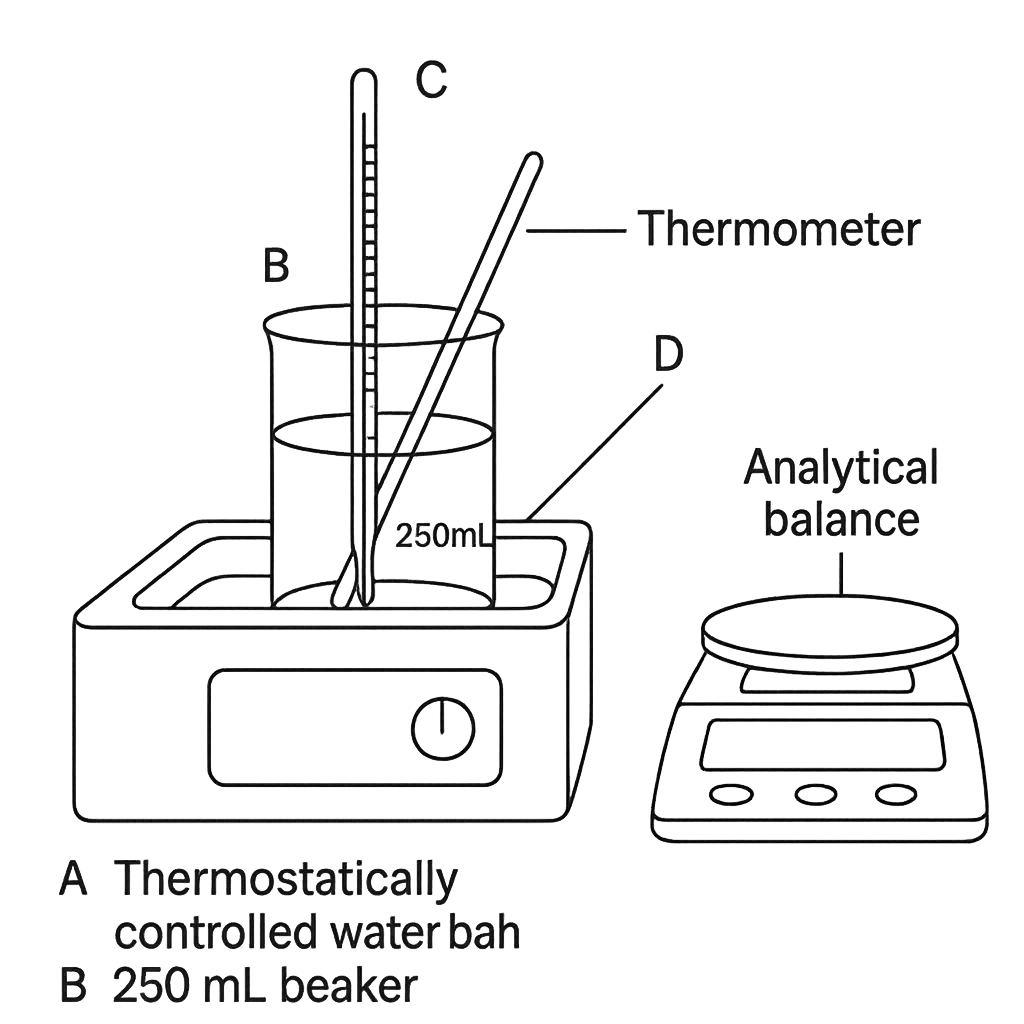
A laboratory set‑up is used to determine the solubility of potassium nitrate (KNO₃) in water at different temperatures. The apparatus consists of a thermostatically controlled water bath, a 250 mL beaker, a thermometer, a glass stirring rod and an analytical balance as shown in the labelled diagram. The procedure is carried out at three temperatures and the following data are obtained for the mass of KNO₃ that can dissolve in 100 g of water: • 30 °C : 32 g KNO₃ • 50 °C : 55 g KNO₃ • 70 °C : 86 g KNO₃ Answer the following questions.
Question Parts
(a)
Describe in detail the experimental procedure that should be followed with this apparatus to obtain the solubility data at a chosen temperature.
(b)
Calculate the percentage increase in the solubility of KNO₃ when the temperature is raised from 30 °C to 70 °C.
(c)
If 250 g of water is heated to 70 °C, determine the maximum mass of KNO₃ that can dissolve in it.
(d)
Discuss qualitatively how temperature affects the solubility of most ionic solids such as KNO₃ and relate this to the enthalpy change of dissolution.
Detailed Essay Solution & Marking Scheme Available

Get the step-by-step mathematical proofs, key points required by examiners, and a comprehensive breakdown from our AI Tutor.

Master the Exam!

You've seen a preview, but there are thousands more questions plus AI tutor to break down complex solutions.

Unlock Full Access Available for Android & Windows
Help others prepare! Share this practice hub:
Chat with Support